
Plot Summary
Endings on Everyone's Mind
In a world teetering on collapse, Rainy and his wife Lark live by Lake Superior, where the coming of the Tashi Comet stirs both awe and anxiety. Their friend Labrino, haunted by personal losses and the world's decline, visits on a stormy night, seeking comfort in music and company. The comet becomes a symbol—of calamity for some, of beauty and possibility for others. Rainy, a gentle giant and musician, finds solace in simple acts: playing bass, sharing warmth, and loving Lark. The chapter sets the tone of a world where endings are ever-present, but so is the stubborn hope that something wondrous might still arrive, even as the ground beneath everyone's feet feels increasingly uncertain.
The Quixote Boarder Arrives
Lark brings home Kellan, a frail, enigmatic young man with a ruined hand and a rare, long-sought book—Molly Thorn's I Cheerfully Refuse. Their attic becomes his refuge. Kellan's presence stirs curiosity and unease, his past as a "squelette" (escaped laborer) hinted at but not revealed. Rainy and Lark, self-described quixotes, are drawn to the wondrous and the lost, even as they sense the risks. The arrival of Kellan, with his secrets and the precious book, becomes a catalyst for change, testing the couple's openness and compassion. The night is filled with whispers, predictions, and the quiet forging of new bonds, as the world outside grows ever more unpredictable.
Greenstone Fair and Kid Brothers
Rainy helps Kellan search for car parts at the bustling Greenstone Fair, a vibrant, medieval marketplace on the lake. Amidst the chaos—vendors, musicians, and a violent altercation—Rainy recognizes in Kellan the vulnerable, mischievous spirit of a kid brother. Their bond deepens through shared errands and confessions. Kellan's status as a fugitive is revealed, and Rainy promises protection, even as he senses the dangers of such vows. The fair's joys are shadowed by news of mass suicides among youth, a sign of the world's despair. Yet, moments of kindness and laughter persist, as Rainy resolves to help Kellan, no matter the cost.
Lark's Book and Love
Rainy recalls how he fell for Lark, first enchanted by her voice in a library, then by her passion for books and knowledge. To win her, he becomes a reader, devouring classics and poetry, discovering the transformative power of stories. Lark's quest for Molly Thorn's lost book becomes a symbol of hope and longing. Their love is built on curiosity, mutual rescue, and the belief that when a flame is lit, one must move toward it. The perfect book, like perfect love, remains just out of reach—cherished, feared, and, when finally found, almost too precious to open.
When a Flame Is Lit
Rainy's journey into reading and self-discovery is recounted, driven by his desire to connect with Lark. He immerses himself in literature, myth, and poetry, finding in stories a way to understand the world's beauty and pain. The search for Molly Thorn's elusive book becomes a metaphor for seeking meaning amid chaos. Rainy's transformation from a knockabout laborer to a man of depth and empathy is traced through his encounters with books, music, and the luminous presence of Lark, whose faith in words and stories becomes his guiding light.
A Bear in Human Form
Rainy spends Mondays with a group of feral children, using music and stories to reach them. He forms a special bond with Tonio, a silent, troubled boy who believes Rainy is a bear in disguise. When Tonio is bullied, Rainy's protective instincts surge, but he learns the painful truth that promises of safety are provisional. The chapter explores the complexities of care, the wounds of childhood, and the ways in which even the strongest cannot shield others from harm. Rainy's own memories of being bullied and becoming a protector are woven into his present struggles.
Sailing Toward Ghosts
Rainy and Lark's sailing trip to the Slate Islands is recounted—a journey of love, peril, and mystery. They weather a fierce storm, find shelter, and encounter an enigmatic old woman who may be the ghost of Molly Thorn herself. The boundaries between life and death, reality and legend, blur in the timeless harbor. Lark's belief in the impossible, her openness to wonder, and her playful seriousness deepen Rainy's love and sense of awe. The sea becomes both a threat and a sanctuary, a place where the past and future mingle, and where romance is both a gift and a trapdoor.
Trouble Me No More
Rainy's friend Labrino chooses to end his life with the drug Willow, seeking peace from a world grown too hard. Rainy is with him in his final hour, sharing pie, music, and memories. The chapter is suffused with grief and tenderness, as Rainy grapples with the limits of comfort and the inevitability of loss. Lark's triumph in acquiring a cache of books is juxtaposed with Labrino's departure, highlighting the fragile joys that persist amid sorrow. The community gathers to mourn and remember, finding meaning in small acts of kindness and remembrance.
A Church You Could Bear
Lark's birthday becomes a revelry—a gathering of friends, music, and laughter that feels like a church one could bear. The bookshop, Bread, is a haven for readers and dreamers, a bulwark against despair. Rainy and Lark's happiness is palpable, even as shadows linger. The arrival of a mysterious old man at the party, and Kellan's quiet disappearance, foreshadow coming troubles. Yet, for a night, the world is suffused with light, music, and the sense that, in dark times, revelry and connection are acts of resistance and hope.
Sea Like a Shroud
After the revelry, Rainy discovers his home ransacked and Lark murdered, the victim of forces pursuing Kellan. The world contracts to pain and numbness as Rainy is interrogated, mourns, and drifts through days of loss. The promise of protection is broken, and the sea becomes a shroud, covering all that was loved. Friends rally, but nothing can restore what is lost. Rainy's grief is total, his sense of self dissolved. The chapter is a meditation on the finality of death, the inadequacy of words, and the impossibility of returning to what was.
Promises Meant and Broken
Rainy is consumed by grief, haunted by memories of Lark and the promises he could not keep. He contemplates suicide, is buoyed by friends, and drifts through a summer of numbness and pain. The world is full of endings—Lark's ashes scattered, the house uninhabitable, the band dissolved. Yet, the memory of Lark's last words, her vision of a future together, stirs something in Rainy. He begins to repair the sailboat, Flower, finding in the work a fragile thread of purpose. The chapter is a testament to the slow, halting work of survival after devastation.
The Windmill Is a Giant
Rainy pours himself into restoring Flower, the sailboat, haunted by memories and the possibility of seeing Lark again in the Slates. The work is both penance and hope, a way to re-enter the world. The narrative blurs past and present, reality and myth, as Rainy prepares for a journey that is both literal and spiritual. The windmill—once a harmless thing, now a giant—becomes a symbol of the challenges ahead. Rainy's resolve hardens: he will sail to the Slates, seeking whatever remains of love, memory, and meaning.
White-Maned Horses
Rainy's escape from pursuers is a harrowing ordeal—he flees by boat into a raging storm, pursued by Werryck and his men. The lake becomes a battlefield, its waves white-maned horses threatening to destroy him. Rainy's survival is a matter of luck, skill, and the stubborn will to live. The storm is both enemy and ally, obscuring him from his hunters but nearly claiming his life. The chapter is a visceral account of endurance, fear, and the thin line between survival and surrender.
So Young to Be in Jail
Rainy's journey takes him through towns marked by loss, violence, and the corrosive effects of despair. He meets children hardened by the world, is warned by old adversaries, and reflects on the fate of those who choose to "go in search of better." The story of Willow, the suicide drug, recurs as a motif of both escape and tragedy. Rainy's compassion is tested, his sense of responsibility deepened. The chapter explores the ways in which innocence is lost, choices are constrained, and the world's wounds are borne by the young and the vulnerable.
The Garment Was Occupied
Rainy encounters the drowned—corpses rising from the warming lake, reminders of history's weight and the persistence of grief. The world is haunted by its dead, both literal and metaphorical. Rainy's journey is marked by encounters with the lost, the dispossessed, and the forgotten. The chapter is a meditation on memory, guilt, and the ways in which the past refuses to stay buried. Rainy's own wounds are mirrored in the world around him, as he struggles to find a way forward.
Our Bright & Zippy Kellan
Rainy learns the truth about Kellan—his theft of Willow, his role in the tragedies that have unfolded, and the ways in which innocence and guilt are intertwined. Werryck, the relentless pursuer, offers Rainy a bargain: betray Kellan and be spared. Rainy refuses, choosing loyalty over self-preservation. The chapter is a reckoning with the limits of forgiveness, the complexity of culpability, and the ways in which even the best intentions can lead to harm. Rainy's journey becomes one of moral clarity amid chaos.
An Immortal Sea of Influence
Rainy is imprisoned on the medicine ship Posterity, forced to play music for Werryck, the ship's tyrant. He befriends fellow prisoners, witnesses the suffering of the "twelve" escapees, and becomes part of a mutiny led by the charismatic Marcel. The uprising is both miraculous and costly—Marcel is wounded, Werryck and his enforcers are overthrown, and the prisoners escape to uncertain freedom. Rainy, Sol, and others find their way to safety, the ship sinks, and the old order is swept away. The chapter is a testament to the power of solidarity, courage, and the enduring influence of those who refuse to surrender.
Perihelion
Rainy and Sol find refuge in Jolie, a town of kindness and memory. The comet reaches perihelion, a symbol of cycles, endurance, and the possibility of new beginnings. Rainy reconnects with friends, mourns the lost, and finds meaning in small acts—planting seeds, telling stories, making music. The world remains wounded, but moments of beauty and connection endure. The story ends with Rainy sailing to the Slates, seeking Lark's spirit, and finding, in memory and imagination, the promise of a future shaped by love, resilience, and the refusal to give in to despair.
Analysis
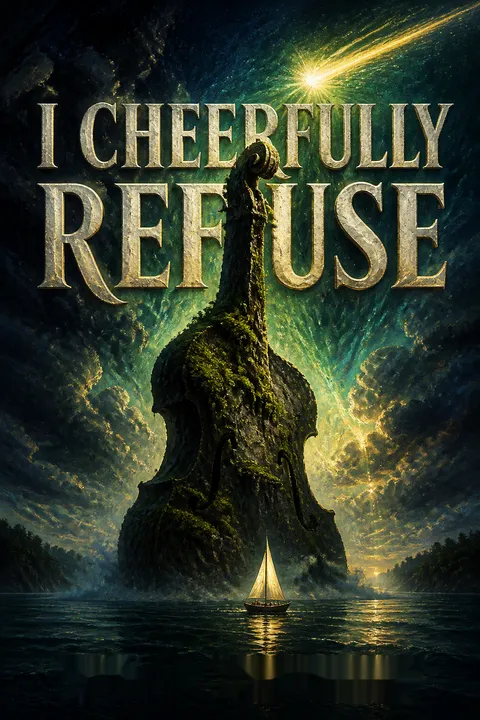
A modern fable of hope amid collapseI Cheerfully Refuse is a luminous, melancholic meditation on survival, love, and the stubborn refusal to surrender to despair in a world unraveling at the seams. Leif Enger crafts a narrative that is both elegy and anthem, blending dystopian realism with mythic resonance. The novel's greatest strength lies in its embrace of contradiction: endings and beginnings, grief and joy, the ordinary and the miraculous. Through Rainy's journey—from loss and numbness to fragile renewal—the book explores the limits of protection, the necessity of community, and the redemptive power of art and story. The comet, the lake, and the recurring motif of the lost book all serve as reminders that beauty persists, even in ruin. The lessons are clear: refuse apocalypse, work cheerfully against it, and find meaning in connection, kindness, and the small, stubborn acts that keep hope alive. In a time of endings, I Cheerfully Refuse offers a vision of beginnings—hard-won, provisional, but real.
Review Summary
"I Cheerfully Refuse" receives largely positive reviews, averaging 3.98/5. Readers praise Enger's lyrical, beautiful prose and compelling characters, particularly the gentle protagonist Rainy and his wife Lark. Set in a near-future dystopian world shaped by climate change, corporate oligarchy, and suppressed literacy, the novel follows Rainy's sailing journey across Lake Superior after personal tragedy. While many celebrate its emotional depth, hopefulness, and rich imagery, some critics find the pacing slow, the plot meandering, and the world-building insufficiently explained.
People Also Read









Characters
Rainy (Rainier)
Rainy is the novel's narrator and emotional core—a large, kind-hearted man shaped by loss, love, and the search for meaning. His relationship with Lark transforms him from a knockabout laborer into a reader, musician, and quixotic protector. Rainy's journey is marked by acts of care—teaching children, sheltering fugitives, comforting the dying—but also by the painful recognition of his limits. He is haunted by promises he cannot keep, the deaths he cannot prevent, and the world's relentless unraveling. Yet, Rainy's resilience, humor, and capacity for wonder persist. His psychological arc is one of grief and renewal, as he learns to live with absence, embrace uncertainty, and find hope in small, stubborn acts of love and creation.
Lark
Lark is Rainy's wife and muse, a bookseller whose passion for words, stories, and the lost Molly Thorn book shapes much of the novel's emotional landscape. She is a force of curiosity, kindness, and quiet strength, drawing people into her orbit and inspiring Rainy's transformation. Lark's belief in the power of stories, her openness to wonder, and her refusal to surrender to despair make her a beacon in a darkening world. Her murder is the novel's central wound, shattering Rainy and catalyzing his journey. Psychologically, Lark embodies the tension between fragility and resilience, the longing for connection, and the conviction that "better is here—stay, and make it better."
Kellan
Kellan is a young, haunted escapee with a ruined hand and a knack for drawing. His arrival brings both hope and danger to Rainy and Lark's home. Kellan's past as a "squelette" and his theft of Willow make him both victim and perpetrator, innocent and guilty. He is perpetually anxious, craving safety but bringing trouble in his wake. Kellan's psychological complexity lies in his self-awareness—he knows he is a burden, fears being given up, and is desperate for acceptance. His journey is one of survival, luck, and the search for belonging, even as his actions have unintended, tragic consequences.
Werryck
Werryck is the novel's primary antagonist—a former military specialist turned enforcer for the powerful "astronaut" class. He is both mythic and mundane: rumored to never sleep, feared for his cruelty, yet revealed as a frail, aging man haunted by migraines and regret. Werryck's psychological profile is shaped by revenge, exhaustion, and the burden of authority. He is capable of both brutality and moments of strange tenderness, especially in his interactions with Rainy. Werryck's arc is one of decline and exposure, his power ultimately undone by the solidarity and courage of those he sought to control.
Sol
Sol is a nine-year-old girl Rainy rescues from an abusive guardian. She is fierce, resourceful, and deeply wounded, carrying the scars of abandonment and violence. Sol's intelligence and humor are matched by her suspicion and capacity for revolt. She is both child and adult, innocent and cunning, longing for safety but wary of trust. Sol's psychological journey is one of gradual healing, as she learns to read, plant seeds, and imagine a future beyond survival. Her relationship with Rainy is transformative for both, offering each a chance at redemption and hope.
Labrino
Labrino is Rainy's friend and the owner of the Lantern tavern. He is marked by loss—estranged from his children, abandoned by his wife, blinded in one eye. Labrino's anxiety and despair are tempered by moments of warmth, humor, and resilience. His decision to end his life with Willow is both a surrender and an assertion of agency. Labrino's psychological arc is one of exhaustion, longing for rest, and the hope that, in death, he might find the peace denied him in life.
Maudie Antoinette
Maudie is the owner of Bread, the bakery-turned-bookshop, and a close friend of Lark and Rainy. She is practical, blunt, and fiercely protective, providing sustenance and stability to those around her. Maudie's psychological strength lies in her acceptance of hardship, her capacity for joy, and her unwavering support for her friends. She embodies the novel's theme of community as refuge and resistance.
Marcel
Marcel is a young, magnetic figure aboard the medicine ship, beloved by all and central to the mutiny that frees the prisoners. He is both ordinary and extraordinary, moving easily among outcasts and inspiring loyalty. Marcel's psychological profile is marked by empathy, courage, and a quiet sense of destiny. His actions catalyze change, offering hope to the hopeless and challenging the inevitability of oppression.
Harriet
Harriet is a member of the paint crew and later a leader in the ship's uprising. She is tough, principled, and deeply aware of the consequences of every action. Harriet's psychological arc is one of reluctant responsibility—she does what must be done, even when it costs her. Her sense of justice and solidarity make her a moral center in the novel's latter half.
Griff
Griff is Sol's supposed grandfather, a charming but unreliable figure who ultimately betrays her trust. He is a storyteller, a schemer, and a man always looking for an angle. Griff's psychological complexity lies in his self-deception—he wants to be seen as brave and capable, but is undone by fear and self-interest. His fate is a cautionary tale about the limits of charm and the necessity of true care.
Plot Devices
Fractured Narrative and Memory
The novel weaves together memories, dreams, and present action, creating a tapestry of experience that mirrors the characters' psychological states. Rainy's narration moves fluidly between times and places, using flashbacks, digressions, and stories-within-stories to build emotional resonance. This structure allows the reader to inhabit the characters' grief, longing, and hope, and to experience the world as a place where past and future are always in conversation.
Symbolism of the Comet and the Lake
The Tashi Comet serves as a recurring symbol—of doom, beauty, and the possibility of renewal. Its approach marks the passage of time, the cycles of despair and hope, and the characters' longing for meaning. Lake Superior, vast and unpredictable, is both setting and metaphor: a place of danger, memory, and transformation. The lake's drowned, its storms, and its moments of calm all reflect the characters' inner lives and the world's precarious state.
Music and Storytelling as Healing
Music—especially Rainy's bass playing—serves as a means of comfort, connection, and, ultimately, rebellion. Storytelling, both oral and written, is a lifeline for characters like Lark, Sol, and Rainy, offering solace, identity, and the hope of a better world. The act of reading, teaching, and sharing stories becomes an act of defiance against despair and erasure.
Foreshadowing and Recurring Motifs
The novel is rich in foreshadowing—early mentions of Willow, the comet, and the medicine ships all presage later events. Recurring motifs—kid brothers, lost books, the promise of protection, the return of the drowned—create a sense of inevitability and interconnectedness. These devices reinforce the themes of loss, survival, and the persistence of hope.
Mutiny and Collective Action
The uprising aboard Posterity is a turning point, demonstrating the power of collective action against tyranny. The mutiny is foreshadowed by smaller acts of kindness, resistance, and connection throughout the novel. The escape of the twelve, the solidarity of the paint crew, and the eventual liberation of the prisoners all underscore the novel's belief in the possibility of change, even in the darkest circumstances.
Download PDF
Download EPUB
.epub digital book format is ideal for reading ebooks on phones, tablets, and e-readers.








































