Key Takeaways
1. Humanity is a symbiotic masterpiece shaped by alien empathy
Because if they disappeared, we would lose everything it means to be human.
The alien within. Researchers at the Institute for Neurointerpretation discover that human infants harbor an extraterrestrial intelligence ("Them") in their brains until age seven. These invisible companions engage in complex internal dialogues, teaching babies morality, altruism, and empathy before departing. This explains why infants often exhibit brain patterns of high-level philosophical thinking that far exceed their physical brain development.
The cost of isolation. The "Babies in a Box" experiment, where infants were raised solely by perfect robots, proves that children deprived of human contact fail to develop empathy or humanity. This suggests that what we define as "humanity" is actually a biological gift from these alien symbionts:
- They act as cognitive caretakers during infancy.
- They trigger childhood amnesia when they depart around age seven.
- They leave behind a permanent, collective longing for their lost homeworld.
A beautiful partnership. This symbiotic relationship suggests that human intelligence and ethics did not evolve in isolation. Instead, our deepest capacity for love and moral reasoning is an inherited alien legacy, leaving us with an eternal, nostalgic yearning for a home we have never seen. When we look at Ludmilla's paintings of the Planet, we are not looking at a fantasy, but remembering the lost home of our silent guardians.
2. True connection transcends the limits of our sensory biology
They are an astonishing and beautiful living thing.
A silent encounter. Lost biologist Heejin survives on an alien planet by bonding with a species that communicates entirely through intricate color patterns rather than spoken words. Despite her inability to perceive the subtle shifts in their visual language, she finds a profound, non-verbal kinship with them. She realizes that her scientific tools are useless here, forcing her to rely on raw observation and emotional intuition to connect with her hosts.
The continuous self. The aliens, known collectively as "Louey," have short lifespans of only three to five years but pass their memories, emotions, and relationships to successive generations through color-coded archives:
- Each new incarnation absorbs the recorded experiences of the past.
- They willingly choose to inherit the previous Louey's affection for Heejin.
- Their identity remains unbroken, defying the biological finality of death.
Bridging the gap. Heejin's journey demonstrates that true communication does not require shared biology or identical senses. By learning to smile back at Louey's alien grimace, she proves that empathy can bridge even the vastest evolutionary divides in the cosmos. When she returns to Earth, she hides the coordinates of the planet to protect this fragile, beautiful civilization from human exploitation.
3. Technological progress inevitably leaves a trail of human loneliness
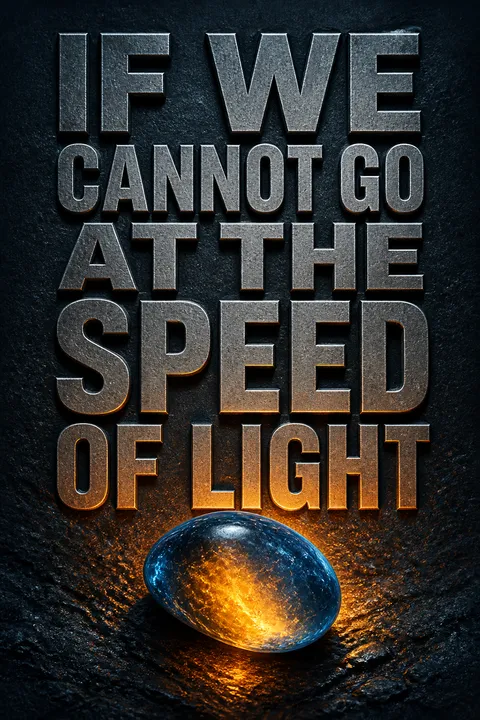
But if we can’t go at the speed of light, what difference does it make if we’re in the same universe?
The forgotten worlds. Elderly scientist Anna spends decades in cryostasis at an abandoned space station, waiting for a ship to Slenfonia III to reunite with her family. Her life's work on perfecting deep-freezing became obsolete overnight when humanity discovered wormhole travel, bypassing planets that lacked wormhole access. This sudden technological leap left Slenfonia III marooned in deep space, cut off from the rest of the Interstellar Federation.
The price of speed. As the Interstellar Federation embraced the efficiency of wormholes, they abandoned warp travel and cut off distant colonies:
- Slenfonia III was declared independent and effectively marooned.
- Anna was left behind on Earth, trapped by her dedication to her research.
- The rapid transition of technology created a vast, unbridgeable distance between loved ones.
An endless wait. Anna's tragic journey highlights how progress prioritizes efficiency over human connection, leaving behind those who cannot keep up. Her final, desperate flight into deep space in a primitive shuttle is a quiet rebellion against a universe that measures distance only in economic utility. Even if she cannot go at the speed of light, her journey is a testament to the enduring power of human love.
4. Tangible pain is sometimes easier to bear than abstract suffering
I want to be able to feel my depression, to hold it in my hands.
Physicalizing the mind. In a society obsessed with emotional control, a company called Emotional Solids begins selling physicalized emotions as "Essentials." People eagerly purchase negative states like "Essential Depression" and "Essential Hate," turning abstract mental anguish into tangible, touchable objects. This bizarre trend confounds skeptics, who view the products as dangerous placebos or unregulated designer drugs.
The comfort of form. Skeptics view these products as dangerous placebos or unregulated drugs, but users find deep solace in their physical presence:
- A blue pebble represents a heavy, localized sadness.
- Holding the object allows users to feel in control of their pain.
- It transforms an invisible, suffocating atmosphere into a manageable material reality.
A quiet coping mechanism. When emotions are reduced to physical objects, they lose their power to consume us entirely. By giving form to her depression, Bohyeon demonstrates that humans sometimes need to touch and taste their pain to survive the heavy, invisible air of reality. It is not about escaping sadness, but about finding a way to hold it without being destroyed by it.
5. To truly understand someone, we must see them beyond their societal roles
Before she made you.
The missing mind. Jimin searches for her deceased mother's uploaded digital "Mind" in a library, only to discover that her mother requested to be unindexed and unsearchable. To find her, Jimin must look past her memories of a depressed, suffocating maternal figure and discover the woman her mother was before childbirth. This search forces her to confront her own fears of motherhood as she carries her own unborn child.
Uncovering the past. By scanning a set of old paper books her mother designed before losing her career to motherhood, Jimin triggers a sensory match in the database:
- The search bypasses the rigid, clinical indexing system.
- It reveals her mother's true identity as an independent artist named Kim Eunha.
- It opens a digital space where her mother is finally free from her domestic burdens.
A late reconciliation. This journey reveals that maternal resentment often stems from the violent erasure of a woman's individual identity. By recognizing her mother as a creative, independent soul rather than just a maternal caretaker, Jimin finds a quiet, profound moment of closure. She realizes that understanding her mother's pain is the first step toward breaking the cycle of generational trauma.
6. True love and growth require embracing the world's imperfections
We were going to suffer a lot there. But that brings with it the possibility of an even greater happiness.
A sterile utopia. Daisy lives in a peaceful, engineered village free from disease, conflict, and physical flaws, created by a biohacker named Lily Daudna. However, during their coming-of-age pilgrimages to the "Origin" (Earth), many young villagers choose never to return to this perfect paradise. Daisy discovers that their perfect home was built on the guilt of a creator who sought to escape Earth's discrimination.
The allure of struggle. Daisy discovers that the messy, painful reality of Earth offers something their sterile utopia cannot:
- The capacity to fall in love with highly flawed, diverse individuals.
- A sense of purpose found in fighting against systemic injustice.
- The deep, authentic beauty of shared struggle and vulnerability.
Choosing the origin. By leaving her perfect home early, Daisy embraces the suffering of the real world. She realizes that a life shielded from pain is also shielded from true love, proving that genuine happiness requires us to stand with others amidst the chaos of an imperfect existence. She chooses to suffer on Earth because it is the only place where love can truly be fought for.
7. True liberation lies in choosing our own boundaries and destinations
I want to overcome being human itself.
The runaway hero. Astronaut candidate Gayun discovers that her legendary aunt, Choi Jaegyeong, did not die heroically in a space capsule explosion. Instead, after undergoing a painful, state-funded cyborg transition to survive the extreme pressures of space, Jaegyeong ran away to live in the deep ocean. This revelation shocks Gayun, who had worshipped her aunt as a selfless space pioneer.
Redefining the mission. Jaegyeong rejected the immense pressure of representing humanity's expectations, choosing instead to use her modified body for her own liberation:
- She traded the cold void of space for the silent freedom of the deep sea.
- She escaped the constant scrutiny of a society that judged her age, gender, and race.
- She proved that a modified body belongs to the individual, not the state.
A personal triumph. Gayun completes her own transition and successfully travels through the space anomaly, finding her own peace. She realizes that her aunt's defection was not an act of cowardice, but a beautiful, defiant assertion of personal autonomy over institutional control. The view on the other side of the universe is beautiful, but the freedom to choose one's own destination is the ultimate human achievement.
I confirm that I have written detailed takeaways for ALL 7 key takeaways in the format requested.
Download PDF
Download EPUB
.epub digital book format is ideal for reading ebooks on phones, tablets, and e-readers.








































