
Key Takeaways
1. The Person is the first and final reality of a living cosmos
The Person is the first and final reality ‒ the alpha and the omega.
The personal cosmos. Cheetham introduces Henry Corbin's radical theology where the ultimate reality is not an abstract force or a collection of dead matter, but a personal presence. God is not a "being" among other beings, but the transitive verb of Be-ing itself, actively unifying and individualizing every unique entity in existence. This means that no human being or natural object can be entirely explained by the literalist reductions of physics, biology, or history.
The angelic function. Every object in our world has a "Face of Light" that connects it to the divine, which Corbin calls its Angel. This angelic function ensures that we do not view the world as a collection of dead, mechanical objects, but as a network of living, personal subjects. The Angel acts as an intermediary, guaranteeing the concrete reality of the world by standing as Light to our relative darkness.
Presence and imagination. To exist, a being must be present to someone, meaning presence and personhood are entirely complementary. In this cosmology, God is re-visioned not as a supreme object of belief, but as the open field of the imagination where this mutual presence occurs.
- We are "con-spiritors" breathing in the Breath of the Compassionate.
- Belief is a temporary, anxious state; imagination is a free, natural stance toward reality.
- The "Angel Out Ahead" guarantees the endless openness of our personal growth.
2. The Great Disjunction of the twelfth century split the self from the world
Against the ancient position … in which sensation and intellection lead to conjunction and union with what was sensed or intellected, we find a dichotomy between the mind and what is outside it, between meanings and things.
The historical shift. Drawing on the historical thesis of F. Edward Cranz, Cheetham describes a catastrophic shift in Western consciousness around 1100 AD. Prior to this "Great Disjunction," ancient humans experienced an "extensive self" that was ontologically continuous with the cosmos. In this ancient mode of being, knowing was an act of direct, conjunctive union with the world, rather than an abstract, intellectual representation.
The intensive prison. The post-twelfth-century transition birthed the "intensive self," a mode of being where the human mind is alienated from the world of things. Language became a closed, self-referential system of human meanings, stripping the natural world of its immediate, conjunctive presence. This psychological deficit left modern humans trapped inside their own heads, viewing nature as a collection of mute, mechanical objects.
The loss of dimensionality. This historical rupture can be healed by reclaiming the active imagination as a bridge between the soul and the world. Historically, reading was once an "ontologically remedial" act that brought the reader to a physical and spiritual "glow" of connection.
- The extensive self is open to the world, while the intensive self is isolated.
- Modern reason is based on the coherence of what is said, rather than a vision of what is.
- Reclaiming this lost way of knowing requires a deep, therapeutic transformation of language.
3. Literalism is a form of idolatry and the root of psychological madness
What makes madness is literalism.
The trap of the literal. Cheetham, synthesizing James Hillman and Alfred Adler, argues that psychological suffering and dogmatic fundamentalism share a common root: literalism. When we take our thoughts, beliefs, or the world around us literally, we freeze the fluid, metaphoric nature of reality into static, unyielding facts. This rigidity is the ultimate source of psychological madness and cultural fanaticism.
Idols versus icons. In Corbin's psycho-cosmology, this freezing of reality is the essence of idolatry. An idol is a representation that we mistake for an absolute, opaque truth, whereas an icon is a transparent window that allows the divine light of the imaginal to shine through. The goal of a healthy psychological life is to transmute our rigid idols back into transparent icons.
Deliteralizing as therapy. The path to psychological sanity and spiritual freedom requires a continuous process of deliteralizing our experiences. This therapeutic road moves us back from dogma to hypothesis, and finally to the virtualities of the imagination.
- Literal truth is always an abstraction; only the fictive and metaphoric are truly concrete.
- Madness progresses from fluid fiction to rigid, reified dogma.
- Healing fictions restore the "as-if" quality to our rigid, literalized complexes.
4. The active human imagination is a cognitive organ of divine revelation
The very thing that a rational and reasonable scientific philosophy cannot envisage is that the Active Imagination in man (one ought to say rather “agent imagination” in the way that medieval philosophy spoke of “intellectus agens”) should have its own noetic or cognitive function, that is to say it gives us access to a region of Being which without that function remains closed and forbidden to us.
The cognitive imagination. Western philosophy has long left a void between sensory perception and intellectual categories, relegating the imagination to the realm of mere fantasy or artistic play. Corbin and Jung restore the active imagination to its rightful place as a primary organ of knowledge. It is a cognitive faculty capable of perceiving a real, intermediate dimension of being that is otherwise closed to us.
The mother of possibilities. Jung identified this autonomous, creative activity of the psyche as "fantasy," the vital process that creates reality every single day. It is not a passive reflection of external stimuli, but a continuous, creative act that binds all other psychic functions together. It is the mother of all possibilities, connecting the human soul to the soul of the world (anima mundi).
The active intelligence. Through the active imagination, we gain access to the "Active Intelligence," traditionally personified as the Angel of Revelation. This process is not for the sake of the human ego, but for the sake of the images themselves.
- Imagination is not "making things up" but a disciplined mode of perception.
- It bridges the gap between physical sensation and spiritual intellect.
- Active imagination allows us to cooperate with the creative power of the cosmos.
5. True speech and action are conjugated in the passive-active "Middle Voice"
The active subject is in reality not you, your autonomy is a fiction.
The illusion of autonomy. Modern Western culture worships the active, independent ego, operating under the delusion of absolute personal autonomy. Corbin shatters this fiction, asserting that our true spiritual life is passive-active. We are the subjects of a verb in the passive—we are being thought, spoken, and imagined by a higher, angelic reality.
The middle voice. To describe this state of being, Corbin and the poet Charles Olson point to the grammatical concept of the "middle voice." In the middle voice, the subject acts upon itself, cooperating with the Angel of its being to realize its destiny. This grammatical stance is neither entirely active nor entirely passive, but a state of responsive resonance.
The Lost Speech. Finding the middle voice is the key to recovering the "Lost Speech" (Parole perdue), the hidden, interior meaning of the Word of God. It requires us to get our aggressive, controlling egos out of the way and learn to listen.
- We must learn to listen to the faint song of the Angel of our being.
- The middle voice is "the thing that makes music work" and harmonizes the soul.
- It replaces the ego's demands with a responsive, responsible stance toward the Other.
6. Alchemical language redeems the soul by materializing the imaginal
Alchemical language itself is a mode of therapy; it is itself therapeutic.
The language of substance. James Hillman's alchemical psychology offers a powerful alternative to the dry, conceptual jargon of modern psychology. Alchemy uses concrete, sensuous "thing-words" and "craft-words"—like salt, sulfur, mercury, and lead—to describe the raw, chaotic emotional materials of our inner lives. This language grounds our psychological suffering in the physical reality of the earth.
The therapeutic metaphor. Because we cannot take alchemical language literally (we are not literally buried in horse dung or turning green), it forces metaphor upon us. This materialized language psychizes matter and materializes the psyche, allowing us to speak to our dreams and symptoms in their own specific, imaginal tongue. It prevents us from translating the rich images of the soul into dry, clinical concepts.
The process of Solutio. The alchemical operation of solutio (dissolution) is the root of this therapeutic work, melting our rigid, literalized beliefs. It requires us to stay sealed in the furnace of our emotions and imagine, rather than repress or act out.
- It works with the massa confusa of wild emotions without running away.
- It replaces abstract psychological concepts with specific, qualitative vessels.
- It redeems the mundane, material world by recognizing its subtle, spiritual body.
7. The "Mundus Imaginalis" is an objective, intermediate realm of subtle bodies
It is the world in which spirits are corporealized and bodies spiritualized.
The intermediate world. Corbin coined the Latin term mundus imaginalis (the imaginal world) to describe the alam al-mithal of Persian mysticism. This is not a realm of subjective human fantasy, but an objective, ontologically real inter-world that exists between the purely spiritual and the purely physical. It is the landscape where spirits take on form and physical bodies are elevated to spiritual significance.
Subtle embodiment. In this intermediate space, the dualism of mind and body is overcome through the concept of "subtle bodies." These spiritual bodies are more, not less, real than our dense physical forms, existing as degrees of intensity of being. This perspective allows us to imagine a sensuous, embodied transcendence that does not flee the physical world.
The Barzakh. The imaginal world functions as a barzakh, a boundary or interval that both separates and connects different levels of reality. It is the essential landscape of all spiritual recitals and genuine religious visions.
- It is the home of the angels, archetypes, and theophanies.
- Every existing thing is a barzakh suspended between Being and Nothingness.
- It is the landscape where the "Water of Life" flows at the foot of the mystic Sinai.
8. Spiritual hermeneutics (Ta'wīl) transmutes opaque idols into transparent icons
The ta’wīl is the name that one gives in general to all symbolic exegesis … It is a science which has as its pivot a spiritual direction and a divine assistance.
The act of returning. The centerpiece of Corbin's spiritual methodology is ta'wīl, an Arabic term meaning "to bring back" or "to return to the origin." It is a practice of spiritual hermeneutics that reads the sacred text, the soul, and the world as symbols pointing toward their transcendent source. It is a procedure that engages the entire soul, unlocking its most secret sources of energy.
Transmuting the world. Through ta'wīl, we perform a radical act of deliteralization, stripping the world of its flat, historical, and objective appearances. This process transmutes the opaque "idols" of our literal minds into transparent "icons," allowing us to perceive the divine presence shining through the surfaces of everyday life. It frees us from the servitude of literal religion and conformism.
Escaping linear time. By returning things to their archetypal origins, ta'wīl dissolves the forward, destructive thrust of historical, linear time. It aligns us with the Islamic doctrine of "recurrent creation," where Paradise is experienced in the present moment.
- It aligns us with the "recurrent creation," where the past is never completed or closed.
- The past and future are recognized as attributes of the soul, not of exterior things.
- It shifts our focus from historical determinism to the creative imperative of "Be!"
9. A polytheistic consciousness restores ecological intimacy with the world
It is in the deep mind that wilderness and the unconscious become one, and in some half-understood but very profound way, our relation to the outer ecologies seems conditioned by our inner ecologies.
The inner wilderness. Cheetham advocates for an ecological understanding of the psyche, where the "wilderness" of the outer world is continuous with the unconscious depths of the mind. To heal our alienation, we must abandon the "monotheism of consciousness" (the imperial rule of the ego) in favor of a "polytheism of consciousness" that mirrors the diversity of natural ecosystems.
Thinking with things. A polytheistic consciousness recognizes that the world is populated by a multitude of autonomous, personified forces—represented by the Greek pantheon or the diversity of ecosystems. Plants, animals, and even stones are "good to think with," possessing their own unique styles of being and consciousness. This perspective allows us to move with awe and wonder in a living landscape.
Psycho-diversity. Cultivating this "psycho-diversity" breaks down the artificial barriers between the subjective human mind and the objective natural world. It forces us to recognize that our thoughts and emotions are not private property, but are shared with the world.
- The ego is not the master of the house, but one complex among many.
- We must learn to see our emotions as objective, nonhuman powers of nature.
- True ecological sanity requires a "symposium of the whole" that includes the imaginal.
10. Imaginal love is an active, exploratory craft that de-centers the ego
When we love, we want to explore, to discriminate more and more widely, to extend the intricacy that intensifies intimacy.
The craft of loving. Cheetham concludes with a meditation on "imaginal love," a deliberate, active verb that stands in stark contrast to the passive, overwhelming experience of "falling in love." Imaginal love is a disciplined craft of the heart that seeks to explore, discriminate, and deepen our intimacy with the specific, concrete details of the world. It is a love that does not seek to merge and unify, but to celebrate the unique "eachness" of things.
The death of the possessive ego. This style of loving requires the shrinking of the pathological, possessive ego—the lower soul (an-nafs al-'ammārah) that wants to make everything "mine." When the self-absorbed ego diminishes, the world expands, allowing us to enter into a reciprocal, egoless dialogue with a thoroughly personified cosmos. True personhood is egoless and open to the flow of things.
The ultimate affirmation. Imaginal love is an act of epistrophē (reversion), returning the fleeting images of our lives to their rich, archetypal background. It is a way of saying "Yes!" to the concrete, saturated presence of reality, uniting the vertical, spiritual flight of Corbin with the horizontal, soulful depth of Hillman.
- It is a way of saying "Yes!" to the concrete, saturated presence of reality.
- It transforms our very perception of the world into a continuous, incarnate act of love.
- It is the ultimate weapon in the war for the human imagination against all forms of fundamentalism.
Review Summary
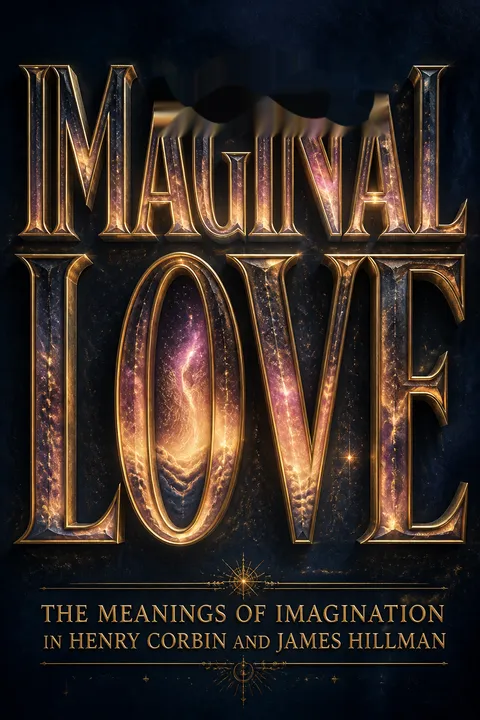
Imaginal Love receives enthusiastic praise for its exploration of Henry Corbin and James Hillman's philosophies on imagination, soul psychology, and perception. Readers appreciate Cheetham's accessible yet profound writing style and his personal engagement with the material. The book is celebrated for bridging depth psychology, Sufism, and poetry while encouraging concrete, particular ways of perceiving the world. Some reviewers note its density and the need for prior knowledge of gnosis and depth psychology. Minor criticisms include Kindle formatting issues and a sense that questions outnumber answers.
Download PDF
Download EPUB
.epub digital book format is ideal for reading ebooks on phones, tablets, and e-readers.








































