
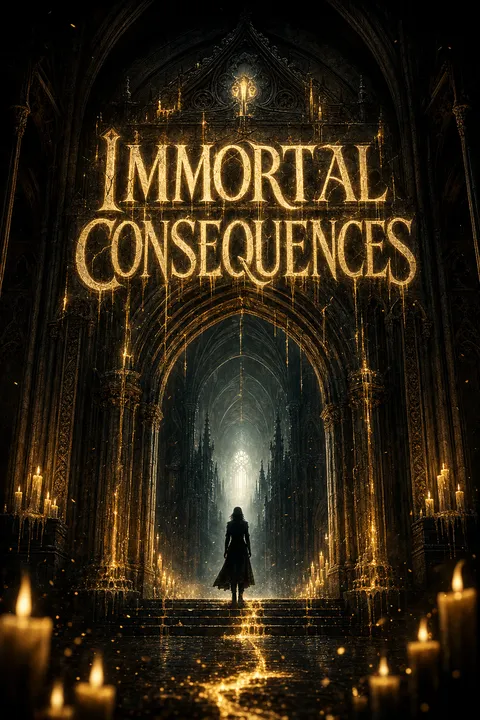


Plot Summary
A Reaper's Rude Awakening
Wren Loughty,1 dead eighteen years and trapped in the purgatorial academy of Blackwood, wakes to her rival August2 clamping a hand over her mouth. He claims a new soul will fall tonight, decades ahead of schedule, and dares her to come watch. Their bond is a knot of stabbing games and reluctant attraction: unable to feel pain, they torment each other simply to feel alive.
Both covet the coming Decennial nomination, the once-a-decade prize that spares a student from the Forgetting, the slow memory-erasure that ends every reaper in the soul-harvesting Ether. Wren1 pockets her silver dagger and follows him into the mist. Something in Blackwood's clockwork order has cracked, and her curiosity refuses to let it go.
The opening establishes a world where death has not ended want, only redirected it toward memory, sensation, and status. Wren and August's antagonism reads as displaced intimacy: two people who weaponize hostility because tenderness is too dangerous to name. The Forgetting functions as the book's existential engine, a purgatorial mortality that makes ambition feel like survival rather than vanity. By opening on a broken schedule, the narrative signals that the institution's vaunted order is already fraying. Marie frames purgatory not as punishment but as bureaucracy, a system that keeps its dead productive, foreshadowing the novel's larger interrogation of who benefits from that machinery.
The Girl Wreathed in Shadow
On a faculty building's roof, August2 and Wren1 are joined by four eavesdroppers who trailed them: bookish Emilio,3 flamboyant Olivier,4 ruthless Irene,5 and her steady friend Masika.6 Together they watch the new student, Louise Nordain,8 plummet from the sky and then convulse as living shadows pour from her body.
Shadow magic belongs only to the Demien Order, the humanity-stripped cult beyond the gates, and students should never touch it. A cloaked figure parts the darkness, whispers to Louise,8 and carries her away. Moments earlier, August2 had wrenched Wren1 back from a fatal tumble off the ledge, a reflex that unsettled them both. Six rivals share one terrified thought: they have seen something that was supposed to be impossible.
The rooftop gathers the ensemble under a single shocking image, forging accidental witnesses into a fated group. Louise's shadow eruption violates the story's stated laws, and violated rules are the narrative's favorite currency, each one hinting the world's cosmology is a curated lie. August's instinctive rescue exposes the gap between his cultivated cruelty and his impulses, planting the romance's central tension. The scene also democratizes fear: the aloof, the anxious, the cruel, and the tender all flinch identically. Marie uses spectacle to bind characters who would never choose one another, and shared secrecy becomes the glue that will later curdle into suspicion and betrayal.
Silas Buys Their Silence
Housemasters catch the trespassers and haul them to Memorium, where Headmaster Silas7 explains the shadows away as a Demien attempt to abduct Louise.8 He pardons their many infractions, sparing their Decennial hopes, in exchange for absolute silence. Privately he summons Wren,1 flatters her rare kindness, and asks her to befriend and monitor Louise,8 dangling the nomination as reward.
The visit cracks Masika6 open, dredging up Catherine,10 the lover she lost to the Order. Irene,5 meanwhile, secretly craves the Demiens' limitless power, and Olivier,4 quietly bleeding memories to the Forgetting, realizes the nomination is his only escape. Each student now carries a private stake and a dangerous secret they cannot share with the others.
Silas's bargain is a masterclass in coercion disguised as mercy: he purchases loyalty with the very ambition he manufactured. The chapter distributes wounds across the cast, revealing that everyone at Blackwood is haunted by a specific loss or hunger, grief for Masika, power for Irene, time for Olivier. These motivations will drive the plot's moral compromises. The scene also introduces surveillance as a mode of intimacy, Wren asked to befriend as a form of spying, corrupting connection at its root. Marie establishes that in this world affection is transactional and information is power, priming readers to distrust every kindness that follows.
The Rules Rewritten
At the Decennial opening ceremony, Silas7 upends tradition: this cycle will be a competition, two nominees per House, twelve students clashing through four trials until only one remains. Wren,1 who had all but claimed the nomination, reels.
That night the six unlikely allies crowd into Olivier4's room, pass a bottle of enchanted whiskey, and grimly christen themselves unfortunate acquaintances, sensing the timing is no accident, that Louise8's shadowed arrival and this sudden rule change are somehow linked. August,2 drawn to Wren1 against his own better judgment, half-carries her drunk to her bed and dodges her question about whether he would ever choose to stay. He already knows he means to leave Blackwood forever, and never come back.
The rule change transforms a coronation into a gladiatorial contest, converting a story about ambition into one about mutual destruction. The whiskey-soaked bonding scene is the emotional counterweight, camaraderie blooming precisely as the system pits them against each other, which makes every future loss more devastating. The label unfortunate acquaintances captures the group's ironic self-awareness, affection admitted only through deflection. August's concealed intention to leave introduces dramatic irony that shadows his tenderness. Marie stages competition and connection as simultaneous forces, arguing that scarcity engineered from above turns friends into rivals, and that solidarity, however fragile, is itself an act of quiet rebellion.
Kidnapped Into the Maze
Sedated in their beds, the nominees wake inside a monstrous hedge maze where wounds no longer heal and terror wears familiar faces. Eight-eyed creatures stalk the corridors, and illusion-replicas taunt each student with private shames. Wren1 pairs briefly with Masika,6 then faces a rotting double of August2 before the real August2 drives a dagger through it and pulls her free.
Emilio,3 the self-doubting scholar, seizes a sword the maze itself offers and beheads a troll to save Irene.5 When the survivors stagger out, Silas7 unveils the brutal machinery: injuries fatal in life mean elimination, and two students, Nick and Liza, are already gone. He binds everyone with a soul vow of secrecy about the Order's supposed threat.
The maze externalizes each character's psychology through replicas that speak their buried fears, making the trial a literal confrontation with self. Restoring pain is the cruelest twist, since these characters have spent years missing sensation, and now agony returns bundled with mortal stakes. Emilio's unlikely heroism reframes his anxiety as untapped courage, while August's rescue deepens the pattern of him protecting Wren at cost to himself. The soul vow tightens the noose, converting knowledge into a leash. Marie fuses gothic horror with competitive dread, suggesting that survival in a rigged system demands both self-knowledge and the willingness to bleed for someone else.
A Fragment of His Soul
The second trial casts nominees into the shifting Ether to reap lost souls. Wandering alone, Wren1 is ambushed by a living shadow that drags her into the forbidden Shadow Lands, where her soul begins to unravel, a death beyond death. August,2 feeling the rupture through some inexplicable tether, abandons everyone and races to her, cradling her fading body as she confesses guilt over a sister she failed to protect.
Desperate, he plunges a hand into his own chest, extracts a sliver of his soul with Olivier4's frightened help, and presses it into Wren.1 She wakes. He hides what he has done, aware it has forged a connection between them that neither of them fully understands yet.
This is the romance's point of no return, sacrifice rendered brutally literal. August gives up a piece of his self, the very thing the Forgetting threatens to steal, an act that recasts his guardedness as devotion strained through denial. Wren's confession about her sister surfaces the guilt that fuels her perfectionism, revealing that her drive to be good is really penance. The Shadow Lands, meant to keep something dangerous away from students, hint that the world's protective architecture has failed. Marie links love and self-annihilation, asking whether saving someone by giving away part of yourself is generosity or another form of losing oneself entirely.
Louise's Impossible Power
The Shadow Lands creature trails Wren1 back to Blackwood, and the six friends scatter across the dark grounds to fight it. Emilio3 deduces the swarming attackers are mere illusions cloaking the real beast, so the group sprints straight through them, though the true monster corners August2 as his magic gives out.
Then a blast of shadow magic annihilates the creature: Louise,8 having snuck out to watch the trial's end, has instinctively wielded the very power that should be impossible for a student. She faints, terrified of herself. Silas7 arrives, and the group lies to shield her, secretly vowing to research how a Blackwood student could summon shadows. Louise8's mystery and Silas7's evasions harden into real suspicion.
The battle rewards intellect over brute force, letting Emilio's bookishness become tactical genius, and it delivers the novel's central puzzle: Louise wielding forbidden magic she cannot explain. Her terror at her own power evokes adolescent alienation from a changing, uncontrollable self. The group's decision to protect her rather than report her marks their shift from Silas's instruments to a covert alliance with their own loyalties. That choice, choosing each other over the institution, is the moral fork the rest of the book pivots on. Marie escalates the conspiracy while dramatizing how solidarity is built through shared risk and mutual concealment from authority.
Dancing With Stolen Minds
At the Decennial Ball, August2 and Wren1 discover they can now hear each other's thoughts, an aftershock of the shared soul he still keeps secret. They waltz while trading silent words, and Wren1 shares a chilling infirmary find: the eliminated nominees are simply gone, and a student named Maya cannot remember they ever existed, her eyes fogged with mind-alteration magic.
August2 warns Wren1 to trust no one, kisses her cheek, and flees. Elsewhere Emilio3 and Olivier4 steal a shadow-magic book from the restricted library and overhear two Housemasters muttering cryptically. Irene,5 courted by a Demien named Mateo9 who slips through Blackwood's failing wards, cradles a locket that summons him and drifts closer to betrayal.
The ball juxtaposes romantic enchantment with creeping horror, telepathic intimacy blooming atop evidence of institutional erasure. The shared thoughts literalize the couple's fusion while advancing the secret August withholds, making closeness inseparable from deception. Maya's fogged memory transforms the missing nominees from tragedy into cover-up, shifting the genre from competition to conspiracy thriller. Meanwhile Mateo's courtship of Irene threads temptation through the celebration, showing how despair primes people for radicalization. Marie choreographs a scene where every dance masks an investigation, arguing that in corrupt systems even joy is surveilled, and that the pursuit of truth fractures the illusions holding a community together.
The Sacrifice Beneath the Trials
Cornering Wren1 and August2 at Memorium, Silas7 drops the mask. The Decennial has always been a competition. Every cycle the eliminated are not healing in an infirmary but consumed by the Ether, their existence scrubbed from every mind by psyche magic. Blackwood students' souls, he explains, are the only thing that keeps the hungry Ether stable for another decade.
To break Wren,1 he names Maeve, the sister who died in a crash Wren1 caused by letting her drive drunk. Then he assembles the surviving nominees in the garden and confirms the horror: breaking the soul vow counts as elimination, meaning death. There is no exit. Only one will live, and the rest will be devoured.
The great revelation reframes the entire narrative as a recurring ritual sacrifice disguised as meritocracy, a devastating critique of institutions that consume the young while calling it tradition and balance. Silas weaponizes Wren's deepest guilt, showing that the system does not merely kill bodies but colonizes memory and shame. His argument, that sacrifice preserves order, is the seductive logic of every atrocity rationalized as necessary. The soul vow's hidden clause seals the trap, converting compliance into complicity. Marie exposes the horror beneath aspiration: that being chosen can mean being harvested, and that a rigged contest survives by erasing everyone who ever questioned it.
Illusions of the Ones They Loved
Silas7 marches the nominees beyond Blackwood's gates into snow and eight stone arches, each opening onto the outskirts of purgatory. Alone, each must drink an elixir and dismantle an illusion built from their deepest longing. Irene5 nearly drowns in a cage conjured by her cruel mother.
Emilio3 finds Josie14's ruined body, then faces a perfect illusion of his dead parents at the breakfast table before shattering it, only for a replica of Olivier4 to drive a dagger through his stomach. Trembling farewells pass among the friends before they scatter through the arches. When they return, the trial has thinned their numbers again, and the survivors grasp, finally, that Blackwood has always stayed several steps ahead of them.
Where the maze mined fear, this trial mines love, forcing each nominee to destroy simulations of the homes and people they mourn. Emilio choosing to shatter his parents dramatizes acceptance as an act of violence against one's own longing, growth that hurts. Irene's drowning cage literalizes her inheritance of maternal cruelty. The trial's genius, and its sadism, is that survival requires refusing comfort. The replica of Olivier stabbing Emilio blurs illusion and reality catastrophically. Marie argues that grief cannot be defeated by clinging to the dead, only by letting them dissolve, yet the trial perverts this wisdom into a mechanism of slaughter.
The Resistance and the Usurper
The third trial strands Masika6 in a mountain where Housemasters Birdie and Russo12 appear beside Catherine,10 her supposedly lost love, all alive and part of a hidden resistance. They unearth the buried history: Silas7 entered the Ether as a Corrupted Soul, devoured the Shadow Lands' darkness, seized Blackwood by destroying its true headmaster, and banished the dissenters who became the Demien Order.
Both sides are now corrupt, and both must be stopped. Then August2 arrives and confesses he has been an undercover Demien for centuries. Feeling betrayed, Masika6 hurls spell after spell at him until the mountain caves in and buries her. At Blackwood, Olivier4 cradles a dying Emilio3 while Irene5 returns to find Masika6 missing.
This chapter detonates the world's binary of good academy versus evil cult, revealing both institutions as descendants of a single act of usurpation. Catherine's resurrection rewards Masika's grief with agonizing complication, love returned but transformed into ideological demand. Silas recast as a self-made tyrant, a soul that refused judgment and consumed corruption, mythologizes tyranny as appetite. August's confession converts the story's romantic hero into a possible traitor, retroactively poisoning every gesture. Marie's thesis crystallizes: corruption is not born but created, and revolutions curdle into the regimes they overthrew. The mountain's collapse literalizes how buried truths bring down everything built above them.
One Night Before the End
The night before the final trial, August2 slips into Wren1's room, wounded by Masika6's magic, and lets her tend him. Their armor finally falls. He admits she is his affliction, the one soul he cannot stay away from, and they spend the night together, telepathy binding their thoughts as their bodies join.
Wren1 wakes to an empty bed and, unable to sleep, goes to check on Louise,8 only to find her room torn apart, nonsense prophecies smeared across the walls, and Wren1's own name written over and over in blood. Louise8 is gone. Before Wren1 can make sense of it, Housemaster Calligan appears with grim news: the schedule has changed, and the final trial begins immediately.
The consummation offers fragile respite amid doom, love claimed precisely because tomorrow is unpromised, a defiantly human gesture against an inhuman contest. August's confession, framing Wren as an affliction, admits love as involuntary affliction rather than choice, honesty that arrives too late to be safe. The empty bed reinstates his pattern of fleeing intimacy. The ransacked room and bloodied name pivot the chapter from tenderness to dread, seeding the climax's revelation that Louise was never what she seemed. Marie balances vulnerability with menace, insisting that in a world designed to consume its inhabitants, choosing to be known is both salvation and exposure.
The Sister in the Shadows
In the fourth trial's Ether, only Wren,1 August,2 and Irene5 remain. August2 begs Wren1 to flee with him through a loophole in the soul vow, but she refuses to abandon the others. Then Louise8 appears with black eyes and a cruel voice: she was only a vessel, possessed all along by Edith,11 a shadow-wielder who is August2's own sister.
Edith11 dissolves Louise8's borrowed body, killing the friend Wren1 trusted, and forces August2 to his knees with agonizing magic. She unveils the design: August2 was planted years ago to earn Wren1's love and deliver her to the Order, because the Soulless One's prophecy names Wren1 the catalyst destined to destroy Blackwood. August2's every kindness now looks like part of a lie.
The climax collapses every mystery into one betrayal: Louise, the sympathetic newcomer Wren mentored, was Edith's puppet, and August's love was allegedly a mission. The reveal weaponizes the reader's investment in both relationships, turning nurture and romance into instruments of manipulation. Prophecy elevates Wren from competitor to cosmic fulcrum, reframing her guilt-driven striving as destiny she never chose. Edith's sibling bond with August gives the antagonism intimate stakes. Marie stages the ultimate dark-academia horror, that one has been groomed, watched, and cultivated toward a predetermined end, forcing Wren to reckon with whether any love in her afterlife was ever freely given.
Wren Chooses the Cage
August,2 writhing under Edith11's torture, screams for Wren1 to run, but first confesses the truth: the Demien Order recruited him before he understood what it had become, yet loving Wren1 changed everything, and he would never have surrendered her. Wren1 believes him even as betrayal guts her. When Edith11 intensifies his suffering, Wren1 stops fighting.
She reaches out, slides her hand into Edith11 's, and whispers for August2 to remember his promise to find her. The two women vanish, leaving August2 broken on the ground. It is a sacrifice of a different kind, love traded for another's mercy, and it hands the Order the very weapon it has schemed for centuries to obtain.
Wren's surrender completes her arc from self-serving ambition to self-erasing love, the mirror image of the reckless choice that killed her sister. Where she once let others suffer for her wants, she now gives herself up to end August's pain, penance transmuted into agency. The moment is tragic precisely because it fulfills the prophecy the enemy engineered, her goodness delivering her into their hands. Her plea for August to remember his promise reframes love as a covenant that survives capture. Marie closes the central movement on paradox: the heroine's most selfless act is also the villains' greatest victory, redemption and doom braided inseparably together.
Epilogue
In the aftermath, Masika6 wakes scarred, rescued by the resistance alongside a healed Emilio3 and Olivier,4 and commits to helping topple both Silas7 and the Order. Irene,5 who won the Decennial and became a glowing-eyed Ascended, secretly answers to Mateo,9 plotting revenge on Silas7 from inside Blackwood.
August2 calls the shadows and gives up his humanity to hunt for Wren,1 keeping his promise. Wren,1 imprisoned in a Demien encampment beyond purgatory, is told she is the destroyer they have awaited for centuries. Starved of its Decennial sacrifice, the afterlife begins to destabilize, and every fractured alliance braces for a coming war over Blackwood's soul.
The multi-POV coda scatters survivors across ideological fault lines, refusing tidy resolution in favor of escalation. Masika's scar externalizes the cost of truth, while her enlistment turns grief into purpose. Irene's hollow victory, a crown of glowing eyes atop a double agent's dread, indicts the very ambition the book has interrogated. August's surrender of humanity inverts his earlier hoarding of self, love now willing to become monstrous. Wren's imprisonment as prophesied destroyer positions her identity itself as the battlefield. Marie ends on systemic instability, the Ether hungering, the sides multiplying, arguing that dismantling corruption creates not peace but a wider war, and that every character must now choose what they will destroy.
Analysis
Immortal Consequences reimagines dark academia as a meditation on complicity, staging a purgatorial school where the pursuit of excellence is quite literally lethal. Its governing metaphor is the meritocracy that devours its own: the Decennial, sold as opportunity, is revealed as recurring ritual sacrifice, and the students' hunger to be chosen becomes indistinguishable from a willingness to be consumed. Marie repeatedly exposes the gap between institutional myth and institutional function, from Silas7's serene rhetoric of balance to the erasure of the dead from living memory, indicting any system that calls its cruelties tradition. The novel's insistence that corruption is created rather than born, voiced through the resistance's revelation that both Blackwood and the Demien Order descend from a single usurpation, refuses the comfort of clear villains, arguing that revolutions and regimes alike rot from the same appetite for control. The ensemble structure, rotating through six wounded consciousnesses, lets grief take many shapes: Wren1's penitent perfectionism, Olivier4's terror of oblivion, Irene5's armored survivalism, Masika6's braced-for-collapse loyalty, Emilio3's self-doubting tenderness, August2's hoarded humanity. Each embodies a different response to a world that has stripped them of pain yet left them aching to feel alive, and the recurring motif of self-harm to reclaim sensation underscores how numbness, not death, is the true horror here. Love operates ambivalently throughout, simultaneously salvation and manipulation, as August2's devotion and possible grooming of Wren1 collapse into the same gesture, forcing readers to question whether any bond formed under surveillance can be freely given. The book's final movement, scattering its cast across fracturing alliances with the afterlife itself destabilizing, argues that dismantling a corrupt order yields not peace but wider war. Ultimately it asks what one owes the doomed, and whether choosing empathy in a rigged game is folly, defiance, or the only meaningful freedom left.
Review Summary
Immortal Consequences received mostly positive reviews, with readers praising its unique premise, dark academia setting, and compelling characters. Many enjoyed the multiple POVs and romantic tension. Some criticized the complex plot and underdeveloped world-building. The book's pacing and cliffhanger ending left readers eager for the sequel. While some found the six POVs overwhelming, others appreciated the distinct character voices. Overall, the novel was praised for its originality and addictive quality, particularly appealing to fans of YA fantasy.
People Also Read








Characters
Wren Loughty
Guilt-driven top studentDead eighteen years, Wren is Blackwood's brightest and most disciplined reaper, a perfectionist who has fused her identity to academic excellence. Beneath the seraphic composure lies corrosive guilt over a sibling she failed to protect, a wound that drives her hunger for the Decennial as much as any ambition. She craves control because her past felt uncontrollable, and she performs goodness as penance for a reckless girl she believes she once was. Her rivalry with August2 is her secret lifeline, the one relationship that makes her feel alive. Kind by instinct yet ruthless in competition, Wren is torn between self-preservation and an empathy she cannot switch off, a tension that repeatedly endangers her.
Augustine Hughes
Feared, secretive lonerCalled the monster of Blackwood, August cultivates dread to keep everyone at arm's length, encouraging rumors that his soul has rotted into the academy's walls. In truth his humanity is stubbornly intact, tethered to fading memories of a mother and sister he loved. Magnetically drawn to Wren1, he expresses affection through provocation, unable to voice the tenderness he feels. He guards enormous secrets about his past and his true purpose, and his self-loathing runs deeper than his arrogance. Elemental fire is his volatile specialty, mirroring an inner rage he barely restrains. August is a study in the wall people build around grief, and the lengths one will go to protect a person one refuses to lose.
Emilio Córdova
Anxious, brilliant scholarDead barely a year after an accidental overdose at seventeen, Emilio drowns his self-doubt in the Library's ancient texts, convinced he deserved his fate and lacks the mettle to compete. He is gentle, panic-prone, and quietly encyclopedic, a boy who prizes routine and safety over adventure. His near-encyclopedic recall becomes an unexpected strength when danger demands cleverness over force. Emilio's tender heart, which he mistakes for weakness, is in fact his defiance against a world that hardens everyone else. His halting, terrified love for Olivier4 is the axis of his growth, pushing him to acts of courage he never believed himself capable of, and reframing his sensitivity as a rare and stubborn form of strength.
Olivier Dupont
Restless French charmerA nineteenth-century soul who cannot sit still, Olivier hides genuine fear behind theatrical wit, relocation spells, and flirtation. Charismatic and cunning, he has lingered at Blackwood long enough that the Forgetting has begun stealing his memories, a private terror that makes the Decennial his desperate lifeline. He masks vulnerability with jokes and lashes out when cornered, a wild animal willing to gnaw itself free. Protective and devoted, he orbits Emilio3 with an affection he struggles to declare plainly. Olivier embodies the dread of erasure, of losing the self piece by piece, and his arc traces a reckless charmer learning that some things, and some people, are worth facing fear to keep.
Irene Bamford
Ruthless corporeal prodigyRaised on the run by an addict mother, Irene armored her heart early and now excels at the violent art of corporeal magic. She wears cruelty like a blade, craves power and control as antidotes to a childhood of powerlessness, and trusts almost no one. Her one true bond is Masika6, though even that she guards jealously. Beneath the iron mask flicker fear and doubt, glimpses of the frightened girl she buried. Irene is drawn to the Demien Order's promise of limitless power precisely because it offers escape from feeling. A survivor to the marrow, she will preserve herself at others' expense, yet remains haunted by the humanity she claims to want gone.
Masika Sallow
Loyal defensive-magic talentGifted at defensive and dismantling magic, Masika is Irene5's steadfast counterweight, fluid where her friend is rigid. She inherited a predisposition to panic and has spent her existence bracing for a breakdown she believes inevitable. Grief defines her: she lost Catherine10, a lover swallowed by the Demien Order, and she masters the art of appearing fine while crumbling inside. Perceptive and morally grounded, Masika notices what others miss and refuses to let the truth stay buried. She yearns for connection yet fears its cost, having learned that love in the afterlife often means loss. Her loyalty is fierce, her intuition sharp, and her capacity to keep fighting through dread is her quiet heroism.
Headmaster Silas
Blackwood's serene tyrantThe enigmatic headmaster of Blackwood, Silas moves with a walking stick and a calm that curdles into menace. He speaks of order, balance, and necessary sacrifice with the reasonableness of a man who has rationalized every atrocity. Obsessed with preserving his institution against the Demien Order, he treats students as resources and wields power both political and magical. His warm-brown eyes darken to something ancient and hungry in shadow, and his true history proves far stranger than the mythology surrounding him. Silas personifies institutional evil made articulate, the administrator who insists the machine must be fed.
Louise Nordain
Mysterious new arrivalThe newest soul to fall into Blackwood, Louise seems sweet, curious, and disarmingly ordinary, with ice-blond hair and wide storm-colored eyes. She latches onto Wren1, who becomes her mentor and friend, and she stirs an unsettling familiarity in Wren1 tied to the past. Her arrival, wreathed in impossible shadow magic, makes her the central enigma the group races to understand. Doe-eyed and trusting, Louise carries a secret even she may not fully grasp, and her presence quietly warps everything around her.
Mateo
Charming Demien recruiterA dark-clad member of the Demien Order who slips through Blackwood's weakening wards unseen, Mateo courts Irene5 with warmth, flattery, and shadows that swim visibly through his veins. He offers her power, purpose, and the escape she secretly craves, and gifts her a locket that summons him with a whispered name. Persuasive and patient, he embodies temptation as intimacy, an invitation to shed humanity dressed as liberation.
Catherine
Masika's lost loveThe girl Masika6 loved and lost, Catherine was drawn away from Blackwood by the Demien Order, leaving behind a cryptic note and a wound that never healed. Once warm and playful, she haunts Masika6's memories and grief. Her fate is more complicated than a simple disappearance, and her shadow shapes Masika6's fears about losing everyone she cares for.
Edith
Shadow-clad Order figureA formidable, shadow-wielding member of the Demien Order whose ambitions reach directly into Blackwood. Cold, theatrical, and immensely powerful, she treats manipulation as sport and pursues a long-laid design with patient cruelty.
Birdie and Russo
Enigmatic HousemastersTwo Blackwood Housemasters, the sharp-tongued Texan Birdie and the stoic Russo, who move through the story with cryptic purpose. Often glimpsed conferring in secret, they prove far more entangled in Blackwood's hidden politics than their stern classroom roles suggest.
Georgia and Carter
Legendary nominee twinsFraternal twins from Fiddle House and celebrated reapers, Georgia and Carter guard the secret of their kinship. Charismatic rule-breakers, they compete in the Decennial and become part of the fragile camaraderie among the nominees.
Josie and Tristan
Devoted fellow nomineesJocelyn, a small and ferocious fighter, and Tristan, a charming heartbreaker turned devoted partner, are nominees who befriend Emilio3 and Olivier4. Their warmth and coupled loyalty humanize the competition's mounting cost.
Plot Devices
The Decennial
Deadly rite of ascensionBlackwood's once-a-decade festival, traditionally a single nominee undergoing four magical trials before choosing to become an Ascended or cross to the unknown Other Side. This cycle it becomes a twelve-way elimination competition. The trials, a monster-filled maze, reaping runs through the Ether, illusions built from loved ones, escalate in danger as wounds stop healing and losers are removed. The Decennial structures the entire plot, functioning as both the characters' cherished escape from eternal reaping and the mechanism that pits allies against one another. Its glittering promise of freedom masks a darker machinery, and the contest's true purpose becomes the novel's central, devastating question.
The Forgetting
Slow erasure of selfBlackwood's natural culling process: after centuries, a student begins losing memories of their living life until nothing remains, at which point they are exiled to the Ether to reap souls forever. It keeps the academy's population in balance and is the fate every reaper dreads. The Forgetting supplies the desperation that fuels the Decennial, making the nomination feel like survival rather than mere honor. For characters like Olivier4, whose memories have already begun slipping, it is a ticking clock that reframes ambition as a fight against oblivion, and it makes memory itself the story's most precious and fragile currency.
Shadow magic and the Demien Order
Forbidden power, humanity's priceShadow magic is the corrupt power wielded by the Demien Order, a cult beyond Blackwood's gates who worship the Soulless One and strip away their humanity for eternal strength, rotting their souls with every use. Students are forbidden from touching it, so its appearance signals catastrophe. The device drives the central mystery when a new arrival wields shadows impossibly, and it represents the seductive temptation to trade one's soul for power. As Blackwood's protective wards weaken, shadow magic bleeds into the academy, blurring the line between the two warring institutions and exposing the corruption festering beneath both.
The soul vow
Binding contract of silenceA magically binding parchment the nominees sign, swearing secrecy about what they learn during the Decennial. Breaking it untethers a soul from Blackwood, condemning it to wander purgatory's outskirts forever. Silas7 uses it to weaponize compliance, ensuring no one can warn the wider student body. Its hidden clauses prove crueler than the students realize, transforming the vow from a gag order into a lethal trap that leaves them no legitimate way to refuse the competition. The device dramatizes how authoritarian systems bind their victims with their own signatures, converting knowledge into a leash and consent into a cage.
The shared soul fragment
Telepathic bond of sacrificeWhen Wren1's soul begins fading in the Shadow Lands, August2 performs a forbidden act, extracting a sliver of his own soul and placing it inside her to save her life. The transfer leaves an unforeseen side effect: the two can hear each other's thoughts, a telepathic tether that deepens their connection while binding their fates. August2 conceals what he has done, and the secret becomes both a symbol of his devotion and a source of dramatic irony. The device literalizes the romance's central danger, that loving someone here means giving away pieces of yourself, and it later enables intimacy and understanding at the story's most desperate moments.
Download PDF
Download EPUB
.epub digital book format is ideal for reading ebooks on phones, tablets, and e-readers.








































