

Plot Summary
Prologue
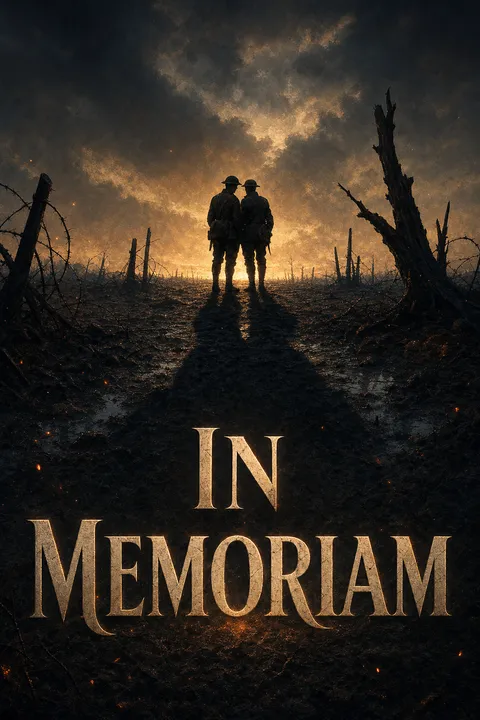
A school magazine, The Preshutian, prattles in its summer issue about debating prizes, bad poetry, and boys bound for Oxford. Then the tone fractures. The London Gazette of August 1914 announces a state of war with Germany, and beneath it run the first obituaries: eighteen and twenty-year-old Preshute graduates shot at Mons, each death praised as gallant, manly, a true soldier's end.
Among the dead are boys whose younger brothers still sit in the Sixth Form. The editor who wrote the magazine's jokes is himself listed, killed at eighteen. The contrast is the book's opening wound: the cosy, jesting world of English boyhood and the industrial slaughter already devouring it, one cheerful column at a time.
Winn weaponizes form. By opening with the school paper's self-satisfied whimsy and then dropping the casualty lists directly beneath it, she stages the novel's central collision before any character speaks. The obituaries' euphemistic language (gallant, painless, noble) establishes the gulf between official myth and bodily reality that the entire book will interrogate. The framing also primes dramatic irony: we learn to read these columns with dread, scanning for names. It announces that this is a story about how a culture narrates death to make war bearable, and about the boys educated to die quoting Tennyson while believing England itself is a kind of magic worth their blood.
Reading the Dead on a Rooftop
At Preshute, Henry Gaunt1 and Sidney Ellwood2 share cigarettes on a roof ledge, reading the obituaries of older boys killed in France. Ellwood2 mimes shooting Germans, intoxicated by war's romance; Gaunt,1 half-German and a stubborn pacifist, refuses to play.
Beneath their bickering lies something unspoken. Ellwood2 loves Gaunt1 and compares himself to Tennyson mourning Arthur Hallam, half-wishing for a tragedy to write about. Gaunt1 loves him too but smothers it under stoicism, terrified of exposure and of Ellwood's2 habit of consuming boys then discarding them.
The whole school adores Ellwood,2 the brilliant poet; Gaunt,1 the prize boxer, simply hits anyone who crosses him. War remains a distant glamour, but the columns of the dead grow longer each term.
The rooftop is a vantage of safety above a world that will soon kill them. Winn establishes the asymmetry at the heart of the romance: Ellwood performs feeling lavishly while withholding the true thing, and Gaunt withholds everything. Both strategies are defenses bred by a system that punished discovery (Sandys and Caruthers vanished overnight). The Tennyson conceit is darkly prophetic, fusing eros and elegy: to love a boy in 1914 is already to anticipate mourning him. Gaunt's pacifism is principled but also tangled with his German cousins, foreshadowing the war's cruelty of forcing men to kill kin. Adolescent banter masks existential stakes.
The White Feather and the Bridge
In town, two fashionable young women hand Gaunt1 a white feather of cowardice, tucking it into his buttonhole before a jeering crowd. The shame paralyzes him; his principled objection to the war collapses into a feeling of being marked as the enemy. On Fox's Bridge, a drunk and tender Ellwood2 cups Gaunt's1 jaw and kisses his cheekbone, nearly his mouth.
Gaunt1 freezes, then flees, raw with terror at what he wants and what it would cost. That same afternoon he walks into the recruitment office, lies that he is nineteen, and signs up for the Royal Kennet Fusiliers. He cannot help being German, cannot help his desire, but he can, at least, choose to go kill people.
Two pressures converge: public shaming and private longing, both threats to a manhood Gaunt cannot safely inhabit. The white feather operationalizes gendered coercion, civilian women enforcing slaughter on men. Crucially, Gaunt enlists not from conviction but to escape feeling, redirecting forbidden desire and humiliation into sanctioned violence. Winn diagnoses how the war machine fed on repressed shame. The near-kiss matters because Gaunt's flight reveals his pattern: intimacy with Ellwood triggers self-destruction. He would rather face machine guns than face himself. The personal and the political fuse, enlistment as both flight from love and capitulation to a culture that has named him suspect.
Letters from a Different War
Posted to Belgium, Gaunt1 befriends Captain John Maitland,8 Ellwood's2 worshipped former protector, who proves genuinely decent, and Lieutenant David Hayes,4 a working-class factory worker whose competence shames the public-school officers.
Their correspondence sustains Ellwood,2 who fills his letters with school gossip: a secret society called the Ardents, the snob Burgoyne9 burning his poems. Meanwhile Gaunt1 writes honestly only to Sandys,10 the older boy with whom he had angry, secret sex at school, the relationship that taught him shame.
Through interleaved memories we learn how Sandys10 once urged Gaunt1 to simply tell Ellwood2 the truth, and how Gaunt1 always refused. Then a returned envelope arrives stamped that the recipient is deceased. Sandys10 is dead.
Epistolary structure becomes a study in concealment: what each man can and cannot say on paper. Gaunt's letters to Sandys, the one peer who knew his nature, expose the loneliness beneath his stoicism, and Sandys's death severs his only channel of honesty. The Sandys flashbacks complicate the romance, revealing Gaunt's sexuality as long-standing, furtive, self-punishing, never tender. Hayes introduces class as the war's other fault line, the public-school officers ruling an army they barely understand. Maitland's kindness dissolves Gaunt's jealousy, showing how the trenches reshape rivalries into fragile brotherhood. The war is already teaching that everyone is provisional, names waiting for a column.
Gas Clouds Over Ypres
At the Second Battle of Ypres, Gaunt1 witnesses the first large gas attack: Algerian soldiers fleeing with melting lungs, clawing at their own throats. His faith that civilization could keep war humane shatters in the green fog. Ordered to plug a gap in the line, his terrified men refuse to climb out; Gaunt1 fires into the trench to drive them and accidentally kills Harkins, a soldier who always won at cards.
He goes over the top, every man around him cut down, and catches a bullet in the thigh. Maitland8 is killed. Hayes4 is wounded. Gaunt,1 promoted to captain over the more experienced Hayes4 purely because of his accent, writes Ellwood2 a devastating letter confessing he longs to see him before he dies.
This is the novel's first descent into atrocity, and it dismantles Gaunt's earlier abstraction about empire and progress. The gas embodies modernity's betrayal: technology meant to elevate humanity now drowns men in their own tissue. Harkins's death by Gaunt's own pistol installs the trauma that will haunt his nightmares, the unbearable knowledge that survival required killing his own. The promotion over Hayes nakedly exposes class privilege operating even amid carnage. And Gaunt's confessional letter is the hinge: his stoicism cracks under mortality, and that crack will summon Ellwood to the front, an act of love disguised as obedience.
Ellwood Follows Him to Hell
News reaches Preshute that Maitland8 is dead and Gaunt1 wounded. Reading Gaunt's1 anguished letter, Ellwood2 understands how deeply he is loved, and that Gaunt1 wants to see him before dying. Though only seventeen and made to promise his mother he would finish school, Ellwood2 enlists at once, joining Gaunt's1 own regiment with his uncle's help.
His mother14 weeps that he is too sensitive, not a soldier, but he insists he cannot sit in a cosy bedroom while his friends are slaughtered. Bertie Pritchard11 signs up too. Ellwood2 imagines reunion as a return to cadet games, songs, and shared tents. He does not yet grasp that the boy he is rushing toward has already been hollowed out by what he has seen.
Ellwood reframes obedience as agency, but Winn shows it is both. He answers the unwritten command buried in Gaunt's letter (come, I need you), proving his love operates through self-sacrifice. The mother's plea names what the culture forbids naming: her son's difference, and her fear it marks him for destruction. Ellwood's romantic vision of war (banners, brotherhood, shared tents) is the same boyish fantasy the prologue mocked, and the gap between that fantasy and the reality awaiting him generates dramatic dread. His enlistment is the point of no return for both lovers, binding their fates and ensuring the trenches will test, and transform, everything they feel.
The Captain Who Won't Look
Ellwood2 reaches the dank, corpse-walled dugout expecting his friend and finds Captain Gaunt:1 bloodshot, hoarse, drinking his meals, barely able to meet his eyes. Gaunt1 answers questions in monosyllables and dispatches Ellwood2 to unpleasant duties.
On Ellwood's2 first patrol a man sneezes, is shot, and bleeds to death in his hands; Gaunt1 orders him to write the widow a lie about a gallant, painless death. Ellwood2 learns the trenches are made unbearable less by violence than by sheer filth: rotting sandbags packed with human remains, flies in the plum-and-apple jam, putrid feet.
One night Gaunt1 breaks, sobbing like an animal over a deck of cards, the game Harkins always won. The boy Ellwood2 came to save has become someone he scarcely recognizes.
The reunion inverts romance: instead of rescue, Ellwood meets a stranger fortified against feeling. Gaunt's coldness is protective, intimacy now a liability he cannot afford amid command and trauma. Winn's relentless emphasis on ugliness over heroics, the maggots, the jam, the latrines, is a deliberate anti-romantic corrective to the propaganda the prologue parodied. The condolence letters institutionalize the very euphemism the novel exposes, forcing Ellwood to manufacture the comforting fictions he once believed. Gaunt's collapse over the cards externalizes guilt that words cannot reach. The dugout becomes a psychic crucible where Ellwood's poetic idealism is scoured down toward the war's true grammar of horror.
Billets, Rain, and a First Kiss
Pulled back to a village for divisional rest, Gaunt1 and Ellwood2 share a whitewashed room. When Gaunt1 screams through a nightmare, Ellwood2 climbs into his bed to soothe him, and the years of restraint finally give way. Days later, sheltering under an oak in the rain, Gaunt1 drops to his knees for Ellwood,2 then lets himself be kissed for the first time.
They become lovers, furtive and feverish. But the terms wound them both: Ellwood2 insists it means nothing, that it will be as if it never happened after the war, believing this is what Gaunt1 wants. Gaunt,1 who has loved him for years, says nothing of it, and so each protects himself by lying to the one person he cannot bear to lose.
Consummation arrives not as triumph but as tragic miscommunication. Both men, schooled to read desire as temporary and shameful, negotiate their love into deniability, Ellwood performing casualness, Gaunt performing acceptance, each misreading the other catastrophically. Winn captures how repression poisons even fulfilled longing: they finally touch but cannot speak truth. The rain and oak evoke the pastoral England they are fighting for, a tenderness possible only in the war's interstitial calm. The cruelty is structural, not personal: a culture that criminalized their love made honesty feel more dangerous than death. Their happiness is real and doomed, contingent on a borrowed pause between slaughters.
Burgoyne's Murderous Revenge
At the Battle of Loos, the regiment endures Britain's own gas blowing back over its troops and walks into machine guns in parade-ground columns. In the chaos Ellwood,2 enraged, strikes Burgoyne,9 now a staff officer safe behind the lines, calling him a coward.
Burgoyne9 discovers Gaunt1 and Ellwood2 embracing and recognizes their secret. As vengeance dressed as orders, he sends the two of them, with three men, to capture a German prisoner at night, a mission Hayes4 knows is essentially murder.
They cross No Man's Land; Ellwood2 bombs the wire, Gaunt1 drops into the enemy trench and flings a German up to Ellwood,2 then glimpses a face like his cousin Ernst's.13 A bullet blooms across his chest. He falls, thinking how much harder it is to be the one left behind.
The personal and political fully merge: a petty schoolyard hatred, empowered by rank, becomes lethal, demonstrating how institutional authority launders private cruelty into sanctioned death. Burgoyne weaponizes the lovers' secret, the era's queer vulnerability made literal instrument of murder. Loos itself indicts the generals: friendly gas, suicidal tactics, men as expendable arithmetic. Gaunt's final thought reverses the expected fear of dying into grief for the survivor, a profoundly relational vision of mortality consistent with his love. The cliffhanger, his chest opening as he recognizes a cousin's double, fuses the war's two horrors: it kills kin, and it severs lovers, all over a buttonhole feather's worth of spite.
Lucky Sid and the Grief Poem
Ellwood2 drags the captured German back, certain Gaunt1 is dead, and delivers him to the colonel, who confirms only what was already known, Bavarian troops, the lives spent for nothing. Grief calcifies into rage.
He becomes Lucky Sid, lobbing grenades on patrols, courting death, watching officer after officer cycle through the dugout to be killed or driven mad: Crawley's suicide, Lansing blown up by his own grenade, Carrington's hysterical paralysis. He publishes a savage poem, In Memoriam H.W.G., bristling with bitterness rather than Pre-Raphaelite beauty.
Hayes,4 his only constant, begins to crack under his own dread of going mad. Ellwood2 loses his eye and half his face to shrapnel only later; for now he carries Gaunt's1 ghost, who watches him from the dugout in a Preshute tailcoat.
Bereavement transmutes the lyric poet into an instrument of slaughter, Winn's portrait of how trauma counterfeits courage. Ellwood's recklessness is suicidal mourning, indistinguishable to the army from heroism, which it rewards. The procession of replacement officers dramatizes attrition as routine, names interchangeable, madness the standard fate. His new poetry, marketable precisely because it sells horror as entertainment, implicates a reading public consuming grief safely. Gaunt's spectral presence literalizes how the dead colonize the living mind. The chapter exposes the obscene economy of the home front: it craves the very atrocity it sent its boys to suffer, and pays in praise.
A Dead Man in a Prison Camp
Gaunt1 did not die. A German officer, Lukas Hohenheimer, mistook him for the cousin he resembled and, hearing his Munich accent, carried him to a field hospital where his collapsed lung was drained.
Shipped to the Fürstenberg prison camp, he finds his childhood friend Gideon Devi,5 an Indian RFC pilot, and Archie Pritchard,6 brother of Ellwood's2 friend Bertie.11 Tormented by nightmares that exile him to a corridor each night, Gaunt1 joins their tunnelling escape, claustrophobia nearly defeating him underground.
When Devi5 and Pritchard6 discover his love for Ellwood,2 they respond not with disgust but with teasing acceptance, the first time his nature is treated lightly. To win forged papers he gently seduces Elisabeth,12 the Kommandant's secretary, learning that women's tenderness leaves him untouched.
Resurrection is engineered by the war's deepest irony: Gaunt's German blood, the mark that shamed him at home, saves his life abroad. The camp becomes an unexpected sanctuary where, among Devi and Pritchard, his sexuality is finally met with affection rather than terror, a model of acceptance the trenches and England denied him. Elisabeth functions as control experiment: her kindness confirms what Gaunt cannot perform, that his love is specific, not chosen, not curable. The Adam Bede repetitions and Greek recitations show men improvising civilization inside captivity. Crucially, Gaunt now knows what he feels, and is driven to return to a lover who believes him buried.
The Tunnel, the Train, the Border
The escape tunnel floods near the surface; Devi,5 trapped underwater, would have drowned had Gaunt1 not crawled in and dragged him out by the ankles before Pritchard6 hauled them both clear.
Caught, they spend two weeks in solitary, then attempt Devi's5 audacious train plan: a staged commotion lets men leap from a moving carriage. When German soldiers corner them near the Dutch frontier, Devi5 flings himself at the guards with a battle cry so Gaunt1 and Pritchard6 can flee. A scream follows them.
The two survivors sprint past a sentry into the Netherlands, are fed by a Dutch couple, and reach Amsterdam through the diplomat father of their friend Cyril Roseveare.7 Only later will they learn, with disbelieving joy, that Devi5 survived and is back in another camp.
Devi embodies a buoyant courage opposite to Gaunt's grim endurance, and his self-offering reframes sacrifice not as the propaganda's empty gallantry but as concrete love between friends. Winn complicates imperial narrative through Devi, an Indian airman who fights for and is marginalized by the empire, his repeated escapes a refusal of confinement on every level. The flooded tunnel reprises Gaunt's drowning, suffocation imagery, yet here he is brave for another, confirming his thesis that courage comes easier for those we love. The eventual revelation that Devi lives provides one of the novel's few mercies, a stay against its arithmetic of loss.
The First Day on the Somme
As Gaunt1 escapes, Ellwood2 faces the Somme, where the colonel promises the wire is dust and the Germans will surrender. Instead, from the German side, Gaunt's1 cousin Ernst Grisar13 works a machine gun, sweeping down advancing Britons like a finger wiping a windowsill.
Lantham, shot for shell shock by his own side; West, decapitated; Aldworth, Bertie Pritchard,11 Finch, all killed. Ellwood2 walks into the German trench utterly fearless, and Ernst,13 recognizing him, hesitates, only to have his face shot away by Roseveare.7
Ellwood2 drags wounded men back across No Man's Land trip after trip until shrapnel destroys half his face and one eye. He earns a Military Cross for the friends he could not actually save, half of whom die at the clearing station.
The Somme is rendered partly through Ernst's German eyes, a structural masterstroke that strips away national distinction: the gunner pities the boys he must kill, remembering Ellwood's joyful visit to Munich. Slaughter becomes mutual, intimate, obscene. Winn refuses any redemptive heroism; Ellwood's medal commemorates futility. His disfigurement literalizes the war's defacement of beauty, the poet who loved loveliness now embodying its destruction. Lantham's execution exposes the army murdering its own traumatized boys. The chapter is the novel's catastrophic midpoint of carnage, severing the Preshute generation almost entirely and ensuring that whoever survives will carry a ruined face, a ruined mind, or both.
A Name Among the Wounded
Safe in Amsterdam, Gaunt1 and Pritchard6 finally read The Times casualty lists they have been dreading. Pritchard6 searches for his brother Bertie;11 Gaunt1 searches for Ellwood.2 Bertie11 is dead. Ellwood2 is merely wounded, alive. Gaunt1 returns to England and walks into Ellwood's2 hospital ward, where Ellwood,2 certain he is a ghost or a dream, can feel almost nothing, not even for the man he mourned.
Ellwood2 tears off his bandages to display the molten ruin of his face; Gaunt,1 who failed his own medical because his lung never healed, will not be sent back to fight. Gaunt1 confesses he loves him; Ellwood,2 numb and seething, cannot answer. Maud,3 Gaunt's1 sister, confronts her brother, names his love aloud, and accepts it.
The reunion subverts every expectation of romantic catharsis. Ellwood's emotional anesthesia, his inability to feel for the resurrected beloved, is shell shock's cruelest symptom: the war has burned out the capacity for the very love that defined him. Gaunt's steadiness now mirrors Ellwood's earlier devotion, the roles reversed, the patient lover now waiting. The casualty list, the novel's recurring instrument of dread, delivers both reprieve and grief in adjacent columns. Maud's acceptance offers a counter-vision to the persecuting world, intimate recognition replacing shame, and her later turn toward German reform movements plants the hope that the lovers might one day live openly somewhere.
No Spring in Brazil
After the Armistice, Roseveare's7 diplomat uncle settles Gaunt1 and Ellwood2 into a grand house in Rio de Janeiro, where their staff are discreet and their love can survive. Ellwood,2 masked over his ruined face, flourishes amid the heat and flowers; Gaunt1 aches with homesickness for cold English drizzle.
When Ellwood's2 mother14 dies and Maud3 writes that Germany's reformers are fighting to decriminalize men like them, Gaunt1 is tempted to leave. But Ellwood,2 terrified of abandonment, asks him to stay, and Gaunt1 promises to remain forever, finally calling him Sidney, the name he withheld for years because it meant he could keep him. Then Ellwood,2 who had stopped quoting poetry, haltingly offers a line of Shakespeare to confess what he cannot say plainly. It is a start.
Exile is the price of survival: to live, they must lose England, the magic they fought for. Winn refuses easy healing, Ellwood may never fully love again, and Gaunt accepts this with a devotion stripped of expectation. The withheld name, Sidney, becomes the book's final emotional currency: to speak it is to claim permanence, a vow uttered where law forbids vows. The returning poetry quotation, after a hundred thousand words of its absence, signals the faintest thaw, feeling creeping back through the only language Ellwood ever trusted. Brazil is no paradise but a negotiated endurance, love continuing not despite damage but alongside it.
Epilogue
The novel closes as it opened, with an obituary. The school paper records that Captain Cyril Roseveare,7 the last of three brothers all killed, all Head Boys, died in action around the tenth of November 1918, almost certainly the day before the Armistice.
His memorial service was poorly attended because nearly all his friends had already gone before him. The notice, written by the wounded Grimsey, insists Roseveare7 died not for war but for peace, and pleads that his sacrifice and a thousand others purchase a lasting European harmony, a century of peace bought, like Waterloo's, in blood.
The circular obituary frame snaps shut with devastating irony: Roseveare, the friend who engineered the lovers' escape to Brazil, dies one day short of survival, his memorial empty because the war consumed everyone who might have mourned him. Winn lets the elegiac propaganda voice return (died for peace, paid in blood) but now we read it knowing its hollowness, the same euphemism the prologue exposed. The plea for a century of peace lands with dramatic irony for readers who know what 1939 brings. The book ends not on its lovers but on the generation's near-total erasure, insisting that the cost was a whole world of friendship, annihilated column by column.
Analysis
In Memoriam interrogates the machinery by which a culture persuades its young to die. Winn frames the novel with obituaries whose euphemisms (painless, gallant, noble) are systematically refuted by the bodily horrors she insists on rendering: melting lungs, brains on a sleeve, sandbags packed with human remains. The gap between the official elegy and the obscene reality is the book's moral engine. Crucially, the war is shown feeding on shame rather than conviction. The white feather, the dread of a poor In Memoriam, the terror of being thought a coward, these psychological coercions drive sensitive boys to the front more reliably than patriotism. Winn locates the war's cruelty in its forced fratricide too: Gaunt's1 German blood, his cousins, his accent, the very things that shame him at home, save his life abroad and make him fire on his own kin. The novel's central love story refracts a larger argument about repression. Gaunt1 and Ellwood2 cannot speak their love because the law and the culture would destroy them for it, so they negotiate it into deniability, lying to protect themselves from the one person each cannot lose. This makes their tenderness both real and tragic, contingent on stolen pauses between slaughters. The withheld name Sidney becomes the book's deepest emotional measure: to speak it is to risk permanence in a world that forbids it. Ellwood's2 poetry, vanishing under trauma and faintly returning at the close, charts the war's assault on feeling itself. The ending refuses redemption. Survival demands exile to Brazil, the loss of the England they fought for, and the acceptance that some damage never heals. Yet within that diminishment, love persists, not despite the wreckage but alongside it, a negotiated endurance that is the only victory the war permits.
Review Summary
In Memoriam by Alice Winn follows two English boarding school boys, Sidney Ellwood and Henry Gaunt, secretly in love but unable to express their feelings during WWI. The novel depicts their journey from privileged youth to the brutal trenches, exploring themes of love, class, trauma, and the devastating impact of war. Reviews praise Winn's vivid prose, unflinching portrayal of combat horrors, and the tender romance between the protagonists. Most readers found it emotionally devastating yet beautifully written, though some criticized pacing issues and derivative elements. The book draws inspiration from war poetry and historical accounts.
People Also Read








Characters
Henry Gaunt
Stoic half-German boxerTall, strong, sandy-haired, Gaunt is a prize boxer and devoted Classics scholar whose stoicism is armor built over years of boarding-school cruelty and concealment. Half-German, summering in Munich among cousins he loves, he is a principled pacifist whose objection to the war tangles with terror of killing kin. He loves Ellwood2 with a depth he cannot voice, having learned that desire means danger, expulsion, even death. Gaunt processes feeling through silence and his fists, finding comfort in Thucydides, who proves his sufferings are ancient and survivable. Driven by shame, loyalty, and a fierce protectiveness toward those few he loves (Ellwood2, Maud3, Devi5), he is a man who would rather walk into machine guns than speak the truth of his own heart.
Sidney Ellwood
Charming poet in loveDark, curly-haired, devastatingly attractive, Ellwood is Preshute's beloved golden boy: poet, athlete, raconteur. Of Jewish heritage he romanticizes into Venetian myth, he craves rootedness in an England that magic-ridden enchants him. He loves Gaunt1 obsessively, channeling years of unrequited longing into Tennyson, sonnets, and a habit of giving himself easily to others to feel loved. Beneath the charm runs a vein of ungovernable violence and a terror of abandonment. Generous to a fault with money and affection, he is also capable of cruelty, especially toward those who threaten his carefully managed image. Ellwood performs feeling lavishly while guarding the one true thing, and the war will test whether a poet so made of language can survive losing his beauty and his words.
Maud Gaunt
Henry's fierce sisterGaunt's1 clever, independent sister, named for a Tennyson poem, who reads Bertrand Russell and dreams of studying in Berlin and entering politics. She trains as a VAD nurse against her parents' wishes, refusing the decorative role expected of her. Perceptive and morally serious, she sees through euphemism and demands honesty from the brother1 who cannot give it. Her eventual understanding and acceptance of Gaunt1 offers a rare vision of recognition without shame.
David Hayes
Working-class lieutenantA former Lewisham factory worker turned officer, a temporary gentleman whose competence outshines the public-school men but whose accent and ill-fitting uniform mark him as an outsider. Sharp, proud, and quietly bitter about class, he becomes Ellwood's2 steadfast companion in the trenches even as he resents Ellwood's2 privilege. His growing terror of losing his mind to shell shock reveals the war's psychological toll on the most capable.
Gideon Devi
Buoyant Indian airmanGaunt's1 childhood friend from Grinstead, an Indian RFC pilot of irrepressible optimism and charm who weaponizes good humor against bullies and despair alike. A serial escape artist, he masterminds prison breaks with cheerful audacity. Loyal, mischievous, and accepting of Gaunt's1 nature without judgment, Devi embodies a courage built on hope rather than Gaunt's1 grim endurance, and a refusal to be confined by camps or empire.
Archie Pritchard
Placid scholarship prisonerRed-haired, freckled, quietly popular elder brother of Bertie11, a scholarship boy at Preshute. Steady, sensitive, and kind, he becomes Gaunt's1 fellow prisoner and escape companion, sleepwalking through phantom sentry duty at night. His calm decency and his anxious devotion to his younger brother11 make him a moral anchor in the camp.
Cyril Roseveare
Loyal Head BoyYoungest of three exemplary Roseveare brothers, all Head Boys, golden and gilded. Outwardly composed and uncomplaining, he carries deep grief and an unwavering loyalty to his friends, keeping a mental list of those he needs to survive. He helps the lovers find a future, and his quiet steadiness masks the heavy cost of watching his world die around him.
John Maitland
Worshipped older protectorA football star idolized by the whole school, once Ellwood's2 particular older friend and protector. At the front he proves genuinely kind and gentlemanly, mentoring Gaunt1 and easing his guilt over killing. Handsome and brilliant, he embodies the charmed prewar golden boy whose fate the war will not spare.
George Burgoyne
Spiteful snobbish antagonistA gangly, clever-but-friendless boy obsessed with ancestral honor, antisemitic toward Ellwood2, whose poems he burns and whose private letters he reads aloud. Cruel because he knows he does not fit and cannot change. His grudges, empowered by rank, turn lethal, making him the human face of how petty hatred and institutional authority conspire.
Sandys
Gaunt's secret schoolboy loverA strong older boxer with whom Gaunt1 had angry, secret sex at school, the relationship that taught Gaunt1 shame. Braver than Gaunt1 in confessing feeling, he urged honesty Gaunt1 refused. His correspondence reveals Gaunt's1 hidden interiority.
Bertie Pritchard
Cheerful loyal friendForgettable-looking, soft-hearted Preshute friend nicknamed Mini, younger brother of Archie6. Kind, unpretentious, and brave to a fault, he is devoted to his friends and beloved despite never knowing what he is good for.
Elisabeth
German camp secretaryThe Kommandant's pretty, dark-haired secretary, sweet on Gaunt1, who gently courts her for forged papers. Her kindness and his indifference confirm to Gaunt1 the immovable specificity of his love for Ellwood2.
Ernst Grisar
Gaunt's Bavarian cousinGaunt's1 cousin in Munich, who once hosted both boys joyfully before the war. Conscripted as a German machine gunner, he becomes an instrument of the war's cruelest irony, forced to fire on the very friends who once climbed mountains with him.
Mrs. Ellwood
Devoted anxious motherEllwood's2 pretty, widowed, somewhat girlish mother who adores her only son and dreads his difference and his danger. Verbally clumsy and easily wounded, she represents the helpless home-front parent the war breaks alongside its soldiers.
Plot Devices
The Casualty Lists
Dread-machine and chorusThe school paper's In Memoriam columns and The Times Roll of Honour recur throughout, structuring the novel like a grim metronome. Characters scan them for names with held breath; readers learn to dread the alphabetical scroll toward G, E, or P. The obituaries' euphemistic praise (instant, painless, gallant) is repeatedly exposed as falsehood by the bodily horrors the narrative shows. Winn uses the lists to deliver crucial plot information (who lives, who dies) and to indict the culture's mythologizing of slaughter. The framing device, opening and closing the book with obituaries, transforms private grief into a generational accounting, the names accumulating until an entire world of friendship has been erased column by printed column.
The Letters
Reveals hidden interiorityThe novel's epistolary spine carries the relationship across separation and exposes what speech cannot. Gaunt's1 affectionate-but-guarded letters to Ellwood2 contrast with his startlingly honest letters to Sandys10, the one peer who knew his nature. The correspondence conveys school subplots, front-line horror, and the precise emotional distances between people (the difference between signing Affectionately and With affection). Censorship of soldiers' letters becomes a theme, the manufacture of comforting lies. A single unfinished letter (the words My dearest, darling Sidney2, then nothing) becomes a devastating artifact, proof of love arrested mid-sentence by presumed death, and the unspoken name that finally must be spoken aloud.
Poetry as Love Language
Coded confession and barometerEllwood2 quotes Tennyson, Keats, Shakespeare, and Wyatt constantly, using verse as a coded vehicle for feelings the law and his fear forbid him to state plainly. The book's title nods to Tennyson's In Memoriam, written for a beloved dead friend, the template Ellwood2 explicitly invokes. Poetry serves as confession (when he recites love sonnets), as armor against madness, and crucially as an emotional barometer: when trauma hollows Ellwood2 out, the quotations stop entirely, and their eventual faint return signals the first thaw of feeling. Winn also tracks how Ellwood's2 own poems mutate from Pre-Raphaelite prettiness to brutal anti-war verse the public consumes as entertainment, implicating the home front's appetite for horror.
The White Feather
Shame as coercionThe white feather, handed to apparently able-bodied men not in uniform, recurs as the era's instrument of gendered shaming, civilians enforcing enlistment. Gaunt's1 paralyzing humiliation when two women feather him precipitates his decision to enlist despite his pacifism, fusing private shame with public coercion. Later Lantham and Roseveare7 receive feathers too, each pushed toward the front. The device crystallizes the novel's argument about masculinity: that the war was fed not only by conviction but by the unbearable terror of being branded a coward, and that this shame killed as surely as bullets, driving sensitive, unwilling boys into the slaughter to escape a feather's weight.
The Prison Camp Escape
Sanctuary and reversalThe Fürstenberg camp and its tunnel-and-train escapes form the novel's surprising second movement, a counterpoint to the trenches. Built from real escape accounts, the camp paradoxically becomes a place of relative safety where Gaunt's1 sexuality is met with acceptance rather than terror, and where men improvise civilization through Greek plays, stolen lamp oil, and endless rereadings of Adam Bede. The escapes (flooded tunnel, leaping from a moving train, a sprint across the Dutch frontier) generate adventure and showcase friendship as sacrifice. The device also engineers the book's structural reversal: it keeps a presumed-dead character alive and offscreen, sustaining dramatic irony while one lover mourns and the other claws his way home.
Download PDF
Download EPUB
.epub digital book format is ideal for reading ebooks on phones, tablets, and e-readers.








































