

Key Takeaways
Mendeleev didn't dream the periodic table; a deadline forced it
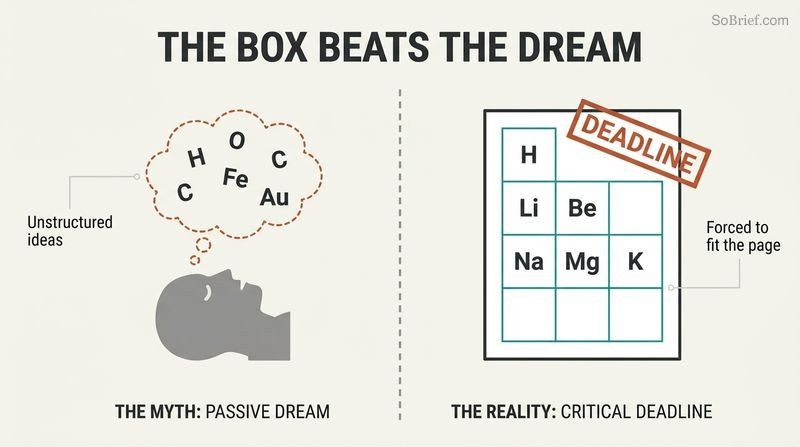
The myth obscures the real lesson. Popular legend says Russian chemist Dmitri Mendeleev discovered the periodic table in a dream in 1869, the elements snapping into place by magic. Historians confirm he did not. He was racing to finish a chemistry textbook, owed his publisher, and needed to squeeze 55 remaining elements into one volume. Grouping elements by shared properties saved space. That cramped assignment, not a vision, produced the most important chart in science.
The box beat the dream. Mendeleev was a polymath consulting on cheese production while a friend presented his table. His broad knowledge mattered, but only a narrowly bounded project channeled that breadth into a breakthrough. We reach for a dream when what we actually need is a textbook.
The reframing is bracing because the dream story is so culturally sticky, repeated in films, mattress ads, and even Matthew Walker's bestseller on sleep. Epstein weaponizes a beloved anecdote against itself, which is rhetorically clever and historically grounded in Michael Gordin's biography. The deeper claim connects to cognitive load theory: unbounded problems overwhelm working memory, while constraints prune the search space. One caveat worth noting is survivorship bias. Countless deadline-pressured workers produce mediocrity, not periodic tables. The constraint was necessary but not sufficient; Mendeleev's two decades of accumulated expertise did the heavy lifting once the box focused him.
Too much freedom and money killed the iPhone's brilliant ancestor
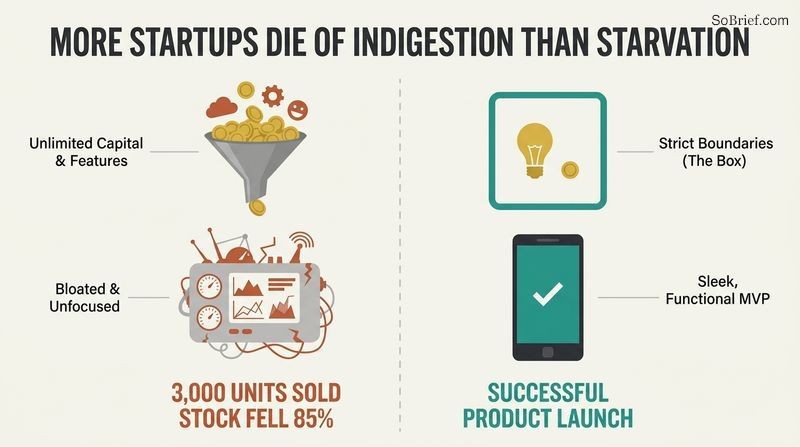
General Magic had everything except limits. In the early 1990s, ex-Apple engineers sketched essentially the iPhone (touchscreen, app store, emojis, the cloud) years before the web existed. They raised vast money, recruited legendary talent, courted sixteen global partners, and went public with zero revenue. Then they collapsed. The book-sized device sold roughly 3,000 units in six months; the stock fell 85% within a year.
Indigestion, not starvation. With unlimited resources, engineers built everything from scratch, added superfluous features, and never defined a real customer (their target was a vague Joe Sixpack). One engineer coded a calendar to start at the beginning of astronomical time. A venture saying captures it: more startups die of indigestion than starvation. Without boundaries, the instinct is always more, bigger, sooner.
The General Magic saga is the book's emotional anchor, and it pairs beautifully with Leidy Klotz's research on subtraction neglect, where people strengthen a Lego structure by adding bricks even when removing one solves it instantly. Bent Flyvbjerg's database of 16,000 projects backs the pattern: only 8.5% finish on time and on budget. The provocative inversion of startup wisdom (kill bloat, not scarcity) challenges the Silicon Valley cult of the moonshot. A useful tension: General Magic's alumni went on to build the iPod, Android, and Nest, suggesting the failure trained a generation. Constraints learned the hard way still compounded.
Break giant visions into testable pieces, then sprint: think slow, act fast
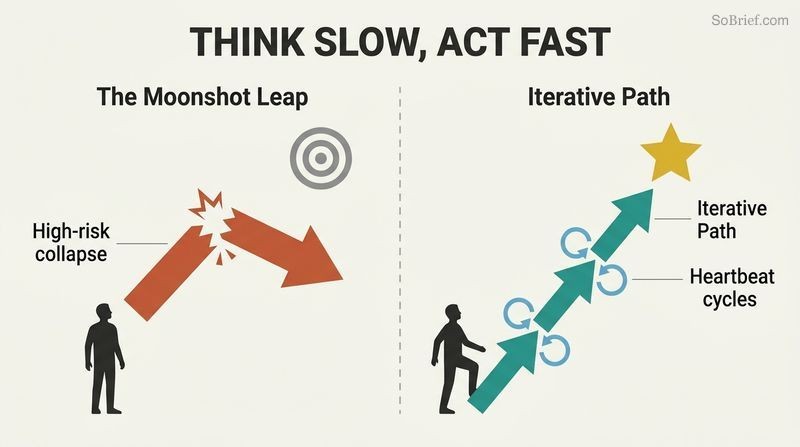
Pixar's Ed Catmull did what General Magic couldn't. Chasing the same dream (a fully computer-animated film) in the same era, Catmull spent twenty years breaking the moonshot into solvable pieces. He estimated it would take 100 supercomputers costing a billion dollars to animate a film, decided to wait, and solved nearer problems first. He kept teams tiny, preferred features that removed complexity, and used daily reviews plus blunt Braintrust critiques.
Iteration is cheap when projects stay small. Tony Fadell, scarred by General Magic, built the iPod and iPhone using self-imposed deadlines he called heartbeats: short cycles to pause, collect lessons, and regroup. Bent Flyvbjerg calls the successful pattern Pixar planning. Frank Gehry tested ideas on his own house before the Guggenheim Bilbao, which finished on time and under budget.
This maps onto lean startup methodology and agile software development, but Epstein's framing via Herbert Simon's problem space is sharper. Simon showed successful solvers systematically shrink the search maze, taking information from each failure, while poor solvers repeat failed guesses in pure trial and error. The modular point is underrated: solar farms rarely suffer cost overruns precisely because panels snap together, letting engineers test one unit to validate the whole. The challenge for readers is that not every domain decomposes neatly. Some breakthroughs genuinely require an all-at-once leap. Still, the bias toward premature scale is real and expensive, and this is the antidote.
Pre-register your hypotheses or you'll fool yourself with false positives
Science stopped working in 2000, then worked better. Before 2000, most large NHLBI heart-disease trials showed benefits. After researchers were required to register in advance exactly what they would measure and how, positive results nearly vanished; almost no supplement beat placebo. The earlier wins were largely false positives born of too much analytic freedom.
HARKing is sharpshooting after the fact. Nutrition star Brian Wansink unwittingly confessed to Hypothesizing After Results are Known: sifting failed data until something looked significant, like a gunman firing at a wall then drawing the bullseye around clustered holes. Eighteen of his studies were retracted. The fix scales beyond labs: entrepreneurs trained to state and test hypotheses (one tattoo startup discovered customers wanted skill-evaluation, not faster search) pivoted more and earned more.
This is the replication crisis distilled into an actionable principle, and the entrepreneurship angle (the Italian RCT of 116 startups) extends it beyond academia in a genuinely fresh way. The connection to Karl Popper's falsifiability is implicit but strong: a prediction only tests a theory if you commit before seeing the data. The Galen anecdote (his cure works except for incurable cases, who all die) is a perfect illustration of unfalsifiable reasoning. One nuance: pure exploration still has value, and many genuine discoveries began as accidents. The point is not to ban curiosity but to separate exploratory data-mining from confirmatory testing, and to label which is which.
Constraints force creativity; total freedom traps you on the familiar path
The Green Eggs and Ham effect. Dr. Seuss wrote his classic after a bet to use only 50 words, and The Cat in the Hat from a 225-word list. Psychologist Catrinel Tromp named the paradox: working within tight limits yields more creative output. Given total freedom, our brains (cognitive misers) default to the path of least resistance, doing what worked before.
Limits push us off that path. When pianist Keith Jarrett was stuck in 1975 with a tiny, out-of-tune piano in Cologne, he avoided its weak registers, leaned on the middle keys and rhythm, and produced the best-selling solo piano album ever. Bach piled rule upon rule writing fugues. Studies show people invent more when handed five random parts they must all use than when given unlimited pieces.
This is the book's signature thesis and it is well-supported across domains, from Stravinsky's praise of self-imposed obstacles to the Constraints-Led Approach in motor learning. The cognitive-miser framing connects to Daniel Kahneman's System 1, which conserves effort by reaching for the readily available. There is a Goldilocks caveat the book honors: when researchers added too much constraint (specifying the exact object to build), creativity collapsed. So the prescription is calibrated friction, not maximal restriction. Worth pairing with Teresa Amabile's work showing that creativity dies under controlling deadlines but thrives under meaningful challenge. The distinction is whether constraints define the problem or dictate the solution.
To invent something new, first block your old default solution
Stokes' paired-constraints process. Psychologist Patricia Stokes found innovators pair a preclude constraint (forbidding a familiar approach) with a promote constraint (a specific new method to try instead). Monet banned black and dark/light shading, promoting contrasting hues, and birthed Impressionism. Cubists precluded single-viewpoint painting and promoted multiple angles at once.
Virginia Woolf rebuilt the novel this way. After a critic called her tidy 1919 novel scarless, Woolf precluded omniscient narration and external detail, experimented through short stories, and promoted stream of consciousness. Jacob's Room broke literary ground. The same logic plays out beyond art: when an NBA star is injured, teammates forced off the usual strategy pass more and keep winning even after he returns. A 2014 London tube strike pushed commuters onto better routes they kept.
Paired constraints is one of the book's most practically transferable tools because it converts a vague aspiration (be original) into a structured experiment (block X, try Y). The NBA pass-network study and the London Underground strike are elegant natural experiments showing that removing the default solution unsticks people from local optima they never knew were suboptimal. This resonates with Adam Alter's Anatomy of a Breakthrough and with behavioral economics on defaults: we drastically overweight the status quo. A constructive caveat: precluding requires knowing which habit to block, which itself demands diagnostic insight. The technique presupposes enough self-awareness to name your own path of least resistance.
Wrap radical ideas in the familiar, or nobody will accept them
Virginia Woolf's rope. Bold new ideas need a tether to what audiences already know. Martin Luther King Jr. borrowed sermon structures, anecdotes, and phrasing from other preachers, then smuggled radical demands inside ultra-familiar material so white Christians felt their own beliefs compelled them. His language persuaded not despite borrowing but because of it.
Optimal newness wins. Shakespeare reworked existing stories; Edison cloaked electric light in gas-lamp aesthetics, even keeping useless lampshades, so adopters barely noticed the change. Analyses of 18 million papers show the biggest hits combine mostly conventional knowledge with a small injection of the unusual. In fantasy films, the wilder the setting, the more conventional the plot must be. The more disruptive the idea, the more essential the familiar anchor.
This counters the Romantic lone-genius myth with a sociologically grounded view of innovation as recombination. The 18-million-paper study (Uzzi and colleagues) and the Harvard Business Review keyword analysis give the claim quantitative teeth that most creativity books lack. The skeuomorphism example (digital folders mimicking paper ones) is a daily reminder. A sharp connection: Everett Rogers' diffusion of innovations theory similarly found that compatibility with existing values predicts adoption speed. The tension Epstein flags via Woolf is real and underappreciated: push too far past the familiar and the work becomes unintelligible, connecting with no one. Genius without the rope is just noise nobody hears.
Design for your most constrained user and everyone benefits
Universal design. When the US Army kept adding armor plates (the Christmas tree effect), soldiers ballooned to carrying up to 151 pounds and one got stuck in a hatch on an obstacle course. Redesigning a modular vest around the most constrained users, including women, produced gear that fit everyone better; about 20% of the close-combat force ended up best fit in vests built for women.
Extreme users reveal universal needs. Curb cuts made for wheelchairs help strollers and bikes. Websites built for screen readers work better on phones. The OXO peeler, designed for an arthritic hand, became a kitchen staple. The deepest shared constraint is working memory: cram unfamiliar information and learners drown, which is why electronic road signs displaying death tolls actually caused more crashes.
Universal design is a mature field, but Epstein's move is to generalize it from ramps and peelers to pedagogy and policy via the working-memory bottleneck. The Texas road-sign study is a genuinely counterintuitive gem: an attention-grabbing safety message consumes the very cognitive resource drivers need, increasing crashes on tricky roads. This dovetails with cognitive load theory in education (John Swerik, Daniel Willingham) and with the chunking research showing familiarity, not raw intelligence, drives comprehension. A subtle point worth flagging: designing for extreme users is not free, and Frederick Taylor's opposite philosophy (fit the worker to the system) dominated for decades because it was cheaper to optimize for an idealized average.
Find the single bottleneck; widening it multiplies the whole system
Theory of constraints. Physicist Eli Goldratt, asked to optimize a chicken-coop business, saw total output was controlled by the slowest step. Moving one worker to that bottleneck tripled production. His business novel The Goal sold over seven million copies. The constraint, which he called the drum, sets the beat for everything; growth comes from looking inward, not just expanding.
The bottleneck shows where to focus. Apeel founder James Rogers realized the food system's limit wasn't quantity but time, so he invented a plant-based coating that makes a strawberry last a week. Olympic swimmer Sheila Taormina diagrammed her own training, found her bottleneck was power (not endurance), retrained, and won gold. A New Zealand cancer pharmacy prepped common drugs in advance and cut patient waits from four hours to thirty minutes.
Goldratt's theory of constraints is a manufacturing classic, but applying it to a swimmer's stroke and a research lab's idea pipeline is where Epstein adds value. The recurring insight is that local optimization (each silo maximizing its own output) can harm the whole, echoing Goldratt's line that the sum of local optimums is not the optimum of the whole. This connects to systems thinking and to Amdahl's law in computing, where the serial bottleneck caps total speedup. The practical power is diagnostic discipline: most people improve whatever is easiest or most visible, not what actually limits results. Taormina's self-audit is a model anyone can copy.
Multitasking is self-distraction; protect attention as your scarcest resource
Attention is the real bottleneck. Gloria Mark's tracking research found office workers switch tasks every 47 seconds, and each interrupted task takes about 25 minutes to resume. You cannot share attention; you switch it, leaving residue from the prior task. The more people switch, the lower their productivity and the higher their stress (measured by heart-rate variability).
Boundaries enable deep work. Isabel Allende has started every book on January 8 for over forty years, clearing her calendar into silence; the ritual is a commitment device. Bluesman Robert Johnson learned guitar so fast people said he sold his soul to the devil, but he was really practicing in a quiet graveyard at midnight. Herbert Simon warned that a wealth of information creates a poverty of attention.
Mark's longitudinal data (task-switching accelerating from three minutes in 2004 to 47 seconds by 2022) is alarming and concrete. The self-interruption finding is the most unsettling: we internalize a distraction rhythm and recreate it even when external triggers vanish, which explains why a phone merely present on the desk degrades cognition. This aligns with Cal Newport's Deep Work and Sherry Turkle's research on the costs of constant connection. The Robert Johnson demystification (genius as quiet, deliberate practice, not Faustian magic) is a lovely parallel to the Mendeleev myth-busting that opens the book. The throughline: extraordinary output looks magical only because the disciplined constraints behind it stay invisible.
Clear, impartial rules let strangers trust and collaborate, enriching everyone
The rules of the game. In Lusaka, Zambia, female entrepreneurs like Mary refuse to partner with men who might steal the proceeds, so they miss big orders. But inside markets with elected market chiefs who enforce agreements with clear, objective rules, the collaboration gender gap vanishes. Nobel economist Douglass North called such constraints institutions: humanly devised rules that make interaction predictable.
Predictable rules built the modern world. North argued declining piracy, not better ships, drove centuries of shipping gains, and that Britain's constraints on the crown enabled the Industrial Revolution. A century after a Romanian village split across an Austrian-Ottoman border, descendants on the fairer-governed side still trust strangers more. Even polarized Wikipedia editing teams produce higher-quality articles when disciplined by clear neutrality policies.
This chapter elevates the book from personal productivity to political economy, and the Lusaka field experiments (Ashraf, Delfino, Glaeser) give it empirical force. The counterintuitive Wikipedia finding (ideological polarization improves articles when bound by neutral-point-of-view rules) is a hopeful corrective to despair about online discourse: structure, not homogeneity, produces quality. North's institutions framework connects to Acemoglu and Robinson's Why Nations Fail and to Elinor Ostrom's work on commons governance. The Romanian natural experiment showing trust persisting a century after the institutions vanished is striking evidence for cultural transmission. The actionable kernel for individuals: ambiguous credit systems quietly suppress collaboration, especially for the less powerful, so clarify the rules upfront.
Satisfice your choices and consolidate your caring to find meaning
Maximizing makes you miserable. Herbert Simon showed humans cannot truly maximize (evaluate every option), so we satisfice: pick what is good enough. Simon practiced it, wearing identical socks and eating the same breakfast to spare cognitive bandwidth for what mattered. Studies confirm maximizers are less happy, more regretful, and more prone to endless comparison. Consumer choices have multiplied a hundred-million-fold since preindustrial times, dwarfing the rise in wealth.
Choose your constraints to find meaning. Sociologist Durkheim found suicide rises whenever rapid change dissolves social norms (anomie) and falls when obligation strengthens. The Harvard study tracking lives for 86 years found strong social ties best predict health. Philosopher Todd May suggests choosing a few narrative values (Epstein added forgiveness) to give a coherent life story shape amid infinite options.
This closing synthesis ties the book's micro lessons to existential stakes, arguing that bounded commitment is not deprivation but the precondition for satisfaction and meaning. Barry Schwartz's Paradox of Choice and the rising-perfectionism data (a study of 40,000 students) reinforce the maximizing critique. The Durkheim-to-Haidt arc linking anomie to modern teen anxiety is provocative and timely, though correlational and contested; social media's causal role remains debated. The most transferable idea is Oliver Burkeman's consolidate your caring: in a world raining infinite urgent demands, choosing a small set of values is itself the maximizing strategy once you count the cost of deliberation. Bernard Suits' lusory attitude (voluntarily accepting unnecessary obstacles) reframes constraint as the source of play and meaning alike.
Analysis
Inside the Box is a thesis-driven popular-science book arguing, against cultural intuition, that constraints rather than freedom drive creativity, achievement, collaboration, and contentment. Epstein, author of Range, structures it as four movements (breakthroughs, creativity, focus, collaboration and contentment), each opening with a Mendeleev interlude that reframes the periodic table's invention as deadline-driven rather than dream-given. The book's craft lies in pairing memorable narratives (General Magic, Pixar, Keith Jarrett, MLK, Apeel, Isabel Allende) with peer-reviewed research, then escalating from individual productivity to civilizational institutions and existential meaning.
The argument is strongest where it converts diffuse advice into mechanisms. Herbert Simon's problem space and cognitive miser concepts provide the cognitive substrate: unbounded options overwhelm finite attention and bias us toward the familiar, so well-chosen limits prune the search and force genuine exploration. Stokes' paired constraints and Tromp's Green Eggs and Ham effect give creativity a procedure. Goldratt's theory of constraints and North's institutions extend the logic to systems and societies. This vertical integration (from neurons to nations) is the book's intellectual ambition and its main risk: the word constraint stretches to cover working memory, body armor, deadlines, market chiefs, and forgiveness, threatening to become a universal explanation that explains nothing.
Epstein guards against this with honesty (he debunks a beloved playground study he could not verify, and concedes too much constraint kills creativity), but a skeptic would press on selection effects. We hear about constraints that produced periodic tables and gold medals, not the millions that produced nothing. The book also leans on the comparison between maximizers and satisficers without fully wrestling with the fact that the same disagreeable, never-satisfied temperament that breeds unhappiness also breeds some breakthroughs. Still, the synthesis is fresh, the storytelling propulsive, and the central inversion genuinely useful: when stuck, the cure is rarely more options. It is the right box.
Review Summary
Readers largely praise Inside the Box for its compelling use of anecdotal storytelling to illustrate how constraints foster creativity and productivity. Many highlight Epstein's ability to make research engaging and accessible across diverse fields. Common criticisms include occasional repetitiveness and an overreliance on anecdotes over deeper narrative analysis. Readers from various backgrounds — writers, coaches, and professionals — found it thought-provoking and practically applicable. Several noted it as a book worth revisiting and sharing.
People Also Read





Download PDF
Download EPUB
.epub digital book format is ideal for reading ebooks on phones, tablets, and e-readers.








































