

Key Takeaways
Humanity lost a kingdom, not a religion, and still hunts for it
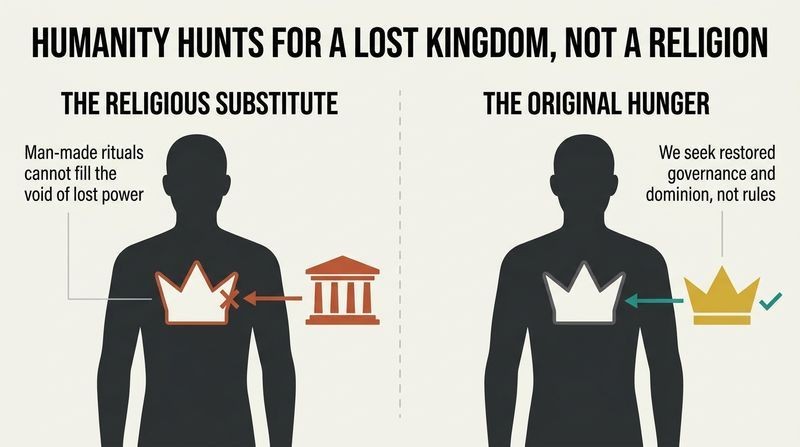
The core thesis reframes everything. Munroe argues that Genesis 1:26, where God grants man dominion over the earth, is the master key. The Hebrew word translated dominion, mamlakah, means kingdom, sovereign rule, or royal power. Man's first gift was governmental, not spiritual real estate. When Adam rebelled, he forfeited rulership over earth, not a ticket to heaven.
Religion is the symptom, not the cure. Munroe claims every human, even the atheist, is religious because all people chase power and purpose to fill a vacuum left by that lost dominion. Religion is what man invents while searching. It preoccupies him but never satisfies because the hunger is for governance restored, not rituals performed. This is why, he insists, no single religion satisfies all six billion people.
What's striking is how Munroe collapses the sacred/secular divide that structures modern Western thought. By defining religion functionally (any belief system regulating behavior), he echoes sociologists like Emile Durkheim and even Yuval Noah Harari, who treat capitalism and humanism as belief systems. The move is clever but contestable: labeling everyone religious risks making the term so broad it loses analytic bite. Still, the diagnosis that people mistake ritual for restored agency resonates with existential psychology. Viktor Frankl argued meaning, not pleasure, drives humans. Munroe adds a political dimension: humans crave not just meaning but rulership, the power to govern their own circumstances.
Reorder your life so pursuing God's government precedes chasing survival
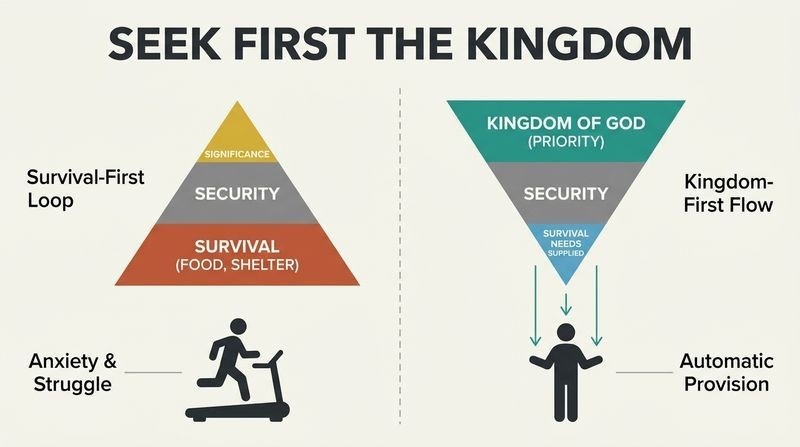
Priority is the currency of a life. Munroe leans on Jesus's instruction to seek first the kingdom, arguing that time is the true measure of life and priorities dictate how it is spent. The greatest tragedy, he says, is not death but a busy life aimed at the wrong target.
This inverts Maslow's hierarchy. Psychologist Abraham Maslow ranked human needs from water, food, and shelter up to self-actualization and significance. Munroe notes that most religions simply promise to secure these base needs, keeping humans trapped in survival mode. Jesus flips the pyramid: stop making food, drink, and clothing your primary motivators, and instead prioritize alignment with heaven's government. The promise is that meeting that priority causes every lower need to be supplied automatically, relieving the anxiety of the survival treadmill.
The deliberate inversion of Maslow is the intellectual heart of this section, and it is bolder than it first appears. Maslow's pyramid is descriptive (how humans actually behave), while Munroe's claim is prescriptive and counterintuitive (how they ought to). Behavioral economics supports part of his case: chronic scarcity, as Sendhil Mullainathan and Eldar Shafir showed, taxes cognitive bandwidth and traps people in short-term thinking. Reorienting toward a higher purpose can indeed reduce that tax. The vulnerability is the promise of automatic provision, which is hard to falsify and can breed passivity. Munroe would counter that citizenship carries responsibility, not merely entitlement, a tension worth holding.
Every human government is a defective substitute for kingdom rule
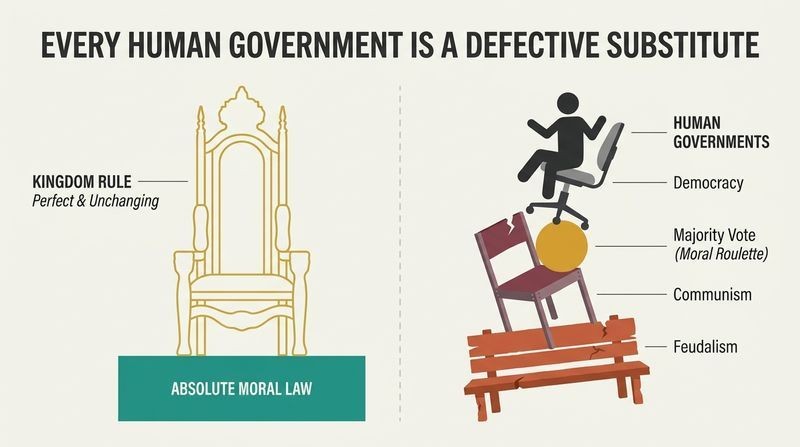
Man keeps rebuilding a throne he cannot fill. Munroe surveys feudalism, dictatorship, communism, socialism, and democracy, concluding all are inferior imitations of the original kingdom concept. Feudalism made land the source of power, birthing landlords and kings. Communism, he argues, is an attempt to build a kingdom without righteousness, seizing property while legislating a love that cannot be forced.
Even democracy has a fatal flaw. He grants democracy is the best civil government humans have devised, with its checks and balances protecting people from tyranny. But its foundation, majority rule, places morality at the mercy of the vote. When the majority becomes the source of truth, society worships itself, reviving humanism. Democracy without accountability to a moral code above the people, he warns, is moral roulette.
Munroe's critique of democracy echoes an ancient anxiety: Plato feared democracy would decay into mob rule and then tyranny. The observation that majorities can vote for injustice is genuinely important and animates modern debates about constitutional limits and minority rights. Where the argument strains is its idealization of benevolent monarchy. History offers few righteous kings and many Neros, a fact Munroe acknowledges by insisting only a divine king qualifies. Critics would note this makes the comparison unfair: he pits ideal theocracy against real democracies. A fairer contest would weigh actual outcomes. Still, his point that no system transcends the flawed humans running it lands with force.
You are a colonist of heaven planted to import its culture
Colonization is heaven's strategy for earth. Munroe's central metaphor, drawn from his Bahamian childhood under British rule, is that God intended earth to be a colony of heaven. A colony is citizens of one country settling foreign territory to influence it with their homeland's values and laws, while remaining subject to the parent government. God never planned to relocate personally; His influence would rule through delegated representatives made in His image.
See the end before the beginning. Trained as an artist, Munroe stresses grasping the big picture, God's original intent, rather than getting lost in disconnected phases. The colonial charter is Genesis 1:26-28: fill the earth, subdue it, rule it. This, he says, is a government document, not a religious one, defining the King's intent to make earth look like heaven.
The colonization frame is Munroe's most original contribution and also his most historically loaded. He redeploys a word associated with exploitation and turns it into a theology of cultural influence, which will unsettle readers attuned to colonialism's brutal record. Yet the underlying idea, that a community can embody an alternative culture within a host society, has deep roots. Sociologist Peter Berger described religious communities as plausibility structures maintaining a distinct worldview. Diaspora studies describe exactly this dual belonging. The autobiographical honesty is disarming: Munroe admits he still wears ties in tropical heat, drinks tea, and drives on the left, showing how thoroughly a governing culture colonizes the mind.
A king owns everything, so citizens are stewards who own nothing
Kingship equals authority; lordship equals ownership. Munroe distinguishes the two words that define a monarch. King relates to dominion (power to rule), while lord relates to domain (the territory owned). In a true kingdom there is no private property; the king personally owns land, resources, animals, and people. Earth, by right of creation, is heaven's crown land, given to humans as stewards, never owners.
This dissolves scarcity anxiety. If the King owns everything and citizens merely manage it, then hoarding, jealousy, and fear of shortage make no sense. Munroe argues that confessing Jesus is Lord means surrendering all ownership claims, which paradoxically grants full access to the King's infinite resources. He frames a kingdom's welfare and commonwealth (wealth held in common) as beautiful concepts impossible in democracy, where the gap between haves and have-nots persists.
The stewardship-not-ownership principle has surprising practical traction beyond theology. Behavioral research on the endowment effect shows humans irrationally overvalue what they possess and cling to it, generating exactly the anxiety Munroe describes. Reframing possessions as held in trust echoes both Stoic practice (Epictetus urged treating everything as borrowed, returnable at any moment) and modern minimalism. The commonwealth ideal, however, invites scrutiny. Munroe distinguishes it sharply from communism by insisting the difference is righteousness and voluntary submission rather than coercion. Whether shared ownership can avoid the free-rider and incentive problems that sank collectivist experiments is the perennial question his benevolent-king solution sidesteps rather than answers.
Treat the Bible as a constitution and legal contract, not devotional literature
The King writes the contract unilaterally. Munroe reframes scripture as the constitution of heaven's kingdom, the documented will, purpose, and intent of the King. Unlike the American constitution's We the people, God's begins with I, the Lord. Citizens contribute no input; Adam received the terms before he even existed. This means the document cannot be amended by its subjects, only by its author.
A will versus a testament. A will is desire held in the mind; a testament is that desire codified in writing so it can be defended in court. Munroe argues God commanded Moses and the prophets to write precisely so His covenant could be contested and verified. He predicts the great coming conflict is kingdom versus religion, because religious people keep trying to edit, water down, or reinterpret an unchangeable constitution to fit modern tastes.
Recasting scripture as constitutional law rather than devotion is rhetorically powerful and pedagogically useful, giving readers a concrete mental model. It parallels how legal scholars debate originalism versus living constitutionalism: Munroe is essentially a strict originalist who insists intent is fixed. That stance clarifies but also hardens. His flat refusal to offer personal opinions on contested moral issues, framing himself as an ambassador quoting his government, is a striking rhetorical device that resembles diplomatic protocol. Critics from within his own faith tradition would note that treating a diverse, multi-genre library assembled over centuries as a single unified legal code flattens enormous interpretive complexity that even the most literal readers cannot escape.
Obeying natural law protects your purpose the way water protects a fish
Laws are freedom's boundaries, not freedom's enemies. Munroe argues laws free us to thrive by defining a safe space, like traffic rules enabling flow rather than restricting it. He distinguishes natural law (built-in principles governing how creation functions) from written law. Birds need no lessons to fly; fish need no training to swim. Violation brings malfunction: a fish out of water dies not by external judgment but by breaking its design.
Written law appears only when natural law fails. If humans obeyed instinctively, no legal code would be needed. Rebellion corrupted the conscience, making generosity feel unnatural where it was once native. Munroe warns that whatever a society repeatedly encounters becomes a norm, and norms harden into law. Thus normalizing evil is a real danger, and God's laws exist to protect the whole community, since one person's violation ripples outward.
The distinction between natural and written law revives a venerable tradition running from Aquinas to the Enlightenment natural-rights theorists. Munroe's biological illustrations (fish, birds, seeds) are vivid but conflate two very different senses of law: descriptive regularities of physics and biology versus prescriptive moral commands. Gravity does not punish; it simply operates. Moral norms require agents who can choose otherwise. This is the is-ought gap David Hume famously flagged. That said, his sociological insight about normalization is sharp and empirically grounded. The mere-exposure effect in psychology confirms that repeated exposure breeds acceptance, and window-of-discourse theory (the Overton window) describes exactly how the unthinkable becomes policy over time.
Scripture gives you keys of the kingdom, but keys are useless unamed
Knowledge, not possession, unlocks power. Munroe compares believers to people holding a ring of unlabeled keys, owning scriptures they cannot apply. Jesus promised the keys of the kingdom, not keys to it, since citizens are already inside. Keys are principles and systems that operate under fixed laws. What looked like miracles to onlookers were, to Jesus, simply keys turned in the right locks, unlocking healing, provision, and peace.
Keys represent seven things: authority, access, ownership, control, authorization, power, and freedom. Munroe illustrates with the widow at Zarephath, whose jar of flour never emptied once she acted on the prophet's instruction, and the feeding of five thousand, where prayer (the key) unlocked heaven's warehouse. The kingdom's keys are counterintuitive: you gain by giving, rise by serving, and receive by releasing, the inverse of the world's grab-and-hoard logic.
The keys-as-principles framing is essentially an argument that spiritual life operates on discoverable, repeatable laws rather than arbitrary divine whim, a quietly rationalist theology. It resembles the self-help genre's insistence that success follows principles anyone can learn, from Napoleon Hill to Stephen Covey, whose habits Munroe's keys echo. The counterintuitive inversion (gain by giving) has genuine empirical support: research by Adam Grant in Give and Take shows givers often outperform takers over long horizons, and studies on prosocial spending link generosity to well-being. The risk in the keys metaphor is a mechanistic prosperity theology, where formulas guarantee outcomes. Munroe hedges by requiring alignment with the King's will, preserving mystery.
God will not intervene on earth without your permission through prayer
Dominion authority was legally transferred to humans. Munroe interprets binding and loosing (Matthew 18:18) not as spiritual warfare against demons but as governmental language: to bind means to prohibit, to loose means to permit. Because God delegated earth's rulership to humanity, He honors that jurisdiction and will not violate it uninvited. This reframes the ancient problem of evil: God does not stop suffering unilaterally because this is not, currently, His direct domain.
Prayer is the invitation that authorizes divine action. Whatever citizens permit on earth, heaven permits; whatever they prohibit, heaven blocks. This makes humans responsible for the quality of earthly management, its evils reflecting our governance, not God's indifference. Munroe insists this demands a mental shift, the biblical repentance, meaning to change one's thinking from a scarcity worldview to a kingdom mindset of more than enough.
This is Munroe's boldest theological move, and it directly confronts theodicy, the problem of why a good, powerful God permits evil. By locating responsibility in delegated human authority, he shifts blame from God to humanity, a position with roots in free-will defenses articulated by thinkers like Alvin Plantinga. It grants humans startling dignity and agency but raises hard questions: does a God bound by His own delegation remain sovereign, and what of suffering caused by natural disasters no human permitted? Munroe's reading of binding and loosing as political rather than demonic is philologically defensible and refreshingly deflates sensationalist interpretations, grounding prayer in responsibility rather than magic.
Your citizenship activates now; religion's fatal trick is postponing it
You cannot appropriate what you postpone. Munroe's sharpest practical claim is that kingdom citizenship is a present reality, granted the moment of the new birth, which he reframes as naturalization into heaven's government. Religion, he argues, is the kingdom's greatest enemy precisely because it defers everything: you will be a citizen someday, you will have joy later, the reward comes after death. This keeps people defeated and destitute while their entitlements sit unclaimed.
Citizenship is invisible, dual, and cultural. Like his Bahamian identity, invisible to a stranger until he spoke and revealed an accent, kingdom citizenship shows through language, values, and behavior, not outward badges. Citizens hold dual passports, living in the world but registered in heaven. The church, properly understood, is not a religious building but an embassy, providing aid, training, and resources to citizens operating in foreign territory.
The now-versus-later distinction taps a real psychological lever. Research on delayed gratification and learned helplessness suggests that believing rewards are perpetually deferred can breed passivity and diminished agency, precisely Munroe's charge against deferral-focused religion. His embassy metaphor for the church is genuinely fresh and reframes institutional purpose from worship venue to equipping station. The invisible-citizenship-revealed-by-accent illustration is memorable and pedagogically elegant. A fair challenge: many traditions hold a both/and view (the kingdom is already present and not yet fully consummated), a tension in the New Testament itself. Munroe leans hard on the already, which energizes but risks underplaying the genuine incompleteness his own new-earth passages acknowledge.
Never approach the King empty-handed, because giving obligates royal response
Giving is kingdom physics, not charity. Munroe frames generosity through royal protocol: one never visits a king without a gift, and a king's glory lies in his power to out-give. When the queen of Sheba lavished gold and spices on Solomon, he returned even more from his royal bounty. Giving places a demand on the king's wealth, obligating a response that exceeds the gift. Applied to heaven, giving to God attracts His infinite wealth back to the giver.
The gift must be worthy and heartfelt. King David refused to offer sacrifices that cost him nothing, insisting on paying full price for the threshing floor. The quality and attitude of a gift reveal the giver's true estimate of the King's worth, the root meaning of worship (worth-ship). The ultimate gift the King seeks is not money but a surrendered heart and life.
The reciprocity-of-giving principle is anthropologically robust. Marcel Mauss's classic study The Gift documented how gift exchange creates binding obligations across nearly every human culture, exactly the dynamic Munroe describes as royal protocol. The insight that generosity attracts return has support in network and reputation research. The obvious hazard, one Munroe partly anticipates, is transactional prosperity theology: giving as a lever to extract wealth from God. His safeguards (the gift must be heartfelt, the ultimate gift is one's life, and giving should expect no return) pull against the very mechanism he describes, creating a productive tension. The worth-ship etymology is a genuinely illuminating reframe of what worship fundamentally means.
Analysis
Kingdom Principles is a work of theological reframing that reads more like political philosophy than devotional writing. Munroe's project is singular: to argue that the entire biblical narrative has been misfiled under religion when it should be understood as governance. His central, unifying claim, that Adam lost a kingdom rather than a heaven, cascades through every chapter, generating a coherent, internally consistent system built on the vocabulary of monarchy, colonization, citizenship, and law.
The book's intellectual force comes from its willingness to make religion itself the antagonist, a provocative stance from a Christian minister. This positions Munroe closer to the anti-institutional strain of thinkers who distinguish authentic message from corrupted apparatus. His Bahamian upbringing under British colonial rule is not incidental decoration but the experiential engine of the entire framework, giving him intuitive access to kingdom mechanics that Western, democracy-raised readers lack. This is genuinely valuable: he defamiliarizes concepts (lord, crown land, commonwealth, welfare) that modern readers gloss over.
The weaknesses are structural. The idealized benevolent monarchy is compared against real, flawed democracies, an asymmetry that stacks the deck. The promise of automatic provision and wealth-attraction skirts prosperity theology and resists falsification. Treating a multi-genre, centuries-spanning library as a single unamended legal constitution flattens interpretive complexity. And the repeated fourteen-point and seven-point lists, while pedagogically sticky, become repetitive across twelve chapters covering overlapping ground.
Yet the book's best ideas transcend its tradition. The inversion of Maslow, the reframing of prayer as jurisdictional authorization that reshapes the problem of evil, the stewardship-versus-ownership antidote to scarcity anxiety, and the now-not-later urgency of activated citizenship all offer portable mental models. Munroe writes with the conviction of someone who has organized his entire life around a single idea, and that coherence, whether or not one shares his premises, makes the argument memorable and unusually clarifying.
Review Summary
Kingdom Principles by Myles Munroe receives overwhelmingly positive reviews, with readers praising its transformative impact on their understanding of God's kingdom. Many describe it as life-changing, offering clear and practical principles for living as kingdom citizens. Readers appreciate the book's insights into spiritual governance, personal potential, and the role of Christians in society. Some found initial chapters challenging but ultimately rewarding. The book is lauded for its clarity, wisdom, and ability to renew mindsets, with many recommending it as essential reading for Christians seeking to understand and apply kingdom concepts in their lives.
People Also Read


FAQ
1. What is "Kingdom Principles: Preparing for Kingdom Experience and Expansion" by Myles Munroe about?
- Rediscovering the Kingdom Concept: The book explores the original concept of the Kingdom of God as the central message of the Bible, distinct from religion, and explains how humanity lost and can rediscover this concept.
- Contrast with Religion and Government: Munroe contrasts the Kingdom of God with human governments and religions, arguing that only the Kingdom can address humanity’s deepest needs for purpose and power.
- Practical Guide to Kingdom Living: The book provides practical principles and concepts for understanding, entering, and experiencing the Kingdom of God in daily life.
- Restoration of Original Purpose: It emphasizes that mankind was created for dominion and rulership on earth, and that Jesus came to restore this lost Kingdom, not to establish a new religion.
2. Why should I read "Kingdom Principles" by Myles Munroe?
- Addresses Life’s Big Questions: The book tackles fundamental questions about purpose, power, peace, and the failures of religion and government to solve human problems.
- Offers a Non-Religious Solution: Munroe presents the Kingdom of God as a practical, non-religious answer to humanity’s search for meaning, fulfillment, and societal harmony.
- Equips for Effective Living: Readers gain actionable principles for prioritizing life, understanding their role in God’s plan, and experiencing the benefits of Kingdom citizenship now.
- Challenges Traditional Thinking: The book encourages readers to rethink their understanding of Jesus, the Bible, and the nature of God’s government, leading to personal and societal transformation.
3. What are the key takeaways from "Kingdom Principles" by Myles Munroe?
- Kingdom, Not Religion: The Bible’s main message is about a King and His Kingdom, not about establishing a religion or rituals.
- Priority of the Kingdom: God’s number-one priority for humanity is to seek, understand, and enter the Kingdom of Heaven, aligning with His righteousness.
- Kingdom Concepts: The book details foundational concepts such as kingship, lordship, territory, constitution, law, keys, citizenship, culture, and giving.
- Practical Application: Understanding and applying Kingdom principles leads to fulfillment, purpose, and the ability to influence the world with Heaven’s culture and values.
4. How does Myles Munroe define the Kingdom of God in "Kingdom Principles"?
- Sovereign Rule of God: The Kingdom of God is defined as the governing influence of a King (God) over His territory, impacting it with His will, purpose, and intent.
- Not a Religion: Munroe emphasizes that the Kingdom is not a religious system but a government with laws, culture, and citizenship.
- Heaven’s Government on Earth: The Kingdom is God’s administration and jurisdiction, aiming to bring Heaven’s influence and order to earth through mankind.
- Restoration of Dominion: The Kingdom involves restoring humanity’s original mandate to rule and manage the earth as God’s representatives.
5. What is the difference between religion and the Kingdom of God according to "Kingdom Principles"?
- Religion as Substitute: Religion is described as humanity’s attempt to fill the void left by the loss of the Kingdom, focusing on rituals, rules, and escaping earth.
- Kingdom as Empowerment: The Kingdom empowers people to influence and manage earth, focusing on bringing Heaven’s will to earth rather than escaping to Heaven.
- Religion Divides, Kingdom Unites: Religion often leads to division, conflict, and separatism, while the Kingdom is meant to unite humanity under God’s original purpose.
- Practical vs. Ritualistic: The Kingdom is about practical living, authority, and purpose, whereas religion is preoccupied with traditions and future promises.
6. What are the main Kingdom concepts explained in "Kingdom Principles" by Myles Munroe?
- Kingship: Understanding the nature, authority, and role of a king, with Jesus as the ultimate King.
- Lordship: The concept that a king owns everything in his domain, and that God’s ownership is absolute.
- Territory: Every kingdom requires land or territory; mankind’s destiny and authority are tied to earth.
- Constitution and Law: The Bible is presented as the Kingdom’s constitution, with God’s laws protecting and guiding citizens.
- Keys: Principles and systems (not literal keys) that unlock the benefits and power of the Kingdom.
- Citizenship: The privilege, rights, and responsibilities of being a citizen of God’s Kingdom, not just a member of a religion.
- Culture: The values, behaviors, and standards that reflect Heaven’s influence on earth.
- Giving: The principle of honoring the King through giving, which attracts the King’s favor and resources.
7. How does "Kingdom Principles" by Myles Munroe explain the concept of kingship and lordship?
- Kingship: A king’s authority is inherent, not given by people; Jesus is King by birthright and divine authority.
- Lordship: A king is also a lord, meaning he owns everything in his domain; God’s lordship means He owns all creation.
- Absolute Authority: In a kingdom, the king’s word is law, and his authority is absolute and unchangeable.
- Implications for Believers: Recognizing Jesus as Lord means total obedience and relinquishing personal ownership, living as stewards rather than owners.
8. What is the significance of territory and land in "Kingdom Principles" by Myles Munroe?
- Validation of Kingship: Land or territory is essential for a king’s legitimacy; without territory, there is no kingdom.
- Human Destiny: God created earth before man to provide a domain for mankind’s rulership; our destiny is tied to managing and stewarding the earth.
- Restoration of Dominion: Jesus came to restore humanity’s lost dominion over earth, not just to offer salvation for Heaven.
- Practical Wealth: Real wealth is in land (real estate), and God’s blessings are often tied to territory and stewardship.
9. How does "Kingdom Principles" by Myles Munroe describe the Kingdom’s constitution and laws?
- Bible as Constitution: The Bible is the written constitution of the Kingdom, expressing the King’s will, intent, and promises for His citizens.
- Unchangeable by Citizens: Only the King can change the constitution; citizens cannot amend or debate it.
- Laws Protect Rights: Laws are established to protect the rights, privileges, and standards set forth in the constitution.
- Natural and Written Law: God’s laws are both inherent in creation (natural law) and written for humanity’s guidance and protection.
10. What are the "keys of the Kingdom" in "Kingdom Principles" by Myles Munroe, and how do they work?
- Principles and Systems: Keys represent principles, laws, and systems that unlock the power and benefits of the Kingdom in practical life.
- Authority and Access: Possessing keys means having authority, access, ownership, control, and freedom within the Kingdom.
- Knowledge is Essential: Knowing how to use the keys (understanding Kingdom principles) is crucial for effective Kingdom living.
- Counterintuitive Nature: Kingdom keys often operate opposite to worldly logic (e.g., giving to receive), requiring a renewed mind and faith.
11. How does "Kingdom Principles" by Myles Munroe explain Kingdom citizenship and culture?
- Citizenship vs. Membership: Citizenship is a legal status with rights and privileges, unlike religious membership which is based on affiliation.
- Immediate and Present: Kingdom citizenship begins immediately upon new birth (being “born again”), not postponed to the future.
- Dual Citizenship: Believers are citizens of both Heaven and their earthly nation, with Heaven’s jurisdiction and resources available now.
- Culture of Heaven: Kingdom culture is manifested through values, behaviors, priorities, and standards that reflect God’s nature and influence on earth.
12. What is the principle of giving to the King in "Kingdom Principles" by Myles Munroe?
- Royal Protocol: Giving is a fundamental principle in honoring a king; one never approaches a king without a gift.
- Reciprocity and Favor: Giving to the King places a demand on His wealth and obligates Him to respond with greater generosity.
- Expression of Worship: Giving is an act of worship, expressing the giver’s value and honor for the King.
- Stewardship, Not Ownership: All giving acknowledges God’s ownership of everything, and positions the giver to receive more from the King’s abundance.
About the Author
Other books by Myles Munroe

Download PDF
Download EPUB
.epub digital book format is ideal for reading ebooks on phones, tablets, and e-readers.








































