


Key Takeaways
Misuse is inevitable when you don't know what something was made for
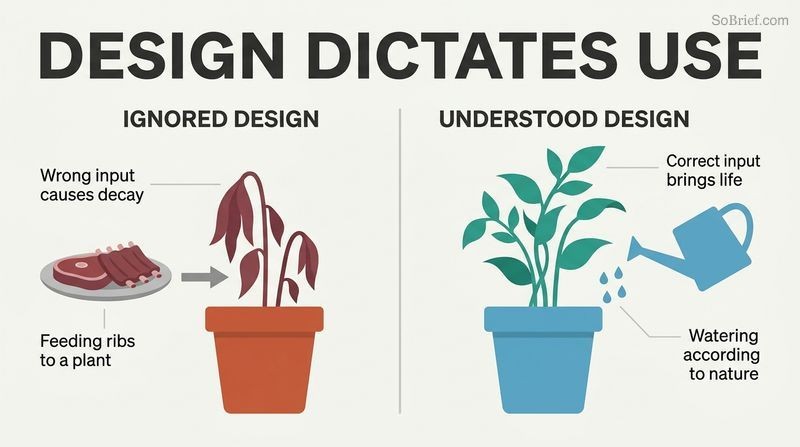
The book's master key. Munroe argues that women across every culture have been devalued for one underlying reason: humanity forgot God's original purpose for them. His governing principle is that when you don't know how something is meant to function, you will misuse and eventually abuse it. He compares it to filling a car's gas tank with water because that is what quenches your own thirst, or trying to feed a houseplant a plate of ribs. The thing breaks down, and you blame the thing.
Applied to women, this means legislation and protest cannot fix the problem at its root. The 2000 UN AIDS report he cites (women were 52% of AIDS deaths) and the situation of women in Afghanistan are, to him, symptoms. The disease is lost knowledge of design. Recover the purpose, he claims, and right treatment follows naturally.
What's compelling is the diagnostic move: Munroe reframes a moral problem (mistreatment) as an epistemic one (ignorance of purpose). This echoes Aristotle's teleology, where a thing's good is defined by its function or telos. The danger is circularity. If men define a woman's purpose, then declare that purpose authoritative, ignorance conveniently justifies whatever role they prefer. Munroe partly anticipates this by locating purpose in God rather than men, but the interpretive gatekeeping remains. The framework is powerful for objects with clear designers and weaker for persons, whose purposes are contested precisely because they are not manufactured.
Demanding your rights from someone admits they own them
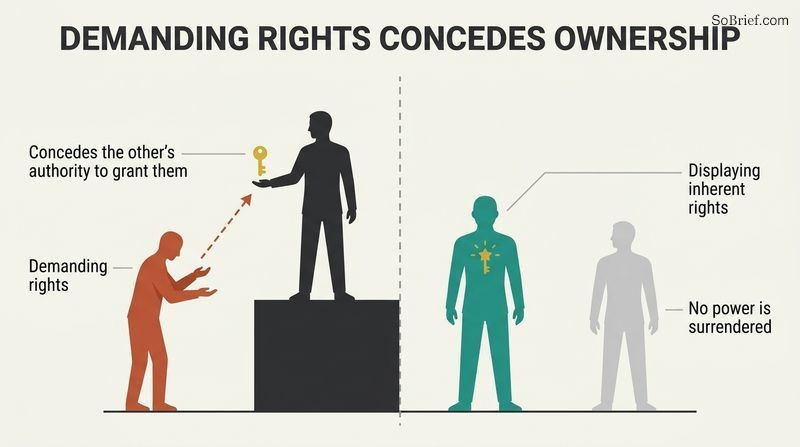
A provocative reframe of activism. Watching the equal rights marches of the 1960s as a college student, Munroe noticed something that bothered him. If you have to ask another person or group for something, you are conceding that they possess it. To demand equality from men, he argues, is to hand men the power to grant or withhold it, which is itself an act of self-devaluation.
His alternative is to display rights you already possess rather than beg for them. He cites Joseph, who declared himself free while jailed and ended up running the prison, and Jesus telling Pilate that no one could take a life he did not surrender. The political punchline: laws cannot grant rights, they can only acknowledge rights that are inherent and God-given. He extends the logic to race relations as well.
This is a dignity-first philosophy with real psychological force, resonant with Stoic teaching that no one can degrade you without your consent, and with Frederick Douglass and later Black-power rhetoric of self-possession. Yet it has a serious blind spot. Rights in the legal sense really are enforced by institutions, and a woman denied a vote or a paycheck cannot simply will those into existence by attitude. The suffrage movement Munroe slightly dismisses delivered concrete protections. Inner freedom and structural freedom are different goods, and treating the first as a substitute for the second can quietly excuse those who hold the levers from acting.
God already made men and women equal, so stop voting on it
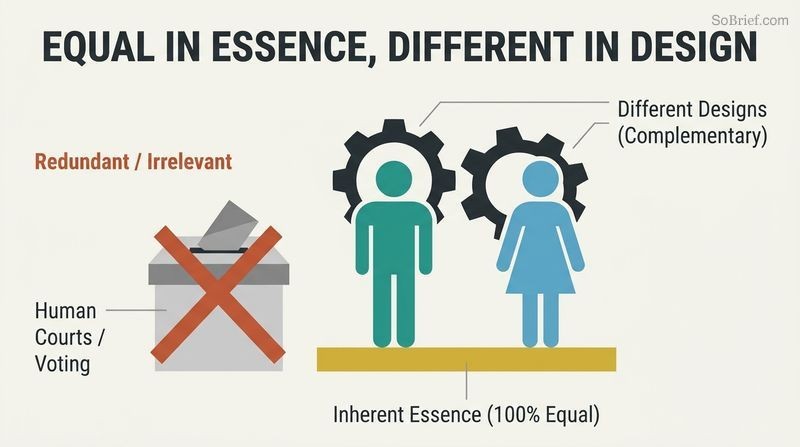
Equal in essence, different in design. Munroe insists equality is not something a parliament or court decides, because creation settled it. His core formula runs throughout: purpose determines nature, and nature determines needs. Men and women share the same essence yet carry different designs because they were built for complementary functions.
He attacks two errors at once. One says different means inferior (used to subordinate women). The other says equal means identical (used by some activists to deny all difference). Both, he argues, miss the point. He reaches for symphony and sports analogies: a violinist and an oboist, a breaststroke and backstroke swimmer in a medley relay, are not ranked against each other but needed together. Difference, properly understood, is mutual strength, not hierarchy of worth.
The equal-but-different position is classic complementarian theology, and Munroe states it more generously than many. The orchestra metaphor is genuinely useful against the inferiority reading. The harder question is whether asserted differences track design or merely socialization, a debate behavioral science has not closed. Critics from de Beauvoir onward warn that complementarity language historically smuggled hierarchy back in through the side door: separate but equal rarely stayed equal. The test is functional reversibility. If the differences truly imply no ranking, then either party could occupy either role without loss, which the book's later headship claims do not fully allow.
You are a genderless spirit living in a male or female house
The anthropology beneath everything. Munroe makes a striking theological claim from Genesis. God first created man as spirit, drawn out of God's own being, with no gender at all. Only afterward did God place that spirit-man into two physical forms, which Munroe calls houses: the male and the female. Spirits, he says, have no sex; the Bible never speaks of a male or female spirit.
The consequences are large. Before God, a woman's spiritual standing never depends on her husband; she worships, prays, and answers to God directly. A wife cannot ride her husband's faith into heaven, and a husband cannot outsource his prayer life to a devout wife. He uses this to argue that a woman can preach, because the spirit within her, not her body, addresses God. Galatians 3:28, neither male nor female, refers to this inner person.
This move is theologically clever and surprisingly egalitarian at the root. By grounding worth in a genderless spirit, Munroe gives every woman unmediated access to God and an argument for women preaching, both pointed claims in conservative church culture. It resembles Gnostic and certain mystical traditions that prize a sexless inner self, though Munroe stops short of devaluing the body. The tension readers should notice is that he builds full spiritual equality on the inner person, then reintroduces functional hierarchy at the level of the body and household, leaving the relationship between the two layers doing a lot of unexamined work.
The Fall turned shared dominion into a man's urge to dominate
Domination is a bug, not a feature. In Munroe's reading of Genesis, God gave dominion over the earth jointly to male and female. Ruling over each other was never the plan; ruling the world together was. The Fall broke that symmetry. He is emphatic that God never cursed the woman. God cursed the ground. Childbearing itself was always part of the design and is therefore no curse; only the pain in it resulted from the Fall.
What God described to Eve, he argues, were natural consequences, not punishments: her desire would turn toward her husband, and he would rule over her. The Hebrew, Munroe says, means regulate more than boss. The man's instinct to dominate and the woman's tendency to endure almost anything to keep him are both distortions of the original equality, not God's intent.
Distinguishing description from prescription in Genesis 3 is a respected interpretive strategy, shared by many egalitarian theologians who argue patriarchy is a symptom of brokenness rather than a divine blueprint. It lets Munroe condemn male domination as sin while preserving order. Anthropologically, his claim that women endure abuse out of a deep attachment drive overlaps uneasily with trauma-bonding research, which explains such endurance through fear, economic dependence, and intermittent reinforcement rather than an inborn longing. Framing endurance as feminine nature risks naturalizing what is often coerced, even as Munroe clearly intends to indict the abuser, not the abused.
Give a woman anything and she returns it multiplied
The incubator principle. Munroe's most memorable image is the woman as incubator. Beyond the physical womb, he argues she carries emotional, mental, and spiritual wombs. Her nature is to receive something, nurture it, transform it, and give it back larger than it arrived. Give her a house and she returns a home; give her groceries and she returns a meal; give her an idea and she returns a developed plan.
The principle cuts both ways, which is the warning. Feed her bitterness or a careless insult and she will incubate that too, then deliver it months or years later, fully grown, to a baffled husband who forgot he ever planted it. This, he says, is why women remember the date and the dress while men forget the fight. Whatever a man consistently gives a woman, he eventually receives back amplified.
As metaphor this is rich and practically useful: it reframes casual male carelessness as planting seeds with delayed, compounding consequences, a genuinely good prompt for thoughtfulness. The memory observation gestures at real findings that emotional salience strengthens encoding, and that women on average report more vivid autobiographical and relational memories. The risk is essentialism. Casting receptivity and multiplication as the female essence can quietly cast initiative and origination as male, boxing both sexes. Read as a description of a relational dynamic rather than a fixed law of nature, the incubator image keeps its wisdom without the determinism.
She speaks her feelings; he speaks his thoughts
Two operating systems for one conversation. Munroe casts the woman as an emotional feeler and the man as a logical thinker. A woman processes facts and feelings almost simultaneously, like reading a grid; a man tends to think in a straight line toward a goal. He attributes this to brain wiring, claiming women have denser connections between hemispheres while men must shift gears between logic and emotion.
The practical payoff is real. When a wife lists everything overwhelming her, she often wants empathy, not a husband rattling off solutions she keeps rejecting. When a man stays calm about an unpaid mortgage, he is not indifferent; he is silently scheming a fix. She expresses what she feels; he expresses what he thinks. Munroe's counsel is to translate: men should voice feelings, women should give men information rather than tears, and both should assume good motive before reacting.
The relational advice is sound and overlaps heavily with Gottman's research and with the popular Mars-Venus literature of the same era: pursue-and-fix versus seek-empathy mismatches genuinely wreck conversations. The neuroscience, however, has aged poorly. The claim that women's corpus callosum is categorically denser, driving multitasking, has been largely undercut by later imaging studies showing enormous overlap and tiny average differences. The behavioral pattern may be real and largely learned. The lesson survives without the biology: treat your partner's processing style as different rather than defective, and translate into the channel they can actually receive.
Love is a woman's fuel; respect is a man's oxygen
Pair the needs, not assume them. Munroe's counseling thesis is that spouses fail because they give what they themselves want instead of what the other is built to need. He pairs three core needs on each side. A woman's primary needs: love, conversation, and affection. A man's: respect, recreational companionship, and sex.
Key misreadings he names: a man thinks providing a house proves love, when love means cherishing, calling, touching, and expressing affection consistently. A wife thinks loving her husband meets his deepest need, when he is actually starving for admiration and respect. Affection, he stresses, is the environment; sex is the event, and rushing to the event without the environment leaves a woman feeling used. He frames it as a virtuous cycle: meet the other's need first and yours tends to get met in return.
This love-versus-respect dichotomy became a staple of Christian marriage teaching and was popularized in Eggerichs's Love and Respect. There is partial empirical support: studies on perceived partner responsiveness show feeling understood and valued predicts relationship satisfaction for both sexes. The weakness is the clean gender split. Plenty of women crave respect and plenty of men crave tenderness, and prescribing needs by sex can leave the off-pattern spouse feeling unseen. The durable insight is the cycle of first giving, which mirrors the reciprocity principle in social psychology: meeting a partner's stated need is among the strongest predictors of getting yours met.
Women lead by influence, the quieter and more dangerous power
Reframing the leadership question. Munroe argues the real question is not whether women should lead but how. He distinguishes position-power, which announces itself through titles and commands and which he assigns to the male, from influence-power, which works silently and which he assigns to the female. A mother who only looks at a child gets compliance a father has to shout for. The hand that rocks the cradle, he notes, rules the world.
He insists Scripture endorses female leadership: God names Miriam alongside Moses and Aaron as one of three leaders sent to Israel. The Fall, he says, corrupted influence-power, which is why the serpent targeted Eve rather than Adam. Satan attacked the influence to topple the position. Redemption through Christ restores women to full partnership, modeled by the church, called Christ's influential bride, entrusted with his work on earth.
The position-versus-influence frame names something real that organizational research confirms: informal influence often outweighs formal authority, and women have historically wielded power through networks and persuasion when titles were closed to them. But the framing carries a sting Munroe half-acknowledges by calling influence dangerous. Assigning women influence and men position can rationalize keeping women out of formal authority, treating the workaround as the design. His Miriam and church-as-bride arguments push the other way, toward genuine partnership. The unresolved tension is whether influence-power is a celebration of female strength or a consolation prize for being denied the title.
Anchor identity in God before doing, or doing devours being
The Proverbs 31 correction. Munroe closes by rescuing the famous Proverbs 31 woman from intimidation. Readers often see an impossible superwoman juggling household, business, charity, and family, and conclude they could never measure up. He reads her differently: she is a doer and multitasker, yes, but her foundation is that her first place is in God. Her worth is received, not earned through output.
This loops back to his opening. Having argued Christ frees women from the inferiority imposed after the Fall, he warns of a new trap: women oppressing themselves by proving worth through ceaseless activity. The world says justify your value by accomplishment; the book says accept your value in the One who made your spirit out of his own love. Strength for the tasks flows from identity in Christ, not the reverse, so the busiest woman must guard her relationship with God first.
This is a shrewd pastoral pivot, anticipating burnout culture decades before it became a wellness cliche. The diagnosis that achievement can become a self-imposed bondage maps onto research on contingent self-worth, where basing esteem on performance predicts anxiety and depletion. Munroe's antidote, unconditional worth grounded in being loved rather than producing, parallels secular therapeutic moves toward self-compassion and intrinsic worth. The closing also quietly reframes the whole book: after extensive talk of roles and functions, he insists a woman's deepest identity is not a role at all but a beloved relationship, which softens some of the earlier functional categorizing.
Analysis
Munroe's 2001 book is a thesis-driven work of Pentecostal complementarian theology dressed in the language of purpose and design. Its engine is a single syllogism applied relentlessly: purpose determines nature, nature determines needs, and ignorance of purpose guarantees abuse. From this he builds an anthropology (a genderless spirit housed in male and female bodies), a fall narrative (domination as distortion, not design), and a relational psychology (enhancer, reflector, life-giver; emotional feeler versus logical thinker; love versus respect). The structure is genuinely systematic, which is both its strength and its hazard. Once the teleological premise is granted, the conclusions cascade with apparent inevitability, and the premise itself, that human beings have fixed manufacturer specifications knowable through one interpretive tradition, is exactly what is contestable.
The book's most durable value is pastoral and practical rather than doctrinal. Its insistence that spouses fail by projecting their own needs, its translate-don't-react communication coaching, and its warning against achievement-based self-worth anticipate findings in relationship science and clinical psychology. The dignity argument, that worth is inherent and not granted by institutions, has real Stoic and abolitionist lineage.
The liabilities are equally clear. The brain-science claims about hemispheric wiring are dated and largely unsupported. The rights critique, that demanding equality concedes ownership, can rationalize institutional passivity. And the equal-but-different architecture repeatedly resolves toward male headship, leaving the gap between asserted equality and functional hierarchy underexplained. Read uncritically, the framework can naturalize subordination it elsewhere condemns.
The fairest reading takes Munroe as a reformer within a conservative tradition, pushing his audience toward valuing women, condemning male domination as sin, defending women preaching, and affirming female leadership through Miriam and the church-as-bride. He is more egalitarian than his framework's logic permits, and the friction between his radical spiritual equality and his traditional household order is the book's defining, unresolved tension.
Review Summary
Understanding the Purpose and Power of Woman receives overwhelmingly positive reviews, with readers praising its insightful exploration of women's roles and purpose from a biblical perspective. Many find it enlightening for both men and women, highlighting gender equality while acknowledging differences. Readers appreciate the book's emphasis on women's influence and leadership potential. Some note its impact on their spiritual growth and relationships. A few readers mention repetitiveness or disagreements with certain points, but overall, the book is highly recommended for its transformative message about women's value and purpose.
People Also Read










FAQ
What's "Understanding The Purpose And Power Of Woman" about?
- Exploration of Womanhood: The book delves into the purpose and power of women as intended by God, exploring their roles, nature, and contributions to society.
- Biblical Perspective: It provides a biblical perspective on the creation of women, their equality with men, and their unique design and purpose.
- Restoration and Redemption: The book discusses how women can be restored to their original purpose through redemption in Christ.
- Empowerment and Leadership: It emphasizes the importance of women in leadership roles and their influence in various spheres of life.
Why should I read "Understanding The Purpose And Power Of Woman"?
- Gain Insight: It offers deep insights into the biblical understanding of womanhood, which can be enlightening for both women and men.
- Empowerment: The book empowers women by affirming their value, purpose, and potential as designed by God.
- Relationship Improvement: It provides guidance on improving relationships between men and women by understanding their unique roles and needs.
- Spiritual Growth: Reading the book can enhance spiritual growth by aligning one's understanding of gender roles with biblical teachings.
What are the key takeaways of "Understanding The Purpose And Power Of Woman"?
- Equality and Difference: Women and men are equal in God's eyes but have different roles and designs that complement each other.
- Purpose and Design: A woman's purpose is intricately linked to her design, which includes being an enhancer, reflector, and life-giver.
- Influence and Leadership: Women possess influence-power, which is a potent form of leadership that should be used for good.
- Restoration through Christ: Through Christ, women are restored to their original purpose and partnership with men.
What are the best quotes from "Understanding The Purpose And Power Of Woman" and what do they mean?
- "A woman's place is in God." This quote emphasizes that a woman's identity and purpose are rooted in her relationship with God.
- "If you don't know how something is meant to function, you will misuse or abuse it." It highlights the importance of understanding God's design for women to prevent misuse and abuse.
- "The woman is an incubator." This metaphor illustrates a woman's ability to nurture and develop what she receives, whether ideas, relationships, or life itself.
- "Influence-power is a tremendous gift from God." It underscores the significant impact women can have through their natural ability to influence.
How does Myles Munroe define the purpose of women in the book?
- Companionship and Help: Women were created to be companions and helpers to men, sharing in the vision and responsibilities of life.
- Enhancer Role: Women enhance what they receive, whether it be ideas, relationships, or resources, making them vital to the fulfillment of shared goals.
- Reflector of Love: Women are designed to receive and reflect love, which is essential for their fulfillment and the health of relationships.
- Life-Giver: Women have the unique ability to conceive, nurture, and bring forth life, both physically and metaphorically.
What is the significance of the "Proverbs 31 Woman" in the book?
- Model of Womanhood: The Proverbs 31 Woman is presented as an ideal model of what a woman can achieve when she fulfills her God-given purposes.
- Multitasker and Leader: She is depicted as a multitasker who manages her home, engages in business, and contributes to her community.
- Character and Faith: Her strength and dignity come from her character and faith in God, which are central to her identity and actions.
- Balance of Being and Doing: The Proverbs 31 Woman exemplifies the balance between being in God and doing for others, highlighting the importance of inner spiritual life.
How does the book address the issue of women in leadership?
- Biblical Endorsement: The book argues that God endorses women in leadership, as seen in biblical examples like Miriam, who led alongside Moses and Aaron.
- Influence-Power: Women lead through influence-power, which is as significant as the position-power typically associated with men.
- Restoration through Christ: Christ's redemption restores women to their leadership roles, allowing them to exercise their influence for God's purposes.
- Cultural Context: The book discusses how cultural contexts have historically limited women's leadership but emphasizes that biblical principles support their roles as leaders.
What does Myles Munroe say about the communication styles of women and men?
- Emotional vs. Logical: Women are described as emotional feelers, processing information with both their hearts and minds, while men are logical thinkers.
- Complementary Differences: These differences are meant to complement each other, with women providing emotional insight and men offering logical direction.
- Communication Challenges: Misunderstandings arise when these styles clash, but understanding and valuing each other's perspectives can improve communication.
- Practical Advice: The book offers practical advice for women and men to communicate effectively by recognizing and respecting their distinct styles.
How does the book explain the emotional needs and sexuality of women?
- Need for Love: A woman's primary emotional need is love, which must be expressed through affection, attention, and care.
- Affection vs. Sex: Women need affection as a precursor to sexual intimacy, while men often focus on the act itself.
- Understanding Seasons: The book discusses the importance of understanding a woman's emotional and physical cycles to meet her needs effectively.
- Mutual Fulfillment: By addressing each other's needs, women and men can achieve mutual fulfillment and strengthen their relationships.
What role does influence-power play in a woman's life according to the book?
- Natural Leadership: Influence-power is a natural form of leadership for women, allowing them to guide and shape their environments.
- Potential for Good or Harm: While influence-power can be used for great good, it can also be dangerous if not aligned with God's purposes.
- Regulation and Redemption: The book explains that God regulated women's influence after the Fall but that Christ's redemption restores it to its rightful place.
- Impact on Society: Women's influence-power is crucial for positive change in families, communities, and the world.
How does "Understanding The Purpose And Power Of Woman" address the concept of equality between men and women?
- Spiritual Equality: Both men and women are spiritually equal before God, created in His image with the same dominion mandate.
- Different Roles: While equal, men and women have different roles and designs that complement each other in fulfilling God's purposes.
- Restoration through Christ: Christ's redemption restores the original equality and partnership between men and women.
- Cultural Misunderstandings: The book challenges cultural misunderstandings that have led to the oppression of women, advocating for a return to biblical principles.
What practical advice does Myles Munroe offer for women to fulfill their purpose?
- Embrace Your Design: Women are encouraged to embrace their unique design as enhancers, reflectors, and life-givers.
- Develop Your Gifts: The book advises women to develop their God-given gifts and talents to contribute to their families and communities.
- Seek God's Guidance: Women are urged to seek God's guidance and strength to fulfill their purposes and overcome challenges.
- Balance Being and Doing: The book emphasizes the importance of balancing one's identity in God with the responsibilities of daily life.
About the Author
Other books by Myles Munroe







Download PDF
Download EPUB
.epub digital book format is ideal for reading ebooks on phones, tablets, and e-readers.








































