

Key Takeaways
Your gift opens doors, but only character keeps them open
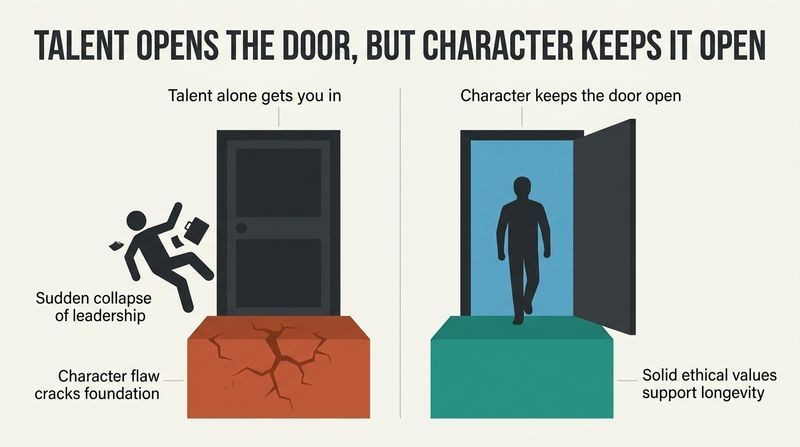
Talent gets you in; character keeps you there. Munroe's central thesis is that leadership training obsesses over vision, skills, charisma, and credentials while ignoring the one thing that determines a leader's longevity: character, which he defines as internal values and principles that show up as consistent ethical conduct.
He stacks the evidence high. Bernie Madoff ran history's largest Ponzi scheme and got 150 years, and when sentenced, not a single letter arrived attesting to his good character. Lance Armstrong lost seven Tour titles. Bill Clinton was impeached. Tiger Woods forfeited roughly $100 million in endorsements. Each had dazzling gifts. Each self-destructed on a character flaw. The pattern is universal: no amount of accomplishment protects a leader whose moral foundation cracks.
What's striking is how Munroe inverts the usual leadership hierarchy. Business schools rank vision and competence first; he ranks them last behind principles. This echoes Jim Collins's Level 5 leadership research, where humility and will outperformed charisma. There's a testable claim buried here: does character predict tenure better than talent? The corporate fraud literature (Enron, Theranos) supports him, though survivorship bias lurks. Plenty of low-character leaders never fall publicly. Still, the framing is useful because it reframes ethics not as moralizing but as risk management. Character is insurance against the specific failure mode that ends careers built on genuine skill.
Install character like a home security system against yourself
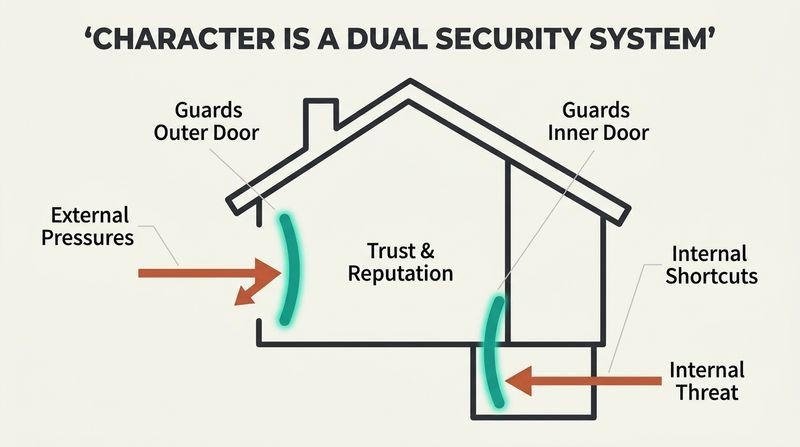
Good character guards two doors at once. Munroe compares character to an alarm system that protects against both external intruders (life's pressures, temptations, dishonest opportunities) and internal ones (your own rationalizations and ethical shortcuts). You arm the system by consciously establishing values and a code of ethics before crisis hits.
The deeper point: character is preventive medicine, not emergency surgery. Thomas Paine's line that character is easier kept than recovered anchors the chapter. Once trust breaks, it rarely returns. Munroe uses the everyday example of a supplier caught padding invoices or a politician exposed taking bribes. You simply stop doing business with them. He extends this to mundane flaws too: chronic lateness, unpaid bills, and held grudges quietly erode credibility long before any headline-worthy scandal.
The security-system metaphor is clever because it makes ethics proactive rather than reactive. Behavioral economists would call this precommitment, the same mechanism Ulysses used tying himself to the mast. Deciding your values in advance removes the need to deliberate under temptation, when willpower is weakest and rationalization strongest. Research on moral licensing shows people who improvise ethics in the moment often talk themselves into exceptions. Munroe's insistence on a written, pre-established code aligns with implementation-intention studies showing that if-then plans dramatically improve follow-through. The weakness: alarm systems can be disabled. He addresses this elsewhere, but character requires ongoing maintenance, not a one-time installation.
Leadership is inherent, not reserved for a chosen few
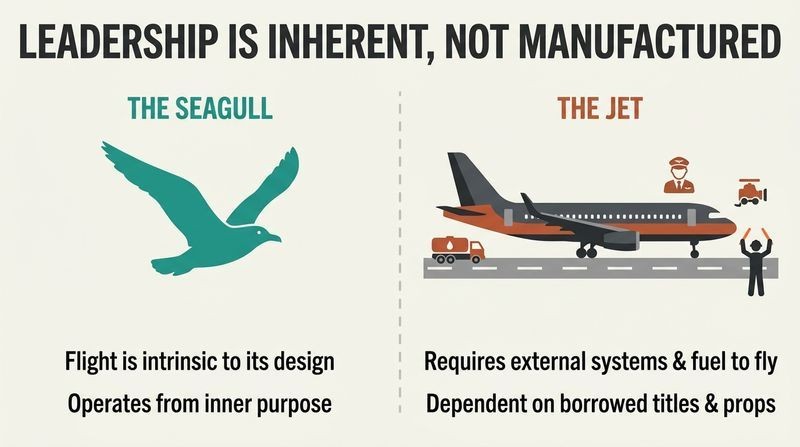
Every person leads in some area of gifting. Munroe rejects the ancient Greco-Roman theories still shaping leadership culture: that leaders are born with special traits (Aristotle), chosen by the gods, defined by charisma, or minted purely by elite education. These philosophies spread through the Roman Empire and its colonies, embedding the toxic belief that a leader is superior to followers.
He illustrates with a seagull and a jet on an airport tarmac. The jet needs pilots, fuel, ground crew, and a runway to fly. The bird just flies, because flight is intrinsic to its nature. Real leaders operate like the bird: they lead from who they were born to be, not from borrowed titles and props. Discover your purpose, and leadership follows naturally.
Munroe's democratization of leadership is genuinely subversive against the trait theory that dominated the field for a century. Modern research partly agrees: the heritability of leadership emergence is estimated around 30%, leaving most to development and context. His attack on the class-based colonial residue is sharp anthropology. The colonizer-superiority mindset really did get baked into institutions. His coined black crab syndrome, where the oppressed pull down their own who rise, parallels tall poppy syndrome and crab-mentality studies in sociology. One caution: saying everyone is a leader risks diluting the word. Munroe's rescue is redefining leadership as purpose-driven self-manifestation, not authority over others.
Character grows through a seven-stage chain from belief to lifestyle
Trace the assembly line of who you become. Munroe maps character formation as a sequence: beliefs produce convictions, convictions produce values, values form morals and principles, principles demand discipline, disciplined conduct becomes ethics, ethics become character, and character determines lifestyle.
The practical power is diagnostic. When you find a character flaw, you trace backward to locate where the defect entered, usually a faulty belief absorbed uncritically from family, culture, or media. Munroe borrows Solomon's proverb that as a person thinks in his heart, so is he, equating the biblical heart with the subconscious mind, a hard drive storing everything you truly believe. He adds Lincoln's test: give a person power, position, or money, and their real character surfaces. What was hidden in the subconscious becomes visible in how they wield resources.
Framing character as a causal chain rather than a fixed trait is the book's most useful engineering move. It converts a vague virtue into a debuggable system. This resembles cognitive behavioral therapy's core insight that beliefs drive emotions and behavior, so changing entrenched beliefs changes downstream conduct. The subconscious-as-hard-drive analogy is dated but functional; contemporary dual-process theory (Kahneman's System 1 and System 2) would say much moral behavior runs on automatic scripts formed early. Munroe's claim that power reveals rather than corrupts character is contestable. The Stanford Prison Experiment and Milgram suggest situations can manufacture cruelty in ordinary people, meaning environment, not just latent character, matters enormously.
Choose standards over expediency, ethical correctness over political correctness
Principled leaders refuse the convenience of the moment. Munroe defines the choice sharply: expediency serves the demands of the immediate situation, while character serves your unrooted purpose according to fixed moral standards. He reframes political correctness as a modern form of expediency that pressures leaders to compromise convictions for acceptance.
His test cuts deep: if you sacrifice your beliefs to be liked, you are not a leader but a compromiser. Immoral acts, he argues, are rehearsed in the subconscious before they happen, so a thief was a thief before stealing. The antidote is deciding in advance what you will serve. He offers the vivid image that it is better to eat bread with your convictions intact than steak with compromise, because you will remember the bread long after the steak is forgotten.
The distinction between principled consistency and mere stubbornness is where this insight earns its keep, and Munroe draws it carefully: compromising opinions to reach consensus is healthy, compromising values is corrosive. This maps onto Kant's distinction between hypothetical imperatives (do X to get Y) and categorical ones (do X because it is right). The rehearsal claim finds support in neuroscience: mental simulation activates the same neural pathways as action, which is why visualizing dishonesty lowers resistance to it. The framing of political correctness as expediency is provocative and will read as partisan to some, but the underlying principle, that social pressure erodes conviction, is politically neutral and empirically robust across conformity research.
Your values are personal but never private
What you prize privately spills into everyone's life. Munroe insists values inevitably impact others, so a leader's ethics cannot be cordoned off into a separate private compartment. A CEO who values only the bottom line harasses employees; a spouse who devalues marriage destroys a family. Values also send signals: a person of visible integrity is never approached by someone hunting a partner in crime.
He adds that values attract similar values, so your closest associations reveal what you truly esteem. Gandhi's transformation began when a South African train conductor dragged him from a first-class seat he had paid for, saying people like him could not sit there. That violation of a value he held dear, human equality, ignited a lifetime of principled resistance that toppled colonial rule without violence.
The public-private collapse is Munroe's answer to the common defense that a leader's personal life is nobody's business. Research on ethical leadership supports him: leaders' private conduct shapes organizational climate through social learning, employees model what they observe, not what is posted on the values wall. The claim that values attract similar values echoes homophily research in network science, where people cluster with the like-minded. The Gandhi anecdote is a masterclass in how a single dignity violation can crystallize dormant conviction into world-changing action. One nuance worth adding: total transparency has costs too. Some privacy protects dignity and growth, so the principle is best read as integrity, not surveillance.
Never value talent, reputation, or position above character
Three false idols quietly hijack our judgment. Munroe names the substitutions our culture makes:
1. Talent over character: talent is a shooting star that flares and vanishes; character is the sun, steady and reliable.
2. Reputation over character: reputation is what others think, the mask; character is the truth, who you are in private.
3. Position over disposition: a title tells you nothing about the person's true nature.
He warns that a fickle public showers approval on the gifted until scandal breaks, then abandons them overnight. Because we overvalue glamour, we assume the talented must also be good, and we are shocked when they are not. His counsel: stop chasing reputation, which is merely a byproduct of character, and stop pursuing position when you should be building disposition.
The talent-versus-character framing anticipates a real organizational hazard: the brilliant jerk. Netflix and other firms now explicitly fire high performers who corrode team trust, validating Munroe's shooting-star warning. His reputation-versus-character split mirrors sociologist Erving Goffman's dramaturgy, where we manage front-stage impressions, but Munroe's point is that back-stage reality eventually leaks. Warren Buffett's line that it takes twenty years to build a reputation and five minutes to ruin it is the practical corollary. The weakest link is his Clinton example, where the assessment of talent versus character bleeds into political judgment. The underlying principle, that competence never substitutes for integrity, stands independent of any single case.
Discipline is policing yourself so beliefs never stage a jailbreak
Convictions require self-imposed guardrails. Munroe argues discipline turns values into lived reality. A person of character polices himself, exercising self-control so his principles do not escape no matter what money or shortcut is offered. He frames it as becoming a convict of your own beliefs, held so firmly you would sacrifice for them.
Discipline begins with priorities. You set self-imposed parameters deciding what you will and will not accept, then order your time, money, and attention around them. He cites Paul of Tarsus training like a runner for a prize that lasts, and Dr. Rick Hodes, who moved to Ethiopia in 1984 as a famine worker and stayed decades, serving tens of thousands and adopting five children. Genuine conviction produced a narrow, focused life aimed at a purpose larger than comfort.
The convict metaphor is memorable because it reverses the usual sense of constraint. Munroe argues that being imprisoned by your own chosen principles is freedom, a paradox Viktor Frankl echoed from the concentration camps: the last human freedom is choosing one's attitude. Modern self-regulation research (Baumeister, Duckworth) confirms that people with strong self-control succeed less through heroic willpower and more through structuring their environment and priorities to avoid temptation entirely, exactly Munroe's self-imposed parameters. The gap in his account is the physiology of addiction and compulsion, which he acknowledges may need professional help. Pure willpower framing can shame those fighting genuine neurological battles, so discipline works best paired with support systems.
True leaders serve people rather than dominate them
Greatness is measured by whom you serve, not who serves you. Munroe contrasts two leadership cultures. The Roman model lords authority over others and orders them around. The model Jesus taught inverts it: whoever wants to be great must serve, and Jesus said he came not to be served but to give himself.
Munroe grounds this in creation. Humans were given dominion over fish, birds, livestock, and the earth, but pointedly not over other humans. Dominating people is illegitimate, which is why the human spirit naturally resists control. He is suspicious of leaders with large entourages, reading them as symptoms of ego. He distinguishes inspiration, which awakens others' own purpose so they join voluntarily, from manipulation, which uses fear, carrots, sticks, and coercion. The moment you stop inspiring and start manipulating, you cease being a leader.
Munroe converges with Robert Greenleaf's servant leadership, developed independently in 1970, and with contemporary evidence that empowering leadership raises engagement and reduces turnover more than authoritarian styles. His theological grounding, that no human was given dominion over another, is a striking argument against domination that predates and undergirds modern anti-authoritarian ethics. The inspiration-versus-manipulation line is practically vital because both produce compliance in the short run; the difference shows up in whether followers grow or shrink. One tension: servant leadership can curdle into martyrdom or passivity if a leader never exercises hard authority. Serving people sometimes means telling them uncomfortable truths, not merely accommodating them.
Character is forged, not found, through the fire of temptation
Being tempted is the tempering process, not the failure. Munroe uses Roman sword-making as his master metaphor. A blacksmith heats iron until dark spots (weaknesses) appear, hammers them out, plunges the blade into cold water to bind the molecules, then repeats. Roman swords were so reliable that smiths engraved their names and could be executed if a blade broke in battle.
Character works identically. Being tempted is not the same as yielding; temptation reveals weak spots so they can be strengthened. Munroe cites Paul: suffering produces perseverance, perseverance produces character. He names the three universal tests Jesus faced in the desert: appetite, fame, and power. Every fallen leader was snared by at least one. He is skeptical of overnight success, preferring the long walk through testing that produces grounded, lasting trustworthiness.
The tempering metaphor reframes adversity as information rather than punishment, which aligns with post-traumatic growth research showing many people emerge from crisis with strengthened values and resilience. Munroe's insistence that temptation is diagnostic, not shameful, is psychologically healthy; it separates the impulse from the identity, much as acceptance-based therapies distinguish having a thought from acting on it. The three-tests taxonomy (appetite, fame, power) is a compact and durable checklist that maps neatly onto real scandal patterns. The overnight-success skepticism echoes the ten-thousand-hour literature. What would sharpen this further is acknowledging that not all suffering builds character; unprocessed trauma can corrode it. The variable is meaning-making, which Munroe implicitly supplies through purpose.
Trust is the only currency that buys real leadership
No trust, no followers, no leadership. Munroe frames trust as an account followers deposit into based on your demonstrated character. Every time you stay steady under pressure, prove reliable, or remain faithful, they add to the account. Violate their faith and the account closes instantly; you cannot buy the currency back at any price.
He argues leadership is a privilege granted by followers, not a right leaders possess. When the United Way's chairman was jailed for embezzling up to $1.2 million, the charity installed an interim leader known for integrity to rebuild donor trust. When Lance Armstrong's doping surfaced, his foundation stripped his name and became LIVESTRONG to survive. The founder's own name had become a liability. Trust, built over years, evaporates in minutes of irresponsibility.
The trust-as-account metaphor tracks closely with Stephen M.R. Covey's emotional bank account and with the economics of trust, where high-trust organizations move faster and cost less because they spend less on verification, contracts, and monitoring. Munroe's claim that leadership is granted by followers rather than possessed by leaders is a quietly radical reframe that dissolves the entitlement many titled leaders feel. The LIVESTRONG rebrand is a vivid case of reputational contagion, where an individual's brand poisons the institution. Behavioral research confirms the asymmetry he describes: trust builds linearly but collapses nonlinearly, because negative information is weighted far more heavily than positive in human judgment. The practical lesson is ruthless: protect the account daily.
After a fall, submit to authority and learn to fall up
Failure is a detour, not a destination. Munroe insists a moral collapse need not end a leader's calling, gifts, or future, but recovery requires a specific process he calls falling up. Leaders are trained to succeed and almost never trained to fail well, so they crash without knowing how to rise transformed.
His restoration steps are counterintuitive because they demand surrender rather than self-defense:
1. Admit you need help and confess the breach of trust.
2. Submit completely to a trusted, qualified authority.
3. Accept full responsibility and stop defending yourself.
4. Let that authority speak for you and decide when you are ready to return.
5. Establish permanent, ongoing accountability.
The greatest tragedy, he argues, is not falling but believing you can never be restored. Genuine change comes from the inside out, not from a well-crafted public apology.
Munroe's most humane chapter directly counters cancel culture's finality with a structured redemption path, a concept religious traditions have long institutionalized through confession, penance, and reintegration. His refusal to let the fallen defend themselves is psychologically shrewd; self-justification (Tavris and Aronson's work on cognitive dissonance) is precisely what prevents genuine change, because defending the act entrenches it. The insistence on external accountability rather than solo willpower aligns with addiction-recovery models like the twelve steps, where a sponsor and community outperform private resolve. One caveat worth flagging: submission to an authority carries real risk if that authority is itself corrupt or self-interested, which is why Munroe stresses the word qualified. Choosing the wrong confessor can deepen the wound.
Analysis
Myles Munroe's book is a thesis-driven work of leadership philosophy dressed in the vocabulary of business self-help but rooted unmistakably in Christian theology. Its structure moves from diagnosis (a global crisis of character), through mechanism (how character develops from belief to lifestyle), to prescription (specific qualities and a restoration process). What makes it distinctive in a crowded genre is its refusal to treat character as one leadership variable among many. Munroe subordinates vision, competence, and charisma entirely to character, arguing that principles protect purpose and that a gift is only as safe as the character containing it.
The book's intellectual spine is a causal chain: beliefs to convictions to values to morals to discipline to ethics to character to lifestyle. This engineering of virtue is its strongest contribution, converting a fuzzy moral abstraction into a diagnosable, buildable system. Where a flaw appears, trace it upstream to a faulty belief. This resonates with cognitive behavioral therapy and implementation-intention research, giving the material more empirical backbone than Munroe himself claims. Two features limit its reach. First, the theological grounding is load-bearing, not decorative. Munroe locates the true north of conscience in the God of the Bible and argues human beings lost their innate character in the Fall and can only fully recover it through Christ. Secular readers can extract the frameworks, but the deepest justification is faith-based, which he presents as fact. Second, the anecdotes lean heavily on early-2010s scandals (Madoff, Armstrong, Weiner), dating the book and occasionally substituting a parade of villains for rigorous argument.
Still, the core claims are durable and increasingly urgent. In an era of algorithmic reputation management and rapid public disgrace, Munroe's insistence that trust is a nonrenewable currency and that private conduct is never truly private reads as prophetic. His most valuable and underappreciated move is treating temptation as diagnostic information and failure as a recoverable detour, offering a structured path back that most leadership literature ignores entirely.
Review Summary
The Power of Character in Leadership is highly praised for its emphasis on the importance of character in effective leadership. Readers find it impactful, thought-provoking, and necessary for personal and professional growth. Many consider it a must-read, highlighting its lessons on values, ethics, and integrity. The book is commended for its easy-to-follow content and practical insights. Some readers note repetition but still find value in its core message. Overall, reviewers appreciate the book's focus on developing strong character as a foundation for leadership.
People Also Read





FAQ
What’s "The Power of Character in Leadership" by Myles Munroe about?
- Core focus on character: The book explores how character—rooted in values, morals, ethics, and principles—is the foundation of effective leadership, more important than power, position, or talent.
- Leadership crisis: Munroe addresses the global crisis of character in leadership, showing how ethical and moral failures undermine organizations and societies.
- Restoration and development: The book provides a roadmap for developing, maintaining, and restoring character in leaders, emphasizing the integration of personal and corporate values.
- Practical guidance: It offers actionable advice for leaders to align their beliefs, values, and actions, and to rebuild trust after failure.
Why should I read "The Power of Character in Leadership" by Myles Munroe?
- Neglected aspect of leadership: Most leadership resources focus on skills and vision, but Munroe prioritizes character as the essential ingredient for sustainable leadership.
- Practical tools for growth: The book provides actionable steps for cultivating ethics, values, and principles, making it relevant for aspiring, current, or fallen leaders.
- Addresses modern crises: It tackles the widespread crisis of character in leadership and offers a path to restore credibility and moral authority.
- Inspiration for principled leadership: Readers are encouraged to embrace servant leadership, humility, and accountability for lasting influence and legacy.
What are the key takeaways from "The Power of Character in Leadership" by Myles Munroe?
- Character is foundational: Leadership power must be built on integrity, consistency, trustworthiness, justice, and compassion.
- Values alignment is critical: Both individuals and organizations must clearly communicate and live by shared core values to maintain unity and effectiveness.
- Character is tested and proven: Trials and temptations reveal and strengthen a leader’s character, building trustworthiness.
- Accountability and humility matter: Leaders must be accountable to themselves, others, and God, practicing humility and servant leadership to maintain ethical standards.
How does Myles Munroe define leadership in "The Power of Character in Leadership"?
- Comprehensive definition: Leadership is “the capacity to influence others through inspiration motivated by a passion, generated by a vision, produced by a conviction, ignited by a purpose.”
- Sequential process: Leadership development follows the order: purpose → conviction → vision → passion → inspiration → influence → leadership.
- Purpose-centered: True leadership is about living in alignment with one’s intrinsic purpose and inspiring others to fulfill their own.
- Beyond titles and power: Leadership is not about position or charisma, but about influence rooted in strong character and values.
How does Myles Munroe define character in leadership?
- Fixed and stable nature: Character is a set of predictable, stable moral qualities that define a person’s true nature and conduct.
- Consistency and integrity: True character means alignment between thoughts, words, and actions, without hypocrisy or compromise.
- Commitment to principles: Leaders of character hold unwavering convictions and are willing to sacrifice popularity or gain rather than compromise their values.
- Revealed under pressure: Character is most clearly demonstrated and strengthened when leaders face temptations and ethical challenges.
What is the role of character in leadership according to Myles Munroe?
- Foundation of credibility: Character establishes a leader’s integrity and ethical conduct, which is essential for trust and influence.
- Longevity and legacy: Strong character extends the duration of leadership and ensures a positive legacy, while character failure leads to downfall.
- Personal security system: Character acts as a safeguard, protecting leaders from external pressures and internal temptations.
- Influence on others: A leader’s character shapes the attitudes, morality, and destiny of followers.
How do beliefs, values, morals, and principles develop character in leadership as explained by Myles Munroe?
- Beliefs form convictions: Personal philosophy, shaped by experiences, creates deep-seated convictions about purpose and conduct.
- Convictions produce values: These convictions lead to values—principles and qualities that guide attitudes and perceptions.
- Values shape morals and ethics: Values translate into moral standards that govern right and wrong behavior, manifesting as ethics and ultimately character.
- Principles as unchanging laws: Principles are described as permanent, non-negotiable laws that safeguard leadership effectiveness.
How does "The Power of Character in Leadership" by Myles Munroe describe the relationship between vision and values?
- Vision interprets values: A leader’s vision reflects and communicates what they value most, serving as a practical expression of those values.
- Values protect vision: Without strong values, a vision is vulnerable to ethical breaches and failure; values provide the moral framework that sustains the vision.
- Balance is essential: Pursuing vision without corresponding values leads to compromise and short-circuits destiny.
- Vision gives meaning: A compelling vision inspires others, but it must be grounded in ethical conduct to endure.
What practical advice does Myles Munroe give for developing character in leadership?
- Self-assessment: Leaders should honestly evaluate their beliefs, values, and conduct, seeking feedback from family, friends, and colleagues.
- Establish a code of ethics: Leaders must write down and internalize their values and moral standards, then live by them consistently.
- Discipline and priorities: Maintaining character requires personal discipline, setting priorities, and making choices aligned with convictions and purpose.
- Seek accountability: Regular self-evaluation and submission to trusted authority figures help maintain and strengthen character.
How does "The Power of Character in Leadership" by Myles Munroe explain the development and testing of character?
- Tempering through trials: Character is likened to a sword tempered by fire—trials and temptations reveal weaknesses that must be addressed.
- Tests reveal true nature: Life’s challenges expose areas of instability or compromise, providing opportunities for growth in integrity.
- Perseverance builds trust: Consistent faithfulness through trials establishes a leader’s trustworthiness, the currency of leadership influence.
- Intentional self-evaluation: Leaders must actively assess their character, seek accountability, and address flaws to develop moral resilience.
What advice does Myles Munroe give for restoring leadership after character failure?
- Admit and confess: Leaders must acknowledge their need for help and openly confess their breach of trust.
- Seek accountability: Restoration requires submitting to a reliable authority who can provide guidance and represent the leader to the community.
- Take full responsibility: Leaders must accept consequences without excuses and commit to genuine change.
- Ongoing submission and discipline: Restoration is a process involving continued accountability, obedience to counsel, and rebuilding trust over time.
What are the best quotes from "The Power of Character in Leadership" by Myles Munroe and what do they mean?
- “Leaders stand for something—vision. Leaders stand on something—values.” Vision gives direction, but values provide the foundation for sustainable leadership.
- “Character is who we are when no one else is watching.” True character is internal and consistent, not just a public facade.
- “The distinguishing mark of a leader is character.” Character, not power or skill, is the defining quality that legitimizes leadership.
- “Never give in except to convictions of honour and good sense.” (Winston Churchill) Steadfastness to principles is more important than popularity or convenience.
- “To be tempted is to be assessed for moral weaknesses—‘spots’—in our character, so they can be removed, and so we can become leaders of principle.” Temptation is a necessary process for strengthening leadership character.
About the Author
Other books by Myles Munroe







Download PDF
Download EPUB
.epub digital book format is ideal for reading ebooks on phones, tablets, and e-readers.








































