

Key Takeaways
Love alone won't save a marriage: men crave respect as women crave love
The missing half of the equation. Eggerichs, a former pastor, spent decades hearing wives cry "He doesn't love me" while husbands silently seethed "She doesn't respect me." His breakthrough came from Ephesians 5:33, which he argues everyone had read but nobody had connected: it commands husbands to love their wives and, separately, commands wives to respect their husbands. Two different needs, two different people.
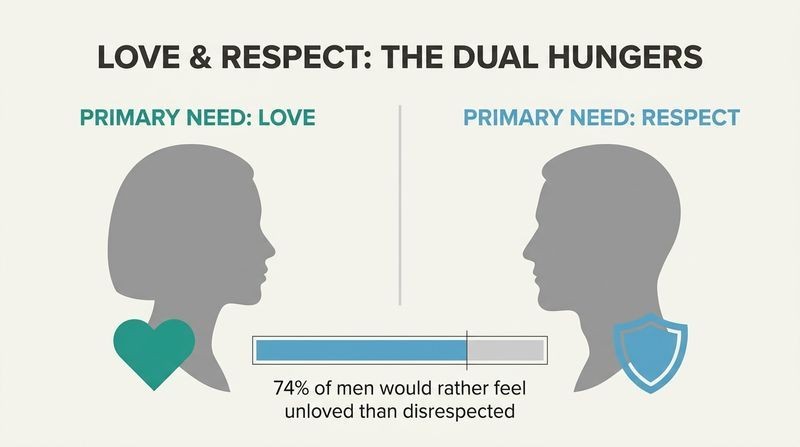
A gendered division of primary needs. The claim is not that men need no love or women no respect, but that each sex has a dominant hunger. He cites a survey where 74% of men, forced to choose, would rather be alone and unloved than feel inadequate and disrespected. Respect, he says, is a man's mother tongue.
The framing is genuinely useful because most marriage advice assumes love is the universal currency. Attachment theory supports the idea that partners have differing emotional triggers, though it locates them in individual history rather than gender. The sharpest critique: Eggerichs treats gender as destiny, while research (Gottman included, whom he cites) shows both partners need admiration and affection. The stronger, defensible version of his thesis is that couples systematically underestimate their partner's non-obvious need. Whether that maps cleanly onto pink and blue is debatable, but the practical prompt (ask what your spouse hungers for, not what you would want) is sound across any relationship.
Withholding love breeds disrespect, which breeds more withholding: the Crazy Cycle
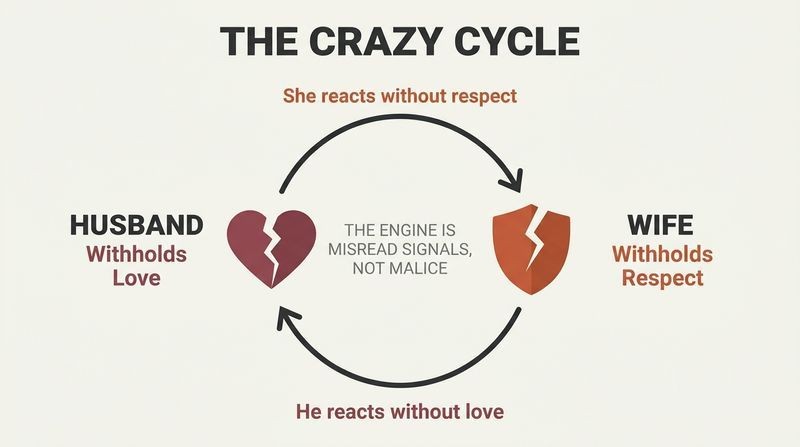
A self-perpetuating doom loop. Eggerichs names the core pattern the Crazy Cycle: without love from him, she reacts without respect; without respect from her, he reacts without love. Around it spins. He compares it to a person flipping a dead light switch for half an hour, expecting different results. The engine is misread signals, not malice.
Both spouses have goodwill but bad decoding. In his tenth-anniversary story, a husband accidentally buys a birthday card. She reads it as proof he doesn't care; he hears only contempt and storms out. Two people who love each other spend the night in separate rooms. The issue is never the actual card, the forgotten anniversary, or the peppered eggs. The real issue is always the unmet need for love or respect underneath.
The Crazy Cycle is essentially a negative feedback loop, and systems thinking validates why it accelerates: each partner's defense becomes the other's provocation. Gottman's research on the pursue-withdraw dynamic (the wife criticizes, the husband stonewalls) is the empirical backbone here and one of the strongest predictors of divorce. What Eggerichs adds is a memorable label and a diagnosis of intent: assuming goodwill breaks the loop. The limitation is that not every partner is goodwilled, a caveat he flags for abuse but which deserves more weight, since the framework can pressure victims to keep decoding a spouse who genuinely intends harm.
Assume goodwill: your spouse isn't plotting to hurt you
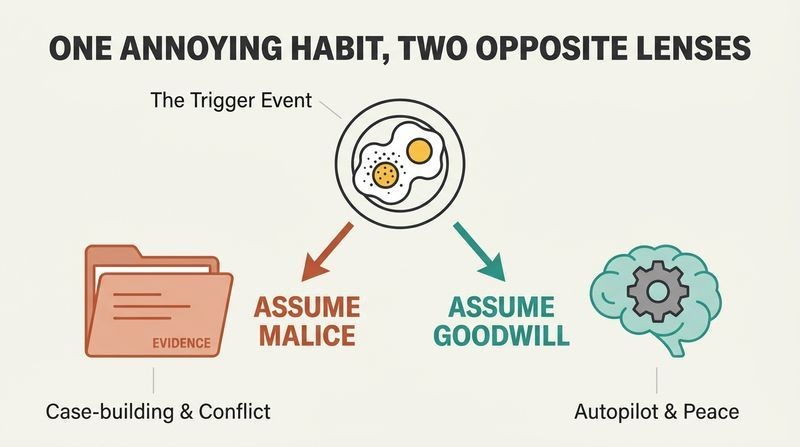
The decision that defused a marriage. Eggerichs and his wife Sarah made one deliberate choice: he decided to believe she never intends disrespect, and she decided to believe he never intends to be unloving. Sarah peppers his eggs black despite knowing he hates it; he leaves wet towels on the bed despite a rack ten feet away. Neither is sabotage. Both are autopilot.
Reinterpretation over accusation. When you assume evil motive, every annoying habit becomes evidence in a case against your spouse. When you assume goodwill, the same behavior reads as forgetfulness or distraction. The husband who threw a dish in anger and landed in jail spent two days realizing his wife's rage actually meant "Why won't you love me?" Goodwill decoding transformed his marriage.
This is a marital application of what psychologists call the fundamental attribution error: we attribute others' bad behavior to character and our own to circumstance. Eggerichs flips the default, urging spouses to grant each other the situational read they reserve for themselves. Research on "positive sentiment override" (Gottman again) shows happy couples genuinely interpret ambiguous acts charitably, while distressed couples do the opposite. The technique is powerful and free. The honest caveat, which the jail anecdote inadvertently raises, is that a pattern of violence is not a decoding error. Goodwill assumption works between two decent people, not as a shield for genuine abuse.
Spouses broadcast in gendered code: her criticism means "love me," his silence means "respect me"
Pink and blue lenses. Eggerichs's central metaphor: women see the world through pink sunglasses and hear through pink hearing aids; men wear blue. The same event gets interpreted differently, and messages get sent in mismatched code. When a wife complains, criticizes, or cries, her encoded plea is "I want your love." When a husband goes quiet or speaks harshly, his encoded plea is "I want your respect."
Decoding, not fixing the surface. The traveling husband comes home hoping for intimacy; his wife hands him a to-do list. He snaps sarcastically; she calls him insensitive. Each is broadcasting a need the other can't hear. The skill is translation: recognizing that her sharpest words and his coldest withdrawals are both distress signals, not attacks. Learn the other's language and the static clears.
The linguistic metaphor echoes Deborah Tannen's work on gendered conversation styles (rapport-talk versus report-talk), which Eggerichs cites. The insight that hostility often masks a bid for connection is clinically robust; couples therapists routinely coach partners to hear the "softer emotion" beneath anger. Where the model strains is its binary determinism. Plenty of women stonewall and plenty of men pursue, a reality Eggerichs relegates to an appendix on "exceptions." Treating communication style as culturally shaped rather than hardwired would make the framework more durable, but the core move (decode the need behind the delivery) is a genuine communication upgrade regardless of gender.
Give respect and love unconditionally, not as a reward to be earned
The counterintuitive core. Both spouses instinctively believe the other must earn better treatment first. Eggerichs argues this guarantees stalemate. Just as the church teaches husbands to love unconditionally, he insists wives must respect unconditionally, citing 1 Peter 3, where wives are told to win disobedient husbands through respectful behavior rather than words. Respect here is behavior and tone, not necessarily feeling.
Unconditional respect as oxymoron. He reports that wives grasp unconditional love instantly but find unconditional respect almost contradictory: surely respect is earned. His reframe: a wife can confront unloving behavior while keeping a respectful face and voice, refusing contempt even when correcting. The point is not that the husband deserves it, but that contempt never motivates change, while respect unlocks it.
This is the book's most provocative and most criticized claim. The strength: game theory shows that reciprocal strategies which wait for the other to cooperate first often deadlock, and someone unconditionally cooperating can break the impasse. The danger, widely noted by critics, is that "unconditional respect" can instruct women to suppress legitimate grievances and appease poorly behaving men. Eggerichs partially guards this by distinguishing respectful tone from endorsing bad behavior, and by condemning abuse. Still, the asymmetry (he frames wives' respect as the pivotal lever more often than husbands' love) invites the charge that the burden of de-escalation falls disproportionately on women.
The mature spouse moves first instead of waiting to be met
Break the standoff. Eggerichs poses the obvious question: who apologizes first, who softens first? His answer: whoever sees themselves as more spiritually mature. Waiting passively for your spouse to change keeps the Crazy Cycle spinning indefinitely. Moving first is risky but powerful, because if you know you would respond well to your spouse's overture, you can trust they likely would respond well to yours.
Take the hit. For husbands, this means embracing a wife's anger rather than stonewalling. Eggerichs invokes military honor: a man willing to take a bullet for his buddy can absorb his wife's venom without fleeing. Gottman's finding that husbands who accept their wives' influence and stay present during conflict have stronger marriages backs this. The scriptural anchor: don't let the sun set on your anger.
Reframing the first move as a sign of strength rather than surrender is psychologically shrewd; it converts a status loss into a status gain, which matters enormously for men socialized around honor. This resonates with the negotiation principle that unilateral concessions can trigger reciprocity norms. The subtle risk is a competition over who is "more mature," which could itself become a power move. And the advice presumes both partners eventually reciprocate. In a genuinely one-sided marriage, perpetual first-moving can shade into martyrdom. The healthiest reading is that someone must break the loop, and volunteering is braver than waiting.
Spell love to a wife with C-O-U-P-L-E: closeness, openness, understanding, peace, loyalty, esteem
Six concrete moves for husbands. Eggerichs packages a wife's love needs into an acronym. Closeness: face-to-face connection, holding hands, hugging without sexual agenda. Openness: sharing your inner world instead of playing the mysterious island. Understanding: listening rather than fixing. Peacemaking: saying "I'm sorry" and resolving conflict rather than "just drop it." Loyalty: reassuring her of lifelong commitment. Esteem: honoring and cherishing her publicly and privately.
Listen, don't repair. The signature story: young Sarah pours out her Spanish-class troubles; Emerson builds her a study schedule. She wanders off happy before he finishes, because she only wanted to be heard. His two rescue questions became "Am I in trouble?" and "Do you want a solution or a listening ear?" Women process feelings by talking; men default to problem-solving, which can feel dismissive.
The listen-versus-fix distinction is the most transferable nugget here and is corroborated across communication research: validation often precedes and outperforms advice in emotional conversations. The acronym's value is mnemonic, turning vague goodwill into behavioral checklists, which behavior-change science favors over abstract intentions. The weakness is essentialism again: framing the desire to be heard as female and the impulse to fix as male overstates a tendency into a rule. Many men also want to vent, and many women want solutions. Read as a menu of relational skills rather than a gender law, C-O-U-P-L-E is a practical toolkit any partner could deploy.
Spell respect to a husband with C-H-A-I-R-S: honor his work, leadership, insight, and sexuality
Six concrete moves for wives. The mirror acronym: Conquest (appreciate his drive to work and achieve). Hierarchy (value his desire to protect and provide). Authority (support his leadership rather than undermining it). Insight (respect his analysis instead of dismissing it). Relationship (accept his bid for shoulder-to-shoulder friendship). Sexuality (honor his need for physical intimacy).
Work is identity, sex is a language. Eggerichs claims men fuse self-worth with their vocation; two friends who survived cancer told him losing their jobs hurt worse than facing death. On sex, he reframes it as symbolic of respect: refusing a husband reads to him as rejection of who he is, just as a husband's refusal to talk reads to a wife as rejection. His shoulder-to-shoulder point: men bond through shared activity and silence, not face-to-face talk.
The shoulder-to-shoulder observation is well supported; studies of male friendship consistently find bonding through side-by-side activity rather than direct disclosure, which explains why "just sit with me" can feel intimate to a man and pointless to a woman. Linking a man's identity to work also tracks with research on male depression following job loss. The sexuality reframe is the thorniest: presenting sex as something a wife owes to affirm her husband risks eroding enthusiastic consent, though Eggerichs frames it as mutual duty per 1 Corinthians 7. The healthiest extraction is reciprocity: each partner ministering to the other's less-visible need rather than keeping score.
During conflict, name the feeling without attacking the person
A scripted de-escalator. Eggerichs offers husbands and wives near-identical phrases. Instead of "You are disrespectful," a husband says "That felt disrespectful. Did I come across as unloving?" Instead of "You are unloving," a wife says "That felt unloving. Did I come across as disrespectful?" The trick is describing your own reaction rather than indicting your spouse's character, then handing them a graceful exit.
Why it works. The phrasing removes the personal attack and invites mutual ownership. Eggerichs admits it feels awkward and forces you to lead with your chin. But he and Sarah use it even on bad days, committing to reach these sentences before bed. Typically it triggers a fast exchange of apologies rather than an escalating fight. Owning your share disarms the other's defensiveness.
This is essentially nonviolent communication and "I-statements" dressed in the book's love-respect vocabulary: describe impact, not character, and avoid the contempt that Gottman identifies as the single strongest divorce predictor. The added ingredient, asking whether you yourself came across badly, is smart because it preempts the defensiveness that derails most "I feel" attempts. The scripted quality can feel stilted, and a spouse who knows the formula may hear it as manipulation. But scripts exist precisely because conflict hijacks our reasoning; having a rehearsed on-ramp back to civility is a legitimate tool, the verbal equivalent of a fire drill.
Contempt is corrosive: physiologically, men flood and stonewall to survive it
The body keeps score in conflict. Eggerichs leans on Gottman's twenty-year study of two thousand long-married couples, which found the healthiest marriages carried an undercurrent of love and respect and, crucially, the absence of contempt, the most destructive marital force. He adds a physiological layer: 85% of husbands eventually stonewall because their heart rate and blood pressure spike higher and stay elevated longer than their wives'.
Stonewalling is not indifference. When a man goes silent and walks away, he experiences it as the honorable move, an attempt to avoid saying something worse. His wife reads the same silence as the ultimate rejection. Understanding the biology reframes withdrawal: he is flooded, not cold. The escalation spiral (she criticizes, he withdraws, she criticizes harder) can be interrupted once both grasp what stonewalling actually signals.
The physiological account is one of Gottman's best-replicated findings: men do tend to experience "diffuse physiological arousal" during conflict and take longer to recover, which incentivizes escape. This reframes stonewalling from a moral failing into a stress response, opening the door to solutions like a timed break to self-soothe. The caveat is that women stonewall too, and chronic withdrawal, whatever its physiology, still damages a partner who feels abandoned. Naming contempt as the arch-enemy is the book's most empirically bulletproof claim. Eye-rolling, mockery, and sneering forecast divorce with eerie accuracy, so any technique that replaces contempt with respect is targeting the right variable.
Act for God's reward, not your spouse's response: the Rewarded Cycle
When it doesn't work, keep going. Eggerichs's final layer answers the obvious objection: what if I love or respect and get nothing back? His Rewarded Cycle reframes the entire enterprise as ultimately about the individual's relationship with Christ, not the spouse. His love blesses regardless of her respect; her respect blesses regardless of his love. The behavior becomes an act of obedience that God notices and rewards, independent of marital outcome.
Response is your responsibility. He argues that a spouse doesn't cause your reaction, only reveals your character, using the image of sand that infects an eye but produces a pearl in an oyster. Same irritant, different inner properties. You can experience hurt, but hatred is a choice. This detaches self-worth from a difficult partner's behavior and, he claims, paradoxically frees you to act well.
Stripped of its explicitly Christian framing, this is a Stoic and cognitive-behavioral principle: you control your response, not others' actions, and locating your locus of control internally reduces the victim mindset. The oyster-and-pearl reframe of adversity as character-forming echoes post-traumatic growth research. For religious readers, anchoring perseverance in divine reward provides motivation that survives a non-reciprocating spouse. The genuine risk, which critics rightly press, is that "keep serving regardless of response" can trap someone in a harmful marriage under a spiritual rationale. Eggerichs carves out exceptions for abuse and adultery, but the framework's momentum leans toward endurance, so readers must supply their own boundaries.
Analysis
Love and Respect is a thesis-driven Christian marriage book built on a single verse (Ephesians 5:33) and a single memorable diagnosis (the Crazy Cycle). Its power lies in reduction: Eggerichs takes the sprawling problem of marital conflict and compresses it into one lever, the mismatch between a woman's hunger for love and a man's hunger for respect. This is both the book's genius and its liability. As a mnemonic architecture (Crazy Cycle, Energizing Cycle, Rewarded Cycle, C-O-U-P-L-E, C-H-A-I-R-S), it is unusually sticky and actionable, which explains its sales and conference success. Couples remember it and can use it mid-argument.
Empirically, the book's strongest ground is borrowed from John Gottman: contempt predicts divorce, men flood and stonewall, and the pursue-withdraw pattern is toxic. These are robust findings, and Eggerichs translates them into lay language effectively. Where the book overreaches is its gender essentialism. It treats statistical tendencies as near-universal wiring, relegating counterexamples to an appendix labeled "exceptions." Modern relationship science increasingly frames these differences as culturally shaped and individually variable, which would make the framework more inclusive without losing its core insight: partners chronically underestimate each other's non-obvious needs.
The most contested element is "unconditional respect," which critics argue can pressure women to appease, minimize grievances, and shoulder de-escalation. Eggerichs mitigates this by distinguishing respectful tone from endorsing bad behavior and by condemning abuse, but the asymmetry persists in emphasis.
The deepest layer, the Rewarded Cycle, quietly transforms the book from marriage manual into spiritual discipline: act rightly regardless of outcome because your character and your relationship with God are what's ultimately at stake. This is essentially Stoicism baptized, and it is the book's most portable idea. For secular readers, the transferable kernel is simple and evidence-aligned: eliminate contempt, decode the need beneath the attack, and control your own response.
Review Summary
Love and Respect receives mixed reviews, with some praising its biblical approach to marriage and others criticizing it as simplistic and potentially harmful. Supporters find the book's emphasis on unconditional respect for husbands and love for wives transformative, while critics argue it promotes outdated gender roles and places undue blame on women. Many reviewers note the book's repetitive nature and overreliance on anecdotes. Some appreciate its practical advice, while others feel it oversimplifies complex relationship issues and misinterprets scripture. Overall, the book's reception is polarized, with strong opinions on both sides.
People Also Read






FAQ
What's Love and Respect about?
- Core Message: Love and Respect by Emerson Eggerichs emphasizes that love is essential for wives and respect is crucial for husbands. It argues that many marital issues stem from a lack of understanding of these needs.
- Crazy Cycle: The book introduces the "Crazy Cycle," where without love, a wife reacts without respect, and without respect, a husband reacts without love, perpetuating conflict.
- Energizing Cycle: It also presents the "Energizing Cycle," where love motivates respect, and respect motivates love, creating a positive feedback loop in relationships.
- Biblical Foundation: The teachings are rooted in scripture, particularly Ephesians 5:33, making it a valuable resource for those seeking to align their marriage with biblical principles.
Why should I read Love and Respect?
- Practical Solutions: The book provides practical advice and biblical principles to improve communication and understanding between spouses.
- Real-Life Examples: Eggerichs shares numerous testimonials and stories from couples who have successfully applied the Love and Respect principles.
- Faith-Based Approach: For those seeking a Christian perspective on marriage, the book integrates biblical principles with practical application.
What are the key takeaways of Love and Respect?
- Understanding Needs: Recognizing that wives primarily need love and husbands primarily need respect is fundamental to improving marital dynamics.
- Communication Techniques: The book emphasizes the importance of clear communication, including the use of specific phrases to express feelings of love and respect.
- Commitment to Change: Both spouses must commit to changing their behaviors and attitudes to foster a loving and respectful environment.
What is the Crazy Cycle in Love and Respect?
- Definition: The Crazy Cycle is a pattern where a lack of love from the husband leads to a lack of respect from the wife, which in turn leads to further unloving behavior from the husband.
- Impact on Relationships: Couples caught in the Crazy Cycle often experience increased tension, resentment, and emotional distance.
- Breaking the Cycle: To break the Crazy Cycle, couples must recognize their roles in perpetuating it and actively work to meet each other's needs for love and respect.
What is the Energizing Cycle in Love and Respect?
- Definition: The Energizing Cycle is the opposite of the Crazy Cycle, where a husband’s love motivates his wife’s respect, and her respect motivates his love.
- Benefits: Engaging in the Energizing Cycle leads to increased emotional intimacy, better communication, and a stronger bond between spouses.
- Implementation: Couples can implement the Energizing Cycle by consciously expressing love and respect in their daily interactions.
How can I show love to my wife according to Love and Respect?
- C-O-U-P-L-E Acronym: The book provides the acronym C-O-U-P-L-E, which stands for Closeness, Openness, Understanding, Peacemaking, Loyalty, and Esteem.
- Practical Actions: Simple actions like holding hands, hugging, and spending quality time together can significantly enhance feelings of love.
- Daily Commitment: Consistently practicing these behaviors will help create a loving atmosphere in the marriage.
How can I show respect to my husband as suggested in Love and Respect?
- C-H-A-I-R-S Acronym: The book introduces the acronym C-H-A-I-R-S, which stands for Conquest, Hierarchy, Authority, Insight, Relationship, and Sexuality.
- Verbal Affirmation: Expressing respect through words of affirmation and appreciation can have a profound impact.
- Understanding His Needs: Recognizing that your husband needs respect as much as you need love is essential.
What are some effective communication techniques from Love and Respect?
- Use of Specific Phrases: The book suggests using phrases like, “Honey, that felt disrespectful,” to express feelings without attacking your spouse.
- Active Listening: Practicing active listening by repeating back what your spouse says can help them feel heard and valued.
- Scheduled Conversations: Setting aside time for regular discussions about feelings and concerns can prevent misunderstandings and build intimacy.
What are the best quotes from Love and Respect and what do they mean?
- “Without love, she reacts without respect; without respect, he reacts without love.”: This quote encapsulates the core message of the book, illustrating the cyclical nature of marital conflict.
- “A wise man listens to counsel.”: This highlights the importance of humility and openness in marriage.
- “Love covers a multitude of sins.”: This underscores the power of love in overcoming challenges and conflicts in marriage.
How can I apply the principles of Love and Respect in my daily life?
- Daily Practice: Make a conscious effort to express love and respect to your spouse every day.
- Reflect and Adjust: Regularly reflect on your communication and behaviors, and be willing to adjust your approach.
- Seek Support: Consider attending a Love and Respect conference or reading the book together with your spouse.
What if my spouse doesn’t respond to the principles in Love and Respect?
- Stay Committed: Continue to practice love or respect unconditionally, regardless of your spouse’s behavior.
- Look for Small Changes: Pay attention to any positive shifts in your spouse’s behavior, no matter how small.
- Seek Support: Consider counseling or support groups to help navigate challenges and reinforce the principles of love and respect.
How does Love and Respect address the issue of conflict in marriage?
- Conflict Resolution: The book emphasizes that conflict is inevitable, but it can be managed through understanding and meeting each other’s needs.
- Peacemaking Strategies: It provides strategies for husbands and wives to communicate effectively during conflicts.
- Long-Term Perspective: The authors encourage couples to view conflicts as opportunities for growth and deeper connection.
Download PDF
Download EPUB
.epub digital book format is ideal for reading ebooks on phones, tablets, and e-readers.








































