Key Takeaways
1. AI and Machine Learning are Transforming Healthcare
"AI's integration into medicine is making better doctors and saving lives."
AI enhances healthcare professionals. Artificial intelligence and machine learning are revolutionizing the healthcare industry by augmenting human capabilities rather than replacing them. These technologies assist in various aspects of healthcare, including:
- Disease prediction and early diagnosis
- Treatment personalization
- Drug discovery and development
- Medical imaging analysis
- Administrative task automation
Data-driven decision making. AI systems can process vast amounts of medical data, including patient records, research papers, and clinical trials, to provide evidence-based recommendations. This enables healthcare professionals to make more informed decisions, reducing errors and improving patient outcomes.
2. Big Data Fuels AI Advancements in Medicine
"Data is proving an invaluable tool in improving health; information is empowering."
Exponential data growth. The healthcare industry is experiencing an unprecedented surge in data generation, driven by:
- Electronic Health Records (EHRs)
- Wearable devices and IoT sensors
- Genomic sequencing
- Medical imaging
- Social media and patient-reported outcomes
Unlocking insights. Big data analytics and AI techniques allow healthcare organizations to extract valuable insights from this wealth of information. These insights can lead to:
- Improved population health management
- More accurate disease risk prediction
- Personalized treatment plans
- Efficient resource allocation
- Enhanced clinical decision support systems
3. Machine Learning Algorithms Drive Precision Medicine
"Machine learning can be used to determine the most effective medication dosage learning on patient real-world and clinical data, reducing healthcare costs for the patients and providers."
Tailored treatments. Machine learning algorithms can analyze diverse patient data to identify patterns and predict individual responses to treatments. This enables:
- Personalized drug dosing
- Targeted therapies based on genetic profiles
- Early identification of potential adverse reactions
Continuous learning. ML models can adapt and improve over time as they process more data, leading to increasingly accurate predictions and recommendations. Key algorithms used in healthcare include:
- Neural networks for image analysis
- Random forests for risk prediction
- Support Vector Machines for disease classification
- Natural Language Processing for clinical text analysis
4. Evaluating and Optimizing AI Models is Critical
"To successfully deploy a machine learning model, there are several stages of development and evaluation that take place."
Rigorous validation. Ensuring the accuracy and reliability of AI models in healthcare is crucial due to the potential impact on patient lives. Key steps in the evaluation process include:
- Data preprocessing and cleaning
- Model selection and training
- Cross-validation and testing
- Performance metric selection (e.g., accuracy, precision, recall)
- Bias and fairness assessment
Continuous improvement. AI models in healthcare require ongoing monitoring and optimization to maintain their effectiveness. This involves:
- Regular retraining with new data
- Adapting to changes in patient populations or clinical practices
- Addressing model drift and ensuring generalizability
- Incorporating feedback from healthcare professionals
5. Ethical Considerations are Paramount in Healthcare AI
"Remaining ignorant about the construction of machine learning systems or allowing them to be constructed as black boxes could lead to ethically problematic outcomes."
Ethical frameworks. Developing and implementing AI in healthcare requires careful consideration of ethical issues, including:
- Patient privacy and data protection
- Algorithmic bias and fairness
- Transparency and explainability of AI decisions
- Accountability and liability
- Informed consent for AI-assisted care
Regulatory challenges. As AI becomes more prevalent in healthcare, regulatory bodies must adapt to ensure patient safety and ethical use of these technologies. Key areas of focus include:
- Establishing standards for AI model validation
- Defining guidelines for AI integration into clinical workflows
- Addressing the legal implications of AI-assisted diagnoses and treatments
- Ensuring equitable access to AI-powered healthcare solutions
6. AI is Reshaping the Future of Healthcare Delivery
"Digital health provides a perfect opportunity for education."
Transformative technologies. AI and related technologies are driving significant changes in healthcare delivery models:
- Telemedicine and remote patient monitoring
- Virtual and augmented reality for medical training and therapy
- 3D printing for personalized prosthetics and implants
- Robotics for surgery and patient care
- Blockchain for secure health data management
Patient empowerment. AI-powered digital health tools are enabling patients to take a more active role in managing their health:
- Personalized health education and coaching
- Wearable devices for continuous health monitoring
- AI-assisted symptom checkers and triage systems
- Digital therapeutics for chronic disease management
7. Real-World Applications Demonstrate AI's Potential
"Applied across the spectrum of medical images and data collected by healthcare and research organizations, the technology will affordably be able to enable large-scale prognostic, risk stratification, and best treatment decisions."
Diverse use cases. AI is being successfully applied in various healthcare domains:
- Diabetic foot ulcer detection and prevention
- Epilepsy management through digital therapeutics
- Radiology image analysis for early cancer detection
- Drug discovery and development acceleration
- Hospital resource optimization and patient flow management
Measurable impact. Real-world studies are demonstrating the tangible benefits of AI in healthcare:
- Improved diagnostic accuracy and early disease detection
- Reduced healthcare costs through efficient resource utilization
- Enhanced patient engagement and adherence to treatment plans
- Accelerated research and development in pharmaceuticals and medical devices
- More equitable access to high-quality healthcare through AI-powered tools
Review Summary
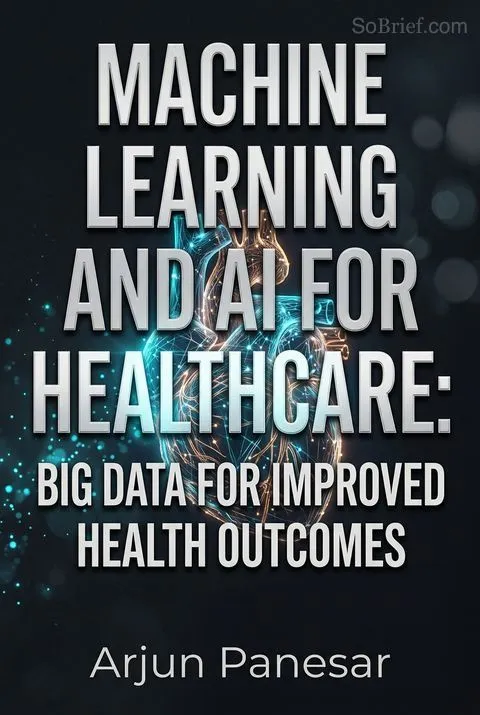
Machine Learning and AI for Healthcare receives mixed reviews, with an overall rating of 3.53/5. One reader initially found it repetitive but ultimately appreciated its thorough research and unique British perspective. The author's expertise in Type-2 Diabetes is evident, though some readers desire more coverage of other diseases. Despite occasional verbosity, the book is praised for its insights into the intersection of healthcare and software, offering valuable contributions to the field of medical informatics and computer-aided disease management.
Download PDF
Download EPUB
.epub digital book format is ideal for reading ebooks on phones, tablets, and e-readers.








































