Key Takeaways
1. The Cod Collapse: A Failure of Management, Not Nature
The story of the northern cod fishery is an astonishing example of management creating the very thing that it was designed to prevent.
Unnatural disaster. The catastrophic collapse of the Newfoundland cod fishery in 1992, leading to a strict moratorium and the commercial extinction of northern cod, was not a natural event. Instead, it was a direct consequence of "managerial ecology," a modern, utilitarian approach to nature that prioritizes control and sustained use for human benefit. This collapse, which put over 30,000 people out of work, exposed the inherent flaws in a system designed to ensure stability and abundance.
Questioning the paradigm. Despite the monumental failure, the fundamental tenets of fisheries management were rarely questioned. Most retrospective analyses focused on identifying cases of "mismanagement" and proposing "new and improved managerial interventions," rather than challenging the underlying assumption that nature can and should be managed. This narrow focus prevented a deeper exploration of how management itself contributed to the crisis.
Managerial ecology defined. Managerial ecology, rooted in Enlightenment ideals, views nature as a resource to be manipulated and optimized for efficiency and production. It operates through three principal meanings:
- Control: Exerting dominion over nature, like breaking wild horses.
- Caretaking: Wise stewardship of resources, treating nature as property.
- Coping: Adapting to disorder and uncertainty when control fails, often by shifting targets.
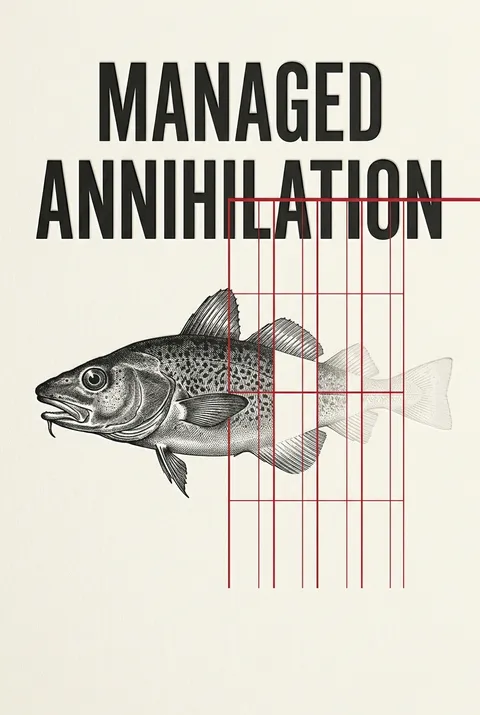
This framework, applied to the cod fishery, transformed a once-teeming sea into a managed annihilation.
2. Management's Genesis: Controlling Nature for Industrial Profit
The slow construction of a manageable cod fishery in response to these economic interests eventually led to the creation of a quantitative fisheries science founded on single-species population modelling.
Industrial imperative. Fisheries management emerged in the late 19th century, driven by the industrial modernization of fishing and the demands of capitalist markets. Investors and governments sought to eliminate natural fluctuations in cod landings, which hindered profitable mass production and industrial development. This marked a shift from accepting nature's cycles to viewing them as problems to be solved.
Scientific domestication. To achieve predictable economic growth, cod had to become a manageable, quantifiable object. This led to the rise of quantitative fisheries science, which conceptualized fish as statistical populations. Pioneering models, like those by Beverton and Holt (Maximum Sustainable Yield, MSY) and H. Scott Gordon (Maximum Economic Yield, MEY), promised to predict and control fish abundance, transforming wild fish into "swimming inventories."
State enclosure. The scientific models, however, required fundamental changes to the centuries-old "freedom-of-the-seas" law. Canada's declaration of a 200-mile Exclusive Economic Zone (EEZ) in 1977 provided the necessary territorial power, allowing the state to "own" cod populations and implement management regimes. This linked scientific knowledge with state authority, creating the illusion of effective control over the fishery.
3. Post-Collapse Paradox: Management Expands, Blame Shifts
The identifi ed problem, that of fi sheries management, reinvented itself as an all-encompassing solution.
Management's resilience. The 1992 cod collapse, despite being a monumental failure of the existing management regime, did not lead to its demise. Instead, fisheries management expanded its scope and reinvented itself, adapting to new economic, political, and scientific contexts. This paradox saw the very instrument of destruction become the proposed solution.
Neoliberal influence. Post-1992, neoliberal policies led to significant budget cuts for the Department of Fisheries and Oceans (DFO), forcing it to "do more with less." The DFO's mandate broadened to include integrated, ecosystem-based oceans management, shifting responsibility for management functions onto industry and local actors. This generalized managerial identities to the entire population, obscuring the state's downloading of responsibilities.
Depoliticizing the crisis. The DFO strategically emphasized environmental explanations, such as climate variability and colder sea temperatures, for the cod collapse. This focus on "natural" and unmanageable factors deflected blame from fisheries managers and industrial fishing practices, legitimizing a program of reformed management rather than a critical re-evaluation of the system. The crisis became an opportunity to expand managerial ecology, albeit with a new emphasis on coping and adaptation.
4. Ecosystem Management: Coping with Complexity, Not Control
The solution to proper management, if it is to be found, will not be through improving science alone.
Beyond single-species. In the wake of the cod collapse, the limitations of single-species management became evident, leading to calls for ecosystem-based fisheries management (EBFM). EBFM acknowledges the complex, non-linear dynamics of marine ecosystems, emphasizing irreducible uncertainty, regime shifts, and the interconnectedness of biophysical and socioeconomic systems. This theoretical shift moved away from confident control towards coping and adaptation.
SOHO systems. EBFM often frames fisheries as "self-organizing, holarchic, open" (SOHO) systems, which are nested, self-organizing, and open to external flows. This perspective highlights:
- Hierarchical nesting: Systems exist within other systems.
- Self-organization: Internal structures and dynamics.
- Openness: Exchange of energy, materials, and information.
Understanding SOHO systems reveals that exact predictions are impossible, and management must focus on influencing, rather than controlling, these complex dynamics.
Precautionary approach. The recognition of complexity and uncertainty led to the adoption of the precautionary principle, though often weakened to a "precautionary approach" in practice. This shift from a strict ethical framework to a utilitarian cost-benefit analysis allowed for continued industrial exploitation, even with scientific uncertainty. While EBFM theoretically expands the scope of management to include all human activities affecting ecosystems, in practice, it often targets human behavior and values, rather than fundamentally altering the industrial way of life.
5. From Fish to Fishermen: Managing Human Behavior
Fisheries management means managing people; not the fi sh.
New targets for management. As wild cod populations proved difficult to manage and recover, the focus of fisheries management shifted from fish to fishermen. This new approach, exemplified by a political cartoonist's image of a scientist examining a fisherman under a microscope, aimed to manage human behavior, values, and beliefs, rather than the unpredictable dynamics of wild fish stocks.
Incorporating LEK (selectively). The DFO began to incorporate "local ecological knowledge" (LEK) from inshore fishermen, previously dismissed as unscientific. Programs like the Sentinel Fishery paid fishermen to collect data using standardized methods, effectively translating their experiential knowledge into quantifiable scientific data. This inclusion, however, was often narrow and did not significantly alter fishermen's decision-making power or challenge the DFO's authority.
Professionalization and privatization. Neoliberal policies encouraged "participatory fisheries governance," where fishermen were expected to take on more management responsibilities and costs. This involved:
- Professionalization: Mandating training and "core" status for commercial fishermen.
- Privatization: Allocating individual transferable quotas (ITQs) to create economic incentives for conservation.
These initiatives aimed to transform fishermen into "self-managing professional fish harvesters" – entrepreneurs operating in a market-driven system, rather than welfare clients dependent on government handouts.
6. Aquaculture: The Ultimate Domestication of Cod
We will domesticate the fi sh over time ... knock them down to a more passive fi sh ... And we’ll have fi sh that will just swim around and graze like a cow ... That’s what we’re all shooting for.
Egg-to-plate control. With wild cod populations endangered, industrial aquaculture emerged as the ultimate managerial solution, promising complete control over the cod's life cycle "from egg to plate." This involves developing cod hatcheries, brood stocks, and even genome projects to engineer fish for marketability. The goal is predictable, year-round production, eliminating the uncertainties of wild fisheries.
Economic viability and risks. Cod farming is expensive and requires large-scale corporate investment, often subsidized by government loans and grants. It aims to sell cod at premium prices in exclusive markets, necessitating a reorganization of processing and marketing. However, it carries significant ecological risks:
- Escapes: Farmed fish can interbreed with wild stocks, transmit diseases, and compete for resources.
- Pollution: Concentrated waste from feed pellets pollutes marine environments.
- Ecological footprint: Industrial aquaculture consumes wild fish (for fishmeal) and agricultural products, exacerbating pressure on global food supplies.
Commodification and enclosure. Aquaculture intensifies the commodification of cod, transforming it into a pure commodity with exchange value, rather than a food source or a living being with intrinsic value. It also privatizes coastal zones, converting collective public property into leased private property for fish farms. This reinforces a market-driven managerialism, where the needs of global seafood markets dictate production, often at the expense of local communities and wild ecosystems.
7. Managerial Ecology's Resilience: Adapting to Maintain Control
More than any other form of knowing or practice, management is claimed to be absolutely nomadic and universally useful.
Management's pervasive nature. Managerial ecology, like other forms of managerialism, presents itself as a neutral, universally applicable solution to any problem. Despite the tragic outcomes in the cod fishery, management has not been abandoned; instead, it has adapted and expanded its reach, selectively incorporating new scientific insights and political demands to reinforce the existing industrial capitalist order.
Shifting targets, enduring goals. When wild ecosystems proved too complex to control, managerial control and caretaking shifted to "manageable" objects: human behavior and domesticated fish. This evolution from high-modern, state-led command-and-control to late-modern, market-facilitated "context steering" maintains the underlying goals of control and caretaking, even if the confidence in achieving them has waned. The focus remains on efficiency and economic growth within the status quo.
Engineering manageability. The new phase of managerial ecology no longer assumes that manageability is an inherent natural law awaiting discovery. Instead, it actively engineers manageability into both cod (through aquaculture) and fishing people (through professionalization and market incentives). This process blunts the critical insights from post-normal science and ecosystem approaches, framing fundamental critiques as opportunities for further managerial reform, rather than questioning the enterprise of management itself.
8. Beyond Management: Embracing Complexity and Moral Action
So much management theory and practice is tunnel-visioned and dangerous – practically as well as intellectually, ecologically as well as culturally.
Renouncing manageability. To move beyond the destructive cycle of managerial ecology, a fundamental shift is required: renouncing the "holy grail of manageability." This means accepting that complex ecosocial systems are, in principle, not fully graspable, knowable, or controllable. This ontological understanding of complexity demands humility, justice, and compassion, rather than a relentless pursuit of control.
Political and moral ecologies. True alternatives require moving from instrumental rationality (how to efficiently achieve ends) to practical rationality (how to live well). This involves:
- Democratic deliberation: Open debate among citizens on what constitutes a "good life" in relation to cod, people, and their ecosystems, rather than relying on expert-driven, consensus-based problem-solving.
- Prioritizing local knowledge: Valuing the engaged, place-based experience of fishermen over abstract scientific constructs.
- Appropriate technology: Questioning industrial fishing technologies that inherently disrupt equitable relations and ecological balance, advocating for methods like baited hook-and-line.
Restoration and food sovereignty. Instead of focusing on maximizing yields for global markets, future fisheries research and policy should prioritize how fishing is done, why it is done, and its ethical and political consequences. This could mean shifting towards restorative fishing practices, local food consumption, and rejuvenating commons. The managed annihilation of cod underscores the urgent need to prioritize heterogeneous knowledge and moral considerations over the relentless pursuit of industrial growth.
Download PDF
Download EPUB
.epub digital book format is ideal for reading ebooks on phones, tablets, and e-readers.








































