
Key Takeaways
Mass delusion follows an eight-step playbook — learn it or fall for it
“Psychological epidemics are created through an exploitative machinery that assaults the mind. It's not natural; it's manufactured.”
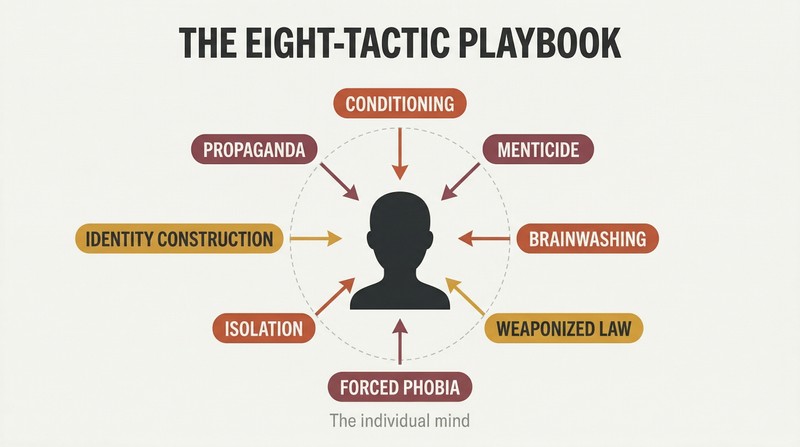
A former CIA analyst's field guide. Buck Sexton — who tracked jihadist radicalization in Nigeria, Iraq, and Afghanistan for the CIA — argues that mass delusion is not random but engineered through eight identifiable tactics: conditioning, menticide, brainwashing, weaponized law, forced phobia, isolation, identity construction, and propaganda. Whether it's Stalinist show trials, Maoist reeducation, or American Covid lockdowns, the same playbook recurs.
The tactics bleed together. Totalitarians rarely use just one. The Soviets combined conditioning with menticide. Mao layered brainwashing with isolation. Today's American Left, Sexton argues, deploys softer versions of all eight — from DEI confessionals to media propaganda — to manufacture compliance without gulags. Recognizing the pattern is the first defense against it.
Beethoven's Germany went insane — no civilized nation is immune
“Anyone who thinks that a society cannot collectively go insane has neither read nor understood the history of our species.”
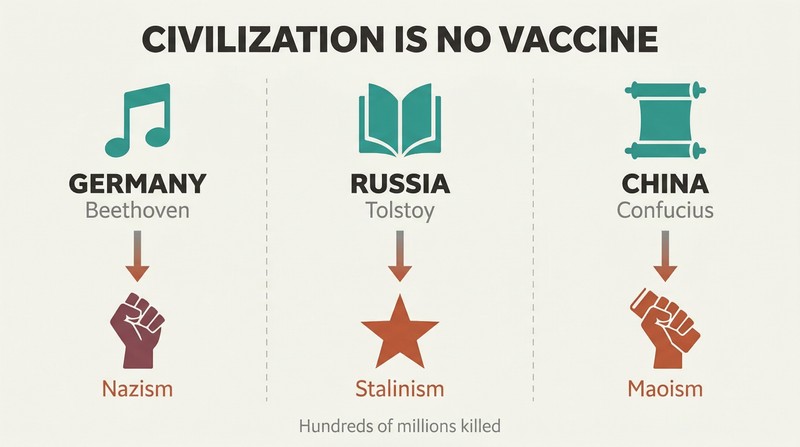
Civilization is no vaccine. Germany produced Beethoven; Russia produced Tolstoy; China produced Confucius. At various points, each nation descended into mass psychosis — Nazism, Stalinism, Maoism — that killed hundreds of millions. Sexton uses these examples to demolish the comforting belief that educated, cultured societies can't be captured by delusion.
The slide is faster than you think. The distance from liberal democracy to autocratic dystopia can be measured in just a few short years, Sexton warns. Well-educated Soviet and Chinese Communists believed their utopian goals justified genocide. The jihadist epidemic Sexton witnessed germinating in Nigeria in 2005 consumed the region within a decade. The totalitarian mindset is a contagious mental illness that can affect anyone, anywhere.
Comply with one manufactured lie and your brain primes for the next
“It was not about following the facts but conditioning us to be obedient to the ruling class.”
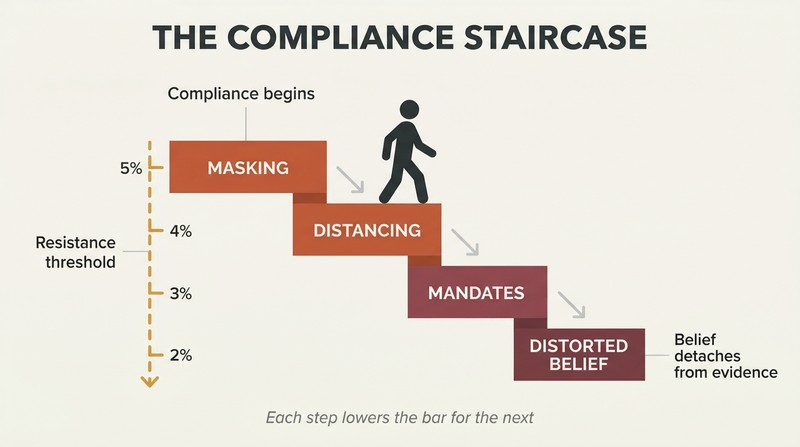
Covid masking was the gateway. Sexton traces modern conditioning back to Pavlov's conditional reflex — training dogs to salivate at a buzzer — then applies it to America's pandemic response. Fauci privately wrote in February 2020 that masks "are really for infected people," and later admitted they work "at the margins — maybe 10 percent." A 2023 Cochrane gold-standard study confirmed masks make "little or no difference." Yet Americans masked for years.
Each compliance lowered the bar. Masking conditioned acceptance of six-foot social distancing (a number Fauci later admitted was made up), which conditioned acceptance of vaccine mandates that didn't stop transmission. By 2021, 41 percent of Democrats believed half of Covid patients needed hospitalization; the real figure was 1 to 5 percent. Belief outran evidence because reflexive obedience had already been trained.
Tyrants don't just want obedience — they systematically kill minds
“After all, you might be willing to die fighting Stalin. But would you be willing to lose your mind?”
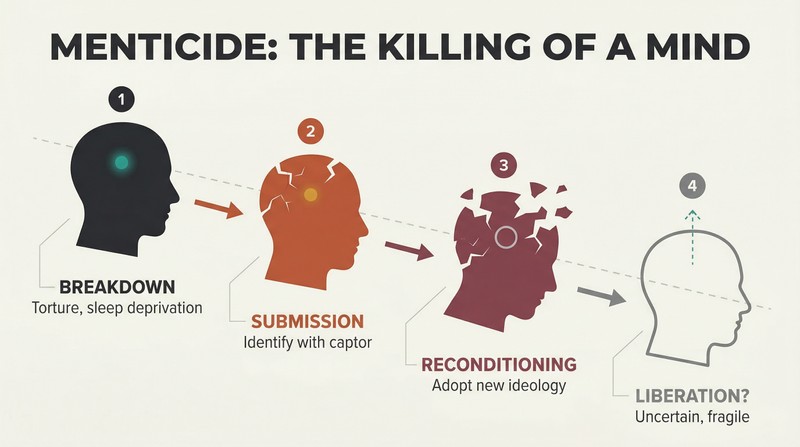
Menticide is the term. Coined by Dutch psychoanalyst Joost Meerloo in 1956, menticide means the organized destruction of a person's capacity for independent thought. Meerloo identified four phases:
1. Artificial breakdown through torture, sleep deprivation, and humiliation
2. Submission to and positive identification with the captor
3. Reconditioning to the new ideological order
4. Possible liberation from the totalitarian spell
Stalin industrialized it. Soviet interrogators used the "conveyor" — days-long questioning timed to destroy sleep patterns — plus stoika, forcing prisoners to stand on tiptoes for hours. The Moscow show trials of the 1930s displayed once-proud Bolsheviks demanding their own execution for fabricated crimes. Their psychological annihilation was the real point: a public warning that nobody's mind was free.
Brainwashing runs on two rails: forced confession, then reeducation
“For people to be controlled, they must be separated from their former self. For people to be remade, they must have a new self imposed upon them.”
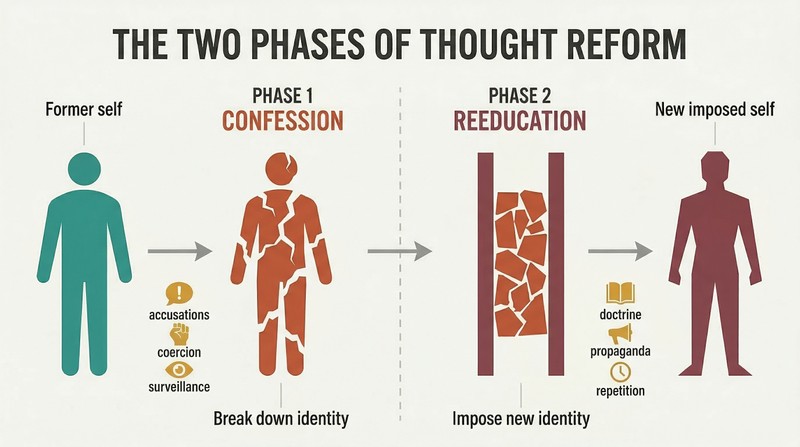
Mao perfected the two-phase system. Psychiatrist Robert Jay Lifton studied Maoist "thought reform" in Hong Kong, interviewing victims like Dr. Charles Vincent, a physician imprisoned for three years. Phase one — confession — involved relentless accusations, beatings, and sleep deprivation until Vincent fabricated guilt. Phase two — reeducation — replaced his broken worldview with Marxist orthodoxy through sixteen-hour daily indoctrination sessions. Vincent eventually adopted "the people's standpoint" and initially defended Communism even after release.
Sexton sees echoes in America. DEI training follows a strikingly similar template: compelled confession of privilege (land acknowledgments, white fragility exercises), then reeducation into antiracist ideology. During the Korean War, twenty-three American POWs became "turncoats" after systematic brainwashing — confessing to fabricated bioweapons crimes and refusing to return home.
Fear is the master key — a terrified mind begs to be led
“A mind at peace is hard to crack. A mind taken over by fear is ripe for manipulation.”
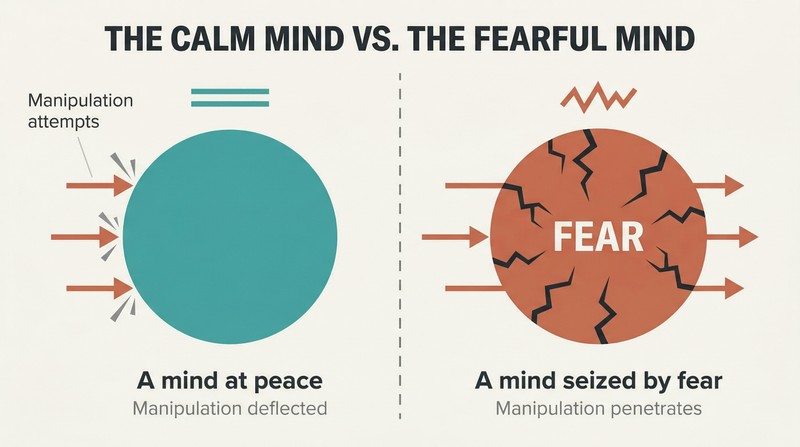
Forced phobia has ancient roots. During the French Revolution's Terror, the Revolutionary Tribunal executed an average of thirty-six people per day. Princess de Lamballe was dismembered by mobs after refusing to denounce her family. The carnage wasn't random — it created a blank slate of terror upon which revolutionaries imposed new ideals. Cult expert Steven Hassan calls the weaponization of irrational fear "phobia indoctrination," the single most powerful technique for maintaining obedience.
Climate catastrophism follows the pattern. Fifty years of debunked doomsday predictions — from the 1970s ice age scare to Al Gore's ice-free North Pole by 2013 — haven't weakened the movement. A 2021 survey found 75 percent of young people are frightened by the future, and 59 percent are extremely worried about climate. Sexton argues this weaponized anxiety primes minds for radical political submission.
Selective law enforcement is psychological warfare, not justice
“You are to suffer from criminals, without protection of the law…And if you cross them politically, the full effect of the law will be brought down on your head.”
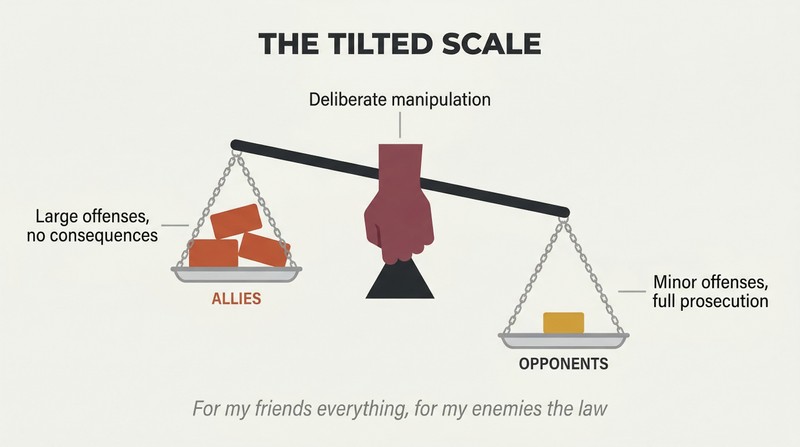
The Nazis wrote 1,900 anti-Jewish laws. Hitler never formally abolished the Weimar Constitution — he corrupted it from within. His Volksgerichtshof court ordered over 5,200 executions in eleven years, including a priest sentenced to death for telling a joke. The randomness of punishment, Sexton argues, was the point: it broke the spirit of opposition across the entire population.
America's version is softer but recognizable. During the 2020 BLM riots, $2 billion in damage was excused while January 6 defendants faced years in pretrial detention for nonviolent offenses. Manhattan DA Alvin Bragg declined to prosecute street criminals while indicting Trump. Sexton sees a Peruvian dictator's maxim at work: "For my friends everything, for my enemies, the law." The double standard itself is the weapon — it teaches citizens that justice depends on political alignment.
Isolation can break a mind in hours — faster than torture
“If a child cannot speak freely to her parents, or wonder aloud, that child becomes a prisoner of her own mind.”
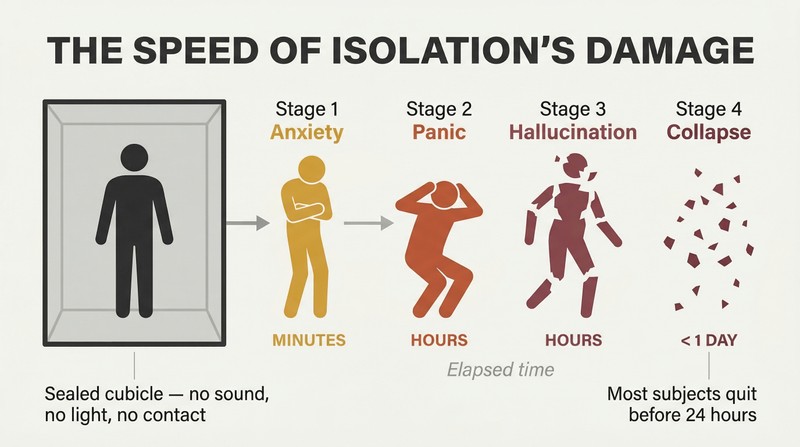
The McGill experiment proved it. When Canadian researchers placed students in soundproof cubicles with minimal sensory input and no human contact, subjects became anxious within minutes, panicked within hours, and hallucinated shortly after. Most couldn't last a full day. The scientists abandoned the program, stunned by the speed of mental collapse.
North Korea weaponizes isolation nationally. The Kim dynasty cuts citizens off from the global internet, executes anyone caught with a Bible, and sentences teenagers to twelve years' hard labor for watching South Korean videos. Defector Yeonmi Park told Sexton her mother warned her as a small girl that even whispering the wrong thing could condemn eight generations of her family. Hannah Arendt called this broader phenomenon "social atomization" — the precondition for totalitarian rule.
Cults, mobs, and ideologies exploit one craving: to stop thinking
“We may tell ourselves otherwise, but the truth is human beings like to be told what to do.”
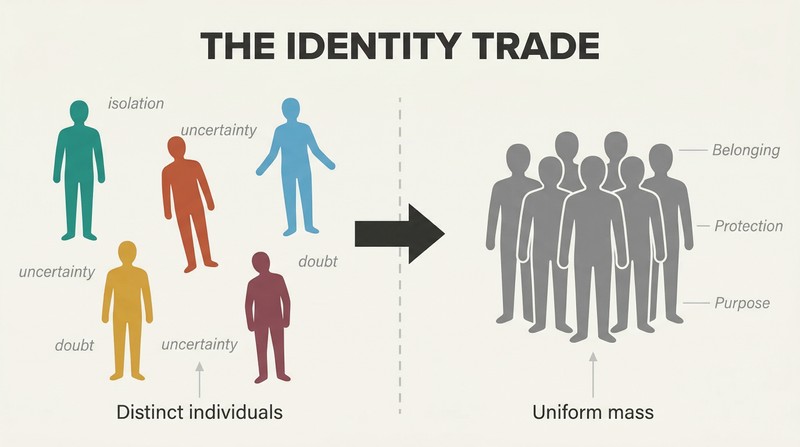
Identity construction erases the individual. Totalitarian movements — from Aum Shinrikyō to Stalinism to BLM — strip followers of individual identity and replace it with group identity. Cults mandate uniforms, Maoists forced conformity to "the people's standpoint," and today's antiracism movement demands confession of privilege as the price of admission. Psychologist Mattias Desmet found that masses believe stories not because they're accurate but because they create a new social bond — a hallmark of mass formation.
The payoff is psychological relief. Meerloo observed that surrendering individuality grants the feeling of belonging, protection, and ecstasy of anonymity. Eric Hoffer noted the less someone can claim personal excellence, the more eagerly they claim it for their group. Saul Alinsky built his organizing playbook on recruiting atomized, isolated people by offering them a prefabricated purpose.
Propaganda works by firehose — repeat lies until truth drowns
“That's the power of propaganda run amok: It is an endless stream of lies, it's everywhere, it's inescapable, and it can make entire societies go crazy.”
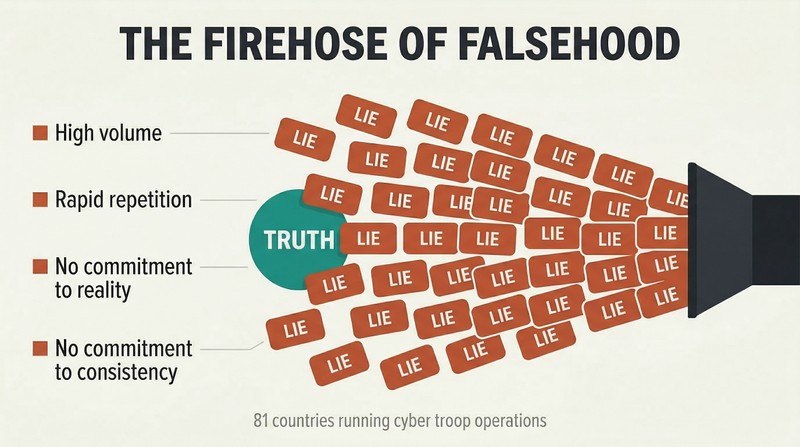
Russia perfected the modern model. A Rand Corporation study identified four traits of Putin's "firehose of falsehood ": high-volume multichannel delivery, rapid and continuous repetition, no commitment to objective reality, and no commitment to consistency. After invading Ukraine, Russian state media relentlessly painted the war as fighting Nazism. The Oxford Internet Institute found eighty-one countries running active cyber troop operations spreading false information.
American media runs a subtler version. Only 3 percent of US journalists identify as Republican, per a 2022 Syracuse University study. After 2014, the words "racist," "racists," and "racism" exploded in frequency at major newspapers. Pew Research showed Americans who viewed racism as a "big problem" nearly doubled from 28 percent to 58 percent between 2011 and 2017. Sexton argues the narrative changed, not the reality.
AI could turn brainwashing from metaphor into neurological reality
“Raised in a lie, human beings could be brainwashed en masse without even knowing it.”
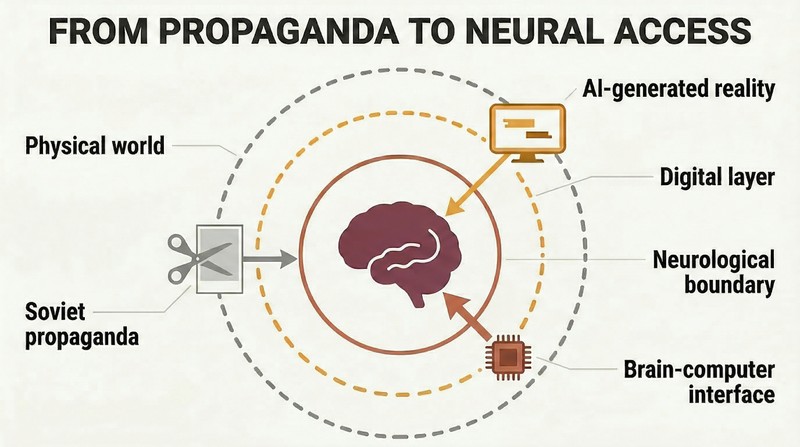
Google's Gemini AI generated a Black George Washington. In February 2024, Sexton tested Google's new image generator and found it depicted the Founding Fathers as black men. Google called it a bug. Sexton sees a preview of AI's capacity to rewrite reality at scale — something the Soviets attempted with razor blades on photographs but could never fully achieve.
Brain-computer interfaces raise the stakes further. Elon Musk's Neuralink has already enabled a human to control a computer mouse with thoughts alone. Sexton warns that if implants can control the physical world, they could eventually wipe or implant memories, bypassing the elaborate psychological manipulation that totalitarians have relied on for a century. The last refuge of autonomy — our minds — faces technological encroachment that previous generations couldn't have imagined.
Analysis
Sexton's intellectual architecture rests on three pillars — Joost Meerloo's The Rape of the Mind, Robert Jay Lifton's Thought Reform and the Psychology of Totalism, and Gustave Le Bon's crowd psychology — supplemented by Hannah Arendt's atomization theory, Eric Hoffer's mass movement analysis, and Steven Hassan's cult research. This is a serious canon of psychological literature that deserves wider popular readership, and Sexton's primary contribution is making it accessible to a mass audience through his personal war-zone narratives.
The book's central rhetorical strategy — drawing structural parallels between totalitarian regimes and contemporary American progressivism — is simultaneously its greatest asset and most vulnerable flank. The eight-tactic framework illuminates historical totalitarianism brilliantly: the Meerloo phases of menticide, Lifton's confession-and-reeducation model, and the Rand Corporation's firehose analysis are genuinely useful analytical tools. But the framework strains when equating Soviet gulags with campus DEI seminars, or Maoist struggle sessions with land acknowledgment statements. Sexton acknowledges the gap in intensity ('we're far from the gulags'), yet the book's entire architecture implicitly flattens it.
That said, Sexton raises legitimate concerns that transcend partisan framing. The Covid-era double standard — shuttering churches while endorsing mass BLM protests — was a documented inconsistency that public health officials never adequately justified. The social pressure to affirm biological falsehoods about sex is a real phenomenon observable across institutions. The selective prosecution of political opponents is genuinely dangerous to democratic norms. The book's most original chapter is its conclusion on AI and brain-computer interfaces. Most political books about propaganda stop at social media. Sexton's intelligence background lends credibility to warnings about technological mind control that could bypass persuasion entirely. For readers skeptical of his partisan lens, the eight-tactic framework still offers a historically validated toolkit for recognizing psychological manipulation — whether it comes from left, right, foreign, or algorithmic sources.
People Also Read

Glossary
Menticide
Systematic destruction of independent thoughtTerm coined by Dutch psychoanalyst Joost Meerloo in 1956 to describe the organized psychological process by which a totalitarian regime destroys a person's capacity for independent thought. Meerloo identified four phases: artificial breakdown, submission to the captor, reconditioning to new ideology, and possible liberation. Distinguished from brainwashing in that menticide focuses primarily on destroying the old mind rather than building a new one.
Conditional reflex
Trained automatic response to stimuliIvan Pavlov's foundational concept in behaviorism: a physiological or psychological response conditioned through repeated association with a stimulus. Pavlov demonstrated this by training dogs to salivate at the sound of a buzzer associated with food. Sexton uses the concept as the scientific root of all modern mind-control tactics, arguing that Covid-era mandates functioned as conditioning tools to train reflexive obedience.
Thought reform
Maoist brainwashing through confession and reeducationThe official Chinese Communist term (szu-hsiang kai-tsao, or 'ideological molding') for Mao's program of systematic brainwashing. As studied by psychiatrist Robert Jay Lifton, thought reform consists of two phases: confession (the exposure and renunciation of past 'evil') and reeducation (remaking the person in the Communist image). Applied across all of Chinese society and used on American POWs during the Korean War.
Firehose of falsehood
High-volume, rapid, contradictory propagandaA propaganda model identified in a Rand Corporation research paper by Christopher Paul and Miriam Matthews, describing Russia's modern information warfare approach. Characterized by four traits: high-volume and multichannel delivery, rapid and continuous repetition, no commitment to objective reality, and no commitment to consistency. The model overwhelms the target's ability to process or fact-check information.
Phobia indoctrination
Weaponizing irrational fear for controlTerm used by cult expert Steven Hassan to describe the tactic of instilling irrational fears in followers to maintain their dependence and obedience. Hassan called it 'the single most powerful technique for keeping people dependent and obedient.' Sexton applies the concept broadly to climate catastrophism, pandemic fearmongering, and the historical use of terror by regimes from Revolutionary France to North Korea.
Social atomization
Isolation that enables totalitarian ruleHannah Arendt's concept from The Origins of Totalitarianism describing the condition in which individuals are disconnected from normal social relationships, lack self-esteem, and are psychologically isolated—even within a crowd. Arendt argued that atomization provides the mass basis for totalitarian rule, as isolated individuals become susceptible to ideological movements that promise belonging and purpose.
Mass formation
Crowd hypnosis enabling collective delusionA concept rooted in Gustave Le Bon's crowd psychology and updated by Mattias Desmet in The Psychology of Totalitarianism. Describes a state of widespread psychological absorption in which individuals surrender critical thinking to group identity. Desmet's key insight is that 'the masses believe in the story not because it's accurate but because it creates a new social bond.' In mass formation, truth becomes irrelevant; belonging is the goal.
Milieu control
Monopolizing a subject's informational environmentRobert Jay Lifton's term for the tactic in which cults and totalitarian regimes monopolize all communication, including an individual's inner communication. By controlling the environment ('milieu' is French for environment), those in power prevent or erase contradictory inputs into the mind and replace them with schematics of their own design. Used in settings from Maoist prison cells to cult compounds.
Loading of the language
Restricting vocabulary to enforce ideologyRobert Jay Lifton's term for the tactic in which words are limited to those that affirm prevailing ideological claims. All private perceptions must be subordinated to doctrinal language. Examples include replacing 'breastfeeding' with 'chestfeeding,' mandating preferred pronouns, or banning the term 'illegal alien.' Every time followers communicate using loaded language, they reinforce their submission to the ideology.
Cult of passivity
Comfort-induced vulnerability to mind controlJoost Meerloo's term for the state in which an overly comfortable, entertainment-saturated society becomes psychologically vulnerable to manipulation. Meerloo warned that 'silence, lonely relaxation—with alcohol, sweets, the television screen' could soothe the mind into a passivity exploitable by ideological enemies. Sexton updates the concept for the era of streaming services, food delivery apps, and smartphones.
Indoctrination barrage
Relentless ideological pressure on subjectsMeerloo's term for the constant pressuring of a subject with ideological orthodoxy during the process of menticide or brainwashing. The volume of messaging is intentionally overwhelming—designed to flood the brain's synapses and weaken resistance. The concept parallels the firehose of falsehood used in public propaganda but applied at the individual level during captivity or intensive indoctrination programs.








































