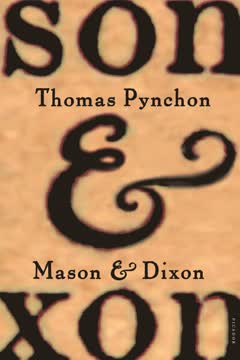
Plot Summary
Christmas on Market Street
The story opens in wintry 1786 Philadelphia, in a household whose kitchen bustles with holiday scents and youthful banter, all shadowed by war's legacy and fragile peace. The Reverend Wicks Cherrycoke, the family's odd, lingering uncle, holds his place by telling rich, sprawling tales, while remembrances of lost friends, particularly the late surveyor Charles Mason, mix with unresolved resentments and haunted memories. The lines that once divided colonies now trace intimate fractures across family and nation, as the new republic stirs unsurely. Hopes, regrets, and traces of vanished glory swirl, reflected in a family mirror and a snow-bound city that feels at once insular and filled with distant, unspoken possibility.
Astronomers and Surveyors Meet
Charles Mason and Jeremiah Dixon, both tentatively recruited for a scientific mission, exchange letters full of self-doubt and cautious courtesy, revealing their backgrounds: Mason, astronomer of some renown but personal tragedy; Dixon, skilled land-surveyor and Quaker with a reputation for both conviviality and violence. At their first awkward meeting in Portsmouth, subtle judgments lurk under friendly banter as provincial and metropolitan attitudes collide. Sharing drink and jokes, they sift through mutual misapprehensions, their destinies clearly entwined though both feel out of place, improvising their roles as gentlemen, scientists, and perhaps soon, friends on a world-altering venture.
Orders from the Crown
The two men receive their assignments: travel by naval frigate to Sumatra to observe a rare astronomical event. In the coaching inns and bustling docks, warnings and superstitions mix with official expectations. Eccentric prophecies from soothsayers, ambiguous omens, and the intrigues of British society weigh on the mission. Amid bureaucratic squabbles, best intentions slip into confusion: war, weather, and politics intervene, foreshadowing that science alone will not determine the journey. Mason and Dixon realize that the mechanics of command, rank, and negotiation are as tricky as any measurement to be made.
Towards Sumatra, Aborted
Their ship, the Seahorse, embarks into dangerous, contested waters. The panic and violence of a sudden battle with a French ship of war shakes both their confidence and trust. In the chaos of cannon and carnage, each man finds his measure of cowardice and courage. The event leaves Mason and Dixon uncertain of their place in any greater plan—divine, royal, or merely accidental. Survival feels at once miraculous and hollow. When a letter from London rebukes them for perceived cowardice, personal and institutional betrayals deepen, but so too does their unexpected dependence on each other.
The Frigate Battle
In the aftermath, Mason and Dixon wrangle with meaning, haunted by loss, exhausted and unable to sleep, repartee masking wounds. Trust between them has been tested rather than sealed. The scientific mission—recast now from Sumatra to the Cape—becomes their penance and their rebirth. The weight of imperial indifference, the caprices of authority, and the body count of imperial projects lurk behind every joke and logistical debate. Trust in each other slowly, painfully, begins, but never become absolute.
Cape of Good Hope Nights
Aboard ship and in South Africa, Mason and Dixon become foreigners seeking station and purpose among Dutch settlers, slaves, and longing for comfort and adventure. Mason, grieving his wife Rebekah, is beset by erotic temptations and guilt. Dixon, at ease among slaves and Malays, draws suspicion and envy for his genial ways across color lines. Both men drift through nights of lust, ghost stories, and cross-cultural encounters, only dimly aware that personal escapades mirror grim hierarchies and colonial injustice at every turn.
Between Slavery and Science
While charged to observe, record, and mark precise measurements for 'History's sake,' Mason and Dixon see everywhere the scars of slavery, settler exploitation, and the rituals binding domination and resistance. Mason's melancholy grows as his sense of science's purity is corrupted by the daily realities of forced labor and the commerce of bodies. Dixon tries to reconcile Quaker origins with local custom, joking but never truly at ease, both men acutely aware that their instruments—and presence—serve profit as much as knowledge.
Transit of Venus Observed
After months of delay and disruption, Mason and Dixon, aided by locals of many faiths and tongues, finally observe the transit of Venus across the sun. Their awe and scientific joy is genuine, producing new understandings for Europe and a record of rare international cooperation. Yet the moment is brief, and once the scientific observations are complete, old appetites and conflicts—among whites, among slaves, and within the two men themselves—resume. The harmony of the cosmos seems to mock the divisions below.
Shadows over Philadelphia
Landing in Philadelphia, Mason and Dixon step into a world as contentious as any they've known: sharp class boundaries, hucksterism, racial hierarchies, and revolutionary rhetoric. Their work to clarify the boundaries between Pennsylvania and Maryland—amid riots, political debates, and near-anarchy—shows them that lines are never merely scientific. Violence, suspicion, and the shadow of slavery persist. Amid the intellectual ferment, they meet Franklin and other luminaries, but discover that their actions, witting or not, are deeply political.
The Tangent Puzzle
Charged with solving the geometric riddle of the Tangent Line—how to properly draw a dividing boundary—Mason and Dixon navigate a thicket of competing claims, local absurdities, and cunning lawyers. The science itself becomes obscured by politics, by endless "solutions" from amateur mathematicians and interested clergy. Each step in the wilderness marks not just space but social rearrangement. Even as their technical project nears success, both men sense the fictions underpinning all boundaries—personal, national, and metaphysical.
The West Line Laid
With a band of axemen, cooks, and odd associates, the pair push west through forest and field, widening a line that is more than physical: it becomes a spectacle, an engine of settlement, a disruption of old orders. Encounters with settlers, rivals, land-claimers, and indigenous people grow stranger. The further west the Line advances, the less their science can explain. The party fractures and reforms as hardships mount. The West, once imagined as a paradise by Mason, is ever receding and full of ghosts.
Surveying the Edge
At the Allegheny divide and the "Warrior Path," Mason and Dixon confront resistance: both from native nations unwilling to permit the Line's transgression and from natural and existential hazards. Death, madness, and the sense that the work is no longer theirs to control force them to confront defeat. Rather than triumph and transformation, they experience only exhaustion, the dissolution of their company, and the queasy awareness that their Line may serve purposes they never intended.
Love, Loss & Longitude
For Mason, the memory of his wife and broken family at home grows ever more insistent, shaping dreams and maybe madness. Dixon, drawn home by loss, also finds himself bound by love, habit, and the responsibilities that define him. The physical act of surveying—measuring space and time—collides with all that cannot be mapped: love, death, grief, and belonging. The narrative winds together personal and cosmic arcs—the quest for longitude (a way of knowing one's place) a metaphor for all they seek and cannot finally find.
Slaves, Lines, and Boundaries
Mason and Dixon, by now more complicit than innocent, witness and sometimes challenge the brutal reality of American slavery. A violent confrontation in Baltimore, in which Dixon intervenes to protect enslaved people, brings their sense of justice into conflict with public legality and their own complicity as "Hirelings." Boundaries—social and literal—prove lethal for many; the line they draw is a conduit, not just for science but for evil, greed, and division. The dream of pure measurement collapses under its human cost.
Encounters in the Wilderness
As they move through haunted woods, ancient mounds, and uncanny American landscapes, the men are trailed by legends and myths—ducks that cannot die, spectral surveyors, restless golems, and tales of boundary curses. Each tale reveals how history, story, and science are inseparable, each new encounter a reminder of forgotten or excluded worlds. The surveyors begin to question the entire project, sensing they are no longer drawing lines but being drawn by them.
Dying Westward Dreams
With the boundary halted by political and native resistance, their company disperses. Lost friends and lovers recede into memory and myth. The surveyors labor through swamps and illness toward a conclusion that feels like defeat, all the while haunted by the knowledge of what, and whom, their work has cost. They complete the degree measurement in Delaware, their subtlest and least heroic work—symbolic penance for what cannot be undone.
Meeting at the Meridian
Home in England, Mason and Dixon meet one last time. Mason, broken and melancholic, finalizes his life's work, haunted by loss and the fading light of science. Dixon, suffering illness, domesticates his own wildness and stays put, reflecting on the abundance and responsibilities at home. Their partnership—one scientific, one practical; one melancholic, one convivial—finds closure as they plan to meet again, dream of further expeditions, and accept that life inexorably closes its circles.
Echoes and Farewells
In the twilight, children and old friends reminisce. Legends and ghosts—of lines drawn, loves lost, boundaries fixed and broken—recur. Mason dies in exile, haunted and ambiguously at peace, his work unfinished, children half-American, his friend lost to death and memory. Their story, scattered through tales, jokes, and rumors, remains unfinished: in myth, in restless American history, and in the lines—real and imagined—that still divide brother from brother and self from world.
Analysis
Mason & Dixon is, at once, an epic of science and a lament for all that boundaries cannot contain or repair. Pynchon's irreducible, teeming narrative shines its light on the Enlightenment's paradox: how the very impulse toward knowledge, clarity, and order makes possible untold violence, slavery, and division. The book is structured around failed boundaries—between men and women, nations, races, ideas, and even between the living and the dead. At its heart is the relationship of Mason and Dixon, whose talents and failings, quirks and hungers, make them both grandly significant and poignantly human. Their long wandering draws a line that simultaneously empowers destruction and possibility, enclosure and freedom, science and myth. As Pynchon retells the creation of one of America's foundational boundaries, he insists that every measurement, every "fact," is unstable—contingent on story, perspective, and the multiplication of voices (comic, tragic, and mythic) that crowd each page and echo through history. The novel unmasks the fantasy of purity—whether in science, memory, or identity—offering, instead, the ambiguous rewards of friendship, humor, and compassion, even as the world makes and unmakes itself along lines both visible and unseen. Its wisdom for modern readers is to question every border, to bear witness to all the ghosts such lines invoke, and to be suspicious of every story that claims to be the only truth.
Review Summary
Reviewers overwhelmingly praise Mason & Dixon as a masterpiece of American literature, lauding Pynchon's breathtaking prose, rich historical research, and masterful blending of fact, fantasy, and humor. Written in an 18th-century style, the novel follows surveyors Mason and Dixon through colonial America, exploring themes of friendship, boundaries, slavery, and national identity. Readers highlight its unforgettable characters, philosophical depth, and brilliant comedy, including a talking dog and mechanical duck. While some find it demanding, most consider it among the greatest novels ever written.
People Also Read
Characters
Charles Mason
Mason, an astronomer of considerable skill but deep sadness, is defined by grief for his wife Rebekah and an elusive search for order—both cosmic and personal. Intelligent, precise, but often paralyzed by self-doubt, he navigates scientific and political worlds with a mistrust that borders on paranoia. His relationships—with family, institutions, and Dixon—are shadowed by a sense of being always displaced, a guest in his own life. His emotional arc is a struggle between the demands of duty and the wounds of the heart, scientific clarity and existential confusion. Though outwardly rational, Mason is driven by haunting, dreams, and memories he can neither control nor escape. He ends his life in twilight, his legacy both foundational and fugitive.
Jeremiah Dixon
Dixon is a land-surveyor, Quaker-honed and Northern-born, mastering both the mathematics of measurement and the practical arts of camaraderie. Outwardly genial and brave, he carries his own shadows: expulsion from his faith, guilt for serving empire, and a gnawing sensation that he is always the second man. His relationship with Mason—by turns comic, contentious, and intimate—forms the emotional spine of the story. Dixon's psychological resilience, appetite for pleasure, and sometimes-violent streak contrast Mason's melancholia. Yet Dixon, too, is unsettled by the moral ambiguity of his work, haunted by home and unable, ultimately, to heed the call of America.
Reverend Wicks Cherrycoke
The Reverend is part narrator, part unreliable witness—an outcast from his family and England, preaching and spinning tales as his passport to belonging. Through a blend of fable, satire, and confession, he shapes the story's tone, foregrounding the constructedness of all history. His position as both participant and observer allows for meta-commentary and comic relief, while also surfacing the sadness and absurdity of a world built on violence, exclusion, and the constant re-drawing of boundaries—moral, social, and literal.
Captain Smith
Captain Smith, of the Seahorse, embodies the contradictions of 18th-century British authority: learned, well-intentioned, yet out of sync with the times. Caught between the bloodiness of his profession and aspirations to scientific progress and reason, he becomes a casualty of bureaucratic indifference, the violence of empire, and the unpredictable workings of fate. His fate forms a potent symbol of doomed idealism in a world ruled by commerce and conflict.
Dixon's Family (Mary Hunter, Meg Bland, Daughters)
Dixon's family represents the tension between worldly adventure and domestic fidelity—a microcosm of his divided soul. They embody the cost of wandering and the magnetic pull of home, love, and responsibility, even as Dixon's plans for return to America are perpetually postponed. Meg Bland in particular, by finally refusing to wait for Dixon, underscores his limits and the costs of desire failing to coincide with duty.
Mason's Family (Rebekah, Mary, Sons)
Mason's first wife Rebekah, through death and memory, is the central absence in his life. Her ghost shapes his every relationship. Later, Mary, his second wife, and their children, especially Doctor Isaac, represent both a chance for renewal and the impossibility of true return. The arc of loss—of mother, home, even one's own story—is replayed across generations.
Learned English Dog (Fang)
The "learned English dog," sometimes named Fang, offers both comic relief and philosophical bite—a talking animal whose survival turns on understanding human cruelty. Across incarnations and settings, Fang is the mythic survivor, a Scheherazade among beasts, teaching men their own humanity and mortality through fable and suffering.
Captain Zhang
Captain Zhang, the mysterious Feng Shui expert, dramatizes the conflict of Western rationality versus mystical, holistic systems. Tailed by his own nemesis, the Jesuit Zarpazo, Zhang's presence exposes the limits of Enlightenment reason and the violence of imposing Euclidean, straight-line order upon living landscapes. Psychologically, Zhang is forever the liminal figure—caught between worlds, his wisdom as much a threat as a blessing.
Captain Shelby
Captain Evan Shelby, surveyor, judge, and eccentric, is emblematic of the American wilderness: full of energy, legal ambiguity, and bravado. At once a neighbor, trickster, and petty tyrant, he straddles borderlines, mediates disputes, and becomes a living boundary personified. His pugnacity and wild wisdom reveal both the potential and the danger of frontier justice.
Timothy Tox (the Poet)
Tox is Pynchon's send-up of the epic poet, author of the Pennsylvaniad, and self-appointed chronicler of American heroism. His bombastic verse, pivoting between satire and prophecy, mirrors the nation's dream of itself—encompassing both utopian hope and underlying violence.
Plot Devices
Nested Narrative and Multiple Perspectives
Mason & Dixon is framed as a tale told by Reverend Cherrycoke, full of digression, embellishment, and competing voices. The nested, recursive structure foregrounds both the unreliable nature of "history" and the power of storytelling to shape reality. Complicated narrative frames dissolve boundaries between fact, myth, and satire, constantly destabilizing authority and truth.
Satire, Parody, and Anachronism
The novel abounds in pastiche: faux 18th-century language, epic poetry parodies, picaresque adventure, romantic opera pastiche, and comic ballads. Satirical riffs on law, philosophy, science, and bureaucracy both locate the book in its era and speak playfully to present-day anxieties—about progress, reason, and empire.
Allegorical Plotting & Symbolism
The literal line drawn by Mason and Dixon becomes the recurring symbol of all sorts of divisions—national, racial, class, gender, metaphysical. Every key event—scientific observations, battles, dreams—recapitulates the search for, and the failure of, pure divisions. Golems, talking animals, automata, and haunting ghosts stand for both the wonders and the wounds of Enlightenment ambition.
Magical Realism and Genre-bending
Time-traveling talking dogs, immortally flying ducks, mysteriously immortal Gnomes, and impossible vegetables punctuate the action, undermining the promise that geometry or science can capture reality. Conspiracies—Jesuit and otherwise—loom as both satirical and sincerely menacing.
Metafiction and Self-Reflexivity
Characters comment on their own roles, on the nature of narrative, and the unreliability of all records. "Missing" eleven days of the calendar, letters unsent or lost, and tales told only in song, all foreground the constructedness and contingency of "history."
Foreshadowing & Recurrence
Signs, dreams, omens (and omens misread) pervade the text, reminding reader and characters alike that lines—whether drawn on the land or in story—can neither guarantee control nor forestall tragedy. Love lost and gained, war, and scientific "progress" are all entwined with personal and political consequences.








































