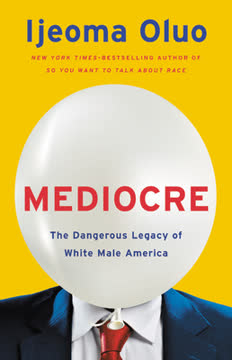
Key Takeaways
1. White Male Supremacy: A System Designed to Oppress
Although the phrase may seem alarmingly coldhearted, it is our way of reminding ourselves that the greatest evil we face is not ignorant individuals but our oppressive systems.
Systemic oppression. White male supremacy is not merely about individual acts of bigotry but a deeply embedded societal design that prioritizes white men, regardless of their actual skill or talent. This system ensures white men hoard power in government, justice, and media, perpetuating the idea that their leadership is inherently superior. It's a design that consistently works to their benefit.
Brutal mediocrity. This isn't a benign form of mediocrity; it's a brutal one that maintains a violent, sexist, and racist status quo. It conditions white men to believe their superiority is a birthright, disincentivizing genuine effort and imagination. This expectation of greatness, divorced from quantifiable achievement, requires the forced limitation of success for women and people of color.
Universal harm. The rewarding of white male mediocrity harms everyone. While it limits white men's drive, it necessitates the suppression of women and people of color, who must often be exceptional just to "get by." This system ensures that those most violently harmed are often queer, transgender, or disabled individuals within marginalized groups, as their identities further challenge the established hierarchy.
2. The Myth of the White Male Hero: Fabricated Villains and Violent Expansion
Mediocre white men who want to be heroes too often feel the need to fabricate villains to justify their imagined role—even if that means vilifying entire populations of people.
Invented heroism. The myth of the American cowboy and westward expansion was built on fabricated heroism and the dehumanization of Native Americans. Figures like Buffalo Bill invented their own legends, dramatizing violent acts like scalping (a practice historically used by Europeans) to portray Native people as barbaric villains. This narrative justified the violent conquest of land and the extermination of Indigenous populations.
Manifest Destiny. This mythology, popularized through dime novels and Wild West shows, inspired figures like President Theodore Roosevelt, who saw the West as a place to be "won" by white Americans. Roosevelt's policies, including the creation of national parks, were often illegal land grabs from Tribal Nations, justified by the belief that Native people would be "exterminated" or unable to adapt to modern life.
Entitlement and destruction. The Bundy brothers, tracing their lineage to Mormon settlers, embody this continued entitlement, battling the federal government over public lands they believe are rightfully theirs. Their actions, fueled by anti-government sentiment and often veiled racism, demonstrate how the "cowboy" archetype continues to justify ravaging the environment and exploiting Native people, even at the cost of broader societal well-being.
3. Co-opting Progress: White Men in Social Justice Movements
But ultimately, if a white man’s abuses are discovered and he’s no longer able to freely center himself or to elevate himself above those he feels entitled to oppress, he will often completely reject his previous declarations of allyship.
Self-serving allyship. White men often enter social justice movements, like early socialist feminism, not out of genuine commitment to equality but for personal gain, such as sexual liberation or intellectual validation. Figures like Floyd Dell and Max Eastman championed women's freedom as a means to men's freedom, often critiquing women who prioritized their own needs.
Hypocrisy revealed. When their privilege is challenged or their abuses exposed, these "allies" frequently abandon their progressive stances. Dell, after an unhappy "liberated" marriage, renounced free love and working mothers, advocating for traditional gender roles. Eastman, disillusioned by Soviet communism, became a staunch anti-communist, even supporting McCarthy's persecutions, demonstrating a consistent pattern of prioritizing self-interest over stated ideals.
Undermining movements. This pattern continues today, as seen with "Bernie Bros" who, despite supporting a progressive candidate, often target women and people of color with vitriol when their political opinions differ. Joe Biden's shifting stance on busing, from supporting it to vehemently opposing it to secure white votes, exemplifies how white male politicians can legitimize racist excuses and undercut efforts for racial justice when it serves their political careers.
4. Higher Education: A Tool for Elite White Male Power
Our college campuses may not have been terribly concerned with elevating the poor white man over the poor Black woman, but they were definitely obsessed with preserving white male elite power at the top of the social and political ladders.
Elite gatekeeping. American universities, initially religious colleges for wealthy white men, evolved to preserve elite white male power. Harvard's President A. Lawrence Lowell, for instance, implemented policies to limit Jewish enrollment, fearing they would "drive away the Gentiles." This historical gatekeeping ensured that higher education remained a bastion of privilege.
Racist foundations. The Scholastic Aptitude Test (SAT), developed by eugenicist Carl Brigham, was designed to screen for "intelligence" but primarily measured English proficiency and familiarity with white culture. Despite Brigham's later repudiation, the SAT persists as a primary admissions test, consistently disadvantaging poor students and students of color, thus perpetuating its racist origins.
Political weaponization. Today, higher education faces attacks from the political right, led by figures like Donald Trump, who demonize colleges as "tax eaters" and "brainwashing" institutions. This rhetoric, despite Trump's own elite education, appeals to white voters without college degrees who feel threatened by increasing diversity and skilled labor demands, effectively weaponizing resentment to consolidate political power.
5. Bitter Dependency: White America's Exploitation of People of Color
The white man who emails me to tell me that my people are a drain on society wouldn’t have a computer without Black and Asian people—not the machine, the electrical components, or the math in its programming.
Manufactured fear. White American identity has always been bitterly and unhealthily bonded to Blackness, using people of color as convenient scapegoats for life's disappointments. Despite white Americans being more likely to be harmed or lose jobs to other white people, messaging consistently claims the opposite, fueling fear and resentment. This manufactured fear is a profitable distraction from systemic issues.
Self-defeating racism. The Great Migration saw over six million Black Southerners move North, seeking jobs, education, and safety from post-Reconstruction terror. Southern white leaders, terrified of losing cheap labor, initially tried to prevent this exodus through violence and economic coercion. Their eventual failure to adapt and their insistence on maintaining white supremacy ultimately devastated the Southern economy, leaving it with stagnant growth and high poverty rates.
Northern hypocrisy. While the North often prides itself on being less racist than the South, it too engaged in violent segregation. The "Red Summer" of 1919 saw widespread anti-Black riots in Northern cities, and racist housing covenants systematically pushed people of color into overcrowded, under-resourced neighborhoods. This deliberate segregation created concentrated poverty and wealth gaps that persist today, proving that racism is a national, not just a Southern, problem.
6. Workplace Hostility: Undermining Women's Professional Potential
The power and ego of entitled white men—who maintain firm control of the vast majority of government offices, manager’s offices, corporate boards, and other realms of leadership—remain the biggest obstacles that most women face in their careers.
Designed exclusion. For centuries, men have designed workplaces to exclude women, establishing work hours that conflict with child-rearing and networking opportunities in male-only spaces. This deliberate structuring reinforces the idea that women are "not a fit" for professional roles, masking systemic barriers as natural differences.
Exploitation and devaluation. During the Great Depression, women were blamed for male unemployment, despite working in different, lower-paid fields. During WWII, women were recruited as patriotic duty, but propaganda ensured they would "happily" return home after the war. Post-war, millions of women were fired or demoted, and the GI Bill largely excluded them, funneling white men into newly created, higher-paying jobs.
The "glass cliff." Women who do reach leadership positions often find themselves on a "glass cliff," appointed to distressed companies where the risk of failure is high. When they fail to quickly turn around these struggling businesses, they are often replaced by white men. This pattern, seen with figures like Jill Abramson and Marissa Mayer, allows white men to avoid accountability for failures while blaming women for them.
7. Political Backlash: Women of Color Challenging the Status Quo
I am the candidate of the people of America.
Unfair scrutiny. Women of color in politics face immense scrutiny, dismissal, and hostility for daring to challenge white male supremacy. Shirley Chisholm, the first Black woman elected to Congress and a presidential candidate in 1972, was ridiculed as "playing vaginal politics" and received death threats, while mainstream media dismissed her broad appeal.
Silencing dissent. Lani Guinier, nominated to head the Civil Rights Division in 1993, was branded a "Quota Queen" for her academic ideas on cumulative voting, a system designed to increase minority representation. Despite her explanations, she was demonized as a threat to white power, leading to her nomination being withdrawn by her friend, Bill Clinton, who claimed he hadn't read her work.
Modern targets. Today, figures like Alexandria Ocasio-Cortez, Ilhan Omar, Rashida Tlaib, and Ayanna Pressley face similar torrents of hatred and bigotry for their progressive agendas. They are called "too radical" and "divisive" for advocating for their marginalized communities, even as their ideas address critical national issues like climate change, healthcare, and criminal justice reform.
8. Exploiting Black Bodies: The Racial Dynamics of American Football
You are six foot three, 280 pounds. You’re running forty yards in 4.5 seconds, and fans, white fans, view these NFL players as half god, half chattel.
White male ideal. American football was created in the Ivy League to cultivate strength and aggression in wealthy white men, an ideal so brutal it caused dozens of deaths annually. This "Muscular Christianity" reinforced white male dominance, leading to the exclusion and violent targeting of Black players like Paul Robeson and Jack Trice in its early days.
Segregation's grip. From 1934 to 1946, the NFL unofficially banned Black players, largely due to the influence of figures like George Preston Marshall, owner of the Washington Redskins. Marshall, a committed racist, leveraged his team's Southern appeal to maintain segregation, only integrating when forced by the federal government, highlighting how racism was prioritized over talent and success.
Controlled labor. Modern football, despite its Black majority players, continues to exploit Black bodies. Players risk life-altering injuries for limited financial security, while white owners and managers maintain control. When players like Colin Kaepernick and Michael Bennett protest racial injustice, they face blacklisting and retaliation, demonstrating how the sport, born from white male power, still works to suppress Black agency and dissent.
9. The Cost of Mediocrity: White Manhood's Self-Destructive Path
Nobody is more pessimistic about white men than white men.
Despair and rage. White male identity, as currently constructed, is in a dark place, leading to widespread despair, disappointment, and rage. White men are told they should be successful and powerful, but when they fall short, they often blame others or themselves. This can manifest as violent acts like mass shootings (70% by white men) or self-harm (70% of suicides are white men).
A "suicide mission." This identity, tied to conquering and competition, fosters a desolate loneliness, where love and belonging are elusive. The belief that success must come at the expense of others traps white men in cycles of fear and violence, making them resistant to change and convinced that the only options are maintaining the status quo or death.
Breaking free. To escape this self-destructive path, society must challenge the violent definitions of white manhood and value empathy, kindness, and cooperation. This requires questioning societal norms that uphold white male supremacy and divorcing ourselves from the lure of proximity to white male power. It's a monumental shift, but necessary to imagine a healthier white manhood and a more just future for all.
Review Summary
Reviews of Mediocre are polarized. Supporters praise Oluo's accessible writing, historical analysis, and intersectional examination of white male supremacy's damaging legacy across politics, education, and culture. Many find it timely, eye-opening, and passionately argued. Critics, however, take issue with selective use of evidence, lack of consistent citations, and perceived bias—particularly in the Bernie Sanders chapter. Some feel the book preaches to the converted rather than persuading skeptics, while others object entirely to its premise. The overall Goodreads rating of 4.39 suggests it resonates strongly with its core audience.
People Also Read