
Key Takeaways
1. True sovereignty and authority must originate from a transcendent, spiritual source
The foundation of every true State is the transcendence of its own principle, namely the principle of sovereignty, authority, and legitimacy.
Transcendent political authority. True sovereignty cannot be derived from below, such as through popular vote or social contracts, but must be anchored in a transcendent, spiritual order. This vertical orientation elevates the State above mere administrative utility, transforming it into a sacred vehicle of order.
The Roman imperium. The ancient Roman concept of imperium represents this pure, underived power of command that is simultaneously sacred and realistic. It is a bright force from above that demands natural recognition and absolute loyalty, rather than coercion.
Absoluteness of decision. A sovereign power must possess the ultimate, unconditioned authority to make absolute decisions, particularly during exceptional crises. Without this stable center, a political body degenerates into a chaotic, unstable aggregate.
- Legitimacy derived from a higher, metaphysical order
- An absolute power of decision in emergency states
- Independence from the shifting whims of the masses
2. The organic State stands in direct opposition to mechanical totalitarianism
A State is organic when it has a center, and this center is an idea that shapes the various domains of life in an efficacious way...
Organic unity vs. centralization. An organic State is a living, spiritually unified entity where parts retain relative autonomy while functioning in harmony with the center. In contrast, totalitarianism is a mechanical, artificial system that imposes uniformity from the outside through bureaucratic coercion.
The role of decentralization. True organic systems naturally favor decentralization and pluralism because the central authority is spiritually secure and universally recognized. Totalitarianism, lacking this spiritual authority, must resort to a monstrous hypertrophy of administrative control.
The dead political organism. When a State loses its animating traditional idea, it becomes a cold, mechanical structure that treats individuals as uniform, interchangeable atoms. This state of sclerosis is the final phase before complete social dissolution.
- Organic: Unity through a shared spiritual idea; Totalitarian: Unity through external force.
- Organic: Differentiated, hierarchical parts; Totalitarian: Leveled, uniform masses.
- Organic: Natural, recognized authority; Totalitarian: Bureaucratic, police-state control.
3. Individualism and egalitarianism destroy the qualitative value of the person
The person is an individual who is differentiated through his qualities, endowed with his own face, his proper nature, and a series of attributes...
Person versus individual. Individualism reduces human beings to mere numbers in a formless mass, stripping them of their unique qualitative value. A true "person" is defined by differentiation, character, and the realization of an unequal, qualitative nature.
The fallacy of equality. The modern myth of equality is a logical and ontological absurdity that promotes regression toward the inorganic. True justice consists not in treating everyone equally, but in giving to each his own (suum cuique) according to his spiritual rank.
Differentiated freedom. Freedom is not an abstract, universal right, but a qualitative attribute that must be earned and measured by the stature of one's personality. True freedom is the power to actualize one's unique potential within an organic hierarchy.
- The Individual: An atomic unit of quantity, interchangeable and formless.
- The Person: A qualitative, differentiated being with unique duties and rights.
- The Absolute Person: The supreme realization of spiritual sovereignty and self-mastery.
4. The modern obsession with the economy is a demonic inversion of values
We must declare in an uncompromising way that in a normal civilization the economy and economic interests... have always played, and always will play, a subordinated function.
The economic tyranny. Modern civilization is plagued by a demonic obsession with economic and material success, treating production and consumption as the ultimate ends of human existence. This materialist hypnosis is shared equally by both capitalism and Marxism.
The pseudo-antithesis. The apparent conflict between capitalism and communism is a false battle, as both systems share the same materialistic view of life. Both reduce human progress to industrial output, technological efficiency, and physical well-being.
Restoring the hierarchy. To overcome this crisis, we must reject the idea that the economy is our destiny and restore the primacy of extra-economic, heroic, and spiritual values. Work must be returned to its role as a means of liberation, not an end in itself.
- The reduction of all social differences to mere economic classes.
- The glorification of work as an absolute ethical value.
- The transformation of the State into a mere administrative machine for wealth distribution.
5. True Ghibellinism defends the sacred nature of political power against clerical overreach
The Ghibelline emperors did not oppose the clergy on the plane of mere political rivalry... The conflict was only consequential and occasional in regard to the conflict among dignitates...
The sacred Empire. Medieval Ghibellinism was not a secular or anticlerical movement, but a defense of the sacred, supernatural origin of the Empire. It asserted that political sovereignty is directly legitimized from above, independent of the priestly caste.
The dualism of authority. The Ghibelline view recognized the Empire and the Church as two distinct, divinely ordained paths for human realization—the path of action and the path of contemplation. This stands in sharp contrast to modern secularism, which strips the State of all spiritual value.
The modern Church's decline. Modern Catholicism has largely abandoned its traditional, hierarchical authority in favor of democratic compromises and social activism. Consequently, it can no longer serve as a reliable spiritual anchor for a traditionalist political restoration.
- The divine right and sacred character of the Emperor.
- The independence of temporal sovereignty from ecclesiastical control.
- The spiritual value of political loyalty and warrior discipline.
6. The warrior ethos and military style provide an essential antidote to bourgeois decay
The 'military' values approximate the specifically 'warrior' ones, and it is regarded as desirable that they join political and ethical values and supply the State with a firm foundation.
The warrior style. The military style represents an essential inner discipline, characterized by self-control, honor, loyalty, and active impersonality. This ethos stands in direct opposition to the soft, safety-seeking, and materialistic values of the bourgeois lifestyle.
The soldier versus the warrior. Modern democracies have reduced the military to a mere instrument of economic interests, turning the warrior into a paid "soldier." A true warrior society, however, values the military spirit as a formative, ethical force that shapes the entire State.
The spiritual dimension of combat. War, in its traditional sense, is not merely physical destruction, but an existential test that can lead to spiritual awakening and self-transcendence. It mirrors the inner struggle that every man must wage against his own lower nature.
- Active impersonality and anonymous sacrifice.
- A strict code of honor and unconditioned loyalty.
- The capacity to subordinate material well-being to a higher duty.
7. Active counterrevolution requires a total rejection of the myths of progress and historicism
The ideas that I call 'traditional' must be thought of along the same lines... Vico called them 'the natural laws of an eternal republic that varies in time and in different places.'
The fallacy of historicism. Historicism is a passive, opportunistic philosophy that legitimizes whatever happens to succeed in the historical arena, treating all values as relative and contingent. A true traditionalist rejects this view, holding fast to immutable, super-temporal principles.
The conservative revolution. Active counterrevolution is not a nostalgic attempt to freeze the past, but a dynamic effort to reestablish order based on eternal principles. It is a "conservative revolution" that uses the creative force of the origins to sweep away modern subversion.
The myth of progress. The modern belief in continuous progress is a dangerous illusion fueled by technological advancement, which masks a profound spiritual and qualitative decline. We must have the courage to be "reactionary" and stand firm against the current of history.
- The immutability of supreme values like authority, hierarchy, and justice.
- The rejection of the "will of the nation" as the source of legitimacy.
- The understanding of history as a process of qualitative decline rather than progress.
8. An elite Order must wage an occult war to preserve the ruins of Tradition
The occult war is a battle that is waged imperceptibly by the forces of global subversion, with means and in circumstances ignored by current historiography.
The subterranean dimension. History is not merely a clash of visible political and economic forces, but is influenced by a subterranean dimension of intelligent, subversive powers. This "occult war" is waged through subtle psychological, cultural, and ideological manipulations.
The tactics of subversion. The forces of subversion employ highly sophisticated tactics to demoralize society, such as the promotion of materialism, the dilution of traditional values, and the creation of false, leveled alternatives. They systematically target the spiritual foundations of the human personality.
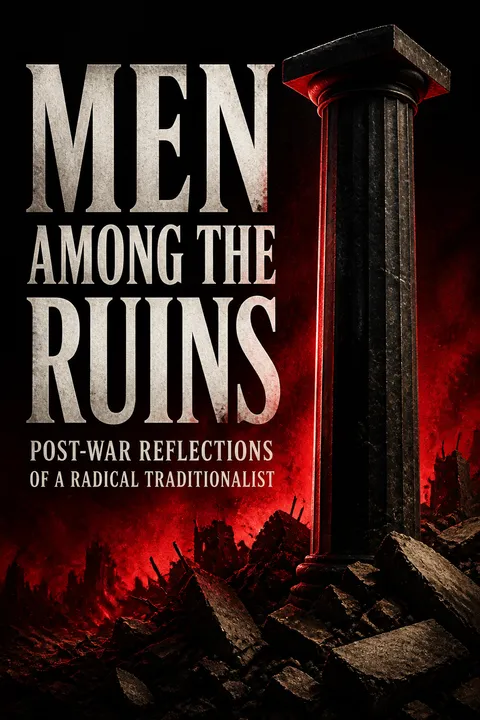
The role of the Order. To resist this onslaught, a new elite must organize itself as a dedicated Order, acting as "stone guests" who remain firm in their principles amidst the ruins. This minority must preserve the pure idea of Tradition, waiting for the moment to restore a true, hierarchical State.
- The scientific and positivist suggestion that denies any hidden causes.
- The tactic of counterfeits that replaces true tradition with empty traditionalism.
- The tactic of dilution that channels reactions into moderate, harmless forms.








































