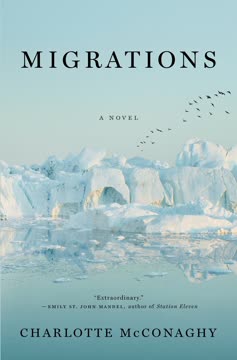
Plot Summary
Last of the Terns
In a near-future ravaged by climate change and mass extinction, Franny Stone, a restless wanderer with a haunted past, arrives in Greenland to tag the last Arctic terns. These birds, making what may be their final migration from the Arctic to Antarctica, become her obsession and her hope. Franny's longing to follow them is both scientific and deeply personal—a quest for belonging, redemption, and escape from her own pain. As she bands the birds and watches their fragile freedom, she feels the weight of humanity's destruction and her own compulsion to keep moving. The terns' journey becomes a metaphor for her own, setting the stage for a desperate voyage across a dying world.
The Reluctant Captain
Franny seeks a way to follow the terns' migration by sea, but no captain will take her—until she meets Ennis Malone, a gruff, world-weary fisherman with his own burdens. Ennis's boat, the Saghani, is one of the last legal fishing vessels, and his crew is wary of outsiders. Franny's offer to help him find fish by tracking the birds is met with skepticism and resistance. Yet, both are driven by loss: Ennis by the hope of one last great catch to reclaim his children, Franny by the need to chase the birds and perhaps herself. Their uneasy alliance is forged in mutual desperation, setting them and the crew on a perilous course.
Salt and Scars
Life aboard the Saghani is grueling. Franny, untrained and unwelcome, is tested by the crew and the sea. She scrubs decks, ties knots until her hands bleed, and faces the relentless cold and danger of the North Atlantic. The crew—each with their own scars and secrets—slowly reveal themselves: Basil the cook, Léa the mechanic, Anik the stoic first mate, Samuel the poetic elder, and the young lovers Malachai and Daeshim. Franny's presence disrupts their fragile balance, but her resilience and pain draw her into their fold. The ocean's violence and the boat's isolation strip everyone to their rawest selves, forging bonds through shared suffering.
Origins of Flight
Franny's childhood is marked by abandonment and longing. Born in Australia to an Irish mother, she is uprooted to Galway, then left alone when her mother disappears. Her life becomes a series of departures—running from places and people, never able to stay. Books and birds are her only constants, symbols of escape and transformation. As she grows, Franny's relationships are shaped by her fear of attachment and her compulsion to leave before she can be left. Her marriage to Niall Lynch, a passionate ornithologist, is both an anchor and a source of pain, as her wildness wars with his steadiness.
The Crew's Burden
The Saghani's crew is a microcosm of a vanishing world. Each member is driven by necessity, love, or escape. Ennis is haunted by lost family and the need to prove himself; Samuel by poetry and regret; Basil by pride and displacement; Léa by superstition and solitude; Anik by loyalty and trauma; Malachai and Daeshim by love and exile. Franny's presence forces them to confront their own fears and prejudices. As they follow the terns' erratic path, the crew's unity is tested by storms, dwindling hope, and the moral weight of their dying trade. The search for fish becomes a search for meaning.
Storms and Survival
The Saghani faces relentless storms and the treacherous Labrador Current. The crew's skills and Franny's endurance are pushed to the brink. A near-fatal accident exposes the fragility of life at sea and the bonds that hold the crew together. Franny's sleepwalking and self-destructive impulses threaten her safety and the trust she's built. The storm becomes a crucible, stripping away illusions and forcing confessions—of guilt, longing, and the impossibility of going back. The ocean, both beautiful and merciless, mirrors the characters' internal turmoil and the world's collapse.
The Weight of Leaving
Franny's compulsion to leave is both curse and survival instinct. Her marriage to Niall is a cycle of departures and returns, love and pain. Niall's devotion is steadfast, but Franny's wildness cannot be tamed. Their shared passion for birds and the natural world is a fragile bridge between them. The loss of their child, Iris, deepens Franny's sense of exile and guilt. Prison, grief, and the impossibility of belonging haunt her steps. The narrative weaves past and present, revealing how every act of leaving is also an act of longing—for home, for forgiveness, for flight.
The Golden Catch
Ennis's quest for the "Golden Catch"—one last haul to reclaim his children—drives the Saghani deeper into danger. The crew's hopes rise and fall with each failed attempt. When a massive catch is lost to a storm, and Samuel is nearly killed, the dream of salvation slips away. Franny's tern tracker goes dark, symbolizing the extinction she fears and the futility of their journey. The crew must decide whether to turn back or press on, risking everything for a chance at redemption. The line between survival and self-destruction blurs, and the cost of obsession becomes clear.
Ghosts and Guilt
Franny's memories of childhood, her mother's disappearance, her father's crime, and her own time in prison surface in waves. Guilt over the deaths she's caused—directly and indirectly—haunt her. Encounters with violence, both suffered and inflicted, shape her sense of self as both victim and perpetrator. The narrative explores the legacy of trauma, the inheritance of pain, and the struggle to forgive oneself. Franny's letters to Niall, unsent and unsparing, become confessions and acts of love. The ghosts of the past are never far, shaping every choice and every loss.
The Childless Sea
The extinction of animals mirrors Franny's personal losses—her mother, her child, her marriage, her freedom. The sea, once a place of possibility, becomes a graveyard. The crew's journey is shadowed by the knowledge that they are witnessing the end of wildness. Franny's inability to have or keep a child becomes a metaphor for a world that can no longer sustain life. The longing for connection, for something to nurture, is set against the reality of irreversible loss. The narrative asks what it means to live in a world without hope of renewal.
Prison and Parole
Franny's time in prison is a study in survival and despair. Violence, isolation, and the struggle for dignity mark her days. Her cellmate Beth teaches her to fight back, to reclaim agency even in captivity. Parole offers the illusion of freedom, but the scars of confinement remain. Franny's relationship with Niall's mother, Penny, is fraught with judgment and misunderstanding, yet ultimately becomes a source of unexpected grace. The question of guilt, punishment, and forgiveness is central—can one ever be free of the past, or is every escape just another migration?
The End of Fish
The world's oceans are declared off-limits to commercial fishing, a last-ditch effort to save what little remains. The Saghani and her crew become fugitives, pursued by authorities and hunted by their own consciences. The collapse of the old order forces each character to confront what they truly value. Franny's quest to follow the terns becomes both more urgent and more impossible. Betrayal, violence, and sacrifice mark the crew's final days together. The end of fish is the end of an era, and the beginning of something unknown.
Sanctuary and Sacrifice
The crew finds temporary sanctuary in Newfoundland, among Samuel's family. The warmth and chaos of the lighthouse household offer a glimpse of what might have been—a life rooted in place, in family, in care for the land. Franny is both comforted and unsettled by this vision. The cost of survival, the meaning of home, and the possibility of forgiveness are weighed. The journey cannot end here; the call of the terns, and of unfinished business, draws Franny and Ennis back to the sea. Sacrifice becomes the price of hope.
The Final Migration
With the Saghani lost and the crew scattered, Franny and Ennis steal a yacht and press on toward Antarctica, following instinct and memory rather than technology. The journey is perilous, marked by exhaustion, cold, and dwindling supplies. As they near the ice, the absence of birds and life is overwhelming. Yet, in a final act of faith, Franny insists on going farther west, beyond the known routes. The decision is both madness and hope—a refusal to accept extinction, a belief that something wild endures.
Ashes and Ice
In the frozen silence of Antarctica, Franny and Ennis find what they seek: a hidden colony of Arctic terns, alive and thriving against all odds. The sight is a miracle, a testament to endurance and the possibility of renewal. Franny scatters Niall's ashes among the birds, fulfilling his last wish and her own need for closure. The act is both an ending and a beginning—a letting go of grief, guilt, and the compulsion to die. The ice becomes a place of mourning and of hope, where the wild persists.
The Wild Remains
Franny survives her ordeal, rescued from the ice and released from prison once more. She is met by her estranged father, a symbol of reconciliation and the possibility of new beginnings. The world is still broken, but the wild remains—in the birds, in the sea, in the stubborn will to survive. Franny's journey is not over; she is changed, but not tamed. The story ends with the promise of another migration, another chance to nurture what is left, and to find meaning in a world that endures despite everything.
Analysis
A meditation on loss, survival, and the wild withinMigrations is a powerful, elegiac novel that explores the intersection of personal and planetary grief. Through Franny's journey—both literal and emotional—the book asks what it means to live in a world stripped of wildness, and whether hope can survive extinction. The narrative is driven by longing: for home, for forgiveness, for connection to something larger than oneself. The characters are shaped by trauma, but also by resilience and the stubborn will to endure. The novel's nonlinear structure and lyrical prose invite readers to inhabit Franny's fractured consciousness, to feel the ache of loss and the thrill of flight. At its heart, Migrations is a call to recognize the value of what remains—to nurture the wild, both in the world and in ourselves, before it is too late. The lessons are urgent: that love is both anchor and risk, that survival requires both sacrifice and hope, and that even in a broken world, the wild endures.
Review Summary
Migrations garners an overall rating of 4.11/5, with most readers praising its emotionally devastating, lyrical exploration of loss, love, and climate change. Many describe it as haunting and unforgettable, deeply connecting with the flawed protagonist Franny Stone and her quest to follow the last Arctic terns. Critics, however, cite implausible worldbuilding, an unconvincing unreliable narrator, and a disjointed non-linear structure. The novel's quiet, character-driven approach to environmental dystopia resonates strongly with most, though some wished for deeper exploration of the sci-fi elements.
People Also Read










Characters
Franny Stone
Franny is the novel's protagonist—a woman marked by abandonment, trauma, and an unquenchable longing for wildness. Her life is a series of departures: from her Irish mother, from her Australian childhood, from every place and person she's ever loved. Franny's psyche is shaped by loss—her mother's disappearance, her father's crime, her own time in prison, and the death of her child. She is both fiercely independent and desperately lonely, drawn to the sea and to birds as symbols of freedom and escape. Her marriage to Niall is a rare anchor, but her compulsion to leave is both curse and survival instinct. Franny's journey is one of reckoning—with guilt, with the limits of love, and with the possibility of redemption. Her development is a painful, beautiful arc from self-destruction to acceptance and hope.
Niall Lynch
Niall is Franny's husband, an ornithologist devoted to the study and preservation of birds. He is Franny's opposite in many ways—rooted, patient, and committed to home and family. Niall's love for Franny is unwavering, even as her wildness and pain threaten to tear them apart. He is haunted by the extinction of the natural world, channeling his grief into scientific work and activism. The loss of their child, Iris, deepens his sorrow but also his empathy. Niall's journals and letters reveal a man who loves deeply, forgives easily, and believes in the possibility of renewal. His death is a shattering loss for Franny, but his presence endures as a source of guidance and grace.
Ennis Malone
Ennis is the captain of the Saghani, a fisherman clinging to a dying way of life. His gruff exterior hides deep wounds—estrangement from his children, the loss of his wife to illness, and the shame of failure. Ennis's obsession with the "Golden Catch" is both a quest for redemption and a form of self-punishment. He is a reluctant leader, respected and resented by his crew. His relationship with Franny evolves from suspicion to camaraderie, marked by mutual recognition of pain and resilience. Ennis's final act—accompanying Franny to the ends of the earth—is an expression of love, loyalty, and the hope that something wild can still be saved.
Léa
Léa is the Saghani's mechanic, a Frenchwoman with a fierce temper and a deep sense of superstition. She is wary of outsiders and slow to trust, but her loyalty to the crew is unwavering. Léa's strength is both physical and emotional; she is a survivor, shaped by hardship and loss. Her relationship with Franny is complex—marked by suspicion, attraction, and eventual solidarity. Léa's fate is ambiguous, a casualty of the world's violence and the crew's desperate choices. She embodies the costs of survival and the possibility of unexpected connection.
Basil
Basil is the Saghani's cook, an Australian with Irish roots and a chip on his shoulder. He is both comic relief and a source of tension, quick to anger and slow to forgive. Basil's pride in his craft masks insecurity and a sense of not belonging—neither at sea nor on land. His relationship with Franny is fraught, marked by misunderstanding and resentment. Basil's eventual betrayal of the crew is a product of fear and self-preservation, but also of the world's unraveling. He represents the fragility of community in the face of crisis.
Anik
Anik is the Saghani's first mate, an Inuit man shaped by survival and loss. He is quiet, observant, and deeply loyal to Ennis, bound by a shared trauma. Anik's wisdom is rooted in tradition and experience; he is a stabilizing force amid chaos. His relationship with Franny is one of mutual respect and understanding, marked by moments of gentleness and insight. Anik's presence is a reminder of what has been lost—and what endures—in a world stripped of wildness.
Samuel
Samuel is the elder of the crew, a Newfoundlander with a love of poetry and a large, scattered family. He is both comic and tragic, offering comfort and wisdom to the younger crew members. Samuel's survival is a testament to resilience, but also to the costs of a life at sea. His near-death experience is a turning point for the crew, exposing the limits of endurance and the necessity of care. Samuel embodies the longing for home, for meaning, and for the possibility of forgiveness.
Malachai
Malachai is one half of the young couple on the Saghani, a Londoner with Jamaican roots. He is energetic, talkative, and fiercely protective of Daeshim, his partner. Malachai's optimism is tempered by the realities of exile and the dangers of life at sea. His relationship with Franny is marked by camaraderie and shared vulnerability. Malachai represents the hope and fragility of the next generation, caught between worlds.
Daeshim
Daeshim is Malachai's partner, a Korean-American marine engineer plagued by seasickness. He is gentle, introspective, and deeply in love with Malachai. Daeshim's technical skills are vital to the crew's survival, but his vulnerability is ever-present. His relationship with Franny is one of quiet support and understanding. Daeshim embodies the costs of migration—chosen and forced—and the possibility of finding home in another person.
Penny Lynch
Penny is Niall's mother, a psychiatrist whose initial suspicion and coldness toward Franny mask her own grief and longing for control. Her relationship with Franny is fraught, marked by misunderstanding and eventual reconciliation. Penny's willingness to support Franny's parole is an act of grace, a recognition of shared loss and the need for forgiveness. She represents the possibility of healing across generations.
Plot Devices
Nonlinear Narrative
The novel unfolds in a nonlinear structure, weaving together present-day events aboard the Saghani with flashbacks to Franny's childhood, marriage, prison, and the aftermath of loss. This structure mirrors Franny's fractured psyche and the disintegration of the world around her. The interplay of past and present deepens the emotional impact, revealing motivations, secrets, and the cumulative weight of trauma. The gradual revelation of key events—such as the loss of Franny's child, her crime, and Niall's death—creates suspense and invites empathy.
Migration as Metaphor
The migration of the Arctic terns is both literal and symbolic—a journey of survival, endurance, and hope against extinction. Franny's pursuit of the birds becomes a quest for meaning, belonging, and redemption. The motif of migration recurs throughout the novel, linking personal and ecological loss, and asking what it means to move, to leave, to return, or to be lost. The birds' resilience and vulnerability reflect the characters' own struggles.
Environmental Collapse
The novel's world is shaped by climate change, mass extinction, and the collapse of natural systems. The disappearance of animals, the end of fish, and the violence of the sea are both backdrop and catalyst for the characters' actions. The environmental crisis is not just context but a force that drives the plot, shapes relationships, and raises existential questions about responsibility, guilt, and the possibility of renewal.
Letters and Unsent Confessions
Franny's letters to Niall—many unsent—serve as a confessional device, revealing her innermost thoughts, regrets, and hopes. These letters bridge the gap between past and present, life and death, and offer insight into her motivations. The act of writing becomes a form of survival, a way to process grief and seek forgiveness.
Foreshadowing and Symbolism
The novel is rich in foreshadowing—Franny's compulsion to leave, her sleepwalking, the recurring motif of birds and flight, the clues her mother told her to seek. Symbols such as the crows, the egg, the sea, and the ice carry layered meanings, connecting personal trauma to global catastrophe. The use of animal imagery underscores the interconnectedness of all life and the stakes of extinction.








































