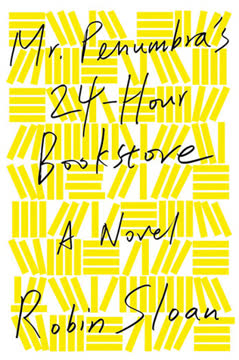
Plot Summary
Unemployment and the Bookstore
Clay Jannon, a young designer in San Francisco, loses his job at a techy bagel startup and, after a period of drifting, stumbles upon a mysterious 24-hour bookstore run by the enigmatic Mr. Penumbra. The store is tall, narrow, and filled with books that seem to stretch into the shadows above. Clay, desperate for work, is hired for the night shift. The job is odd: few customers, strict rules, and a requirement to keep detailed logs of every transaction, especially those involving a select group of eccentric, obsessive patrons. The store's atmosphere is both comforting and unsettling, hinting at secrets hidden in the stacks. Clay's curiosity is piqued, and he senses that this bookstore is more than it appears—a threshold to a deeper mystery.
Night Shift Mysteries
As Clay settles into his nocturnal routine, he notices two types of customers: ordinary browsers and a peculiar group who borrow obscure, unlisted books from the highest shelves. These "Waybacklist" books are not for sale and are written in indecipherable code. Clay is forbidden from reading them but must record every detail about the borrowers. The regulars—Tyndall, Lapin, Fedorov—are obsessed, returning books and requesting new ones with ritualistic urgency. Clay's friends visit, intrigued by the store's oddness, but only Clay is drawn into its deeper enigma. The store's business model makes no sense, and the coded books, along with the meticulous logbooks, suggest a secret purpose. Clay's curiosity grows, and he begins to suspect a hidden society at work.
The Secret Society Emerges
Clay's investigation reveals that the bookstore is part of a global network of secret libraries, overseen by a shadowy figure named Corvina. The coded books are "codex vitae"—life books—created by members of an ancient fellowship called the Unbroken Spine. The society's goal is to decode the founder Aldus Manutius's encrypted book, believed to hold the secret to immortality. Clay learns that the store's logbooks are part of a tradition stretching back a century, and that his role is more than just clerk—he is a chronicler for a clandestine order. The society's rituals, hierarchies, and obsession with secrecy become clear, and Clay realizes he is entangled in a centuries-old quest.
Friends, Codes, and Curiosity
Clay enlists the help of his friends: Mat, a creative special-effects artist; Ashley, a pragmatic PR executive; and Neel, his childhood friend turned tech entrepreneur. Together, they probe the coded books and the store's patterns. Neel's resources and Mat's ingenuity help Clay break the rules and examine the forbidden volumes. They discover that the coded books are not just puzzles but steps in a larger riddle—the "Founder's Puzzle"—that each member must solve. Clay's friendship with Neel, rooted in their shared love of fantasy novels, becomes a source of strength and nostalgia, fueling their determination to uncover the truth behind the Unbroken Spine.
Kat and the Power of Google
Clay meets Kat Potente, a brilliant data visualization specialist at Google, through a targeted ad campaign. Kat is fascinated by Clay's 3D model of the bookstore and quickly becomes both a romantic interest and a vital ally. She brings the power of Google's technology to bear on the mystery, scanning logbooks and analyzing patterns with advanced algorithms. Kat's optimism and belief in technological innovation contrast with the Unbroken Spine's traditionalism. Her connections at Google open new possibilities, and together, she and Clay begin to see the coded books as data to be visualized and decoded, not just artifacts to be revered.
The Puzzle of the Waybacklist
Using Kat's skills and Google's resources, Clay digitizes the logbooks and visualizes the borrowing patterns of the Waybacklist customers. He discovers that the sequence of borrowed books forms a hidden image—a face—when mapped in three dimensions. This "Founder's Face" is the solution to the first layer of the society's puzzle, a test that has stymied novices for years. Clay's technological approach solves in days what others have labored over for lifetimes. The revelation both impresses and unsettles Mr. Penumbra, who sees in Clay's methods a challenge to the society's traditions and a promise of new ways forward.
The Founder's Hidden Face
Clay's discovery of the Founder's Face marks a turning point. He realizes that the society's puzzles are not just intellectual exercises but encoded messages, layered with meaning. The solution earns him recognition within the Unbroken Spine but also draws the attention of Corvina, who views technological shortcuts as heresy. Penumbra is summoned to the society's headquarters in New York, leaving the store closed and Clay adrift. The tension between tradition and innovation comes to a head, as Clay and his friends prepare to follow Penumbra and confront the society's leadership.
Corvina's Warning
In New York, Clay and his allies infiltrate the Unbroken Spine's secret library, a subterranean reading room beneath Fifth Avenue. They witness the society's rituals and meet Corvina, the stern First Reader who enforces strict adherence to tradition. Corvina warns Clay that Penumbra's embrace of technology is dangerous and that failure will bring ruin. The society's members are divided—some are inspired by Clay's success, others fear change. Penumbra pleads for the use of computers to solve the ultimate puzzle, but Corvina refuses, threatening to sever support for the San Francisco store and punish Penumbra for his transgressions.
The Library Beneath New York
Clay, Kat, Neel, and Penumbra descend into the society's underground library, where the codex vitae of generations are chained to tables and the founder's book, MANVTIVS, sits at the center. The society's purpose is laid bare: to decode Manutius's encrypted book and achieve immortality for all members who have created their own codex vitae. The library is both a sanctuary and a prison, its members bound by faith in a secret that has eluded them for centuries. Penumbra proposes a daring plan: to scan the founder's book and use Google's computational power to break the code once and for all.
The Great Decoding
With the help of Kat and a coalition of Googlers, Clay orchestrates the scanning and digitization of MANVTIVS. The society's elders and the tech team gather for a grand decoding event, harnessing the full power of Google's servers. For a brief moment, the world's largest search engine is dedicated to cracking the code. But after an intense computational assault, the result is nothing—no message, no secret, just noise. The society is devastated, Penumbra is humiliated, and the promise of immortality seems lost. The failure exposes the limits of both tradition and technology, leaving Clay and his friends searching for meaning.
Failure and Fallout
The aftermath of the failed decoding is bleak. Penumbra disappears, ashamed and defeated. The society fractures, with some members abandoning the quest and others clinging to hope. Clay is wracked with guilt, feeling responsible for Penumbra's downfall. Kat, disillusioned, throws herself into her work at Google, while Clay returns to San Francisco, haunted by unanswered questions. The dream of immortality seems further away than ever, and the Unbroken Spine faces an uncertain future. Yet, Clay's curiosity persists, and a new thread of investigation begins to emerge.
The Hunt for Immortality
Clay learns that the key to decoding MANVTIVS may lie not in the text but in the physical typeface used to print it—Gerritszoon. With the help of Oliver, Tabitha, and the Accession Table (a global museum artifact database), Clay tracks down the original Gerritszoon punches, lost for a century and stored in a Nevada warehouse. The journey is both physical and intellectual, requiring resourcefulness, collaboration, and a willingness to break rules. Clay's search for the punches becomes a metaphor for the larger quest: immortality is not a secret formula but a legacy built through friendship, creativity, and persistence.
The Lost Type and the Key
Examining the Gerritszoon punches under magnification, Clay discovers tiny notches—deliberate marks that encode a message. The key to MANVTIVS is not in the words but in the shapes of the letters themselves. With this insight, Clay deciphers the founder's book, revealing that the true secret is not immortality but gratitude and friendship. The message, hidden in plain sight for centuries, is a tribute from Gerritszoon to Manutius: "Thank you, Teobaldo. You are my greatest friend. This has been the key to everything." The revelation is both anticlimactic and profound, shifting the society's focus from eternal life to the value of human connection.
Moffat's Secret Message
Clay realizes that Clark Moffat, author of The Dragon-Song Chronicles and former member of the Unbroken Spine, embedded the society's secrets in his fantasy trilogy. The third volume, written as his codex vitae, contains allegories and puzzles that mirror the society's own. Listening to the audiobook, Clay hears Moffat's voice channeling Penumbra and encoding the message of friendship and creativity. The boundaries between fiction and reality blur, and Clay understands that stories, like typefaces, are vessels for meaning that endure beyond their creators. Immortality is achieved not through secrets but through the stories we share.
Revelation and Resolution
Clay presents his findings to the Unbroken Spine, decoding MANVTIVS and returning the Gerritszoon punches. The society is shaken but ultimately liberated from its centuries-old obsession. Corvina is deposed, and Edgar Deckle becomes the new First Reader. Penumbra's codex vitae, saved by Clay, is preserved for future generations. The society embraces a new mission: to preserve and share knowledge, not hoard it. Clay, Penumbra, and their friends form a new fellowship, blending tradition and innovation, and dedicate themselves to helping others navigate the intersection of books and technology.
New Beginnings and Fellowship
The story ends with new ventures: Neel's company is acquired by Google, Kat rises in the ranks, Mat and Ashley create art, and Clay and Penumbra found a consultancy to solve mysteries at the crossroads of literature and technology. The bookstore is reborn as a climbing gym, its spirit preserved in murals and memories. The Unbroken Spine is transformed, its members freed from the burden of immortality and united by the fellowship of curiosity and care. Clay reflects on the lessons learned: that immortality is built on friendship and work done with care, that secrets worth knowing are hiding in plain sight, and that life, like a city, must be open to wandering.
Analysis
A celebration of curiosity, friendship, and the open city of lifeMr. Penumbra's 24-Hour Bookstore is a modern fable about the search for meaning in an age of rapid change. It explores the tension between tradition and innovation, showing that true progress comes not from rejecting the past but from integrating its wisdom with new tools and perspectives. The novel argues that immortality is not found in secret formulas or eternal life, but in the stories we tell, the friendships we forge, and the work we do with care. The coded books and secret societies are metaphors for the mysteries that surround us—mysteries that can only be solved through collaboration, curiosity, and openness. The story's ultimate message is that life, like a city, must be open to wandering, and that the greatest secrets are often hiding in plain sight, waiting for those who are willing to look closely and ask the right questions. In an era obsessed with disruption and novelty, the book reminds us that the most enduring legacies are built on gratitude, generosity, and the courage to seek and share knowledge.
Review Summary
Reviews for Mr. Penumbra's 24-Hour Bookstore are deeply divided, averaging 3.72/5. Fans praise its charming blend of mystery, secret societies, and the tension between traditional books and modern technology, calling it whimsical, fun, and original. Critics, however, find the characters shallow and one-dimensional, the plot convenient and tension-free, and the excessive references to Google tiresome. Many note the story's contemporary tech references will date it quickly. The short length leaves some feeling the ambitious ideas were underdeveloped.
People Also Read




Characters
Clay Jannon
Clay is the protagonist, a young, underemployed designer whose curiosity and adaptability drive the narrative. His outsider status allows him to question the bookstore's mysteries and challenge the Unbroken Spine's traditions. Clay's relationships—with friends, mentors, and Kat—anchor his journey, and his willingness to blend technology with tradition leads to breakthroughs. Psychologically, Clay is motivated by a desire for purpose and belonging, but he resists dogma, preferring open-ended exploration. His arc moves from passive observer to active solver, ultimately finding meaning not in secrets or immortality, but in friendship, creativity, and the joy of discovery.
Mr. Ajax Penumbra
Penumbra is the elderly proprietor of the 24-hour bookstore and a high-ranking member of the Unbroken Spine. He is both mentor and mystery, embodying the tension between tradition and innovation. Penumbra's faith in the society's quest is deep, but he is open to new ideas, seeing in Clay and Kat the possibility of progress. Psychologically, Penumbra is driven by loyalty—to the fellowship, to his friends, and to the ideals of knowledge and curiosity. His journey is one of humility and adaptation, accepting the limits of old ways and embracing the value of change and collaboration.
Kat Potente
Kat is a data visualization expert at Google, whose intellect and enthusiasm for technology accelerate the investigation. She is Clay's romantic interest and intellectual equal, embodying the spirit of the digital age. Kat's optimism about the Singularity and human potential contrasts with the Unbroken Spine's nostalgia. Psychologically, she is driven by a desire to upgrade the human "operating system," seeking meaning in progress and connection. Her arc explores the limits of technology and the enduring need for human relationships, ultimately finding that not all mysteries yield to computation.
Neel Shah
Neel is Clay's childhood friend, now a successful tech CEO. His wealth and resources are instrumental in the quest, but his true value lies in his unwavering loyalty and shared history with Clay. Neel's journey from bullied outsider to confident patron mirrors the story's theme of transformation through friendship. Psychologically, Neel is motivated by a desire to prove himself and to support those he cares about. His humor and practicality balance the story's more mystical elements, grounding the narrative in real-world stakes.
Mat Mittelbrand
Mat is Clay's roommate and a special-effects artist, whose imaginative projects (like Matropolis) symbolize the power of making and building. Mat's artistry and attention to detail are crucial in replicating logbooks and supporting the investigation. Psychologically, Mat is driven by the need to create beauty and order from chaos, finding meaning in the act of making. His relationship with Ashley and his role in the group highlight the importance of collaboration and the value of diverse talents.
Ashley Adams
Ashley is Clay's roommate and a PR executive, whose competence and attention to detail provide stability. Though initially portrayed as robotic, Ashley's appreciation for beauty and her eventual partnership with Mat reveal her depth. Psychologically, Ashley values order, efficiency, and harmony, serving as a counterpoint to the story's more chaotic elements. Her willingness to adapt and support her friends underscores the theme of community.
Corvina
Corvina is the First Reader of the Unbroken Spine and the story's primary antagonist. He embodies the dangers of dogmatism and the fear of innovation, enforcing strict adherence to tradition and punishing deviation. Psychologically, Corvina is motivated by a need for control and a belief in the sanctity of the society's mission. His inability to adapt leads to his downfall, serving as a cautionary figure about the perils of inflexibility and the necessity of evolution.
Edgar Deckle
Deckle is a former clerk of Penumbra's and the guardian of the Reading Room in New York. He is both a rule-follower and a covert ally, helping Clay at key moments. Psychologically, Deckle is motivated by respect for tradition but recognizes the need for change. His ascent to leadership after Corvina's fall signals the society's shift toward openness and adaptation.
Rosemary Lapin
Lapin is one of the Waybacklist borrowers, an elderly woman whose slow progress through the society's puzzles reflects both dedication and the challenges of aging. Psychologically, Lapin is motivated by a love of books and a longing for connection. Her background as an early computer programmer adds depth, bridging the gap between old and new. Lapin's vulnerability and resilience highlight the story's themes of perseverance and the value of every member.
Clark Moffat
Moffat is the author of The Dragon-Song Chronicles and a former member of the Unbroken Spine. His decision to encode the society's secrets in his fantasy novels is both an act of rebellion and a gift to future seekers. Psychologically, Moffat is driven by creativity, intuition, and a desire to share knowledge beyond the confines of secrecy. His legacy endures not through immortality, but through the stories and puzzles he leaves behind.
Plot Devices
Duality of Tradition and Innovation
The narrative structure juxtaposes the ancient rituals of the Unbroken Spine with the disruptive power of modern technology. The coded books, logbooks, and secret societies represent tradition, while Clay's 3D modeling, Kat's data visualization, and Google's computational might symbolize innovation. This duality is explored through foreshadowing (the forbidden books hint at deeper mysteries), parallel investigations (physical and digital), and the eventual synthesis of both approaches. The story uses puzzles, hidden messages, and layered codes as metaphors for the search for meaning, illustrating that progress often requires both reverence for the past and openness to the future.
The Quest Structure
The plot follows a classic quest structure: the call to adventure (Clay's hiring), the gathering of allies, the crossing of thresholds (into the Waybacklist, the Reading Room), trials and revelations (solving the Founder's Puzzle, confronting Corvina), and the return with the elixir (the decoded message and new fellowship). Each stage is marked by escalating challenges, moral dilemmas, and moments of self-discovery. The quest is both external (solving the society's mystery) and internal (finding purpose and connection).
Metafiction and Intertextuality
The novel is deeply self-referential, with The Dragon-Song Chronicles serving as both a literal text and an allegory for the main plot. The use of logbooks, coded messages, and references to real and fictional books blurs the line between fiction and reality. This metafictional device invites readers to question the nature of storytelling, the transmission of knowledge, and the ways in which meaning is constructed and preserved.
Symbolism of Type and Typography
The Gerritszoon typeface is both a literal key and a symbol of the story's themes. The hidden notches in the letters represent the idea that meaning is often embedded in form, not just content. The act of decoding the typeface mirrors the process of uncovering hidden truths in life and literature. The preservation and loss of the punches symbolize the fragility and resilience of cultural memory.
Foreshadowing and Parallelism
The narrative uses foreshadowing (the coded books, the founder's face) and parallelism (Clay's journey mirroring Moffat's, Penumbra's mentorship echoing Manutius and Gerritszoon) to create a sense of inevitability and interconnectedness. Events and relationships recur in new forms, reinforcing the idea that history is both cyclical and cumulative.








































