
Key Takeaways
Strip the indicators off your charts and trade raw price alone
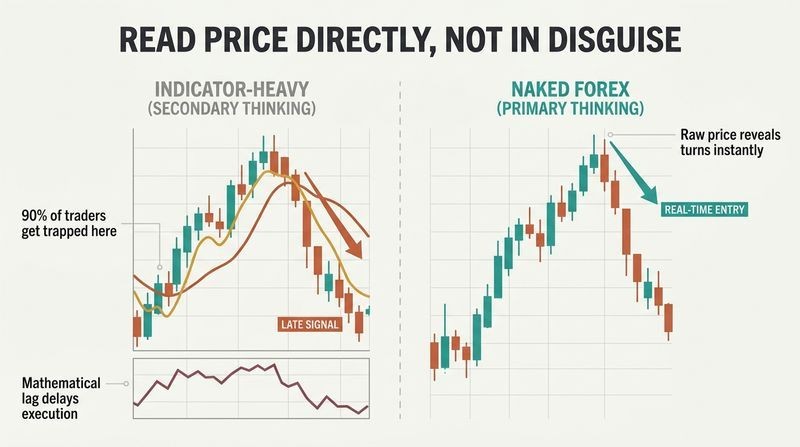
Indicators are price in disguise. Every technical indicator (RSI, MACD, stochastic) is built by feeding past price into a formula and spitting out a line, number, or color. Nekritin and Peters compare this to running a formula through your wristwatch hoping it tells better time. Because the math takes time to process, indicators always lag: they flash "sell" after the market already fell.
Naked trading means reading price directly. A naked trader watches the actual candlesticks and catches turning points as they happen, entering earlier with a tighter stop loss. Roughly 90% of Forex books and seminars push indicators, which traps beginners in "secondary thinking": analyzing the indicator instead of the market itself.
The lag critique is mathematically sound. A moving average is a smoothing function, and smoothing inherently introduces delay. Yet the claim that price alone is purer deserves nuance. Price action patterns are themselves interpretations, and behavioral finance shows humans see illusory signals in random walks (apophenia). The authors essentially argue for discretionary chart reading over mechanical systems, a debate that mirrors the wider tension between rules-based and judgment-based decision making found in Kahneman's work. Stripping indicators removes a crutch but also removes a check on bias, placing the entire burden on the trader's pattern recognition skill.
Stop blaming your system or the market; own every losing trade
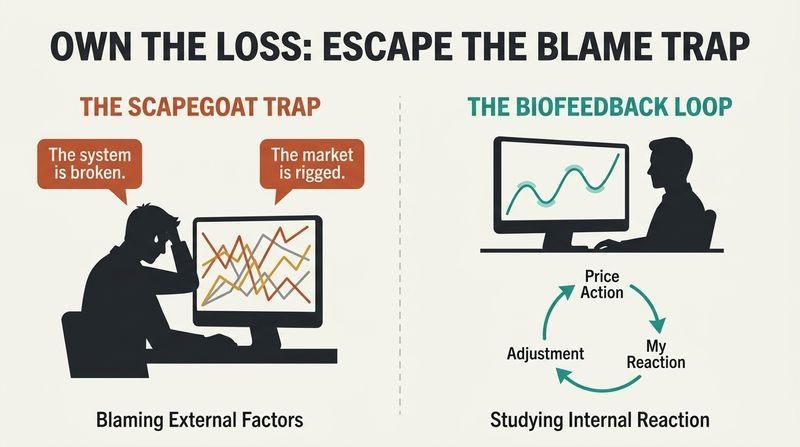
Two excuse-making tribes lose money. When a tested system delivers ten losses in a row, traders split into camps. Terrible-system traders declare the method broken and hunt for a new one, often adding indicators to filter losses. Bad-market traders insist conditions changed ("Spain went bankrupt," "the broker froze my order") and blame external forces, sometimes spinning broker conspiracy theories.
Naked trading removes the scapegoat. When you trade pure price, blaming the market is like blaming a river for being wet. Losses can only come from poor execution or plain bad luck. The authors frame the market as a biofeedback machine: pay attention to how price reacts after your entry, and how you react emotionally, and you learn faster than from any guru or course.
This reframing aligns with the psychology of an internal locus of control, repeatedly linked to higher performance and resilience. The biofeedback analogy is genuinely useful: treating each trade as data rather than a verdict on your worth defuses the ego. One caution, though. Radical self-attribution can tip into harmful self-blame during genuinely unlucky streaks, the same trap that makes gamblers chase losses. The healthiest stance combines ownership of process with acceptance that outcomes are probabilistic. The authors' own emphasis on luck as the true cause of any single loss actually softens the responsibility message into something more balanced.
Back-test thousands of trades to buy expertise in hours, not years
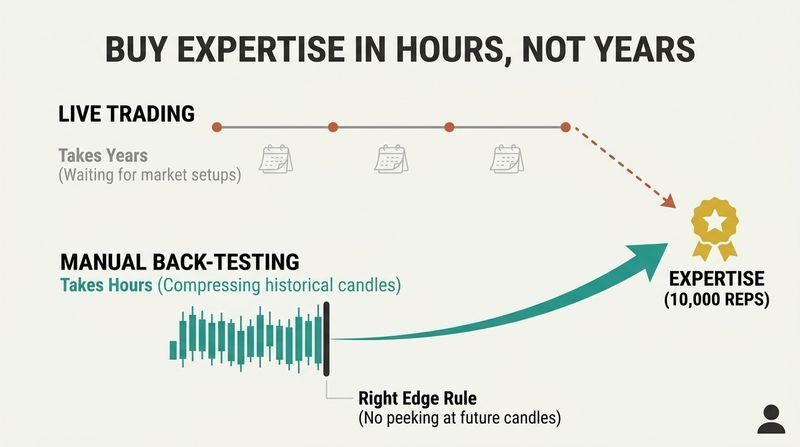
Expertise is just reps. The authors cite a figure that roughly 75% of Forex traders lose money, and the dividing line is practice. Becoming an expert traditionally demands around 10,000 repetitions; live trading would take years. Manual back-testing (scrolling historical charts candle by candle, recording entries, stops, and targets as if trading live) compresses that experience into hours.
Back-testing delivers three payoffs.
1. It reveals whether a system fits your personality and lifestyle, not just whether it is profitable.
2. It breeds the confidence to let trades run and walk away from the screen.
3. It accumulates genuine expertise.
The enemy is hindsight bias: peeking at future candles inflates your sense of predictability. Trade only from the right edge of the chart to keep results honest.
The 10,000 reps reference echoes Ericsson's deliberate practice research, though popular accounts distort it. Ericsson stressed that mere repetition is useless without feedback and progressive difficulty, which manual back-testing does provide. The fit-over-profitability point is underrated and wise: a statistically sound system you cannot psychologically tolerate is worthless to you. The hindsight-bias warning is crucial and often ignored. One limitation worth flagging: historical back-tests assume the future resembles the past, and regime changes (shifting volatility, central bank intervention) can break patterns. Forward testing on demo accounts, which the authors also recommend, partially addresses this survivorship and overfitting risk.
Treat support and resistance as fat zones, never thin lines
Markets remember price. The authors rename support and resistance as "zones" and insist they are areas, not exact prices, comparing them to pushing a fist into a beer belly: you sink in a bit before hitting resistance, and different people stop at different depths. Price repeatedly reverses near these zones, which they call market scars.
Zones improve with age. On the EUR/CAD daily chart, the 1.4350 level acted as support in 2006, then resistance, then resistance again four years later. The 1.1930 zone on EUR/USD held seven years after first forming. To find zones: start one timeframe higher, switch to a line chart (which connects closing prices and exposes the bends), and ignore minor zones to avoid clutter. The more touches, the stronger the zone.
The zone-not-line insight has real microstructure logic. Large institutional orders cluster around psychologically round numbers and prior reversals, and they fill across a range rather than a single tick, so a fuzzy band models reality better than a precise line. The memory-of-markets idea connects to Schelling points in game theory: a level becomes meaningful simply because many participants expect others to act there, making it self-fulfilling. The line-chart trick is clever pedagogy, filtering noise to reveal structure. The weakness is subjectivity. Where exactly to draw a zone invites confirmation bias, and back-testing such discretionary judgments is notoriously hard to replicate consistently across traders.
Skip the breakout; wait for price to return and kiss the zone
Breakouts fake out constantly. Markets trend only about 15-30% of the time, so most breakouts fizzle and snap back inside the consolidation range. Standard breakout traders get whipsawed repeatedly.
The last kiss filters the fakes. Instead of entering when price first bursts past a zone, you wait. After a genuine breakout, price often drifts back to retouch the broken zone from the other side (the retouch principle) before continuing. You enter only when price returns and prints a strong candle in the breakout direction, placing a buy stop above (or sell stop below) that candle. The emergency stop sits at the midpoint of the consolidation box, but a closer exit triggers if price closes back inside the box, keeping average losses small.
The last kiss is a textbook example of trading a confirmation rather than an anticipation, trading reaction over prediction. Statistically, demanding a retest raises win rate at the cost of missing the fastest, strongest breakouts that never look back, a classic precision-versus-recall tradeoff. The retest behavior has a plausible mechanism: stranded traders from the failed move provide liquidity and the broken level flips polarity as old sellers become buyers. Worth noting that in genuinely explosive moves (news shocks, central bank surprises), waiting for a kiss leaves money on the table. The strategy suits patient temperaments and range-to-trend transitions far better than momentum-chasing markets.
Hunt reversal candles only where price has not traded in ages
The closing price is king. The authors build catalysts, simple candlestick patterns valid only on zones, around where a candle closes. The big shadow is a two-candle reversal where the second candle engulfs the first; a bearish version must close near its low, a bullish one near its high. A close near the midpoint is a weak, skippable signal.
Room to the left predicts big turns. All-time highs and lows share one trait: empty space to their left, with no recent price action. The authors want at least seven candles of clear space before a reversal setup. A bearish big shadow on the EUR/USD weekly that had not touched its zone in 74 weeks preceded a 22-week move away. Kangaroo tails (long-wicked single candles) and big belts (Monday gap-and-reverse candles) follow the same logic.
Room to the left is essentially a proxy for exhaustion and absence of overhead supply, concepts technical analysts have circled for a century. When price reaches territory nobody has traded recently, there are few trapped participants waiting to sell into a rally, so reversals can run cleanly. The closing-price emphasis is well grounded; the close is the session's consensus verdict after all intraday emotion resolves, which is why candlestick theory and even daily settlement in futures markets weight it heavily. The risk is pattern proliferation. With enough named catalysts (shadows, tails, belts, wammies), a motivated trader can always find one, inviting overfitting and post-hoc storytelling.
Demand a higher low before buying a double bottom
Classic patterns fail too often. A double bottom (price hits a zone, bounces, falls back to the same zone, then climbs) is famous but unreliable. The authors sharpen it into the "wammie": the second touch must be a higher low than the first, signaling fading downside momentum, with at least six candles between touches so it is a real retest rather than a breakout buildup.
The mirror trade is the moolah. A moolah is the wammie inverted: a double top where the second touch is a lower high, hinting the market is running out of steam before a fall. Entry comes via a buy stop above the bullish candle (wammie) or sell stop below the bearish candle (moolah), with the stop loss beyond the first, deeper touch so a third touch does not knock you out prematurely.
Requiring a higher low or lower high is a smart filter because it stacks two independent signals: a tested support zone plus a shift in swing structure, the very definition of an uptrend in classical Dow Theory. This converts a coin-flip pattern into a higher-probability one by insisting the market already show evidence of the turn rather than merely promising it. The six-candle spacing rule cleverly distinguishes accumulation from imminent breakout. The whimsical names (wammie, moolah) aid memory but obscure that these are disciplined refinements of well-documented structures. The deeper lesson generalizes: most popular patterns underperform until you add a momentum or structure confirmation.
Enter with stop orders so the market must prove you right first
Never buy on a discount you hoped for. Tempted to enter a setup at a cheaper price after the market moves against it? The authors warn this is how losing trades multiply. Every failed setup retraces in the wrong direction, but few failed setups push to a new high (bullish) or new low (bearish).
Let price trigger you. For bullish setups, place a buy stop a few pips above the pattern's high; for bearish setups, a sell stop below the low. The order fires only if the market moves your way, automatically filtering out trades that never confirm. On a CAD/JPY bearish big shadow, the market rose instead of falling, never triggered the sell stop, and the trader avoided a guaranteed loss. It feels counterintuitive to enter at a worse price, but it eliminates many losers.
This is a disciplined application of the principle that confirmation beats anticipation, trading what the market does over what you predict it will do. The logic resembles the difference between limit orders (betting on reversion) and stop orders (betting on continuation). Behavioral finance explains why traders resist it: humans are loss-averse and crave bargains, so entering at a worse price triggers regret aversion. Yet the math favors filtering. The hidden cost is slippage and the occasional whipsaw where price triggers your stop entry then reverses, paying you the worst of both worlds. On balance, for trend and reversal-confirmation setups, stop-order entries impose valuable discipline.
Decide if you are a runner or a gunner before you exit
Exits make the money, and split traders. The authors argue exiting is the hardest, most important stage. Every trader is either a gunner (prizes a high win rate, banks small consistent profits, lacks patience) or a runner (accepts many small losses to capture rare giant trends).
Match exit to temperament.
1. Zone exit (gunner): take profit at the very next zone.
2. Split exit (gunner): close half at the first zone, move the rest to breakeven.
3. Ladder exit (runner): trail the stop zone by zone as price advances.
4. Three-bar exit (runner): trail behind the highest high or lowest low of the last three candles.
The cardinal sin is re-trading the last trade, changing your exit because the previous move ran further. Each trade is independent; switching styles guarantees you optimize for the trade that already happened.
The runner-gunner dichotomy maps onto the statistical reality that profit equals win rate times average win minus loss rate times average loss. You can build a profitable system by maximizing either term, but mixing them mid-stream destroys the math, which is the real insight here. The warning against re-trading the last trade is essentially a plea against recency bias and outcome bias, two of the best-documented decision errors. Trailing exits like the three-bar method embody the trader's maxim to cut losses and let winners run, though they guarantee you give back open profit at every reversal. Knowing your psychological type prevents the self-sabotage of chasing the exit you wish you'd used.
Escape the cycle of doom: traders make profits, not systems
The doom loop has three phases. Most traders cycle endlessly:
1. Search (hunt for an exciting new system).
2. Action (trade it live, usually untested, with high hopes).
3. Blame (hit a drawdown, declare the system broken, discard it).
Then back to searching. The fatal error is believing profits come from systems.
Two traders, one system, opposite results. Give the same method to two people and one profits while the other loses. The variable is the trader, not the tool. Breaking the cycle means picking a system that genuinely fits your beliefs, back-testing it until you trust it, and sticking through inevitable losing streaks. The authors predict success feels boring: a friend who became a profitable trader confirmed that good trading is repetitive and dull, not thrilling.
The cycle of doom is a sharp behavioral diagnosis that parallels the dieting industry's yo-yo problem: people blame the plan and switch rather than confront execution and consistency. The boring-equals-profitable claim is profound and runs against the dopamine-seeking psychology that draws people to markets in the first place. Excitement, the authors imply, signals either an unproven edge or excessive risk, a point that aligns with research showing overtrading and sensation-seeking predict retail losses. The deeper philosophical move is shifting responsibility from external tool to internal operator, which empowers but also discomforts. The blind spot: sometimes a system genuinely does stop working, and dogmatic persistence can be its own trap.
Size every trade so you can fall asleep without checking it
Find your sleeping point. Risk is the whole game. The authors define the sleeping point as the position size at which you can place a trade, accept the risk, and sleep soundly. If a trade keeps you checking your phone at 3 a.m., it is too big. Cap weekly losses with a maximum drawdown rule, for example risking 1% per trade with a 5% weekly ceiling, which means stopping after five straight losses.
Watch correlated trades. If bullish signals appear on six yen pairs at once and you risk 1% each, a bad day costs 6%, blowing past your 5% limit. The fix: when correlated pairs (correlation above 0.65) fire together, cut per-trade risk to roughly 0.5% so the cluster cannot wreck your account.
The sleeping point is an elegant heuristic because it converts an abstract risk-tolerance question into a visceral, honest bodily signal, sidestepping the self-deception that plagues questionnaires. Physiology does not lie about stress. The correlated-trade warning addresses a failure mode that destroyed real funds in 2008, when supposedly diversified positions all moved together because they shared hidden risk factors. Treating six yen pairs as essentially one trade is exactly the lesson institutional risk managers learned the hard way. The framework echoes the Kelly criterion's spirit of sizing to survive variance, though the authors keep it intuitive rather than mathematical, which suits their discretionary, psychology-first philosophy well.
Your beliefs about money cap your trading profits
Wealth follows worthiness. The authors argue your subconscious beliefs about money and whether you deserve it drive your trading behavior more than any system. They cite lottery winner William Post, who won 16.2 million dollars in 1988, blew through it, ended up in debt and back on a 450-dollar monthly disability check, declaring he was happier broke. The pattern: people revert to the financial reality their beliefs support.
Audit your money attitudes. Ask yourself: are rich people good people? Is money the root of evil? If you secretly believe the wealthy are immoral, you will sabotage your own path to wealth. Pair this with worst-case planning (size for your maximum loss plus 20%) so trading tolerance builds and you focus on execution, not the dollars at stake.
The belief-drives-behavior thesis is the book's most speculative and least falsifiable claim, edging into self-help territory that empirical finance cannot verify. Yet it is not baseless. Research on money scripts by financial psychologists like Klontz documents how unconscious beliefs (money avoidance, money worship) predict financial outcomes and self-sabotaging behaviors. The lottery-curse pattern is real, though it owes as much to lack of financial literacy, sudden social pressure, and absence of gradual skill-building as to deep belief. The worst-case planning advice is the concrete, defensible core: habituating to a fixed loss reduces emotional reactivity, a genuine exposure-therapy mechanism that shifts attention from outcome to process.
Analysis
Naked Forex is a discretionary price-action trading manual disguised as a three-part argument against the retail trading industry's myths: that profits require indicators, complexity, and the perfect system. Its structure is deliberate and contrarian. Parts one and two teach mechanics (zones and a menagerie of whimsically named candlestick catalysts: big shadows, kangaroo tails, big belts, wammies, moolahs), but the authors repeatedly insist part three, psychology, matters most. This inversion of priorities is the book's intellectual signature and its most defensible thesis.
The technical content is competent but not novel. Support, resistance, engulfing candles, double tops, and trailing stops are century-old chart-reading staples; the contribution is repackaging them with memorable names and strict qualifying filters (room to the left, higher lows, closing-price location, stop-order entries). These filters genuinely raise probability by demanding confirmation over prediction, the recurring discipline that unifies the whole method.
The deeper value lies in the behavioral framework. The cycle of doom, the runner-gunner dichotomy, the sleeping point, and market biofeedback are crisp, practical psychological tools that transfer well beyond Forex to any domain involving uncertainty and self-regulation. The authors correctly identify that retail traders fail mostly from execution inconsistency, oversizing, and system-hopping, not from lacking the right signal.
The book's weaknesses are honesty about its own subjectivity and statistical rigor. Discretionary zone-drawing and pattern-spotting resist replication and invite confirmation bias and overfitting, problems the back-testing chapters acknowledge but cannot fully solve. The cited 74.8% loss statistic and 10,000-hour expertise figure are presented loosely. The closing claim that money beliefs cap profits drifts into unfalsifiable self-help.
Net assessment: as a practical, psychologically grounded introduction to simplified discretionary trading, it succeeds. As rigorous market science, it is suggestive rather than proven. Its enduring lesson, that the operator matters more than the tool, is both wise and broadly applicable.
Review Summary
Naked Forex receives mixed reviews, with many praising its simplicity and focus on price action trading without indicators. Readers appreciate the psychological insights and trading strategies presented. Some find the book particularly helpful for beginners, while others criticize the renaming of traditional patterns and repetitive writing. The book's emphasis on discipline, risk management, and developing a personal trading style is widely commended. However, experienced traders may find the content too basic, and some argue that the strategies may not be suitable for current market conditions.
People Also Read





Glossary
Naked Forex
Trading using only priceAn approach to Forex trading that discards all technical indicators and relies solely on raw price action displayed on a clean chart. Naked traders read candlesticks, support and resistance zones, and price patterns directly, aiming to catch market turns as they happen rather than waiting for lagging, formula-derived indicators to confirm a move.
Zones
Areas where price reversesThe authors' redefinition of support and resistance as fuzzy areas rather than precise price lines, likened to a beer belly that yields slightly before resisting. Zones are spots where price has repeatedly reversed (called market scars), grow more significant with more touches and age, and form the foundation for every naked trading setup.
Market Biofeedback
Learning from post-entry price reactionThe trademarked practice of consciously observing two things after entering a trade: how price behaves and how you emotionally react to it. By recording these responses, traders surface the unconscious feedback that secretly shapes which systems and timeframes they gravitate toward, turning every trade into a deliberate learning tool.
Last Kiss
Breakout retest entryA high-probability breakout variant. Instead of entering when price first breaks a zone (often a fake-out), the trader waits for price to drift back and retouch the broken zone from the other side, then enters on a strong confirming candle. Based on the retouch principle, it filters out the many breakouts that fizzle and reverse.
Big Shadow
Two-candle engulfing reversalA two-candlestick reversal catalyst where the second candle dwarfs and engulfs the first. Valid only on a zone. A bullish big shadow should close near its high, a bearish one near its low. The best ones have wide range and room to the left, signaling a likely turning point.
Kangaroo Tail
Long-wicked single reversal candleA single candlestick with a small body and a very long tail or wick, where the open and close sit in the top third (bullish) or bottom third (bearish). It signals price probed too far past a zone and was rejected. Must print on a zone with room to the left to be valid.
Big Belt
Monday gap-and-reverse candleA reversal candle that nearly always appears on the first trading day of the week. It opens far from the prior close, then reverses to close at the opposite extreme (bearish opens high and closes low; bullish opens low and closes high). Must print on a zone with room to the left.
Wammie and Moolah
Filtered double bottom and topRefined reversal patterns. A wammie is a double bottom whose second touch is a higher low, signaling fading downside momentum. A moolah is its mirror, a double top whose second touch is a lower high. Both require at least six candles between touches and a confirming candle for entry.
Cycle of Doom
Search, action, blame loopThe self-defeating pattern most losing traders repeat: searching for an exciting new system, trading it live without testing, then blaming and discarding it after a drawdown, before searching again. Escaping it requires recognizing that traders, not systems, produce profits.
Runner versus Gunner
Two opposite exit philosophiesTwo trader personality types defined by exit preference. Gunners want a high win rate and take small, quick, consistent profits at the nearest zone. Runners accept many small losses to capture rare, large trending moves using trailing exits. The authors stress committing to one style and never mixing them mid-trade.
Sleeping Point
Risk size allowing restful sleepThe position size at which a trader can place a trade, accept the risk, and sleep soundly without obsessively checking it. If a trade keeps you awake or compels constant monitoring, it carries too much risk and should be reduced to the sleeping point.
Trading Tolerance
Precision improves with constant riskThe tendency for trade execution to become more precise and emotionally detached over time when the same fixed amount is risked on every trade. Like building tolerance to hot pavement, repeatedly facing an identical, planned maximum loss desensitizes the trader to dollar swings, shifting focus to execution quality.
FAQ
What's Naked Forex about?
- Price Action Focus: Naked Forex by Alex Nekritin emphasizes trading without indicators, relying solely on price action to make trading decisions. This approach helps traders understand market movements more deeply.
- High-Probability Techniques: The book introduces techniques that can be applied across various market conditions, suitable for both beginners and experienced traders.
- Psychology and Risk Management: It delves into the psychological aspects of trading and the importance of risk management, crucial for long-term success in forex trading.
Why should I read Naked Forex?
- Avoid Indicator Dependence: Many traders struggle with indicators that can lead to confusion. This book teaches you to focus on the market itself, enhancing your trading skills.
- Practical Strategies: The authors provide actionable strategies, such as the Last Kiss and Big Shadow methods, that can be easily implemented in your trading routine.
- Comprehensive Learning: It covers essential topics like support and resistance zones, trading psychology, and back-testing, providing a well-rounded foundation in forex trading.
What are the key takeaways of Naked Forex?
- Price is King: The book stresses that price is the most important indicator, and all trading decisions should be based on price action rather than secondary indicators.
- Trading Psychology Matters: Understanding your trading psychology and managing your emotions is crucial for success. The book provides insights into building confidence and managing risk effectively.
- Simple Systems Work: The authors advocate for simple trading systems that are robust and easy to apply, leading to consistent profitability over time.
What is the Last Kiss method in Naked Forex?
- Breakout Strategy: The Last Kiss method is a breakout strategy that involves waiting for the market to consolidate within a defined range before breaking out.
- Retouch Principle: After a breakout, the market often returns to the zone for a retouch, confirming the breakout's validity. Traders enter a trade only after this retouch occurs.
- Entry and Exit Rules: A buy stop is placed above the bullish candlestick after the retouch for bullish trades, while a sell stop is placed below the bearish candlestick for bearish trades.
How do I identify support and resistance zones in Naked Forex?
- Historical Price Levels: Support and resistance zones are identified by looking at historical price levels where the market has reversed multiple times.
- Zone Characteristics: Zones are not fixed points but areas on the chart where price has shown a tendency to reverse. The more touches a zone has, the stronger it is considered.
- Use of Line Charts: The authors recommend using line charts to easily spot these zones, as they highlight the closing prices and make it easier to identify areas of support and resistance.
What is a Big Shadow in Naked Forex?
- Two-Candlestick Formation: A Big Shadow is a two-candlestick reversal pattern where the second candlestick is significantly larger than the first, indicating a potential market reversal.
- Location Matters: The Big Shadow must print on a support or resistance zone to be considered valid, adding to the reliability of the reversal signal.
- Entry and Stop Loss: For bullish Big Shadows, a buy stop is placed above the high of the big shadow, while the stop loss is set below the low.
What are kangaroo tails in Naked Forex?
- Definition of Kangaroo Tails: Kangaroo tails are specific candlestick patterns that indicate potential market reversals, with a long shadow and a closing price significantly different from the opening price.
- Trading Strategy: Traders use kangaroo tails as entry signals, placing buy or sell stops just above or below the tail's high or low.
- Key Characteristics: Ideal kangaroo tails have long tails and should print at significant support or resistance zones, enhancing the reliability of the signal.
What is the big belt concept in Naked Forex?
- Definition of Big Belts: The big belt is a candlestick pattern occurring at significant support or resistance levels, indicating potential reversals.
- Trading Implications: Traders use big belts to identify entry points, placing sell stops below bearish big belts and buy stops above bullish big belts.
- High Win Rate: Big belts often have a high win rate, especially on daily charts, making them valuable for traders seeking significant market movements.
How does Naked Forex address trading psychology?
- Importance of Psychology: Trading psychology is crucial for success, as emotions can significantly impact trading decisions.
- Cycle of Doom: The book introduces the "cycle of doom," describing the repetitive cycle of searching for new systems after losses.
- Building Confidence: Strategies for building confidence include back-testing and maintaining a trading journal, helping traders develop discipline.
How can I back-test my trading system as suggested in Naked Forex?
- Manual Back-Testing: The book recommends manual back-testing by reviewing historical price data to evaluate your trading system's effectiveness.
- Using Software: Automated back-testing software can streamline the process, providing insights into win rates, drawdowns, and overall profitability.
- Setting Goals: It's essential to set clear goals, such as aiming to triple a demo account with a specific risk percentage, to focus on achieving consistent results.
What are the best quotes from Naked Forex and what do they mean?
- "You make your money when you make your exit.": This quote emphasizes the importance of having a solid exit strategy in trading.
- "Profits come from traders.": It underscores that trading success depends on the trader's mindset and execution, not just the system.
- "Every battle is won before it is ever fought.": Reflects the importance of preparation and planning in trading, suggesting successful traders anticipate challenges.
How does Naked Forex suggest managing risk?
- Risk Management Rules: The book emphasizes strict risk management rules, such as limiting the risk per trade to a small percentage of the trading account.
- Maximum Drawdown: Traders are encouraged to set a maximum drawdown limit to manage trading activities and avoid emotional decision-making.
- Accountability: Finding an accountability partner can help enforce risk management rules, reducing the likelihood of emotional trading.
About the Author
Other books by Alex Nekritin
Download PDF
Download EPUB
.epub digital book format is ideal for reading ebooks on phones, tablets, and e-readers.








































