


Key Takeaways
Lonely, broke young men are society's most dangerous unattended fire
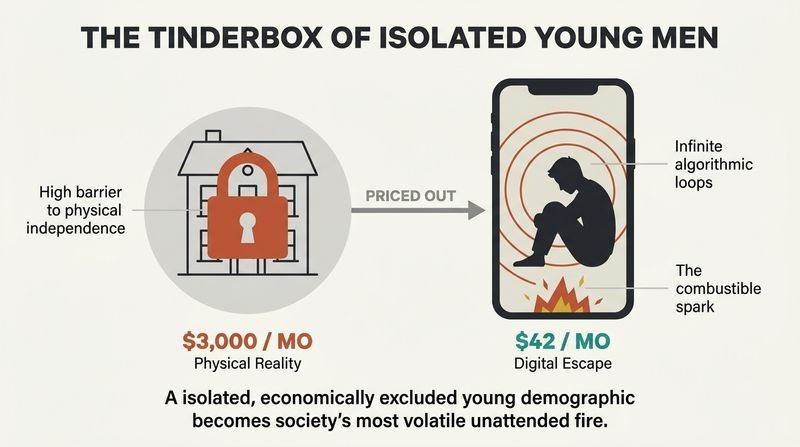
Galloway's alarm bell. Galloway, an NYU professor and serial entrepreneur, argues American boys have fallen farther, faster than any recent cohort. His evidence stacks up grimly:
1. The percentage of men aged 20-24 neither working nor in school has tripled since 1980.
2. Sixty percent of men 18-24 live with their parents.
3. Roughly 45% of men 18-25 have never approached a woman in person.
4. Deaths of despair (suicide, overdose, alcohol) killed about 70,000 Americans yearly, disproportionately non-college white men.
The mobile studio apartment. He notes a Manhattan 400-square-foot apartment costs $3,000 monthly, while a phone (a 17-square-inch escape) runs $42. Tech firms profit by convincing young men a facsimile of life on a screen suffices. His thesis: nothing is more combustible than a lonely, broke young man in a society awash in guns and algorithms.
What's striking is how Galloway reframes a moral panic into an economic diagnosis. Rather than scolding men as inherently toxic, he locates the crisis in wealth transfer: 70-year-olds are 72% richer than 40 years ago while under-40s are 24% poorer. This echoes Richard Reeves's work in "Of Boys and Men" and Anne Case and Angus Deaton's deaths-of-despair research. A fair challenge: some scholars argue the male crisis narrative understates women's persistent disadvantages. Galloway anticipates this, insisting empathy is not zero-sum. The framing that phones function as cheap dopamine substitutes for genuine density and connection is his sharpest contribution.
Anchor masculinity to three jobs: protect, provide, procreate
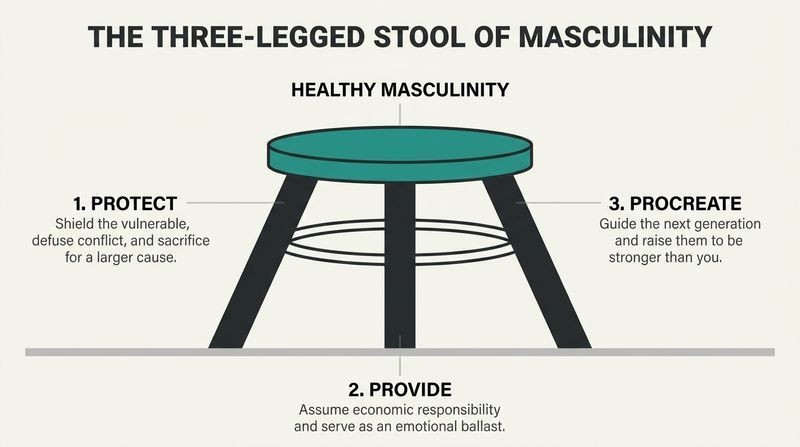
The three-legged stool. Galloway proposes healthy masculinity rests on three functions. Protect means the mensch instinct: your default is to break up bar fights, not start them, to shield the vulnerable and sacrifice for something bigger than yourself. Provide means assuming economic responsibility for your household, becoming a ballast that absorbs drama without adding to it (and sometimes stepping aside for a higher-earning partner). Procreate means ensuring the species endures, which starts with pursuing sex and, if you have kids, raising them to be stronger and more impressive than you.
Toxic masculinity is an oxymoron. Galloway rejects the phrase entirely. Cruelty, bullying, and predation aren't masculine, he argues, they're anti-masculine. Conflating maleness with savagery insults the men who built the Empire State Building and stormed Normandy.
The protect-provide-procreate triad is ancient, essentially evolutionary anthropology repackaged as life advice. Its strength is that it gives aimless young men a concrete role rather than a lecture on what not to be. The risk is prescriptiveness: not every man wants or can fulfill all three, and Galloway concedes procreation is optional. Critics might note the framework skews heteronormative and traditional. Yet his "mensch" reframing (Yiddish for a person of integrity) is genuinely useful, shifting masculinity from dominance toward stewardship. It resonates with Jordan Peterson's emphasis on responsibility and with older honor codes, updated for an era suspicious of the word masculine itself.
Give more than you take: aim for the surplus column
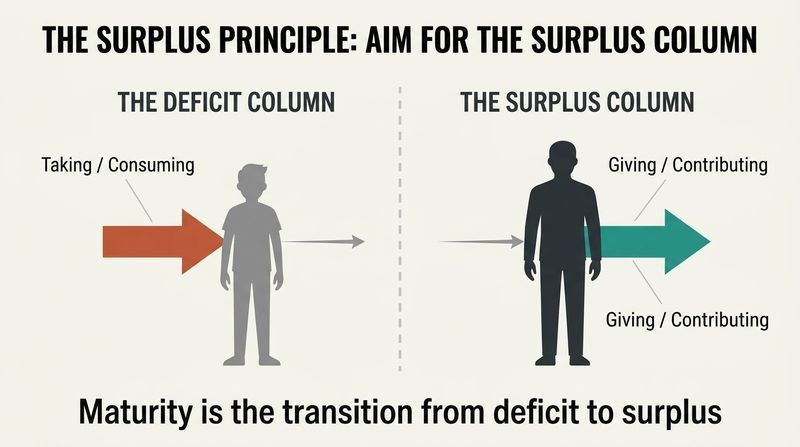
The organizing principle. Borrowing from Richard Reeves, Galloway builds the entire book around surplus value: giving more than you get, without keeping score. For a father, it means being a better dad than your dad was to you. For a friend or employer, it means providing more love and support than you receive. Children under 18 have negative value, he notes bluntly, they take far more than they give. Maturity is the transition into the surplus column.
Jettison the tape measure. Until his forties, Galloway ran life like a corporation, always calculating whether he got more than he gave. He overpaid people, over-tipped, gave people the benefit of the doubt, and stopped tracking slights. Paradoxically, he found generosity made him feel more masculine, not less.
Surplus value elegantly reframes generosity as strength rather than sacrifice, which is psychologically shrewd for men allergic to anything that smells like weakness. It maps onto Adam Grant's research in "Give and Take," where givers, when strategic, outperform takers over time. The evolutionary framing (caregivers have lower mortality rates) grounds altruism in self-interest, a clever hook. One tension: Galloway simultaneously advises ruthless self-promotion and score-keeping in one's twenties, then surplus-giving later. That may be honest about life stages, but readers should note the framework is aspirational for a man who admits he spent decades taking more than he gave.
Your career slope is unfairly set in your first five years
Burn fuel early. Galloway's most contrarian career advice: balance is a myth, there are only trade-offs. The trajectory of your professional life is disproportionately determined by the velocity you build in your twenties and thirties. He advises reallocating time from gaming, porn, streaming, and betting toward three areas only: work, relationships, and fitness. Walk into any room believing you could outlast everyone in it.
Don't follow your passion. He calls this commencement-speech poison. Instead, find what you're good at, something with a 90%+ employment rate that AI can't easily supplant, and get great at it. The rewards and recognition from mastery generate passion, not the other way around. Boring is sexy: he invests in smelting and pesticides, not dubcore nightclubs, because overcrowded glamour sectors suppress returns.
The passion-is-overrated stance aligns with Cal Newport's "So Good They Can't Ignore You," which similarly argues skill precedes passion. Galloway's career-as-asset-class framing is genuinely useful: human capital floods glamorous fields and depresses their risk-adjusted returns, a real economic phenomenon. The harder claim is that balance is illusory. Behavioral research on burnout and the diminishing marginal productivity of overwork complicates his warrior ethos. His honesty saves it: he admits obsessive work cost him his hair, his first marriage, and arguably his sanity, and explicitly says most people are happier choosing differently. That candor turns dogma into an honest trade-off menu.
Boys' brains lag two years behind; feed them Slowpa
The prefrontal cortex gap. Male and female brains are 99% identical, but the prefrontal cortex (the CEO governing impulse control, planning, and judgment) matures up to two years earlier in girls. Combined with a testosterone-fueled amygdala that makes boys lose their cool faster, this leaves adolescent males at a huge maturity disadvantage that doesn't close until around 25. It helps explain why you rarely hear of girls eating Tide Pods or blowing off exams.
Slowpa versus fast dopa. Galloway coins Slowpa (slow dopamine): the delayed, incremental rewards of reading, lifting weights, building LEGO, or cooking, versus the fast dopamine hits of TikTok and Instagram that leave you empty and craving more. Compound interest, he argues, is the most powerful force in the universe. Small consistent efforts accumulate into transformation.
The neuroscience is broadly accurate, though Galloway responsibly flags diagnostic bias: ADHD is under-identified in girls, and autism is caught earlier in affluent white boys. The Slowpa concept is a memorable rebranding of delayed gratification, echoing the famous Stanford marshmallow test and Anna Lembke's "Dopamine Nation." What extends the idea usefully is his environmental design: he built a home gym and does nightly ten-minute workouts with his son over Zoom, collapsing the gap between should and do. The deeper insight, borrowed from colleague Jonathan Haidt, is that children today are overprotected offline and underprotected online, precisely inverting what developing brains need.
Having no friends kills you like smoking fifteen cigarettes daily
The friendship recession. Since 1990, the share of Americans with fewer than three close friends doubled from 16% to 32%. Two-thirds of American men agree that "no one really knows me well." Loneliness rivals smoking and alcohol as a cause of early death, and men are hit hardest because they're trained to see vulnerability as weakness. When relationships end, male social networks contract while women's stay intact.
Friendship is a muscle, not an accident. Galloway prescribes proactive maintenance: last-minute invitations, sharing your calendar, friendship cold-calling (he literally tweeted a stranger "Can we be friends?" and got brunch). His rule for deepening male friendship: go first. Take a risk on a subject that hasn't come up. Nine times out of ten your friend engages. He also prunes friends who no longer add intelligence, kindness, or growth.
The health data is robust: Julianne Holt-Lunstad's meta-analyses found social isolation raises mortality risk by roughly 20-30%, and the Harvard Study of Adult Development (running since 1938) concluded relationship quality at 50 predicts health at 80 better than cholesterol. Galloway's contribution is tactical rather than diagnostic, treating friendship like a fitness regimen with reps. The "go first" heuristic is quietly profound, addressing the pluralistic ignorance that keeps men mutually silent about struggles everyone shares. His willingness to prune friendships may strike some as transactional, but it reflects an honest reallocation-of-capital mindset applied to the one domain men most neglect.
Boys need guardrails; a good relationship is the best one
Men detach without structure. Galloway argues boys and men need an organizing principle more than women do: work, a friend group, hobbies, ideally a romantic partner. Left alone, especially under 25 with an unfinished prefrontal cortex, young men make remarkably bad decisions, gain weight, stop shaving, and revert to negative surplus value. His own guardrails were his mother, his fraternity, and a college girlfriend who threatened to stop sleeping with him if he didn't cut back on weed (highly motivating).
Sync on passion, values, money. The best partnerships align on three things: physical attraction, shared values (religion, kids, proximity to parents), and money (the number-one source of marital conflict). His dating advice cuts against romantic mythology: like someone who likes you. Don't mistake someone's disinterest for their superiority.
The guardrails concept reframes commitment as scaffolding rather than confinement, which is persuasive given the data on married men living longer and accumulating more wealth. Sociologists have long observed the male marriage premium, though causation is debated (do stable men marry, or does marriage stabilize men?). Galloway's "like someone who likes you" is a corrective to the scarcity-driven pursuit of the unavailable, echoing attachment research showing anxious pursuit predicts worse outcomes. The claim that men need guardrails more than women is contestable and risks essentialism, but his lived examples make it feel less like biology-as-destiny and more like honest observation of male fragility under isolation.
Porn is a masculinity-killer that quietly erodes your risk muscle
The most underreported addiction. Galloway admits he likes porn and has, at times, technically qualified as addicted. His concern isn't moral but functional. Horniness historically drove young men to take social risks: approach women, endure rejection, build calluses, create opportunity. Ubiquitous free porn (some estimates put it at a third of internet traffic) eliminates the incentive to ever get to no. If porn had existed when he was young, he says, he wouldn't have bothered leaving his dorm.
Homo solo. He warns of an emerging asocial, asexual male whose AI girlfriend never says no, never tires, and obviates the risk of rejection. Citing Stanford's Dr. Anna Lembke, he frames addiction as a disease of loneliness, with all drugs (porn included) as ersatz replacements for human connection. Moderate use, get help if it controls you.
Galloway wisely sidesteps the culture-war framing of porn as sin, grounding his critique in behavioral economics: porn substitutes a low-friction reward for the high-friction skill-building of courtship. This dovetails with Lembke's dopamine-balance model and with research linking heavy consumption to sexual objectification. The evidence base is genuinely thin (porn addiction isn't in the DSM), and he honestly flags this. The strongest version of his argument is developmental: rejection tolerance is a transferable life skill, and anything that removes the need to practice it atrophies broader agency. The "Homo solo" coinage is provocative but captures a real anxiety about synthetic intimacy replacing the generative friction of real relationships.
Being a great dad means ending up in the minus column
Parenthood is a negative game. Galloway's central fatherhood insight: you will give more love than you get back, and that's the point, not a failure. When his teenage sons take him for granted, ignore his interests, and prefer their mother, he reframes it as evidence he's done his job. They know he's there. New fathers' testosterone drops by a third; evolution retools men from competing for mates to bonding with babies.
Garbage time beats quality time. Borrowing from Ryan Holiday, he champions garbage time: the unplanned, mundane moments (driving to school, cooking dinner) when kids actually open up. "Quality time" is a myth invented by absent fathers. His practical moves: kiss your sons, hold their hands, adopt their interests rather than expecting them to inherit yours, and just love them rather than constantly correcting.
The garbage-time concept has real empirical backing: attachment research consistently shows connection forms through frequency and availability, not staged intensity. Galloway's reframe of being taken for granted as success is psychologically generous and probably healthy, sparing fathers the resentment that poisons so many parent-child bonds. His testosterone data is accurate and underappreciated, undercutting the myth that fatherhood is unnatural for men. The advice to adopt kids' interests rather than impose your own inverts a common paternal error. What deepens the section is his contrast with his own charming, absent, four-times-married father, making the surplus-value ethos feel earned rather than preached.
Fitness is the keystone habit that upgrades every other domain
The CEO trait worth stealing. The most common trait among CEOs isn't pedigree or minimal sleep, it's exercising four to five times a week. Galloway treats fitness as non-negotiable medicine: it lowers cortisol and adrenaline, boosts endorphins, improves sleep and mood, and (per a 2024 study) rivals medication as a treatment for depression. His mnemonic for pulling out of a dark spell is SCAFA: Sweat, Clean eating, Abstinence, Family, and Affection.
Mind the gap. The secret to working out isn't thinking about it, it's collapsing the space between should and do. He hired a trainer not for expertise but to eliminate procrastination by scheduling. A half-hour of intense home dumbbell work beats the whole gym ritual. Women also read fitness as a signal of discipline and commitment, the same traits that make good partners and providers.
Fitness-as-keystone-habit is well supported: Charles Duhigg's "The Power of Habit" identified exercise as a keystone that cascades into better eating, sleep, and productivity. Galloway's mental-health framing is increasingly validated, with exercise now recommended as frontline treatment for mild-to-moderate depression in several clinical guidelines. The "mind the gap" insight, engineering commitment devices to defeat the should-do gap, is behavioral economics in practice, akin to Thaler and Sunstein's nudges. His candor about body dysmorphia (persisting even at 200 pounds of muscle) adds nuance, acknowledging fitness solves much but not the underlying self-image, a healthy caveat against treating the gym as total salvation.
America rewards the unremarkable if you keep taking swings
Water many plants, don't force a few. Galloway's origin story is a manifesto against early sorting. A mediocre student rejected by UCLA, he got in on appeal as "a son of a single mother and the great state of California," then earned a 2.27 GPA, failed seven classes, and needed a fifth year. He argues no institution can predict greatness in an 18-year-old, and America errs by hydroponically cultivating a few super-seeds while letting everyone else wilt.
Kindness and asking for help are underused male weapons. He got into UCLA partly because he gave a hard-grading biology teacher an anonymous giant chocolate bar and earned a rare A. A calculus professor tutored him for days and gave him an undeserved B so he could graduate. Both times, kindness and the willingness to ask saved him.
This is Galloway's most politically charged thread, an argument for public investment and second chances over meritocratic winner-take-all. It resonates with Michael Sandel's "The Tyranny of Merit," which similarly critiques how meritocracy moralizes success and shames the unremarkable. His personal data point (state-subsidized education transforming a directionless kid) is the emotional engine of the whole book. The service-job-as-anti-meritocracy-vaccine idea is a sharp reframe: watching immigrant coworkers outwork him for minimum wage taught him agency is unequally distributed. The vulnerability, that kindness and help-seeking are strengths men squander, quietly subverts the self-reliant masculine archetype the book otherwise celebrates.
Manners are manhood in action, surplus value made visible
Etiquette as rehearsed generosity. Galloway teaches his sons that manners aren't about forks or fox hunts, they're respect made tangible, proof you have a code and consider others before yourself. His rules: stand when someone enters, make three seconds of eye contact, ask follow-up questions (Queen Elizabeth's go-to was "Have you come far?"), fill others' glasses before your own, don't interrupt, and be prepared.
Pay for people, generously. Scarred by a father so cheap he charged his son's friend two dollars for a movie ticket and ignored young Scott for 48 hours over a three-dollar milkshake, Galloway made generosity a core identity. He gives away more than he spends each year, wires friends money after disasters without asking, and refuses to befriend the wealthy who dodge the check. Generosity, he insists, feels masculine and creates a room full of opportunities.
Framing manners as surplus value applied to daily micro-interactions is a clever unification of the book's threads. Sociologically, manners are costly signals: they demonstrate self-restraint and other-orientation, which is why they build trust and reputation (the word etiquette itself derives from Versailles garden tickets, as Galloway notes). The generosity-as-identity move is psychologically sound, since research on prosocial spending (Dunn, Aknin, Norton) shows giving reliably boosts the giver's happiness more than spending on oneself. The intergenerational contrast is the section's power: a son deliberately inverting his father's parsimony illustrates how codes are consciously chosen, not inherited, the book's quiet thesis about becoming a man.
Analysis
"Notes on Being a Man" is a hybrid: part memoir, part data-driven polemic, part fatherly instruction manual. Galloway structures it as a chronological life story (boyhood, adolescence, college, work, health, friendship, love, fatherhood) that doubles as a developmental arc for young men. The book's genre-bending is both its strength and its summarization challenge, because the argument advances through vulnerable anecdote (his father's cruelty, his mother's death, his own divorce) rather than tidy frameworks.
The intellectual spine is Richard Reeves's surplus value, and the operating metaphor is masculinity as a three-legged stool of protect, provide, procreate. What distinguishes Galloway from the crowded field of masculinity commentators is his refusal of both poles: he rejects the manosphere's grievance and the progressive dismissal of men as problems. He insists empathy is not zero-sum, that celebrating men need not diminish women's gains. This centrist positioning, backed by economics (intergenerational wealth transfer, the mating market's winner-take-all dynamics, deaths of despair), gives the book unusual credibility.
The most valuable material is counterintuitive: don't follow your passion, balance is a myth, porn erodes agency, garbage time beats quality time, being taken for granted proves good parenting. These invert conventional wisdom in ways that are testable and actionable.
The book's limitations are worth flagging. Galloway's prescriptions skew toward a heteronormative, high-achieving, capitalist template, and his own life (nine companies, private jets, a Scottish castle birthday) sits awkwardly beside advice for basement-dwelling young men. He knows this and repeatedly says "that's my way, not the right way," which is disarming but occasionally lets him avoid harder questions about structural fixes versus individual grit. His claim that men need guardrails more than women flirts with essentialism.
Still, the emotional honesty (a self-described introvert with anger and depression who couldn't cry for a decade) transforms what could be lecture into confession, and confession, delivered with data, is harder to dismiss.
Review Summary
Notes on Being a Man receives mixed reviews averaging 4.01/5 stars. Many readers note it's more memoir than masculinity guide, featuring Galloway's life experiences and advice for young men. Supporters praise his candor, actionable guidance, and focus on kindness as masculine strength. Critics find it repetitive, self-congratulatory, and overly focused on wealth and career success. Some question his priorities, particularly sacrificing personal relationships for economic status. Several reviewers appreciate his attempt to provide alternative male role models but wish for more scholarly depth, less American-centrism, and clearer distinction between parenting advice and masculinity-specific guidance.
FAQ
What is Notes on Being a Man by Scott Galloway about?
- Modern masculinity explored: The book examines what it means to be a man in contemporary America, blending memoir, research, and cultural critique.
- Challenges for men: Galloway addresses issues like educational bias, economic hardship, social isolation, and the crisis of male identity.
- Three pillars of masculinity: He introduces the "three-legged stool" of Protect, Provide, and Procreate as a framework for understanding manhood.
- Call for societal change: The book urges recognition of men’s struggles and advocates for more support, empathy, and positive role models.
Why should I read Notes on Being a Man by Scott Galloway?
- Personal and relatable: Galloway’s candid memoir-style storytelling makes complex societal issues accessible and engaging.
- Data-driven insights: The book combines personal anecdotes with research and statistics, offering a comprehensive look at the male experience.
- Practical frameworks: Readers gain actionable advice for personal growth, relationships, and parenting through the three pillars of masculinity.
- Empathy and inclusivity: Galloway encourages a balanced, inclusive conversation about gender, highlighting the unique struggles of boys and men.
What are the key takeaways from Notes on Being a Man by Scott Galloway?
- Action builds agency: Taking action, even when feeling low, is essential for building confidence and opportunity.
- Friendship and connection matter: Maintaining friendships and social networks is vital for mental health and happiness.
- Love and generosity are central: The most important life decisions revolve around love, relationships, and giving more than you take.
- Fatherhood and mentorship: Embracing responsibility as a father or mentor transforms purpose and legacy.
What are the main challenges facing boys and men according to Notes on Being a Man by Scott Galloway?
- Educational disadvantages: Boys face an education system that often doesn’t suit their developmental timeline, leading to disengagement.
- Economic and social struggles: Young men encounter declining wealth, fewer job opportunities, and increased social isolation.
- Mental health crisis: High rates of suicide, addiction, and loneliness are prevalent among men, exacerbated by unemployment and disconnection.
- Relationship difficulties: Economic instability and social trends have led to fewer romantic opportunities and increased loneliness.
How does Scott Galloway define masculinity in Notes on Being a Man?
- Three-legged stool metaphor: Masculinity is built on Protect, Provide, and Procreate, forming a stable foundation for male identity.
- Protect: Involves integrity, honor, and defending family and community.
- Provide: Emphasizes economic and emotional responsibility within households and relationships.
- Procreate: Focuses on raising children and ensuring the next generation thrives, not limited to biological parenthood.
What is the "three-legged stool" framework for masculinity in Notes on Being a Man by Scott Galloway?
- Protect: Being a person of integrity, defending loved ones, and standing up for what matters.
- Provide: Taking responsibility for financial and emotional support, regardless of shifting gender roles.
- Procreate: Ensuring the continuation and improvement of the next generation, through parenting or mentorship.
- Stability and purpose: Galloway argues these three pillars offer men a clear path to fulfillment and societal contribution.
What does "surplus value" mean in Notes on Being a Man by Scott Galloway?
- Giving more than you take: Surplus value is about offering more love, kindness, and support than you receive in relationships and life.
- Measure of masculinity: Galloway sees leaving a legacy of surplus value as a hallmark of true manhood.
- Applies to all roles: Whether as a friend, partner, father, or citizen, providing surplus value means being generous and engaged without keeping score.
- Kindness and strength: Surplus value is rooted in kindness and strength, not weakness.
How does Notes on Being a Man by Scott Galloway address friendship and male camaraderie?
- Friendship recession: The book highlights the decline in close male friendships and the health risks of loneliness.
- Vulnerability is key: Galloway urges men to practice emotional openness and vulnerability to build deeper connections.
- Proactive effort required: Friendships need to be maintained through regular contact, shared activities, and genuine compliments.
- Community and belonging: Finding a tribe—through sports, clubs, or fraternities—builds social skills, confidence, and purpose.
What advice does Scott Galloway give about love, sex, and marriage in Notes on Being a Man?
- Love as the ultimate goal: Galloway emphasizes that love and relationships are the most important pursuits in life.
- Choose partners wisely: He advises men to seek partners who genuinely like and respect them, aligning on values and financial compatibility.
- Kindness is essential: Kindness and consideration are the "secret sauce" for successful relationships and are often overlooked in modern masculinity.
- Risks of porn: Excessive pornography use can harm ambition, relationships, and sexual energy; moderation and seeking help are encouraged.
How does Notes on Being a Man by Scott Galloway explore fatherhood and mentorship?
- Fatherhood transforms priorities: Becoming a father shifts focus from self to child, often accompanied by emotional and hormonal changes.
- Engagement over perfection: Being present and loving unconditionally, even in mundane moments, is more important than being perfect.
- Modeling affection and kindness: Fathers should show physical and emotional affection and support their children’s interests.
- Mentorship beyond family: Men are encouraged to mentor and invest in the lives of boys and young men beyond their own children.
What is the "Slowpa" (slow dopamine) concept in Notes on Being a Man by Scott Galloway?
- Definition of Slowpa: Slowpa refers to the satisfaction from delayed gratification and sustained effort, as opposed to instant rewards from technology.
- Examples of Slowpa: Activities like building, cooking, or reading foster patience, focus, and deeper fulfillment.
- Counteracting instant gratification: Teaching boys to value Slowpa helps combat the addictive pull of screens and promotes healthier brain development.
- Emotional resilience: Slowpa builds emotional strength and resilience, essential for long-term well-being.
What are Scott Galloway’s views on work, career, and the pursuit of "enough" in Notes on Being a Man?
- Follow talent, not passion: Galloway recommends focusing on what you’re good at for economic viability and fulfillment.
- Work hard and persevere: Early career success requires discipline, stoicism, and a willingness to do challenging tasks.
- Fail fast and quit wisely: Knowing when to quit and move on is as important as perseverance.
- Appreciate what you have: Galloway reflects on the dangers of always wanting more and advocates for gratitude, simplicity, and prioritizing relationships over material gain.
About the Author



Download PDF
Download EPUB
.epub digital book format is ideal for reading ebooks on phones, tablets, and e-readers.








































