Key Takeaways
1. The Revolution: A Civil War of Divided Hearts
John Adams would say that the American Revolution was in the “minds and hearts” of the American people before it produced the armed struggle between the United States and Britain; what Adams neglected to mention was the degree to which those minds and hearts were at odds, one American against another.
Internal conflict. The American Revolution was fundamentally a civil war, pitting American against American, often shattering trust among neighbors and rending families. This internal struggle, rather than solely the fight against Britain, was crucial in determining the conflict's outcome. Thousands of men and women in every colony valued British rule and resented the Patriots for initiating the war.
Brutal examples. The savagery of this internal conflict was starkly evident in the Carolinas. In the Waxhaws region in 1780, Loyalist troops under Banastre Tarleton massacred Patriot forces, plunging bayonets into the wounded. This atrocity fueled a retaliatory fury among Patriots, leading to a similar slaughter of Loyalists at Kings Mountain, where many were killed after surrendering.
Defining the outcome. Before the United States could secure its independence from Britain, the Patriots first had to win this bitter civil war against the Loyalists. The struggle for minds, hearts, political allegiance, and material support among Americans ultimately shaped the destiny of the homeland both sides claimed.
2. Taxation Without Consent Ignites Colonial Fury
It is supposed an undoubted right of Englishmen not to be taxed but by their own consent given through their representatives.
New British policies. Following the French and Indian War, Britain, burdened by debt, implemented new policies to raise revenue from the colonies. The Proclamation of 1763 restricted western settlement, jeopardizing land speculation by figures like George Washington and Benjamin Franklin. This was followed by the Sugar Act (1764) and the Stamp Act (1765), which aimed to levy taxes directly on the colonies.
Colonial resistance. The Stamp Act, in particular, provoked widespread outrage, leading to riots, threats against stamp agents, and boycotts across America. Colonists, including John Adams and Patrick Henry, vehemently argued that Parliament had no right to impose "internal taxes" without colonial representation, a fundamental principle of English liberty. Franklin, initially seeking compromise, proposed alternatives like a paper money scheme, but British ministers prioritized asserting parliamentary authority.
Escalating tensions. Despite the Stamp Act's repeal, Parliament passed the Declaratory Act, affirming its right to legislate for the colonies, and later the Townshend Duties (1767), imposing "external taxes" on imports. This led to renewed non-importation agreements, demonstrating that Americans rejected all taxes for revenue, not just internal ones, and further solidified their resolve against British impositions.
3. Allegiance in Flux: Patriots, Loyalists, and Personal Stakes
The American Revolution turned accepted notions of allegiance on their heads.
Unlikely rebels. Figures like George Washington and Benjamin Franklin, who had achieved great success under British rule, became leading rebels. Washington, a Virginia aristocrat, and Franklin, a world-renowned polymath, initially sought to preserve the empire but ultimately chose independence when British policies threatened their liberties. Their transformation highlighted the profound shift in colonial sentiment.
Staunch Loyalists. Conversely, individuals like William Franklin, Benjamin's son and New Jersey's royal governor, remained fiercely loyal to the Crown. Thomas Hutchinson, a Massachusetts native and governor, criticized British policy but refused to break with London, believing connection to the parent state was vital. Joseph Galloway, a prominent Pennsylvania politician, initially challenged proprietary power but recoiled from outright rebellion, fearing "independent republican tyranny."
Complex choices. The war forced agonizing choices, often dividing families and friends. Benedict Arnold, a Patriot hero, later switched sides, becoming synonymous with treachery. Native American leaders like Joseph Brant also faced a civil war within their confederacies, choosing alliances based on perceived self-interest and survival. These shifting allegiances underscored the deeply personal and often tragic nature of the conflict.
4. Washington's Crucible: Forging an Army from Defeat
I heard bullets whistle and, believe me, there was something charming in the sound.
Early military experience. George Washington's military career began in the French and Indian War, where he gained crucial experience and a taste for command. His early expeditions to the Ohio Valley, including the disastrous defeat at Fort Necessity, exposed him to the realities of frontier warfare and the limitations of British military strategy. He found the experience of battle "thrilling."
Braddock's debacle. Washington served as an aide to General Edward Braddock during the ill-fated 1755 expedition to Fort Duquesne. Braddock's overconfidence in regular troops and disdain for American and Indian fighting methods led to a devastating ambush. Washington's Virginians, however, "behaved like men," outperforming the panicked British regulars, giving Washington his "first suspicion that our exalted ideas of the prowess of British regulars had not been well founded."
Learning from adversity. These early trials, though marked by defeat, were formative. Washington learned invaluable lessons about leadership, logistics, and the unique challenges of American warfare. His resilience and ability to adapt, even in the face of overwhelming odds, would become hallmarks of his command during the Revolution, transforming him from a provincial officer into a continental leader.
5. Franklin's Diplomatic Triumph: Securing French Aid
The hearts of the French are universally for us, and the cry is strong for immediate war with Britain.
Mission to France. Following the Declaration of Independence, Benjamin Franklin was dispatched to Paris as a commissioner to negotiate a treaty with France. His task was to convince the French government that American independence was not only plausible but also in France's strategic interest, offering commercial benefits and a chance for revenge against Britain.
Strategic patience. Despite initial French enthusiasm, King Louis XVI was hesitant to openly support a republican rebellion. Franklin skillfully navigated this ambivalence, leveraging informal aid (weapons, loans via Beaumarchais) while patiently awaiting a decisive American victory. He understood that France's self-interest, not mere sentiment, would drive their ultimate decision.
Saratoga's impact. The American victory at Saratoga in late 1777 proved America's military capability and tipped the balance. Franklin seized the moment, pressing Vergennes for a formal alliance. The resulting treaties of amity, commerce, and military alliance secured crucial French naval and military support, transforming the American Revolution into a global conflict and ensuring American independence.
6. Loyalists' Ruin: The High Price of Crown Allegiance
The unhappy fate of the poor Loyalists in Lord Cornwallis’s army is dreadful.
Persecution and exile. For Loyalists, the Revolution brought immense suffering and often ruin. Prominent figures like Joseph Galloway, who sided with the British, saw their property confiscated and faced threats of violence. Sarah Logan Fisher, a Philadelphia Quaker, endured the arrest and exile of her husband, the seizure of her home, and the loss of her daughter to England, experiencing profound abandonment and poverty.
Betrayal and abandonment. Loyalists often found themselves caught between two unforgiving sides. Cornwallis's surrender at Yorktown, which explicitly excluded protection for American Loyalists, was a bitter betrayal. This left thousands vulnerable to Patriot retribution, forcing many to flee with British forces to England, Canada, or the West Indies, never to return to their native land.
Lingering animosity. Even after the war, the animosity towards Loyalists persisted. William Franklin, despite his unwavering loyalty to the Crown, received only a pension from the British government and was disinherited by his father, Benjamin Franklin, who cited his son's actions against the Patriot cause. The Loyalists, unlike the victorious Patriots, had no new nation to call their own, only the memory of a lost cause and the scorn of their former countrymen.
7. Freedom's Paradox: Slaves Choosing Sides
Liberty is sweet.
Dunmore's Proclamation. Lord Dunmore, Virginia's royal governor, dramatically escalated the conflict in 1775 by offering freedom to enslaved people who would join the British army. This promise of liberty forced a profound choice upon thousands of slaves, who weighed the immense risks of flight and potential re-enslavement against the chance for freedom.
Difficult choices. Enslaved individuals like Boston King and Jeffrey Brace made perilous journeys to British lines, seeking the freedom denied by their Patriot masters. King, after multiple close calls with re-enslavement and disease, eventually found freedom in Nova Scotia and later Sierra Leone. Brace, fighting for the Patriots, ironically found himself a "slave to liberate freemen," but ultimately secured his own emancipation after the war.
Patriot response. Washington, initially hesitant to arm enslaved people, was compelled to counter Dunmore's offer, albeit with a more limited promise of freedom for free blacks who enlisted. The paradox of fighting for liberty while upholding slavery was a profound moral dilemma for the Patriots, highlighting the complex and often contradictory nature of the Revolution's ideals.
8. Frontier's Fury: Brutal Warfare with Native Allies
The messengers of justice and of wrath await them in the field, and devastation, famine and every concomitant horror that a reluctant but indispensable prosecution of military duty must occasion will bar the way to their return.
Native American alliances. The Revolution extended into a brutal frontier war, with Native American tribes aligning with both sides. Joseph Brant, a Mohawk war chief, led Iroquois warriors in support of the British, believing their future was more secure with the Crown against American expansion. Other tribes, like the Oneidas, sided with the Patriots, leading to a civil war within the Iroquois Confederacy.
Terror and reprisal. Loyalist and Native American forces, under leaders like Brant and John Butler, launched devastating raids on Patriot settlements in the Mohawk and Wyoming Valleys. These attacks, characterized by massacres, scalping, and the burning of homes and crops, aimed to depopulate the frontier and instill terror. The Battle of Oriskany, a brutal ambush, resulted in heavy losses for the Iroquois, leading some to abandon the British.
Washington's scorched earth. George Washington responded to these atrocities with a scorched-earth policy, ordering General John Sullivan to "total destruction and devastation of their settlements" and to "ruin their crops." This campaign, though effective in crippling Loyalist Indian power, further intensified the cycle of violence and left a lasting legacy of bitterness on the frontier.
9. Army's Anguish: Mutiny, Neglect, and Washington's Resolve
The patience of the army, from an almost uninterrupted series of complicated distress, is now nearly exhausted, and their discontents matured to an extremity.
Valley Forge's ordeal. The winter of 1777-1778 at Valley Forge pushed the Continental Army to its breaking point. Soldiers endured severe shortages of food, clothing, and pay, leading to widespread disease, desertion, and profound demoralization. Washington, deeply frustrated by Congress's neglect, felt his leadership questioned and his army on the verge of dissolution.
The Pennsylvania Mutiny. By 1781, the accumulated grievances erupted into the Pennsylvania Line mutiny, where soldiers marched on Philadelphia demanding redress. Washington, recognizing the peril of using force, cautiously negotiated, fearing that a harsh response would drive entire regiments to the British. He used the mutiny to underscore to Congress the dire need for adequate support.
Washington's leadership. Despite the immense pressure and the "Conway cabal" (a perceived conspiracy to replace him), Washington held the army together. His personal appeal to his officers at Newburgh, where he shamed them into rejecting a plot to pressure Congress, demonstrated his unparalleled moral authority and commitment to civilian control, preventing a catastrophic internal conflict.
10. Yorktown's End: Victory, Peace, and Lingering Scars
Happy, thrice happy, shall they be pronounced hereafter who have contributed anything, who have performed the meanest office, in erecting this stupendous fabric of freedom and empire on the broad basis of independency.
Strategic shift. After years of stalemate, Washington, in coordination with French forces under Rochambeau and the French fleet under de Grasse, executed a brilliant strategic shift from New York to Virginia. This decisive move trapped Lord Cornwallis's British army at Yorktown, leading to a siege that culminated in the British surrender in October 1781.
The peace treaty. Yorktown effectively ended major hostilities, discrediting the British war government and paving the way for peace negotiations in Paris. Benjamin Franklin, as the lead American commissioner, skillfully navigated complex demands, securing not only full American independence but also favorable western boundaries and fishing rights, while resisting British demands for Loyalist compensation.
Aftermath and legacy. The Treaty of Paris (1783) formally recognized the United States, but the civil war's scars remained. Patriots celebrated their "stupendous fabric of freedom," while Loyalists faced exile and ruin, their property confiscated and their loyalty unrewarded by a weary British government. The war's end marked a new beginning for America, but a bitter conclusion for those who had chosen the losing side.
Review Summary
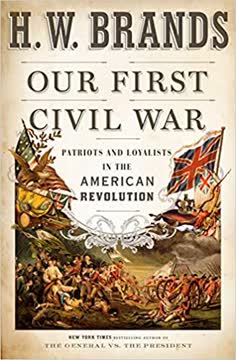
Our First Civil War receives mixed reviews, averaging 3.9/5. Readers appreciate Brands' use of primary sources and the fresh perspective on the Revolution as an internal conflict, particularly the Franklin family divide. However, many feel misled by the title, expecting deeper exploration of Loyalist versus Patriot tensions among ordinary colonists. Instead, the narrative centers heavily on elite figures like Washington and Franklin. Recurring criticisms include excessive direct quotations, insufficient attention to common citizens, and sparse coverage of the Southern theater.