
Plot Summary
November Solitude Beckons
. In the cold embrace of early November, Trond Sander, sixty-seven, revels in his chosen solitude on the Norwegian frontier. Each ritual—watching birds, listening to foreign cricket broadcasts, the daily fire, walks with his dog Lyra—reinforces a self-imposed exile where time is tangible but detached. News of the coming millennium stirs no excitement; instead, the quiet hours and simple labors fill his days. Trond feels both content and haunted by the silence, recalling how he has always yearned for aloneness even amid happiness. Yet this longed-for calm is tinged with uncertainty: memories simmer under the surface, waiting to breach his carefully structured present.
A Neighbor's Night Call
. One cold night, the sharp sound of a dog whistle and a neighbor's search for his missing dog shatter Trond's attempt at perfect solitude. Lars Haug, a lined and weathered figure, confesses old wounds as they hunt for his rebellious border collie. In the dark, a story from Lars's youth—ordered to shoot a dog to protect deer, the haunting aftermath—mirrors Trond's buried discomforts. Compassion rises between the two men, despite the strangeness, as the quiet countryside is revealed to hold complex histories. The night leaves Trond unsettled, the encounter opening up old summer memories that begin to trouble his peace.
Summer of Stealing Horses
. The narrative slips back to the formative summer of 1948, with fifteen-year-old Trond staying with his enigmatic father by a remote river cabin. Jon, an intense local boy, invites Trond "out stealing horses" at dawn—a term meant to excite, not to take. Their wild ride through the misty forest is a contest of bravery, skill, and boyish daring. Jon always craves only Trond's company, and both are bound by unspoken rules and shared risks. Underlying this youthful freedom, tension simmers: Jon's avoidance of Trond's father, symbolically refusing to step inside, and the sense that this morning, suffused with fog and possibility, is laden with something heavier.
The Egg and the Storm
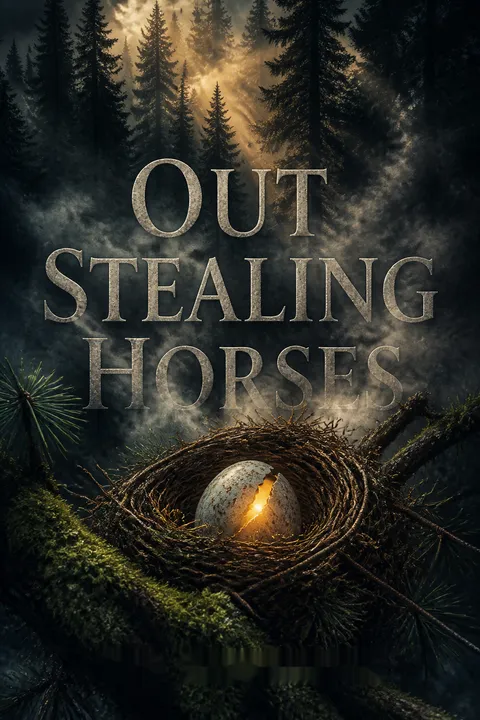
. After their escapade, Jon invites Trond to witness a goldcrest's nest. Trond marvels at the delicate egg—the promise of life and flight—until Jon's face contorts in anguish. Suddenly, he crushes the egg and nest in a fit of unexplained fury and grief, unleashing an animal wail. A thunderstorm follows, mirroring the violence inside Jon. Trond, thrown and battered from his horse, limps home through rain and pain, feeling the electric tension between childhood and something darker. Waking up in warmth, fed and tended by his father, he learns only that local tragedy has struck. This pivotal day's meaning churns beneath the surface, the consequences still unseen.
A Family Broken
. The reason for Jon's breakdown and the community's somber mood is gradually revealed. Jon's youngest brother Lars—later Trond's neighbor—accidentally shoots and kills his twin, Odd, with Jon's gun, in a senseless act that leaves the family stunned and silent. Their father is paralyzed by grief; their mother returns home to this devastation. Jon disappears emotionally and then physically, unable to face the collapse of his world. At Odd's funeral, human restraint crumbles: Lars runs wild, Jon stares ahead, Trond feels the rupture in friendship and innocence. The horror of fate, blame, and the inexplicable intertwines with the memory of stealing horses.
War's Secret Shadows
. Trond learns from Franz, a neighbor and war survivor, that his taciturn father was deeply involved in Resistance activities during the German occupation. The cabin was not only a summer retreat but a waypoint for escapees and secret couriers, with Jon's mother a vital conspirator. Day-to-day chores and neighborly interactions masked perilous undertakings. Jon's father refused participation yet could not avert his gaze from his wife's clandestine ventures with Trond's father. When betrayals and conflicts with occupiers threaten everyone, the lines between public and private, love and duty, bend and sometimes break. These revelations complicate Trond's memory of his father and shape his understanding of adult secrecy.
Haymaking and Friendship's Cost
. Summer's cycle resumes with haymaking, involving Trond, his father, the community, and Jon's mother. Under the surface, relationships are brittle: Trond and Jon are estranged after Odd's death, Jon's father drifts into bitterness, and Trond's father grows drawn to Jon's mother. Work in the fields is both exhausting and transformative, forging camaraderie but highlighting divisions. Trond is acutely aware of his outsider status, both regarding local customs and within the triangle of his father, Jon's mother, and Jon's absent father. The shadow of tragedy hovers over every gathering, and the sense of approaching endings grows.
Father's Hidden Strength
. Trond's father organizes the felling and rafting of their timber, enlisting neighbors—including Franz and Jon's family. Trond watches his father's natural leadership, his ability to command and inspire, with a mix of pride and growing unease. The grueling work, risk, and river's temperament test everyone. Competition and collaboration vie, culminating in a mishap that badly injures Jon's father during a senseless contest of strength. This accident turns joy to bitterness, and Trond feels both complicit and alienated, realizing the limits of childhood and the onset of adulthood's ambiguous responsibilities. The working rhythm of men is both mesmerizing and subtly destructive.
Rivalries and Timber Falls
. As the timber piles up, so do tensions—between Trond's father and Jon's, and within Trond himself. A contest to build the highest stack, cheered by the presence of Jon's mother, ends in disaster: Jon's father's leg is broken, and all previous alliances shatter. The event becomes emblematic of masculine pride and the unintended consequences of prideful rivalry. Jon's mother rushes to care for her husband, Trond feels bitter toward his father for spoiling his only taste of primal intimacy, and the valley's fragile sense of community is left in splinters. Nothing feels reparable; Trond senses a turning point from which life will not recover.
The Root of Betrayal
. After the accident and Jon's departure, Trond witnesses his father's deepening relationship with Jon's mother. He stumbles upon them sharing an intimate moment—a stolen kiss across the river—shattering his already fraught sense of family loyalty and trust. The personal betrayals echo the era's larger betrayals, with everyone forced to make impossible choices. Jon flees to sea, Lars grows apart from what remains of his family, and Trond's father becomes ever more remote. The idyllic landscape now feels charged with loss, duplicity, and irreparable breaks—emotions that will reverberate through Trond's adult life.
Farewell Without Return
. As the summer concludes, Trond departs, believing his father will follow soon—a promise never fulfilled. The ultimate betrayal comes in the form of a brief letter to Trond's mother: his father is not returning. Financial and emotional resolution is left to a distant bank in Karlstad, and Trond and his mother undertake a bleak journey to claim a pitiful sum from the failed timber sale. Trond's sense of direction is lost; the vibrant self created in the country now feels displaced and rootless. The final separation cements both Trond and Lars (Jon's brother) on paths defined by the ghosts of this severance.
Present and Past Collide
. Back in the present, Trond's attempts at solitary purpose—chopping wood, fending for himself—are interrupted when Lars, now his neighbor, reappears in his life. At first, recognition is delayed, but when they finally acknowledge their shared past, a mutual, uneasy understanding unfolds. Both men are marked by the same childhood summer and its trauma; both remain exiled from their families and younger selves. Lars, like Trond, has abandoned his roots, never returning to take over his family farm. Their reunion is neither cathartic nor comfortable, but it compels Trond to confront the persisting influence of that distant time.
Chainsaws and Reckoning
. A heavy storm fells a great birch tree in Trond's yard, necessitating help. Together, Lars and Trond wield chainsaws to tame the chaos—physical labor becoming a form of reckoning as snow falls silently around them. Their coordinated efforts force them to reconcile the inevitability of relying on others after a lifetime of striving for independence. Small confessions and gestures during breaks hint at decades of solitude and pain: Lars reveals how he abandoned his family, never returning after adulthood; Trond wrestles with the meaning and limitations of his chosen isolation. The chains emerge as metaphors—binding, severing, connecting all at once.
Letters from Karlstad
. Trond recalls the trip to collect the proceeds from the failed logging—a final, humiliating passage with his mother to Karlstad, Sweden. The money is negligible, the journey itself a test of dignity and endurance. Small humiliations—a language barrier, misunderstandings, simmering anger—are offset only by a fleeting moment when Trond dons a new suit and walks arm-in-arm with his mother, suspended in grace. This ephemeral dance cannot last: soon, gravity reasserts itself. The family is left to remake itself from ashes, weighed down by what has been lost, yet scattered enough to carry on as strangers.
The Daughter's Visit
. Unexpectedly, Trond's adult daughter Ellen arrives at his remote home. Her presence disrupts his attempts at ordered isolation, but the encounter is laden with affection, old patterns, and mutually unspoken regrets. Their conversation oscillates between small talk, practical matters, and the existential chasms of their shared past. Ellen urges him to reconnect, to consider living rather than merely existing. For a brief moment, Trond is pulled into the warmth of family ties, but even this hopeful intrusion makes him aware of how much he has receded from the world of his emotions.
Memory's Last Ride
. The interplay of past and present converges: as Trond and his father did years ago, Trond now sets out, metaphorically and physically, into the snow. The unresolved strands—memories, betrayals, loves, regrets—bind together in Trond's aged realization that while the past is foreign, it is always present. He recognizes his own transformation: from the "boy with the golden trousers" protected by faith in luck and love, to a man adrift but enduring. The novel closes on a note of unresolved, haunting acceptance. Memory, like the snow outside, persists—softening, obscuring, and making all things possible and impossible at once.
Analysis
Out Stealing Horsesis a profound meditation on memory, masculinity, and the long shadow of trauma. Petterson's spare, poetic prose weaves an arresting study of what it means to lose, to long for, and ultimately to survive the betrayals wrought by both history and loved ones. The novel's psychological depth lies in its quiet; silence, more than revelations, defines relationships. Childhood adventure gives way not only to adult disillusionment, but also to a persistent, if fragile, hope that order, beauty, and love can be recovered or at least endured through the habits of daily life. The subtlety of Petterson's craftsmanship is seen in his refusal to contrive closure—losses are neither fully understood nor reconciled. Instead, the lessons are elegiac: we are shaped—sometimes mangled—by events beyond our control; our lives run parallel and sometimes in exile from one another; and meaning arrives not with the restoration of what was lost, but with the humility to persist, to cut wood for the winter, to watch the snow fall, to find and give small generosities. In a modern context, Trond's journey resonates as a parable for anyone seeking peace after long unrest: the past cannot be undone, but it can be borne.
Review Summary
Out Stealing Horses receives widespread acclaim for its spare, poetic prose and meditative exploration of memory, loss, and aging. Readers praise Petterson's ability to evoke Norway's stunning landscapes while crafting a quietly powerful story of Trond Sander, a 67-year-old man reflecting on a pivotal 1948 summer with his father. Many note the minimalist style rewards patient readers, though some find the underdeveloped characters and unresolved plot threads unsatisfying. The novel's emotional depth, restrained yet affecting, leaves lasting impressions, with most reviewers considering it a beautifully melancholic meditation on how past events shape entire lives.
Characters
Trond Sander
. Trond is at once the story's protagonist, unreliable narrator, and most inscrutable presence. In old age, he seeks isolation to master the silent chaos of his past. A childhood marked by secret-keeping, the sudden withdrawal of his father, and the traumatic events of 1948—Jon's family tragedy and forbidden love—form the backbone of his psychological landscape. Trond's relationships are ambivalent: he yearns for connection but fears vulnerability, replicating his father's patterns. Defined by his sensitivity, reserved resilience, and reluctance to confront pain directly, Trond only finds brief moments of clarity in physical labor or fleeting intimacy. His journey is inward—toward learning to endure and accept the irretrievability of the past.
Trond's Father
. A man of contradictions: externally confident, inventive, and respected, yet emotionally opaque and withholding. His wartime heroism as a resistance courier is revealed to be hidden beneath his post-war restlessness and his need for control. The duality of his public and private lives—family versus secret mission, town versus countryside—infects his relationships, particularly with Trond and the women in his orbit. His eventual abandonment of Trond and his mother leaves a wound both literal and symbolic, positioning him as both formative hero and the ultimate betrayer. Psychoanalytically, he is a model of the unavailable father whose silences speak volumes.
Lars Haug
. Lars represents the inescapable repercussions of childhood catastrophe. As a boy, he survives the accidental shooting of his twin brother, becoming the focus of family and community grief. In adulthood, Lars is physically and emotionally scarred, preferring solitude, lines of communication with the past cut off. Their later-life reconnection with Trond is fraught, but their similarities—retreat from roots, inability to forgive or forget, ambivalent need for companionship—form a fragile bond. Lars's psychological development is stunted by guilt, loneliness, and a quiet, inexhaustible endurance.
Jon
. Jon, the catalyst for the narrative's central tragedy, exerts a posthumous influence. A boy absorbed by hunting, prone to intense moods, and haunted by guilt after Odd's death, Jon embodies vulnerability and the consequences of repressing grief. His friendship with Trond is intimate, almost exclusive, and when severed, leaves both boys unmoored. Jon's flight to sea and permanent estrangement from his family mark the loss of innocence and the persistence of unresolved trauma.
Jon's Mother
. A complex figure: loving but ultimately helpless within the changes afflicting her family, she takes on roles as mother, resistance courier, and, secretly, the object of Trond's father's affection. Her resilience is tempered by deep sadness, and her allure—both sexual and maternal—influences the boyish longings of Trond and the blossoming of his father's clandestine desires. She is the emotional core of the community, yet one who is also fated to be left behind, burdened by both loss and survival.
Trond's Mother
. Trond's mother is depicted as heavy, weary, and resigned, shaped by her husband's absences and ultimate departure. She persists—raising her son, undertaking demeaning journeys for failed promises, coping with diminishing support. Her psychological stance is pragmatic rather than expressive, but beneath lies an unmet desire for connection and a capacity for brief, poignant tenderness, as seen in her one moment of mother-son lightness in Karlstad. Ultimately, she is both an object of Trond's affection and a symbol of the undramatic casualties of others' choices.
Franz
. Old neighbor, woodsman, and participant in the war's underground, Franz functions as both a provider of practical help and a living archive of village memory. His anecdotes expose both bravery and the random nature of fate; his exuberance and resilience contrast with the novel's more psychological characters. Suffering his own private solitude, he is a partial surrogate father to Trond, bridging the gap left by others.
Ellen
. Ellen's unexpected visit to her father's country home provides a momentary intrusion of warmth, reality, and connection. Her directness and emotional intelligence challenge Trond's complacency, embodying a possible path toward reconciliation with the world and himself. The generational gap between them is both a source of awkwardness and the site of hope, as Ellen encourages Trond to see himself as a protagonist rather than a ghost in his own life.
Jon's Father
. A strong, proud, and ultimately defeated figure. His refusal to participate in resistance activities, rivalry with Trond's father, and susceptibility to injury and emotional distress mark him as a tragic character. His family's collapse and his own bitterness offer a cautionary parallel to Trond's father's legacy.
Odd
. As the twin accidentally killed, Odd stands for all that is irreplaceable and inexplicable in loss. His absence is deeply felt by his family and community, and his death marks the critical fracture point from which no one (least of all Lars and Jon) can recover.
Plot Devices
Shifting Temporal Structure
. The novel's structure hinges on the interplay of Trond's present solitude with his vivid recollections of 1948, cycling unpredictably between now and then. This method blurs the boundary between memory and event, suggesting that past traumas cannot be sequestered. The act of remembering shapes the narrative, with each present-day moment triggering a cascade of associations. The result is a psychological, rather than chronological, unfolding—a lived experience of memory's persistence.
Objects as Memory Triggers
. Everyday items—a chainsaw, a goldcrest's egg, a pair of working gloves, a suit—form potent links to the past. These objects not only root the story in physical reality but also serve as mnemonic devices, connecting Trond and others to irruptive memories and emotional truths they otherwise avoid. The tension between the simplicity of things and the complexity of what they recall drives the action forward.
Parallel Lives
. The story counterpoints Trond and Lars, Jon and his father, Trond's mother and Jon's mother, exploring how similar traumas can produce both echoing and diverging lives. The motif of the boy with the golden trousers—invincible but ultimately abandoned—highlights the universal longing for luck and the fragility of happiness. The presence of Ellen, Trond's daughter, further questions whether cycles of abandonment and connection can ever be decisively broken.
Nature as Inner Landscape
. Weather, landscape, and animal life mirror characters' psychological realities: storms follow storms within, the river both divides and connects, snow alternately quiets and threatens isolation. The cycles of Norwegian rural life give structure to the year and implicitly to Trond's healing, though the threat of being snowed in mirrors the risk of being trapped in memory.
Secrets, Silences, and Unsaid Words
. Essential plot points are left for the reader to infer—Trond's father's motivation, the true feelings between characters, even the full meaning of Jon's acts. This device renders the story more faithful to real memory, where gaps are filled by supposition and emotion. The inability or refusal to articulate pain, love, or blame is at once the root of tragedy and a means of survival.
Foreshadowing
. The early notes of longing for solitude, the unease in Jon's demeanor, the mysterious absence of Trond's father—all these set the stage for revelations and losses that only later crystallize. The repeated image of "stealing horses" itself—simultaneously innocent adventure and transgressive, fateful choice—echoes through every key moment.
Download PDF
Download EPUB
.epub digital book format is ideal for reading ebooks on phones, tablets, and e-readers.








































