
Plot Summary
A Letter Signed Dante
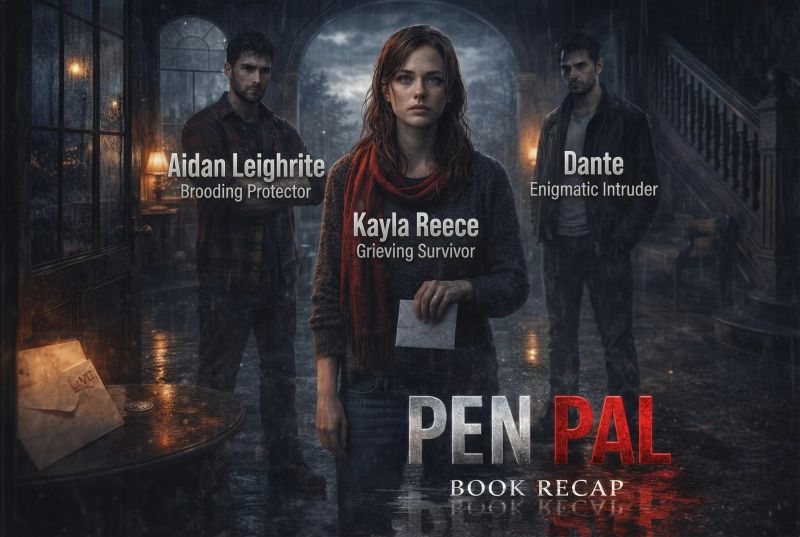
Kayla1 stands in the rain at what she believes is her husband Michael's3 funeral, numb and hollow, and tosses dirt onto the coffin. Back home on Bainbridge Island, she discovers an envelope she didn't bring in — postmarked from Washington State Penitentiary, stamped with the word LOVE, addressed to her in neat blue ink. Inside, a single line: a promise to wait forever, signed by someone called Dante.
She has no idea who he is or how the letter appeared on her kitchen table. The Victorian house groans around her — leaking roof, flickering lights, headaches that won't break. She writes back with one blunt question, and Dante's response arrives a week later: a single word, You, with what looks like dried blood smudged in the corner.
Aidan Pounds the Door
The man who arrives for the roof estimate looks like the founder of an underground fight club — dark hair, dark beard, tattooed forearms, zero warmth. Aidan2 from Seattle Roofing doesn't smile, doesn't make small talk, and stares at Kayla1 with intensity bordering on hostility.
Their exchange is abrasive: he insults her dirty floor, she tells him women aren't called lady, and their negotiation over his ten-thousand-dollar quote devolves into verbal chess. He cuts his price to five thousand for reasons he won't explain, announces he'll return in the morning, and leaves without asking if they have a deal.
Meanwhile, Dante sends another letter — claiming he knows the sight, taste, and smell of her, the shape of her soul. She writes back ordering him to stop. Neither the roofer nor the prisoner listens.
Barefoot in the Rain
Floorboards creak on the dark stairway. Kayla1 huddles behind her bed gripping a flashlight like a bat, then something ancient in her brain screams run. She bolts from the house without shoes, coat, or underwear and drives through the rain to the apartment above a bar where Aidan2 lives.
He opens the door shirtless, pulls her inside, and wraps her in a towel. He doesn't mock her — he dries her hair, puts her in his sweatshirt, and listens. Then something shifts between them.
She drops the towel and stands bare from the waist up, whispering that she wants more than looking. He calls her his beautiful bunny, grabs her, and the night becomes something neither expected. Afterward, he holds her on a mattress on the floor and tells her she's staying.
What the Lion Killed For
Their dynamic crystallizes into something Kayla1 has never experienced — predator and prey, dominance and surrender, a chase game around his kitchen table that leaves her breathless and laughing. He calls her his bunny; she calls him her lion.
In the shower afterward, gentleness replaces ferocity as he washes her hair. Then his voice goes quiet. He tells her his father was a violent alcoholic who hospitalized his mother repeatedly. When Aidan2 grew up, he ended it — permanently. He spent years in prison.
He's terrified the confession will drive her away. Instead, Kayla1 tells him the past is dead, that she'll never judge him for protecting someone he loved. His body trembles against hers. She has no idea yet how far this man's willingness to sacrifice himself extends.
No Footprints in Mud
Through her office window, Kayla1 spots a tall gaunt figure in a gray trench coat and hat, partially hidden behind a tree at the water's edge, his teeth bared in an ugly grimace. She investigates and finds no footprints in the soft ground — only Michael's3 lucky 1937 buffalo nickel, the coin he carried everywhere.
Days later, the same coin materializes on her car dashboard though she left it in a desk drawer. A cheerful blond boy in a red rain slicker appears on the back lawn, giggling and chasing leaves, but vanishes when she goes outside.
Her security camera records only static. A jar of honey launches itself from a kitchen shelf. Every drawer and cupboard stands open one morning. Reality is fraying, and the house seems to breathe with a presence she cannot name.
Fiona Names the Haunting
With the calm of a woman raised in Scotland's haunted countryside, Fiona4 presents her case over tea. She ticks off the checklist: flickering lights, cold drafts, the sensation of being watched, objects moving on their own, headaches, memory lapses. Her sister Claire5 is a professional medium.
What matters most, Fiona4 insists, is to never tell a ghost it's dead — spirits don't know they've left the living world, and forcing that truth risks trapping them in darkness forever. Kayla1 resists, calling it ridiculous.
Then the overhead lights blink three times, as if the house itself is answering. Fiona4 proposes a séance on the next full moon. Kayla1 says she'd rather see a therapist, but the one a handyman named Eddie8 recommended doesn't appear to exist, and the electrical problems Eddie8 found nothing wrong with keep worsening.
Ring On, Doors Closed
At dinner with Aidan's2 best friend Jake6 and Jake's wife Deb,7 Kayla's1 jealousy over a misunderstanding — she'd seen Aidan2 walk in with his arm around Deb7 and assumed a date — cracks her open. She admits she's in far deeper than she realized. But Jake6 spots her obsessively twisting her wedding ring and confronts her: Aidan2 doesn't deserve any bullshit.
Later, alone in his truck in the rain, Aidan2 delivers his terms. He won't be a distraction she walks away from when she's feeling better. When she's ready to remove the ring — when she has clarity — she knows where to find him. He presses a single close-mouthed kiss to her lips and drives into the dark. She stands on the curb, rain sliding down her face, watching his taillights vanish.
Drowning in Dante's Storm
Without Aidan,2 the days curdle into insomnia and wine. A flamboyant psychic named Destiny10 draws the Ten of Swords — betrayal and deep wounds — alongside a reversed Death card, warning Kayla1 she's clinging to illusions and resisting transformation.
Dante writes that she IS the storm, the source of everything happening, and must listen to her own thunder. She dreams of drowning every night. The burning smell from the dryer turns putrid. The television switches itself off.
A blue jay breaks its neck on Michael's3 office window, where a newspaper shows his photo beneath a partially visible headline: Local Man Drowns. A body-shaped indent appears on Michael's3 side of the bed. Kayla1 sends Aidan2 a desperate text. He replies with a rabbit emoji and two devastating words: Sorry, bunny.
One Word: REVENGE
Claire5 arrives with a duffel bag of candles and chocolate offerings, looking so identical to Fiona4 they could be twins. They set up in Michael's3 office — the room Claire5 insists the spirit demands. Hands flat on the table in wavering candlelight, Claire5 invites the spirit to speak.
A framed diploma crashes from the wall. Two knocks confirm a single presence. It knows Kayla.1 It has a message. Claire's5 hand seizes the pencil and scrawls one word in block capitals scratched so deep the paper tears: REVENGE.
A freezing draft snuffs the candles. Something cold brushes Kayla's1 cheek — like ghostly fingers. She screams and runs. From the kitchen floor, she begs for answers. Claire5 instructs her to research the house's history and call the detective who handled her case.
The Narrator Was Dead
Kayla1 dials the police station and learns Detective Peters died of cardiac arrest six months ago — before he supposedly sat on her dock and interviewed her. She calls Eddie's8 handyman business and his grandson answers: Eddie8 died in 1974.
County records show the house was sold to a new family in January. The boy on the lawn is their son — a child who can see ghosts, and screamed because he was looking at one. Fiona4 holds up a letter from Dante and tells Kayla1 to truly see the return address.
The letters rearrange: Dante Alighieri is an anagram of Aidan Leighrite.2 The wedding ring drops through the ceiling onto the table. Kayla1 runs to Michael's3 office and unfolds the newspaper. The full headline: Local Man Drowns Wife. Her own photo stares back.
Fireworks Over Dark Water
Four months earlier — the real timeline. Kayla1 had buried her ring and returned to Aidan,2 who'd been reading The Divine Comedy and marveling that Dante Alighieri was an anagram of his own name. Michael,3 however, was deteriorating.
A brilliant mathematician with paranoid schizophrenia, he'd refused medication for years, his delusions escalating until he was stalking Kayla1 in a trench coat and hat. On New Year's Eve, she and Aidan2 took the boat out for fireworks. Michael3 was already aboard with a pistol, convinced Aidan2 was CIA.
He forced them to choose who would die. Aidan2 looked at Kayla,1 told her he loved her, and told Michael3 to shoot him. The bullet struck his forehead. Michael3 dragged Kayla1 to the stern and held her underwater as fireworks painted the sky.
Aidan Rings the Bell
When Kayla1 opens her eyes, dawn pours golden light through windows she now recognizes are painted a different color, in rooms furnished by strangers. She moves toward the front door, pulled by a force older than gravity.
Aidan2 stands on the porch, drenched in sunlight, smiling at her the way he always did — as if she were the first sunrise he'd ever witnessed. He asks if she missed him. She falls into his arms. The doorbell that rang through all those haunted months, the one that never showed a visitor on camera — it was him, waiting on the other side.
He never lost her. He'd been patient, sending letters under a poet's anagram, leaving breadcrumbs she needed time to follow. Together now, wrapped in light, they turn toward one final piece of unfinished business.
Epilogue
A forensic psychiatrist evaluates Michael Reece3 in prison, where he awaits trial for double murder. Michael3 is arrogant and dismissive, insisting his genius exempts him from consequences. The doctor introduces evidence of an affair with a colleague, a life insurance policy taken out on Kayla,1 and Michael's3 documented refusal of antipsychotic medication despite warnings it could cause violence.
Mid-interview, Michael's3 composure detonates. He screams that she's in the room — her and him both — and cowers in the corner, shrieking a single word. The word is Boo. He is restrained, sedated, and transferred to psychiatric care. The ghosts of Kayla1 and Aidan2 have begun their revenge.
Analysis
Pen Pal executes one of fiction's most demanding structural feats: it weaponizes first-person narration against the reader. Kayla1 isn't deceiving us — she's deceiving herself, and the intimacy of her perspective traps us inside her blindness. Every clue is present from page one. The funeral she attends is her own, misread as her husband's. The handyman who checks her wiring died in 1974. The detective who interviewed her was already a ghost. We rationalize these impossibilities exactly as Kayla1 does, because inhabiting someone's consciousness means inheriting their cognitive failures.
The three-part structure mirrors Dante's Divine Comedy: Inferno as confused limbo, Purgatorio as painful remembering, Paradiso as reunion and acceptance. But the novel subverts its spiritual source material. Kayla's1 paradise isn't transcendent peace — it culminates in two ghosts terrorizing their murderer in a psychiatric ward. The book's closing word is 'Boo,' a punchline simultaneously comic, vengeful, and devastating, reframing the soul's entire journey as something more morally complex than redemption.
The treatment of domestic violence resists simplification. Michael's3 paranoid schizophrenia complicates any reading of him as pure evil — mental illness is not chosen — yet the epilogue strategically introduces his affair and life insurance policy, suggesting calculation operating alongside genuine psychosis. The novel refuses to let diagnosis become exoneration; his refusal of medication wasn't helplessness but narcissism masquerading as self-sufficiency.
Most provocatively, the book argues that surrender can be the highest form of agency. Kayla's1 submission to Aidan2 — in bed and in trust — unlocks the version of herself brave enough to stop rationalizing, stop gripping reality until her knuckles whiten. The same tenacity that makes her a powerful lover is precisely what prevents her from recognizing she's dead. She holds on past every logical breaking point, and only when she finally lets go does she discover what was waiting on the other side of the door.
Review Summary
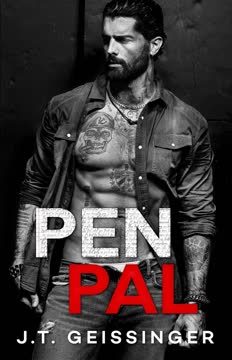
Pen Pal has divided readers with its unconventional plot and marketing. Many praise its steamy scenes, unpredictable twists, and ability to keep them guessing. However, others criticize the misleading romance label, lack of trigger warnings, and disappointing ending. The book's paranormal elements and non-traditional structure surprised some readers. While some found it a captivating, mind-bending experience, others felt it was poorly executed and overhyped. The intense debate around genre classification and content warnings highlights the book's controversial nature.
People Also Read







Characters
Kayla Reece
Narrator and illustratorA children's book illustrator living in a crumbling Victorian on Bainbridge Island, Kayla narrates with sharp self-deprecating humor that masks profound vulnerability. Both parents died from medical errors, seeding a lifelong distrust of institutions. Her marriage was marked by complications she hasn't fully processed, including a devastating miscarriage and a separation she describes only in fragments. She over-empathizes with others yet isolates herself, creating a paradox of connection and withdrawal. With Aidan2, she discovers a submissive side that liberates rather than diminishes—surrendering control becomes the first thing that makes her feel free. Her relentless rationalizing protects her psyche but also blinds her to what she cannot afford to see. She approaches every mystery logically, even when logic has long since fled the premises.
Aidan Leighrite
Roofer and dominant loverOwner of Seattle Roofing and the most abrasive man Kayla1 has ever encountered, Aidan communicates through silences, grunts, and devastating honesty. His childhood was defined by his father's alcoholic rages against his mother—violence Aidan ended permanently as a teenager, serving seven years in prison. That history calcified him into someone who trusts no one, likes fewer, and loves almost never. With Kayla1, his armor cracks open. He builds a house from scratch on the island's far side, a quiet monument to the stable home he never had. His dominance in the bedroom is not performance but necessity—control born from years of powerlessness. He reads Dante's poetry and uses words like 'reproach,' masking a self-educated intelligence beneath rough-hewn exterior. Fiercely protective, he would sacrifice anything for someone he loves.
Michael Reece
Kayla's estranged husbandA mathematics professor at the University of Washington, Michael is brilliant, meticulous about grooming, and a snob about higher education. He represents the clean-cut intellectual world Kayla1 chose young—before undisclosed difficulties eroded their marriage from within. He named their boat the Eurydice after a Greek nymph trapped in the underworld, finding the mythology romantic where Kayla1 saw only doom. Even in absence, his influence pervades the narrative: his untouched office, his boat at the dock, his lucky buffalo nickel surfacing in impossible places. The gap between his public respectability and private reality widens as the story progresses, and the figure in the trench coat who stalks Kayla's1 property carries his outline long before his identity becomes clear.
Fiona
Scottish housekeeper and guideKayla's1 plump, blue-eyed housekeeper, raised in one of the world's most haunted countries. She treats supernatural phenomena with the same pragmatism she applies to scrubbing floors. Fiona is the first to name what Kayla1 cannot—that the strange occurrences may have paranormal origins—and serves as a gentle guide, nudging without forcing, patient with skepticism while quietly orchestrating the conditions for revelation. Her warmth conceals sharper perceptions than she lets on.
Claire
Professional mediumFiona's4 sister, so physically identical they could be twins despite Fiona's4 insistence otherwise. Claire has communicated with spirits since age four and conducts séances with brisk competence. She provides the technical framework for understanding the supernatural events in the house, and her no-nonsense manner counterbalances the terror of what she summons. She cancels two other appointments because Kayla's1 case proves too fascinating to abandon.
Jake
Aidan's fiercely loyal friendAidan's2 best friend since high school and owner of a security company. He installs Kayla's1 alarm system and later confronts her at dinner about her wedding ring, protective of a man he's watched suffer for years. His directness mirrors Aidan's2, though with less restraint and more visible anger. He serves as a barometer for how seriously Aidan's2 feelings have developed.
Deb
Jake's warm, grounding wifeJake's6 wife, warm and enthusiastic, who provides Kayla1 with female solidarity and normalcy. Her easy physical affection toward Aidan2 inadvertently triggers Kayla's1 jealousy and forces an emotional reckoning about commitment.
Eddie
Anachronistic handymanA cheerful handyman in bell-bottoms and a John Lennon shirt who reeks of pot. He finds nothing wrong with the electrical system and recommends a therapist. His lack of a cell phone and disconnection from modern life hint at something deeper than eccentricity.
Madison
Grief group motherA polished woman at the grief group whose four-year-old daughter was kidnapped six years ago. Her haunted confession about searching for her missing child mirrors Kayla's1 helplessness and isolation.
Destiny
Flamboyant local psychicA psychic in a flowery muumuu and Mardi Gras beads whose theatrical Southern drawl masks genuine insight. Her Tarot reading warns Kayla1 of betrayal, resistance to change, and the urgent need to release illusions.
Plot Devices
Letters from Dante
Spirit breadcrumbs in disguiseMysterious letters arrive postmarked from Washington State Penitentiary, signed by Dante Alighieri—a name that is an anagram of Aidan Leighrite2. Written in cryptic, poetic language quoting The Divine Comedy, the letters claim intimate knowledge of Kayla1 and urge her toward self-examination. They function simultaneously as romantic connection, supernatural mystery, and coded truth. Each letter escalates in emotional intensity, from a promise to wait forever, to philosophical advice about being the storm. The dried blood smudge, the LOVE stamps, and the prison postmark all form a layered cipher. The prison address reflects both Aidan's2 past as an actual convict and the spiritual imprisonment of being trapped between worlds. The correspondence provides the novel's through-line, growing more meaningful as its true origin surfaces.
The Buffalo Nickel
Memory forcing its way backMichael's3 lucky 1937 D-type buffalo nickel, carried everywhere and valued at over two thousand dollars, becomes an object that refuses to stay buried. It first appears in mud beneath a tree where a mysterious figure stood watching Kayla1. It then materializes on her car dashboard, then atop her laptop—always in places she didn't leave it. The coin fell from Michael's3 shirt pocket as he held Kayla1 underwater on New Year's Eve, making it the last earthly object she perceived before death. Its persistent reappearance represents suppressed memory fighting to surface, each sighting pulling Kayla1 one step closer to remembering the truth. The coin connects three timelines: Michael's3 habitual possession, the moment of Kayla's1 murder, and her ghost's confused present.
The Wedding Ring
Anchor binding Kayla to denialKayla's1 wedding band operates as both emotional tether and narrative barometer. Aidan2 makes its removal the condition for their relationship to continue, understanding it represents her inability to release the past. In the real timeline, Kayla1 buries the ring in a shoebox alongside her marriage license and baby's sonogram—a private funeral for her former life. But in her ghost existence, the ring persists on her finger, impossible to explain or fully remove. The séance requires she take it off; the house seems to gasp when she does. In the climactic revelation, the ring drops through the ceiling onto the table beside the buffalo nickel, placed by forces beyond the physical world—the final circuit connecting Kayla's1 denial to the truth that everything she was holding onto had already ended.
The Eurydice
Mythological foreshadowing vesselMichael's3 sailboat, named after the Greek nymph Eurydice who was trapped in the underworld when her husband Orpheus failed to rescue her. Kayla1 warned Michael3 the name was cursed—in myth, love follows death into hell but cannot bring it back. The boat becomes the site of both murders on New Year's Eve and bobs restlessly at the dock throughout Kayla's1 ghost narrative, drawing her gaze as if watching her back. The name operates as structural prophecy: like Eurydice, Kayla1 becomes trapped between worlds. Like Orpheus, Aidan2 follows her into death rather than accept separation. But unlike the myth, this Orpheus succeeds—he waits at the threshold until his beloved finds her own way through.
The Divine Comedy
Structural blueprint for afterlifeDante Alighieri's thirteenth-century epic about one soul's journey through Hell, Purgatory, and Paradise provides the novel's architecture. Part I (Inferno) follows Kayla's1 confused ghost existence. Part II (Purgatorio) delivers revelation and painful truth. Part III (Paradiso) brings reunion and transcendence. Aidan2 reads the poem in bed and quotes its final line about love turning the stars—a verse he also sends in his pen pal letters under the poet's name, which is an anagram of his own. The poem's themes of spiritual blindness, guided awakening, and redemption through love mirror Kayla's1 arc precisely: she must journey through her own inferno of denial, endure the purgatory of remembering her murder, and arrive at a paradise that is equal parts grace and revenge.

Download PDF
Download EPUB
.epub digital book format is ideal for reading ebooks on phones, tablets, and e-readers.








































