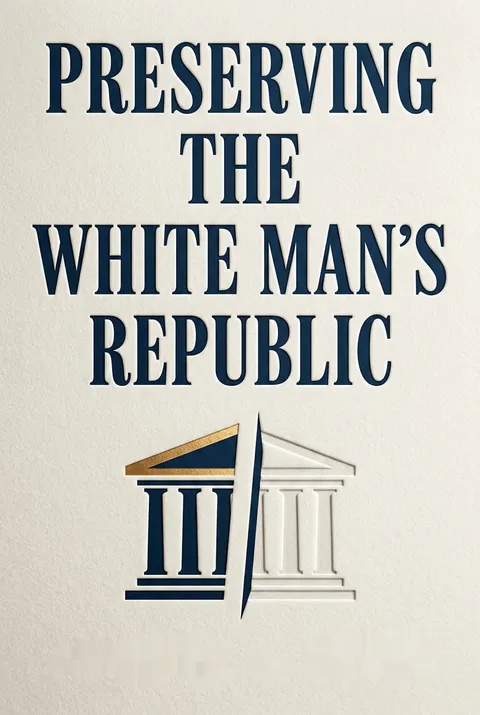
Key Takeaways
1. Jacksonian Democrats: From Radicalism to Conservative Guardianship
The party previously decried for its radicalism manifested a reflexive conservatism in the 1850s, when they perceived a new generation of reformers seeking coercive state power to enforce gender and racial equality.
A Pivotal Shift. The Jacksonian Democratic Party, once seen as a radical force challenging established hierarchies, underwent a significant ideological transformation in the 1850s. Having achieved their vision of a democratic republic for white men, they pivoted to a conservative stance, aiming to preserve the existing social and political order against perceived threats. This shift was not an abandonment of their core principles but a reapplication of them to new challenges.
Consolidating Gains. By the late 1840s, Democrats celebrated their success in establishing a political culture that championed mass democracy for white men, a limited federal government, and continental expansion. They believed their "happy republic" had reached an unprecedented state of prosperity and freedom. Their new conservatism was thus a defense of this already "progressive" achievement, rather than a rejection of progress itself.
New Adversaries. The traditional economic debates with the Whigs faded, replaced by what Democrats termed "fanaticism." This new enemy encompassed a range of reform movements—abolitionism, nativism, and temperance—all seen as attempts to use state power to impose moral uniformity and undermine the autonomy of white men. Democrats, drawing on their Jacksonian heritage, viewed these movements as despotic concentrations of power, akin to the "Monster Bank" of old.
2. The "White Man's Republic": A Vision of Exclusive Democracy
Although Democrats proclaimed rights to be “natural,” their rights-bearing individual was not a universal abstraction. He was a white man, making Democrats’ happy republic a white man’s republic.
Racialized Rights. The "happy republic" envisioned and championed by Jacksonian Democrats was fundamentally a "white man's republic." Their revolutionary concept of equal, natural rights was explicitly defined by race and gender, extending political equality only to white men. This foundational premise meant that any expansion of rights to other groups was seen as unnatural and a threat to the rights already achieved by white men.
Exclusion as Foundation. Democrats forged their egalitarian political order by dismantling older social hierarchies based on economic or household status. In their place, they established impermeable racial boundaries, ensuring that all white men stood on a base level of political equality. This "Herrenvolk democracy" meant that the inclusion of white men was predicated on the explicit exclusion and subordination of African Americans and other racial minorities.
Fragile Equilibrium. Democrats believed this racial equilibrium was precarious. They feared that "fanatical reformers" would push progress too far by empowering marginalized Americans, thereby resurrecting a social order where white men's rights would become relative rather than absolute. Preserving the "white man's republic" meant resisting any challenge to the strict correlation between whiteness, manhood, and political legitimacy.
3. Fanaticism: The Multifaceted Threat to Democratic Order
Of all the political parties which have arisen in this or any other country, there has not been another, in the formation and history of which, there have been such exclusive regard and devotion to the maintenance of human rights, and the happiness and welfare of the masses of the people.
A Unified Enemy. Democrats in the 1850s consolidated diverse reform movements—abolitionism, nativism, temperance, women's rights, and even socialism—into a single ideological monolith they called "fanaticism." This hydra-headed foe was characterized by its "one-idea" obsession and its perceived desire to use centralized state power to impose restrictive moral codes on autonomous white men.
Assault on Autonomy. Democrats viewed fanaticism as a direct assault on individual liberty and democratic self-governance. They argued that reformers, by seeking to legislate morality (e.g., prohibition) or dictate social arrangements (e.g., ending slavery), were usurping the natural rights of white men to manage their own affairs and households. This mirrored their earlier battles against the "Money Power" and other concentrations of authority.
Unintended Consequences. Fanatics, in their "nervous haste" for perfection, were accused of exacerbating the very social ills they sought to alleviate. Democrats argued that such zealotry, divorced from practical politics and constitutional limits, would lead to social strife, hypocrisy, and ultimately, the degradation of white men. This critique drew on Enlightenment antifanaticism, which warned against impassioned politics leading to tyranny and disorder.
4. Popular Sovereignty: Democracy as a Conservative Tool
By going back to our true principles, we go back to the road of peace and safety.
A National Solution. Faced with escalating sectional conflict over slavery in newly acquired territories, Democrats proposed "popular sovereignty" as their core policy. This doctrine allowed white male settlers in the territories to democratically decide whether to permit slavery, thereby removing the contentious issue from Congress. It was presented as both a pragmatic solution to end legislative gridlock and a principled return to fundamental Jacksonian ideals.
Rooted in Self-Governance. Democrats grounded popular sovereignty in the revolutionary concept that ultimate power resides with "the people." They argued that territorial settlers, as self-governing white men, possessed the inherent right to determine their own institutions, just as states did. This approach aimed to empower local majorities, trusting them to make decisions that would preserve the racial and gender order from which they benefited.
Conservative Intent. The policy was intended to exert a conservative influence by localizing decision-making and depriving "extremists" of a national platform. Democrats believed that white men, when left to their own devices, would naturally uphold existing hierarchies. However, this reliance on local democracy, while ideologically consistent with Jacksonian principles, proved to be a volatile and ultimately destabilizing solution, as it raised questions about the limits of popular power and the racial boundaries of "the people."
5. Doughfaces: Northern Men with a National, Conservative Principle
Northern Democrats cannot be understood apart from southern Democrats, with whom they shared a partisan cultural identity that often outranked any sectional affinity felt toward fellow northerners outside their party.
Beyond Caricature. Northern Democrats who supported popular sovereignty and southern interests were often derided as "Doughfaces"—unmanly, subservient tools of the "Slave Power." However, the book argues that these "northern men with southern principles" saw themselves as principled national conservatives. They believed they were upholding the Union by mediating sectional tensions and ensuring equal treatment for both free and slave states.
Intersectional Identity. The Democratic Party's strength lay in its ability to knit together white men across the country, fostering a shared partisan culture that transcended sectional divides. Northern Democrats' commitment to popular sovereignty was not merely opportunistic; it stemmed from a genuine belief in local self-government and white male supremacy, which resonated with their southern counterparts. This shared ideology allowed them to maintain a national party in an increasingly polarized era.
Defending White Manhood. Doughfaces, like their southern allies, viewed antislavery and other reform movements as threats to white male autonomy and equality. By defending the South's right to its "peculiar institution" and resisting federal intervention, northern Democrats believed they were protecting the broader principle of white men's self-governance everywhere. Their unpopularity in the North was often framed as a badge of honor, proof of their selfless commitment to national unity and conservative principles.
6. Gendered Conservatism: White Male Mastery as the Republic's Foundation
The democratic process projected their household mastery into political power over all women and Americans of color.
Household as Republic. For Democrats, the white man's republic was fundamentally rooted in patriarchal household mastery. White men derived their public political power and legitimacy from their control over female and black dependents within their homes. This "egalitarian patriarchy" meant that while white men interacted as equals in the public sphere, their equality was predicated on the maintenance of strict racial and gender hierarchies at home.
Fanatical Degradation. Democrats viewed "fanaticism" as a direct threat to this domestic order. Reform movements like women's rights and abolitionism were seen as undermining men's household authority, encouraging "mutiny" among dependents, and ultimately leading to the "degradation" of white manhood. This degradation was not just personal but political, as it eroded the very foundation of the white man's republic.
Conservative Bulwark. The individual white man, secure in his domestic mastery, was thus envisioned as the conservative bulwark of the republic. By upholding racial and gender prerogatives at home, he would naturally use his democratic power to preserve the existing social order. This fusion of liberal individualism with conservative organicism (within the household) was a novel way to make democracy a force for stability, ensuring that white men's self-governance would not subvert, but rather protect, inequality.
7. James Buchanan: The Bachelor as National Conservative Patriarch
Though his head be white as snow . . . he is yet vigorous in mind and body, and is a man of Herculean labor.
An Unlikely Symbol. James Buchanan, a lifelong bachelor, seemed an unconventional choice to lead Andrew Jackson's aggressively masculine Democratic Party. However, Democrats ingeniously reframed his bachelorhood as a political asset, arguing that his lack of personal family ties made him an impartial, national leader. His "personal conservatism" (sexual restraint) was linked to his "ideological conservatism" in politics.
Manly Moderation. Buchanan's supporters portrayed him as a figure of restrained masculinity, avoiding the excesses of both effeminacy and hypersexuality. His bachelorhood signified self-control, a temperament that contrasted sharply with the "hot blood" and "insanity" attributed to fanatical reformers. This image of a "manly conservative" was crucial in an era where political legitimacy was deeply intertwined with normative gender roles.
Father of the Nation. Buchanan's childlessness was presented as a virtue, allowing him to be a "father" to the entire nation, impartially overseeing both free labor and plantation households. His "nonpartisan body" became a symbol of national unity, capable of mediating sectional passions and diverse family structures. This strategic deployment of Buchanan's unique gender identity underscored the party's commitment to a conservative nationalism that embraced diversity while upholding white male supremacy.
8. Partisan Realignment: A Battle for the Soul of American Conservatism
It is quite impossible that you should become Know Nothings or Free Soilers; & you have no place to go except to the Democratic party, which has now become the only true conservative party of the Country.
Whiggery's Demise. The 1850s witnessed the collapse of the second party system, with the Whig Party disintegrating under the weight of sectionalism and the rise of new movements like the Republicans and Know-Nothings. Democrats actively sought to hasten Whiggery's demise, portraying their former rivals as either dead or absorbed by "fanaticism." They strategically mourned deceased Whig statesmen like Clay and Webster to claim their legacy of Unionism and moderation.
A New Conservative Home. Democrats positioned themselves as the sole national and conservative party, appealing to politically homeless Old Whigs. They argued that the old economic issues were "dead," and the new battle was against the "isms" that threatened the Union and white male autonomy. Many conservative Whigs, wary of Republican radicalism and Know-Nothing nativism, found a tactical alliance, if not a permanent home, within the Democratic ranks.
Ideological Purity. While welcoming Whigs, Democrats insisted on ideological orthodoxy. They did not adopt Whig principles but rather expected converts to embrace Jacksonian tenets, particularly white supremacy and limited government, as the true conservative path. This realignment, though messy, ultimately strengthened the Democratic Party's commitment to its core ideology, allowing it to emerge as the dominant force against the burgeoning Republican Party.
9. The Paradox of Popular Sovereignty: Democracy's Unintended Radicalism
The people in whose cause I come here to-night, are not among those whose right to regulate their own domestic concerns, is so feelingly and eloquently contended for.
Racial Contradictions. Popular sovereignty, intended to preserve white male supremacy, inadvertently exposed deep contradictions within Democratic ideology. Frederick Douglass, the "Black Douglass," brilliantly critiqued Stephen Douglas's "White Douglas" by highlighting that the "people" whose sovereignty was championed did not include African Americans. Douglass argued that denying black political agency while determining their fate was a "hell black denial of popular sovereignty itself."
Limits of Power. The doctrine's practical application in Kansas revealed its theoretical clumsiness. Debates over whether territorial legislatures or only constitutional conventions could decide on slavery, and the impact of the Dred Scott decision, forced Democrats to confront the limits of popular power. Conservatives within the party, like Attorney General Jeremiah Black, feared that Douglas's expansive view of "political communities" would lead to unchecked "omnipotent sovereignty" and social chaos.
Erosion of Uniformity. Democrats' enthusiasm for local diversity, a core tenet against fanatical uniformity, ironically threatened the one type of homogeneity they valued: the racial and gender makeup of the body politic. By allowing communities to define their own membership, popular sovereignty opened the door to the possibility of empowering women, nativists, or even African Americans, thereby undermining the natural equality of white men and the racial absolutism of the "white man's republic."
10. An Enduring Legacy: The Birth of Modern American Conservatism
Democrats breathed new life into American conservatism by reducing democracy and individualism to brittle tools of exclusion.
A New Conservative Trajectory. The 1850s Democratic Party, despite its ultimate failure to preserve the Union, profoundly reshaped American conservatism. Unlike traditional European conservatism, which distrusted democracy and individualism, Democrats fused these liberal tenets with a commitment to social order and inequality. They demonstrated that in a liberal democratic political culture, conservatives could not eschew democracy but had to adapt it to their ends.
Libertarian Roots. The Democratic emphasis on individual rights, antistatism, and laissez-faire principles, initially progressive, began its transformation into modern conservative libertarianism. By arguing that a limited state and individual autonomy were essential for preserving white male equality and property rights (including enslaved property), Democrats laid intellectual groundwork for later conservative movements that would champion individual liberty against government intervention, often to protect existing power structures.
Populist Conservatism. Democrats pioneered a populist, democratic conservatism that trusted local majorities to maintain social order and resist change. This approach, while seemingly democratic, often served to legitimize inequality and marginalize minorities through "home rule" and racial terror. The party's legacy is a complex one, demonstrating how democracy, when wielded by the privileged, can become a powerful tool for consecrating an inegalitarian present, a distinctly American form of conservatism that endures today.
Download PDF
Download EPUB
.epub digital book format is ideal for reading ebooks on phones, tablets, and e-readers.








































