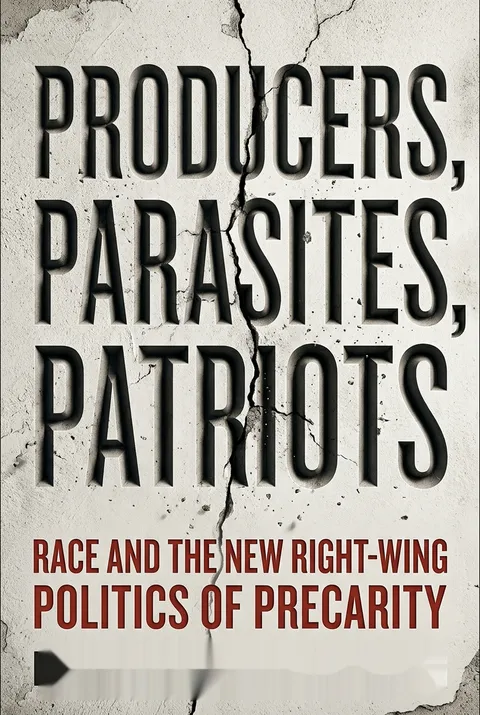

Key Takeaways
1. Racial Transposition: How Race is Reconfigured in the New Gilded Age
Indeed, the stories we tell in Producers, Parasites, Patriots underscore the fundamental role that race continues to play in reproducing and naturalizing the growing social, political, and economic inequalities marking the current moment.
Race's enduring role. In an era marked by unprecedented economic inequality—a "New Gilded Age"—race remains a central, dynamic force, not merely a relic of the past. Far from a "postracial society," the United States sees race actively shaping and legitimizing widening disparities, differentiating those deemed worthy of protection from those abandoned. This process is crucial for understanding the political landscape, where vulnerability and suffering are made socially legible through racialized categories like "producer," "parasite," and "patriot."
Shifting racial meanings. The post-civil rights era has transformed how race operates, with racial disparities at historically high levels even as overt racism is denounced. Political elites, including conservatives, now embrace symbolic multiculturalism, incorporating non-white narratives and figures to legitimate their authority. This involves detaching racial concepts from old associations and shifting them to new meanings, allowing narratives of racial uplift to paradoxically justify policies that exacerbate inequality.
Racial transposition defined. This book introduces "racial transposition" to describe how racial meanings, valences, and significations travel and circulate between different contexts, groups, or settings. It's not about erasing existing racial hierarchies but about transferring racialized "scripts"—like those of dependency or cultural deficiency—from one group (historically people of color) to another (increasingly, some white groups). This dynamic process highlights how race, as a political construct, continues to constitute political subjects and justify economic hierarchies.
2. "Parasites of Government": White Public Workers Stigmatized with Racialized Tropes
Claims that public-sector unions and workers are parasitic on the body politic are only cognizable because of this history of racialized populism.
Public workers under attack. During the Great Recession, a new target emerged for the "parasite" label: public-sector workers and their unions. Figures like Rush Limbaugh and Governor Scott Walker condemned them as "freeloaders" and "parasites of government," consuming tax dollars without producing value. This was a significant shift, as these tropes were historically reserved for racialized groups like "welfare queens" or "illegal aliens," not predominantly white public employees such as:
- Teachers
- Firefighters
- City and county employees
Racialized anti-statism. This attack represents a new phase of racialized anti-statist politics, extending the logic of stigmatizing the redistributive state to white beneficiaries. Cultural representations, from political cartoons depicting gluttonous, grotesque union members to an SNL skit portraying idle public employees, transposed these racialized scripts of excess and indolence onto white workers. This made the attacks resonate widely, framing public workers as threats to the "virtuous producer"—the hardworking taxpayer.
Unions reclaim producerism. In response, public-sector unions, particularly in Ohio, countered these charges by performing their own "white producerist commitments." Campaigns featured heroic firefighters, police officers, and nurses, emphasizing their indispensable role in public safety. While effective in defeating anti-union measures, this strategy inadvertently reinforced the producer/parasite binary, potentially narrowing the political framework for other public workers who cannot be portrayed in such heroic, racially and gender-conventional terms.
3. New Racializations of White Precarity: Cultural Explanations for Economic Decline
The white poor have become behaviorally similar to the Black poor he had described in previous work in terms of declining marriage rates, out-of-wedlock births, aversion to work, and increased criminality; and cognitively similar to them in terms of genetic inheritance.
Declining white security. The "New Gilded Age" has eroded the economic guarantees and privileges many white Americans once took for granted, leading to sustained economic abandonment for middle- and working-class whites. This is starkly visible in the rise of "deaths of despair"—suicide, drug, and alcohol-related fatalities—among middle-aged, non-college-educated whites, a trend contrasting with declining mortality rates for Black and Latino populations. This signifies a stagnation of the "wages of whiteness" that historically provided a material and social floor.
Pathologizing white poverty. In response to this growing white precarity, political elites and conservative intellectuals have begun to explain it using cultural and even biological terms, transposing tropes historically reserved for people of color. Authors like Charles Murray (in Coming Apart) and J.D. Vance (Hillbilly Elegy) depict impoverished whites as:
- Socially disorganized
- Culturally deficient
- Genetically compromised
This mirrors earlier narratives used to explain Black poverty, deflecting blame from structural economic forces onto individual and familial failings.
Trump's white rage. Donald Trump's rise capitalized on this sense of declining white status, linking economic precarity to fears of political abandonment and a debasement of whiteness. His rhetoric—from "birtherism" to anti-immigrant claims—reasserted the "right to exclude" as a core component of white authority. This "white rage" represents a demand for the state to reinvest in and protect the historic value of whiteness, seeking to restore it as a form of "treasured property" in an increasingly unstable political identity.
4. Black Conservatives: Legitimizing Right-Wing Ideals for a Predominantly White Base
At a time of growing precarity and vulnerability for many white households, we argue that they become the idealized subjects of the marketized and militarized nation, continually testifying to its exceptional qualities at a time of crisis.
Rise of Black conservatives. The contemporary GOP has seen the rise of prominent Black conservatives like Allen West, Tim Scott, and Mia Love, who have become celebrated figures within the party. Despite the Republican Party's overwhelmingly white base and its historical antipathy towards racial justice, these individuals have achieved significant electoral success, often defeating white conservative opponents in predominantly white districts. This phenomenon signals a subtle yet profound transformation in how race is deployed within conservative politics.
Reconfiguring Blackness. These Black conservatives are not merely "tokens" but actively reconfigure the meaning of Blackness to legitimize core right-wing ideals. They narrate their personal stories of Black uplift—emphasizing self-sufficiency, discipline, and market freedoms—as exemplars of conservatism and American exceptionalism. This contrasts with earlier Black conservatives who primarily critiqued anti-discrimination policies. For figures like Scott, their Blackness makes them more appealing to white conservative voters, who see their success as evidence of color-blind commitments, even while maintaining racialized attitudes.
Protean Blackness and neoliberalism. This shift is rooted in the "protean character of Blackness" in the post-civil rights era, where symbols of Blackness became unmoored from radical, redistributive politics. As Black elites integrated into governance, and Blackness became a "banal symbol" of "otherness" without insurgency, it opened avenues for both Democrats and Republicans to incorporate Black narratives into increasingly conservative agendas. This allows for a cultural celebration of Black America that performs moral authority and individual freedom, while simultaneously advancing anti-statist, pro-market policies that exacerbate racial inequality.
5. The Multiculturalism of the Far Right: Non-White Figures Bolster White Nationalism
Paradoxically, the incorporation of people of color by the far right makes white supremacy a more durable force.
Far-right's racial ambiguity. The contemporary far right, including Trumpist, alt-right, and alt-lite movements, exhibits a surprising "multiculturalism," featuring non-white figures like Tusitala "Tiny" Toese, "Uncle Chang," and "Diamond and Silk." This blurs the traditional distinction between exclusionary racial nationalism and inclusionary civic nationalism. This racial ambiguity is not a sign of diminishing white supremacy but rather a strategic deployment that allows for plausible deniability of open racism, drawing in more recruits and bolstering white nationalism.
Selective incorporation and gender. The far right selectively incorporates aspects of non-white figures to shore up a historically racialized national identity, often through masculinized narratives. For example:
- Tiny Toese, a Samoan streetfighter, performs a war dance and defends white people, whom he sees as "under attack."
- "Uncle Chang," an Asian American, uses his identity to mock liberal "identity politics" while defending white working-class grievances.
- "Diamond and Silk," Black video bloggers, frame undocumented immigrants as criminals preying on law-abiding Black Americans, legitimizing harsh anti-immigrant stances.
Bolstering white supremacy. These non-white figures provide moral authority for xenophobic and nativist policies, framing them as anti-racist or economically just. Their presence allows the far right to claim a multiracial identity while simultaneously advancing anti-immigrant, anti-Muslim, and anti-Black discourse. This dynamic demonstrates how "racialized civic nationalism" can claim universal ideals while covertly securing white racial dominance, making white supremacy a more adaptable and enduring force in a multiracial society.
6. White Anti-Statist Rage: Misdirected Blame Amidst Rural Abandonment
Long abandoned by private elites and devastated by market forces, they rage against the very state that supplies the resources that keep their communities economically viable.
Malheur occupation's paradox. The Malheur National Wildlife Refuge occupation, led by Ammon Bundy, exemplified white anti-statist rage in rural Oregon. Protesters, almost entirely white, used chants like "Hands Up... Don't Shoot!"—a direct appropriation of Black Lives Matter—to protest federal land control and the harsh sentencing of local ranchers. This revealed a profound sense of fear and loss among rural white communities facing economic decline and state abandonment, yet their political vision was rooted in a "revanchist white producerism" and settler-colonial worldview.
Misdirected grievances. The occupation's focus on federal land control obscured the true drivers of rural economic crisis: global timber market shifts, corporate profit imperatives, and uneven development between urban and rural areas. Ironically, the federal government, the target of their resentment, was often the primary bulwark against deeper economic collapse through public-sector employment. This anti-statist rage, fueled by a Lockean belief in individual agency and frontier autonomy, misdirected blame, preventing a deeper analysis of shared structural issues.
Contrasting struggles. While rural Oregonians faced state abandonment, their response differed sharply from racialized communities experiencing similar precarity. Black communities in places like Ferguson or Flint, facing systematic state predation and violence, have developed sophisticated analyses linking police brutality to corporate extraction and demanding state responsibility for living-wage jobs and public services. The white-producerist framework, however, struggles to recognize these interdependencies, instead clinging to myths of self-sufficiency that ultimately limit their capacity for transformative political action.
7. Beyond Fixed Identities: Forging Solidarity Through Interdependence and Shared Struggle
The problematic of coalition is that coalition isn’t something that emerges so that you can come help me, a maneuver that always gets traced back to your own interests. The coalition emerges out of your recognition that it’s fucked up for you, in the same way that we’ve already recognized that it’s fucked up for us.
Challenging fixed narratives. The book argues against treating political identifications as fixed or determined by immutable cultural norms, especially the "white working class" narrative. Instead, it highlights how political identities are constantly "made and remade" through shifts in discourse and identification. This dynamic understanding is crucial for challenging the current landscape where racial meanings are flexible and recombinant, often shoring up white supremacy and neoliberal inequality.
Lessons from King's vision. Dr. Martin Luther King Jr.'s Poor People's Campaign offers a historical blueprint for forging solidarity across diverse social locations. King envisioned an expansive state that recognized the interdependence of all in the polity, rejecting settler myths of autonomy and producerism. His framework, born from Black struggle, sought to link the specific experiences of different groups—Black, Indigenous, Mexican-American, Puerto Rican, Appalachian—to a shared vision of redistribution and emancipation, demonstrating that solidarity doesn't require undifferentiated unity.
Interdependence and "dangerous work." Building genuine solidarity requires recognizing both similarities and differences in experiences of deprivation and state violence. It means moving beyond superficial "allyship" to a deeper recognition that systemic issues are "killing you, too," albeit perhaps "more softly." Organizations like the Rural Organizing Project in Oregon exemplify this "dangerous work," linking rural economic precarity to broader histories of racial exclusion and corporate extraction. This approach, rooted in collective learning and a capacity to metabolize diverse experiences, offers a path to illuminate new futures beyond the confines of racialized capitalism.
People Also Read



Download PDF
Download EPUB
.epub digital book format is ideal for reading ebooks on phones, tablets, and e-readers.








































