


Key Takeaways
Sexual desire is raw energy first, behavior second
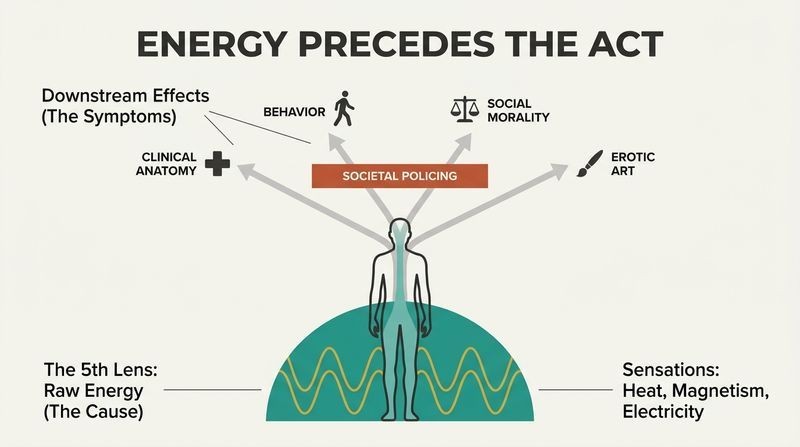
Energy precedes the act. Swann argues that Western culture studies sex through four lenses (clinical anatomy, psychological behavior, social morality, and erotic art) but ignores a fifth, more fundamental one: sexualizing energies. His logic is simple. If a body had genitals but no energization, sex would never occur to anyone. The energy is the cause; anatomy, behavior, and morality are downstream effects.
Everyone already feels it. Across all cultures, people describe sexual charge with tangible words: heat, tingling, electricity, magnetism, beams, auras. These sensations arrive before any moral or behavioral interpretation. Swann, who grew interested watching adults in his childhood town, noticed that society obsessively polices sexual behavior while never addressing the forces driving it, which is why the policing so often fails.
The reframe has real explanatory appeal: modern neuroscience locates desire upstream of action too, in dopaminergic 'wanting' circuits that fire before any conscious choice. Reducing sex to behavior, as behaviorism did, conveniently sidesteps the felt, motivational core. Where Swann overreaches is in treating felt 'energy' as a literal substance rather than a subjective report of physiological arousal. Still, his core complaint stands as a critique of methodology: a science that measures only what people do, never what moves them, mistakes the visible symptom for the invisible engine. That blind spot recurs across disciplines that prize observable data over interior experience.
Western science amputated energy, leaving only body-mind
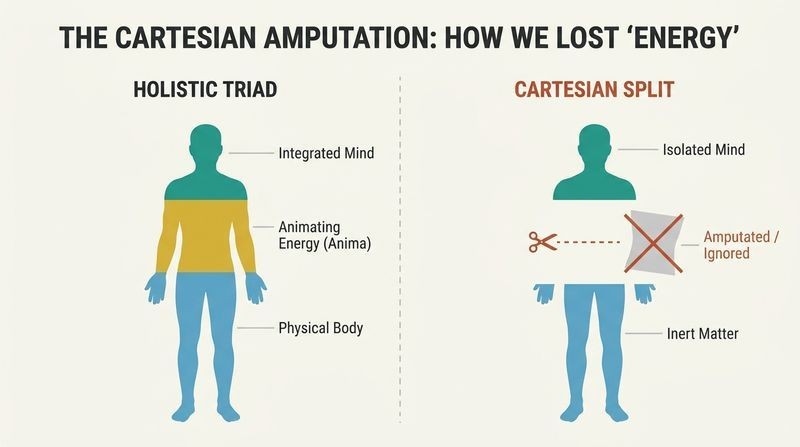
Descartes split us in two. Swann blames the dominant 'image of man' as body plus mind on Rene Descartes, who declared reality consists of two unrelated substances: physical matter and thinking mind. This dualism conveniently let biology study the body and psychology study the mind, but it erased a third element that pre-modern and Eastern systems always included: animating energy. The human, he insists, is body-energy-mind.
Matter alone cannot animate itself. Inert atoms are identical in living and dead bodies, and every atom in you is swapped out within seven years. Something must organize matter into a living, motile form and keep it that way. Pre-modern cultures called this the 'life principle' or anima (breath). Modern materialism declared it unscientific around 1919, leaving the origin of animation mysteriously unexamined.
Swann's history is broadly accurate: Cartesian dualism did sideline vitalism, and 'vital force' was indeed banished from respectable biology. But his framing that science left animation 'unexamined' understates what replaced it. Self-organization, thermodynamics, and molecular biology offer mechanistic accounts of how matter assembles into living systems without invoking a separate energy. The deeper philosophical puzzle he points at, the 'hard problem' of why animation and consciousness exist at all, remains genuinely unsolved, which is why thinkers like Chalmers and process philosophers still wrestle with it. Swann conflates that legitimate mystery with a literal energetic fluid, a leap the evidence does not require.
Five centuries of energy research were erased, not disproven
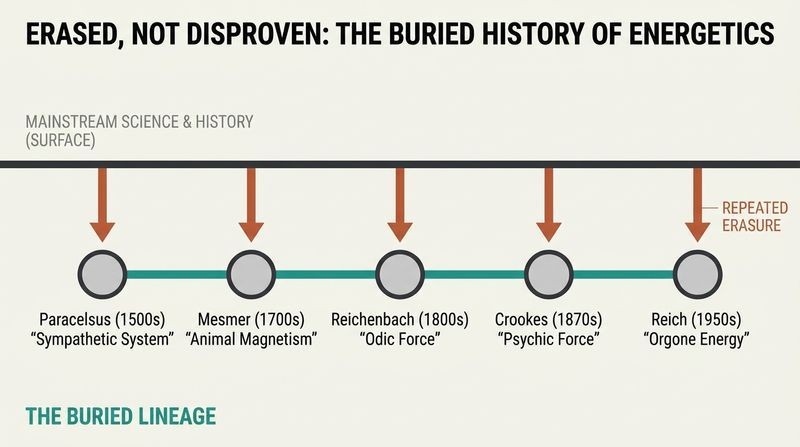
A buried lineage. Swann traces a continuous, suppressed investigation of human energetics from the Renaissance forward, each researcher renaming the same phenomenon to dodge the condemnation that buried the last:
1. Paracelsus and the Renaissance magnetists: a 'sympathetic system' linking all bodies
2. Franz Anton Mesmer: 'animal magnetism' (vats where patients convulsed, some to spontaneous orgasm)
3. Karl von Reichenbach: 'Odic force' seen as light by sensitives in dark rooms
4. Edward Cox and William Crookes: 'psychic force' measured moving objects via the medium D.D. Home
5. Wilhelm Reich: 'orgone,' for which he was jailed and his books literally incinerated by the FDA in 1956
The pattern is the tell. Each was attacked, stigmatized, and written out of mainstream history. Swann's point is that the relentlessness of the suppression, not any disproof, is what should arouse suspicion.
The historical figures are real, and the social hostility was real: Reich did die in prison, Crookes did damage his reputation defending Home. Swann's 'erased not disproven' argument is rhetorically powerful but logically incomplete. Ideas also vanish because they fail to replicate under controls, and many of these did. Mesmerism's effects were attributed to suggestion by the Franklin commission in 1784, an early triumph of the placebo concept. Yet his sociological observation has teeth: science is a human institution with taboos, and historians of science from Kuhn onward document how paradigms resist anomalies. The honest reading sits between conspiracy and clean meritocracy.
You were born clairvoyant; society trained it out of you
Conditioning dulls the senses. Swann claims all humans possess faculties for sensing invisible energies, but social conditioning systematically desensitizes them because uniform perception makes societies easier to manage. People literally stop perceiving what the group agrees not to perceive. He recounts seeing colored lights and beams streaming from people, animals, and flowers as a child, including red 'light things' protruding from men, until a doctor reassured his mother it would 'go away,' and largely it did.
Sex-vibe sensing survives the purge. Even heavily conditioned adults still feel sexual energy ('vibes') across a room. Swann calls this vibe-sensing a form of clairvoyance without pictures: information bypasses the visualizing brain and registers directly as feeling. Because it is nearly universal, he treats it as the easiest doorway into studying all human energetics.
The childhood-synesthesia angle is intriguing and partly corroborated: many children report vivid perceptual experiences (synesthesia, imaginary perceptions) that fade with development as the brain prunes connections and learns culturally sanctioned categories. Developmental psychology confirms perception is shaped by expectation; we genuinely fail to see what we lack concepts for, as inattentional-blindness experiments like the invisible gorilla show. Swann smuggles a large claim inside a small truth, though. That perception is culturally filtered does not establish that auras are objectively there waiting to be seen. 'Vibe-sensing' is better explained by subliminal pickup of microexpressions, pheromones, and posture than by literal energy fields.
A copper chamber switched on 'lucidity' he couldn't switch off
The Mahatma device, rebuilt. A 1923 esoteric text described a copper-walled dark room used to develop 'lucidity' in students. Drs. Elmer and Alyce Green reconstructed it as the Copper Wall at the Menninger Foundation, insulating a copper room on glass blocks with a magnet suspended over the sitter. In 1989 Swann sat in it twice daily. By day three an orange mist appeared, then he saw the bones, blood vessels, and acupuncture points inside his own hands.
Lucidity versus clairvoyance. He distinguishes ordinary clairvoyance (mental seeing, viewer separate from object) from lucidity: several layers of clairvoyance firing at once, with the viewer-object boundary dissolving into participation. Back home he built his own copper mirror, and lucidity ran nonstop, even in dreams, for about a year, until a clairvoyant healer helped him dial it down.
This is the book's narrative spine and its most testable claim: a physical apparatus reliably altering consciousness. The Greens were legitimate biofeedback pioneers, and copper, magnets, and electrostatic isolation can plausibly affect a sitter, though sensory deprivation, fixed posture, and expectancy alone produce vivid hallucinatory imagery (as ganzfeld and flotation-tank research shows). The 'couldn't turn it off' motif mirrors clinical accounts of derealization and perceptual flooding following intense contemplative practice, what some researchers now call meditation-related adverse effects. Swann's honesty about the distress is disarming and lends credibility to his sincerity, even if the mechanism he proposes outruns what the setup can demonstrate.
Sexual energy has an anatomy: resting plumbing and aroused regalia
Two states, two vocabularies. Swann maps what he claims to have seen clairvoyantly into two categories. Paraphernalia are the always-present energy structures, the body's resting 'plumbing': a red 'crotch chakra' between genitals and anus (present from birth, vital to life), an anal chakra, tiny gem-like points at the tips of penis and clitoris, and erogenous clusters of white chakras at lips, nipples, palms, and thighs that sexologists already call erogenous zones.
Arousal unveils regalia. When energized, these structures flare into 'regalia,' spectacular displays visible only during arousal. He emphasizes that none of this belongs to the physical body, which merely responds; the structures belong to an energetic 'Greater Vehicle' within which the physical 'Lesser Vehicle' is enfolded. Fingertips, he says, emit pink rays that excite these zones, something anyone can allegedly feel by passing fingers just above the skin.
The paraphernalia-regalia split is the book's most original framing device, mapping a resting-versus-activated distinction onto subtle anatomy. It rhymes loosely with autonomic physiology: parasympathetic baseline versus sympathetic arousal genuinely do transform the body's signaling. The detail that erogenous-zone 'chakras' coincide with mapped erogenous zones is double-edged: it lends plausibility, but also suggests Swann may be re-describing known nerve-dense regions in luminous language. The borrowed Mahayana terms 'Greater' and 'Lesser Vehicle' are repurposed idiosyncratically here. As phenomenology of one trained perceiver's inner experience, it is rich; as anatomy claiming objective structures, it offers no independent corroboration beyond his testimony.
Aroused bodies broadcast displays that hunt and select mates
Living mating signals. In Swann's accounts, an aroused woman's energy field sprouts luminous 'wings' and upward fountains of light reaching twenty feet, emits a musky fragrance detectable across a thirty-foot room, and extrudes a selective green beam from above the clitoris that plunges into nearby men, rejecting or choosing them in an instant. He likens the green-rayed 'headdress' that then wraps the chosen man to the myth of Medusa's snakes turning men senseless.
The male display differs. An aroused man grows a red energy column up to forty feet, a pink genital 'pseudopodia' that can extend astonishing distances (he claims once seeing one stretch 200 feet), and pink-red coils up the limbs that also appear in fighters and runners, imparting strength and dulling pain. Notably, the male display seems to broadcast indiscriminately while selection rests with the female.
Read literally these passages strain credulity; read as visionary phenomenology they are vivid and internally consistent. What is anthropologically sharp is Swann's instinct that human courtship runs on signals operating below awareness. Mainstream biology agrees: ovulation subtly shifts scent, voice, and behavior, and women's mate choice shows documented selectivity rooted in parental-investment theory. He independently arrives at female choice as the decisive filter, echoing Bateman and Trivers. The mythological reading (Medusa as the overwhelming aroused feminine) is a genuinely interesting lens, anticipating how archetypal imagery may encode ancestral observations of sexual power. The literal measurements, however, function more as poetry than data.
Energy bodies ignore the gay-straight binary entirely
Three archetypes, not two boxes. Swann reads sexual energy through three ancient archetypes: Mars (intense masculine), Venus (intense feminine), and Mercury (the mixed, fluid, shape-changing intersexual). Crucially, he claims the masculine and feminine energies are not naturally complementary, and that most people display blends, smatterings, or alternations of both. A 'butch' woman may show a masculine pseudopodia; a married man may carry feminine regalia while his wife carries masculine.
The categories are sociological, not energetic. Because the energy body is plastic and constantly fluctuating, sometimes shifting within the same person across occasions, Swann calls heterosexual, homosexual, and bisexual labels narrow and often inapplicable. Above all three archetypes sits the Androgyne, symbolized by zero: a state of consciousness beyond sexual form altogether, associated with people whose auras show little sexual energy and high aesthetic or spiritual aims.
This is the book's most quietly progressive thread, written in 1998. Swann's spectrum-not-binary view anticipates contemporary research treating sexual orientation and gender as continuous and partly fluid (Lisa Diamond's work on sexual fluidity, Kinsey's earlier scale). His insistence that rigid categories are social constructs imposed on a plastic reality lands close to current queer-theory and biological-variation arguments. The Mercury/Mercurial archetype as the symbol of change is an elegant repackaging of alchemical and Jungian motifs. The weaker move is causal: asserting that energy mixtures explain orientation simply relocates the mystery into an unobservable layer. Still, as a humane reframing that de-pathologizes variation, it was ahead of its moment.
Horniness is a hunger to merge minds, not just bodies
Sex that repetition can't satisfy. Swann observes that purely physical sex often fails to quench horniness, suggesting the real craving is for 'melding,' a deep energy-body fusion and information exchange that can occur through touch, embrace, and kissing without intercourse. He frames hornyness as the energy body wanting to remodulate itself with compatible stimuli, more about the destiny of the energetic self than the genitals.
The brothers who hated each other. Two brothers in years of analysis, told their bond was 'incestuous,' visited Swann with their energy 'torques' visibly throwing sparks. He explained the magnetic torques wanted to meld; once given psychological permission, they embraced and kissed, their auras shifting from angry red to gold-rimmed blue. Their attraction, he argues, was a fraternal melding misdiagnosed as sexual because our culture has no category for non-genital bonding.
The melding-versus-genital distinction is genuinely useful and survives translation out of Swann's metaphysics. Attachment research and the neuroscience of oxytocin support the idea that humans crave bonding and co-regulation that sex only sometimes delivers, which is why post-coital loneliness and serial dissatisfaction are common. His brothers anecdote dramatizes a real cultural poverty: Western men especially lack sanctioned scripts for intense non-sexual intimacy, so the body's pull toward closeness gets misread as eros and then suppressed. Anthropologists note many cultures ritualize male bonding that the modern West sexualizes and forbids. Whether torques exist or not, the diagnosis of a missing category is incisive.
Suppressing sexual energy is really about controlling power
The forbidden link. Swann's deepest claim is that sexual, creative, and 'power' energies are the same family of force, and that unobstructed sexual energy can be transmuted upward to activate higher faculties like clairvoyance. He cites the Theosophist Charles Leadbeater, whose inner circle allegedly used synchronized ritual to lift sexual ecstasy toward 'cathexis,' and whose clairvoyant duo with Annie Besant drew atomic structures decades before instruments confirmed them.
Why authority resists. If ordinary people learned to amplify the force flowing through them, Swann argues, established power structures would lose their grip, which is why energetics is hedged with taboo and confusion. The Soviets quietly funded 'bio-energetics' research across nineteen centers; the Chinese systematized it as Ch'i (qigong). The West, lacking a body-energy-mind model, dismissed the same phenomena as either fraud or mere 'powers of mind.'
The sublimation thesis has a respectable ancestry: Freud built civilization itself on redirected libido, and tantric and Taoist traditions explicitly route sexual energy toward higher states. Swann's political twist, that controlling sexuality is controlling human potential, echoes Reich's mass-psychology argument and Foucault's analysis of how power operates precisely by regulating sex and discourse about it. The cross-cultural point is fair: qigong is a serious, institutionalized practice the West long mocked. The Leadbeater-Besant 'quark prediction' claim, however, is contested and likely retrofitted. The chapter's strength is sociological insight into why a topic gets tabooed; its weakness is treating motive to suppress as evidence the suppressed thing is true.
Analysis
Ingo Swann was no fringe crank but a celebrated psychic who worked with the CIA's remote-viewing program, and that pedigree shapes this book's peculiar character. It is part suppressed intellectual history, part personal vision quest, part speculative anatomy. The structure moves cleanly through four parts: a five-century history of erased energy research (Mesmer to Reich), a study of clairvoyance, his firsthand Copper Wall experience triggering 'lucidity,' and finally his detailed map of sexual energy structures. The book's hardest summarization problem is epistemic: Swann mixes verifiable history, defensible sociology of science, and unfalsifiable first-person reports, demanding that a faithful summary hold all three without collapsing them into either endorsement or ridicule.
The strongest material is diagnostic rather than descriptive. Swann's claim that Western thought amputated 'energy' from its model of the human, leaving an awkward body-mind dualism that cannot explain animation, motivation, or sexual pull, is philosophically serious and overlaps with live debates about the hard problem of consciousness, embodied cognition, and the limits of behaviorism. His sociology of taboo, that institutions enforce uniform perception and write inconvenient findings out of history, is partly vindicated by Kuhnian philosophy of science and by the documented hostility Reich and Crookes faced. His sexual spectrum, dismissing the gay-straight binary as sociological overlay on a fluid reality, was strikingly progressive for 1998.
The weakest material is the literal energetic anatomy: forty-foot columns, selective green beams, measured globule intervals. These rest entirely on one trained perceiver's testimony, with no independent corroboration, and are better understood as the phenomenology of an extraordinary altered state than as objective structures. The honest verdict: read Swann for his critique of materialism's blind spots, his insight that desire is upstream of behavior, and his humane reframing of bonding and orientation, while treating the clairvoyant cartography as visionary art rather than verified science.
Review Summary
Psychic sexuality by Ingo Swann receives an overall rating of 3.82 out of 5 stars from 56 Goodreads reviews. Readers praise the book as a fascinating exploration of sexual energy field phenomena observed through vivid lucidity. Reviewers appreciate the practical, down-to-earth explanations that articulate what many have intuitively sensed. The book is valued for providing readers with tools to experiment with and develop their own perceptions, while offering a comprehensive picture of this esoteric topic.
Glossary
Sexualizing energies
Invisible force driving sexual arousalSwann's term for the tangible-but-invisible energies he claims cause sexual arousal and behavior. He treats them as a fifth, neglected category of sexuality beyond the clinical, psychological, social, and artistic approaches, arguing the energy exists before and independent of any anatomical, behavioral, or moral expression of sex.
Lucidity
Super-clairvoyance, many layers at onceA heightened state above ordinary clairvoyance in which several thresholds of psychic perception operate simultaneously and the boundary between viewer and viewed dissolves into participation. Swann says it was triggered by the Copper Wall device and ran uncontrollably for about a year. Drawn from the Mahatma Letters, where it named the goal of the copper-mirror training.
Copper Wall / copper mirror of the Mahatmas
Copper chamber that triggers lucidityA copper-walled, electrostatically insulated chamber with a suspended magnet, described in a 1923 esoteric text and rebuilt by Drs. Elmer and Alyce Green at the Menninger Foundation. Sitters allegedly develop enhanced perception. Swann sat in it in 1989 and reported the onset of lucidity, then built a personal version at home.
The entangled manifestation
Complex multidimensional aura energy fieldThe Theosophists' term, adopted by Swann, for the aura understood not as a simple colored cloud but as a highly complex, interpenetrating, multidimensional field of many simultaneous energies (health, vitality, emotion, thought, sexual). It is always in fluid motion and resplendently beautiful, with different layers visible only to different levels of clairvoyance.
Sexualizing paraphernalia
Resting sexual energy structuresSwann's label for the always-present, baseline energy structures of the sexual energy body, visible clairvoyantly in everyone. Includes the crotch chakra, anal chakra, gem-like points at the genital tips, and white erogenous-zone clusters at lips, nipples, palms, and thighs. He compares them to personal apparatus or plumbing.
Sexualizing regalia
Aroused sexual energy displayThe spectacular energetic displays that appear only during sexual arousal, contrasted with the resting paraphernalia. Examples include the female luminous wings and fountains and selective green probing beam, and the male red column, genital pseudopodia, and limb coils. Swann likens them to ceremonial finery signaling status and readiness.
Vibe-sensing
Clairvoyance without mental picturesSwann's term for non-visual clairvoyance: directly sensing invisible energies, especially sexual ones, as feelings rather than images, because the information bypasses the brain's visualizing centers. He considers it nearly universal among humans and the easiest entry point for studying human energetics.
Crotch chakra
Vital reddish sexual energy centerIn Swann's anatomy, the main sexualizing chakra located in the crevice between the legs (behind the scrotum in males, between vagina and anus in females), usually red, present from birth, and essential to life. Distinct from the pubic-mound chakra usually drawn in conventional illustrations, which he says displaces it for propriety.
Mercury archetype
Fluid, mixed-sex energy typeOne of three sexual archetypes (with masculine Mars and feminine Venus), representing blended, shape-changing intersexual energy, symbolized by liquid mercury and depicted with coils and wings. Swann uses it to argue most people display energetic mixtures of masculine and feminine, making rigid hetero/homo/bisexual labels inadequate.
Energetic melding
Deep fusion and information exchangeThe deep merging of two energy bodies, accompanied by exchange of energy-information, which Swann argues is the real aim of horniness and bonding, often achievable through touch and embrace without intercourse. Visible clairvoyantly as interlocking 'torques' and geometric light displays above the partners' heads.
Psychic force / affluent substance
Body's outflowing vital magnetismEdward Cox's 1870s term (adopted by Swann) for a magnetic, flowing substance proceeding from the human organism, stronger in some people ('Psychics'), conditioned by emotional state and the presence of others, and exhibited in 'tremulous pulsations.' Swann equates it with Chinese Ch'i, animal magnetism, Odic force, and orgone.
Orgone
Reich's blue sexual life-energyWilhelm Reich's name for a non-electromagnetic life energy, derived from 'organism' and 'orgasm,' which he believed permeated nature, could be collected in accumulator boxes, and was tied to orgastic potency. Reich was imprisoned and his books incinerated by US authorities in 1956. Swann presents orgone as the first deliberate research into sexual energy.
About the Author
Other books by Ingo Swann

Download PDF
Download EPUB
.epub digital book format is ideal for reading ebooks on phones, tablets, and e-readers.








































