Key Takeaways
1. The battle between mathematical rigor and substantive real-world utility
The growing technical complexity of recent formal work has not been matched by a corresponding increase in insight, and as a result, recent formal work has relatively little to say about contemporary security issues.
Rigor versus relevance. The central tension in contemporary security studies lies in whether academic scholarship should prioritize mathematical precision or practical, real-world problem-solving. While formal rational choice theory has gained immense popularity and prestige in elite departments, critics argue that its highly abstract nature isolates it from actual political events. This division threatens to split the discipline into those who value technical virtuosity and those who prioritize historical and political substance.
The core conflict. The debate pits two distinct visions of social science against each other:
- The Formalist Vision: Believes that political science must emulate the hard sciences by using axiomatic, deductive mathematical models to establish clear, logical laws of strategic behavior.
- The Substantive Vision: Argues that politics is too complex, historically contingent, and psychologically nuanced to be captured by elegant but unrealistic equations.
A question of balance. Is an elegant, mathematically flawless model of any use if it fails to explain why actual wars start or how they can be prevented? If social science isolates itself in a self-referential loop of theorems and lemmas, it risks losing its societal value. Ultimately, the field must decide whether it exists to solve real-world puzzles or to admire its own methodological tools.
2. Logical consistency as either the ultimate gatekeeper or an overvalued metric
Logical consistency is the first test of a theory because consistency is necessary, though not sufficient, for understanding how international politics works.
The gatekeeper of science. Proponents of rational choice theory argue that without logical consistency, a theory has no empirical content because any contradictory statement can be derived from its premises. If a theory is internally inconsistent, it cannot be falsified, rendering its empirical testing meaninglessness and its policy prescriptions arbitrary. Therefore, they place logical consistency at the absolute top of the hierarchy for evaluating social science.
The counter-argument. Critics, however, point out that complete logical consistency is neither a necessary nor a sufficient condition for scientific progress. They argue that many of the most influential theories in history have contained logical gaps or contradictions:
- Charles Darwin's theory of natural selection lacked a complete genetic mechanism when first proposed.
- John Maynard Keynes's macroeconomic theories contained significant internal inconsistencies that took decades to resolve.
- Kenneth Waltz's neorealist theory contains contradictions regarding why states compete in peripheral areas, yet remains highly influential.
The limits of logic. Can a theory be perfectly logical yet completely useless? Yes, because if a model's initial assumptions are fundamentally detached from human psychology or historical reality, its flawless deductions will lead to mathematically precise but empirically false conclusions. Thus, while consistency is highly desirable, it must not be pursued at the expense of empirical truth.
3. The debate over originality: "Old wine in new bottles" versus precise refinement
In each of these examples, in short, technical sophistication and logical consistency did not yield particularly creative or original results.
Methodological overkill. A major criticism of recent formal modeling is that it often uses incredibly complex mathematical machinery to prove completely obvious or long-established points. Critics label this phenomenon "old wine in new bottles" or "algebraying the obvious," where simple, intuitive ideas are dressed up in dense notation to appear scientific. This raises the question of whether the massive investment required to learn these techniques yields a proportional return in actual human knowledge.
Examples of triviality. Critics point to several prominent formal studies to illustrate this lack of original insight:
- Models showing that states are less likely to start a crisis when their opponent has a massive military advantage.
- Deductions proving that states enter into alliances with the expectation of improving their security.
- Complex proofs demonstrating that states with greater expected benefits from war are more likely to fight.
The value of refinement. In contrast, defenders of formal modeling argue that proving a "well-known" conclusion is a vital scientific achievement because it establishes the exact conditions under which that conclusion holds. They argue that informal "wisdom" is often contradictory and vague, and only formalization can sort out which intuitive notions are logically sound. Thus, what critics see as redundant repetition, modelers see as necessary logical hygiene.
4. The empirical deficit: The challenge of testing highly abstract mathematical models
With a few notable exceptions, the bulk of formal work in security affairs does not engage in any empirical testing at all.
The testing gap. One of the most damaging charges against the recent wave of formal rational choice theory is its widespread failure to subject its models to rigorous empirical testing. Critics argue that modelers prefer to live in a world of pure deduction, relying on stylized facts, mathematical simulations, or brief anecdotes rather than systematic historical or statistical analysis. This creates a disconnect where highly complex theories are accepted as "scientific" despite having little to no empirical validation.
Flawed empirical attempts. Even when formal theorists do attempt large-scale empirical testing, critics argue their methods are often deeply flawed:
- In War and Reason, Bueno de Mesquita and Lalman collapse eight complex outcomes into simple 2x2 tables, which critics argue inflates their model's predictive success.
- In The Balance of Power, Niou, Ordeshook, and Rose rely on ad hoc historical explanations (like German "mistrust" of Russia) to explain away alliance choices that contradict their model.
- Many quantitative indicators used to measure abstract concepts like "utility" or "resolve" suffer from severe internal validity issues.
A division of labor. Defenders of the modeling enterprise counter that a single scholar does not need to perform both the theoretical modeling and the empirical testing. They argue that science naturally progresses through a division of labor, where some scholars specialize in pure theory and others in experimental or historical verification. However, this defense only holds if the academic community maintains a healthy balance of both types of scholars.
5. Methodological pluralism as a safeguard against a "cult of irrelevance"
Just as natural sciences profit from the fruitful collaboration of theoreticians and experimentalists, security studies should welcome contributions from formal theory, large-N statistical analysis, historical case studies, and even the more rigorous forms of interpretive or constructivist analysis.
The danger of monoculture. The debate highlights a deep concern that if any single methodology—particularly formal rational choice—dominates security studies, the field will succumb to a "cult of irrelevance." When a discipline becomes "method-driven" rather than "problem-driven," researchers choose topics based on what is mathematically tractable rather than what is substantively important. This risks turning the academic world into an isolated community engaged solely in a self-referential dialogue.
The value of diversity. Methodological pluralism ensures that different tools are applied to different aspects of complex security problems:
- Historical Case Studies: Provide deep contextual understanding, process-tracing, and a rich source of new theoretical hypotheses.
- Formal Models: Offer logical discipline, clarify underlying assumptions, and test the deductive soundness of verbal arguments.
- Statistical Analysis: Helps identify broad patterns and correlations across a large number of cases.
- Constructivist/Cultural Analysis: Explores the powerful role of ideas, norms, and identities in shaping strategic behavior.
A collaborative ecosystem. Just as a healthy ecosystem relies on biodiversity, a vibrant academic discipline requires a variety of intellectual perspectives. No single method has a monopoly on truth or scientific legitimacy. By fostering mutual respect and collaboration among different traditions, security studies can remain both theoretically rigorous and practically relevant to the tragic realities of international conflict.
6. Formalization as an "accounting standard" for transparent and reproducible arguments
Formalization provides a kind of 'accounting standard' that can often help us think through some issues more carefully than ordinary-language arguments can.
The discipline of mathematics. Proponents of formal modeling argue that mathematics serves as a powerful tool for disciplining our thoughts, acting much like a rigorous accounting standard for financial transparency. In ordinary-language arguments, key assumptions are easily buried, logical leaps are masked by eloquent rhetoric, and vague predictions can be retrofitted to match any historical outcome. Formalization forces the analyst to lay bare every assumption, step, and boundary condition.
Exposing hidden assumptions. Formal modeling has successfully exposed critical gaps in several highly influential, nonformal international relations theories:
- Robert Powell demonstrated that Thomas Schelling's classic "reciprocal fear of surprise attack" relies on the unstated assumption that states cannot simply surrender the stakes to end a crisis.
- Formal analysis has shown that the realist claim that anarchy automatically induces a concern for relative gains is theoretically fragile and highly contingent.
- Models have revealed that the standard assumption that states always balance against power or threat is far from a universal law under anarchy.
Ensuring reproducibility. When an argument is written in the precise language of mathematics, it becomes fully reproducible. Other scholars can inspect the equations, identify mathematical errors, or alter specific assumptions to see how the conclusions change. This level of transparency prevents scholars from shifting their arguments after the fact and forces a level of intellectual honesty that verbal prose cannot guarantee.
7. The divide over policy relevance and the practical utility of academic models
To inform public policy effectively, advice should be based on careful logical and empirical foundations.
The engineering of politics. A major point of contention is whether formal models can actually help policymakers make better decisions in real-time crises. Proponents argue that political science should operate like engineering, using basic scientific principles to design practical solutions to complex problems. They reject the idea that policy should rely solely on the unstructured "wisdom" or "intuition" of experienced practitioners, which they view as prone to bias and inconsistency.
The "expected utility" model. Defenders of formal theory point to Bruce Bueno de Mesquita's "expected utility" forecasting model (Policon/Factions) as a prime example of practical utility:
- It has been used extensively by the United States government, including the Central Intelligence Agency, to forecast political events.
- Declassified reports claim the model has an accuracy rate of approximately 90 percent in predicting complex political outcomes.
- It successfully predicted the succession of Ayatollah Khomeini in Iran five years before his death and the dynamics of the 1991 Soviet coup.
A skeptical view. Critics remain highly skeptical of these claims, pointing out that the inner workings of such commercial forecasting models are kept secret, violating the scientific principle of transparency. They also point to high-profile failures, such as the model's failure to anticipate the collapse of the Soviet Union or the actual outcome of the Middle East peace negotiations. For critics, these models are often a "weak reed" that cannot substitute for deep historical and regional expertise.
8. Adding specificity and contingency to classic, informal strategic insights
These benefits can be summarized as providing specificity to propositions and identifying the contingency of many hypotheses.
Refining the classics. A common critique of formal modeling is that it merely formalizes what brilliant informal strategists, like Thomas Schelling or Albert Wohlstetter, already said decades ago. However, defenders argue that while informal theorists provide brilliant intuitive insights, they often advance contradictory propositions without specifying when each applies. Formalization adds the necessary specificity and contingency to these seminal ideas, turning them into precise, testable scientific hypotheses.
The case of Schelling. Lisa Martin illustrates this by pointing out an apparent contradiction in Schelling's classic works:
- In The Strategy of Conflict, Schelling argues that domestic political constraints (decentralization) enhance a negotiator's credibility.
- In Arms and Influence, he argues that centralizing decision-making and divorcing war from political processes enhance the credibility of nuclear threats.
Sorting out contradictions. Both of Schelling's claims are highly plausible, but they point in opposite directions. Without formal modeling, it is incredibly difficult to systematically sort out the exact conditions—such as the level of information, the nature of the strategic interaction, and the actors' beliefs—under which decentralization is an asset versus a liability. Formalization does not replace the original insight; it refines it into a precise, conditional law.
9. The political struggle for dominance and resources within academic departments
Because technical proficiency is often used as a surrogate for professional competence—and even to define what constitutes “legitimate” scholarship in a particular field—the outcome of this debate will have a powerful impact on the basic nature of the social sciences and on the allocation of finite academic resources.
The academic turf war. Beyond the intellectual arguments, this debate is a highly contentious struggle over the allocation of finite academic resources, hiring decisions, and the definition of "legitimate" scholarship. Critics argue that elite academic departments are increasingly treating formal modeling as a prerequisite for professional advancement, effectively marginalizing scholars who use qualitative, historical, or area-studies approaches. This institutional pressure forces graduate students to prioritize technical training over substantive knowledge.
The reality of representation. Lisa Martin's empirical survey of leading security journals from 1994 to 1998 challenges the narrative of an imminent formalist takeover:
- Only 13.1 percent of published articles on international security featured a formal model.
- Nearly 60 percent of those formal articles were concentrated in a single specialized outlet, the Journal of Conflict Resolution.
- Major journals like International Security and Security Studies did not publish a single formal modeling article during this five-year period.
Hegemonic ambitions. While the current numbers show that formal modeling does not dominate security studies, critics argue the real danger lies in the "hegemonic ambitions" of the modeling community. They point to the tendency of formalists to dismiss non-formal work as unscientific "journalism" or "Luddite" resistance. To prevent the field from narrowing, critics and moderate formalists alike emphasize that departments must actively protect and value methodological diversity.
I confirm that I have written detailed takeaways for ALL 9 key takeaways in the format requested.
Review Summary
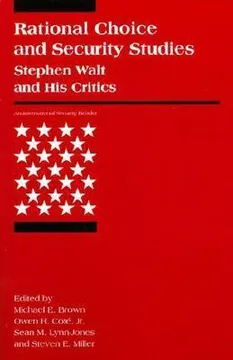
The lone review of Rational Choice and Security Studies is written informally, offering a skimming-based overview of the book's origins in a 1999 International Security journal debate. The reviewer highlights Stephen Walt's critique of formal rational choice approaches in security studies, noting concerns about originality and "methodological overkill." The reviewer also points out Walt's seemingly defensive footnote about his voting record, suggesting the debate carried personal tensions, though it remained within academic boundaries.
Download PDF
Download EPUB
.epub digital book format is ideal for reading ebooks on phones, tablets, and e-readers.








































