Key Takeaways
1. The Foreigner's Initial Isolation in Fuling
No Americans had lived there for half a century.
Arrival in Fuling. Peter Hessler, a 27-year-old Peace Corps volunteer, arrived in Fuling in 1996, a small, isolated city on the Yangtze River previously closed to outsiders. He and Adam Meier were the first Americans in half a century, making them instant anomalies in a city of 200,000. This unique status led to constant scrutiny and a profound sense of being an outsider.
Overwhelming sensory experience. Fuling was a cacophony of unfamiliar sounds and sights: constant car horns, construction noise, and pervasive coal dust. The initial experience was disorienting, with every public outing attracting stares and shouts of "waiguoren" (foreigner) or "hah-loooo!" This intense attention, coupled with the language barrier, made simple tasks like going to town frustrating and isolating.
Coping mechanisms. To manage the overwhelming environment, Hessler and Adam initially tried going out together, but this only amplified the attention. They eventually resorted to individual trips, with Hessler often wearing headphones playing loud music to drown out the shouts. This early period highlighted the profound cultural and personal adjustments required to live in such an unfamiliar and scrutinizing environment.
2. Mastering Language: A Bridge to Chinese Life
I knew that studying Chinese was one of the most important things I could do in Fuling.
The language barrier. Mandarin Chinese, with its complex characters and tones, presented a formidable challenge, compounded by the distinct Sichuanese dialect. Hessler's initial attempts were met with amusement from students and frustration from tutors, who struggled to teach a Westerner a language so different from his own. This linguistic isolation severely limited his ability to connect with the local community.
Dedicated study. Despite the difficulties, Hessler committed intensely to learning Chinese, spending hours daily studying characters, listening to tapes, and practicing. He found that simply making himself available in public spaces, like teahouses, led to spontaneous conversations with curious locals, who, despite his errors, were patient and eager to interact. This organic immersion proved invaluable.
Breaking through. Gradually, the language began to "make sense," transforming from elusive scratches to meaningful words. This progress not only improved his communication but also shifted his relationship with his tutors, Teacher Kong and Teacher Liao, from formal instructors to real people. Learning Chinese became the primary tool for unlocking the city's secrets and forging genuine connections.
3. Education's Blend of Learning and Political Indoctrination
It wasn’t by accident that academic study came third. The top priority was political.
Communist Party's influence. Fuling Teachers College served a dual purpose: training teachers and extending the Chinese Communist Party's ideology. Students were required to study Marxism-Leninism and Mao Zedong Thought, with academic subjects taking a secondary role. This indoctrination aimed to "authenticate a viewpoint of Historical Materialism," often leading to rote learning and unquestioning acceptance of official narratives.
Teaching foreign literature. Hessler taught English and American literature, navigating a curriculum that included texts like "The Three Gorges Project Is Beneficial" as a model for argumentation. He found himself teaching "English Literature with Chinese Characteristics," where students sometimes interpreted Shakespeare through a Marxist lens or used political slogans in their essays, highlighting the pervasive influence of propaganda.
Student perspectives. Despite the indoctrination, students displayed a raw intelligence and eagerness, especially when engaging with foreign texts. Their interpretations, though sometimes politically colored, were fresh and intense. Hessler observed a paradox: while they were taught to conform, their engagement with literature often revealed a yearning for critical thought and a nuanced understanding of the world.
4. The Three Gorges Dam: A Symbol of Progress and Loss
The dam is being constructed on an earthquake fault, and the unstable Gorges have a long history of enormous landslides that cause massive waves.
Massive scale and promises. The Three Gorges Dam, the world's largest hydroelectric project, promised immense benefits: electricity, flood control, and improved transportation, turning Chongqing into a seaport. Local residents, like those in Fuling, largely accepted the project, believing government assurances of dikes and new housing, despite the vague details.
Hidden costs and risks. Critics, both Chinese and foreign, warned of catastrophic consequences:
- Environmental: Flooding of cultural relics (like White Crane Ridge), endangered species, silt accumulation, and pollution from submerged sewage and factories.
- Social: Displacement of nearly two million people, with concerns about corruption in resettlement funds and inadequate compensation.
- Geological: Construction on an earthquake fault and the risk of massive landslides.
Local passivity. Despite the profound impact, Hessler observed a striking lack of concern or protest among Fuling residents. This passivity stemmed from a history of massive, externally imposed changes (like Mao's Third Line Project), a lack of reliable information, and a collective mindset that often disengaged individuals from broader public affairs. They simply accepted it as inevitable, like the river's flow.
5. Navigating the Nuances of Chinese Social Interaction
The Chinese could be hard on foreigners, but at the same time they could be incredibly patient, generous, and curious about where you had come from.
The "waiguoren" experience. Living as a foreigner in Fuling meant constant attention, ranging from innocent curiosity to mocking shouts. Hessler learned to navigate these interactions by developing patience, accepting invitations, and not taking himself too seriously. He found that a relaxed, humorous approach, including self-deprecating jokes about being a "foreign devil," often disarmed locals.
Generosity and "face." Chinese people, particularly in Fuling, exhibited immense generosity, often insisting on paying for meals or offering hospitality without expectation of repayment. This was intertwined with the concept of "face," where showing kindness to a guest, especially a foreigner, was important. However, this generosity also came with unspoken rules and expectations, such as not refusing gifts or invitations.
Social circles and trust. While outwardly collective, Chinese society in Fuling was characterized by tight-knit groups (family, close friends, work units) that could be exclusive. Hessler found that building trust and genuine friendships, especially with those outside the college's official circles, required time and effort, often transcending the initial barriers of language and cultural differences.
6. History's Lingering Grip on Modern Chinese Identity
The past fifty years had taught the people not to meddle in public affairs, but to some degree Communism merely built on the foundations of traditional Chinese collectivism, which had shaped social patterns for centuries.
Mao's legacy and Deng's reforms. Hessler observed a complex relationship with China's past leaders. While Mao Zedong was still revered as the "savior and Red Sun," his disastrous policies like the Great Leap Forward and Cultural Revolution were acknowledged, albeit often with a pragmatic "70% correct, 30% wrong" assessment. Deng Xiaoping, in contrast, was widely praised for his economic reforms and bringing "freedom."
Selective memory and sensitivity. Students, though often joking about the Cultural Revolution, were highly sensitive about the Opium Wars, viewing Hong Kong's return as a redemption of national shame. This selective historical memory, shaped by state narratives, meant that events from the 19th century felt more immediate and unresolved than the recent traumas of their parents' generation.
The weight of the past. Hessler realized that the Chinese people's resilience and pragmatism were deeply rooted in a history of immense hardship and constant change. Their ability to "eat bitter" and adapt to new realities, whether political or economic, was a defining characteristic, making them less prone to questioning authority or dwelling on past injustices.
7. The Paradox of Freedom and Control in Daily Life
I couldn’t imagine thinking that life in the college was any sort of true freedom, although I knew that I would feel differently if I had spent the Cultural Revolution in China.
Subtle control mechanisms. While Deng Xiaoping's reforms brought economic liberalization, political control remained pervasive, often subtly enforced. Hessler experienced this through censorship of his mail, monitoring of his classes, and the college administration's attempts to restrict his and Adam's interactions with students and local faculty. These actions, though often clumsy, fostered a climate of caution.
Internalized limits. Hessler observed that many Chinese, including his students, had internalized these limits. Discussions on sensitive topics were often handled in Chinese, not English, suggesting that the "safest" language was their native tongue, where they felt more comfortable expressing nuanced or dissenting views. This indicated that the boundaries were often self-imposed, a product of decades of political conditioning.
Disengagement and pragmatism. Many Fuling residents, particularly the "Old Hundred Names" (common folk), exhibited a profound disengagement from public affairs. They prioritized personal well-being and economic advancement over political freedoms, often viewing government policies with a pragmatic acceptance rather than active opposition. This "silent consent" was a form of democracy with Chinese characteristics, born of a history where individual agency in politics was often futile or dangerous.
8. Personal Transformation: Embracing a Chinese Self
There was an enormous freedom in that—at the age of twenty-eight, I suddenly had a completely new identity.
Evolving identity. Hessler's deep immersion in Fuling led to a profound personal transformation. He developed a distinct "Chinese self," Ho Wei, who was friendlier, more outgoing, and less self-conscious than his American counterpart. This new identity allowed him to navigate social interactions with greater ease and humor, embracing the local customs and even the dialect's quirks.
Dual perspectives. He came to view himself as two people, Ho Wei and Peter Hessler, each with distinct roles and ways of interacting with the world. This duality provided a unique lens through which to observe and understand China, allowing him to participate actively while also maintaining a critical, analytical distance. The notebook became the bridge between these two selves.
Growth and adaptation. The challenges of Fuling, from the initial alienation to navigating complex social dynamics, forced Hessler to adapt and grow. He learned patience, developed a deeper empathy for the local people, and found satisfaction in the simple routines of his Chinese life. This transformation was not without its difficulties, but it ultimately enriched his understanding of himself and the world.
9. The Enduring Resilience and Pragmatism of the People
They don’t care what people think, and they don’t care what work they find, as long as it is work.
"Eating bitter" (chiku). The Sichuanese people, including Hessler's students and local friends, demonstrated an extraordinary capacity for "eating bitter"—enduring hardship without complaint. This resilience was evident in their tireless work ethic, their ability to adapt to difficult conditions, and their pragmatic approach to life's challenges, from poverty to political upheaval.
Generosity and family ties. Despite their own struggles, Fuling residents were remarkably generous, especially within their families and close social circles. Children supported parents, and relatives pooled resources, reflecting a strong sense of collective responsibility. This deep-seated generosity often extended to Hessler, who was frequently offered meals and hospitality.
Focus on tangible improvements. For many, progress was measured in concrete terms: electricity, better housing, and economic opportunities. The promise of modernization, even with its costs, was eagerly embraced as a path to a better life. This pragmatism, born of historical poverty, meant that abstract concepts like political freedom often took a backseat to immediate material improvements.
10. The River's Constant Flow Amidst Human Endeavors
The river is the quickest way out of Chongqing. The city has a new airport and a new expressway, and the railroad, although now aging, was a technological breakthrough when it was completed in 1952—the first great postwar achievement of Deng Xiaoping, acting as Mao’s lieutenant in the southwest. But none of them has improved on the Yangtze.
A timeless presence. The Yangtze and Wu rivers served as a constant, powerful backdrop to Hessler's two years in Fuling. Their unchanging flow, marked by ancient carvings on White Crane Ridge and the rhythms of river life, contrasted sharply with the rapid human-made changes occurring in the city and surrounding landscape. The rivers embodied both history and an indifferent natural force.
Life shaped by water. The rivers dictated much of Fuling's existence: transportation, economy, and even the city's physical layout. From fishermen to barge captains, people's lives were intimately connected to the water, adapting to its currents and seasons. The dam, a monumental attempt to control this force, represented a clash between human ambition and nature's enduring power.
Metaphor for change. The rivers became a metaphor for China itself—a vast, powerful entity constantly in motion, yet also deeply rooted in its past. Hessler observed that while human endeavors, like the dam or political movements, sought to redirect its course, the fundamental essence of the river, like the spirit of the Chinese people, continued to flow, adapting and enduring.
Review Summary
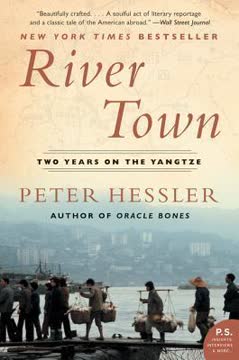
Reviews of River Town are largely positive, averaging 4.28/5. Readers praise Hessler's immersive, honest account of life in Fuling as a Peace Corps volunteer, highlighting his engaging prose, thoughtful cultural observations, and meaningful interactions with students. Many appreciate his self-awareness and willingness to acknowledge his own shortcomings. Critics note occasional repetitiveness, cultural condescension, and a slow, journal-like pace. The book is widely valued as a candid time capsule of 1990s China, particularly regarding the Three Gorges Dam's impact and the complexities of teaching under Communist constraints.