Key Takeaways
1. Childhood Emotional Neglect (CEN) is an invisible wound that shapes your life.
在你的童年里,你的父母未能充分回应你的情感需求。
Silent struggle. Childhood Emotional Neglect (CEN) is not about what did happen, but what didn't happen: your parents failed to adequately respond to your emotional needs. Unlike overt abuse, CEN leaves no visible scars, making it difficult to identify and understand its profound impact on adult life. This invisible wound often leads to a deep-seated feeling that something is "wrong" with you, even when your childhood seemed outwardly normal.
Unseen consequences. Growing up with CEN means your emotions were often dismissed, ignored, or even punished. To cope, you learned to suppress your feelings, building an "emotional wall" to protect yourself and avoid burdening your parents. This adaptive mechanism, while helpful in childhood, becomes a significant hindrance in adulthood, preventing you from fully connecting with yourself and others. The lack of emotional validation leaves you feeling confused, empty, and disconnected from your authentic self.
Widespread impact. CEN affects every aspect of your life, from career choices to friendships, but its most significant impact is on your intimate relationships. You might struggle to understand your own desires, feel uncomfortable with deep emotional connection, or find yourself repeating unhealthy relationship patterns. Recognizing CEN is the first crucial step towards understanding your struggles and beginning the healing process, offering a profound sense of relief and clarity.
2. CEN creates an "emotional wall" and a pervasive sense of emptiness.
当你的一部分情绪被心墙隔离,你的生活会是痛苦而又艰难的。
Emotional suppression. As a child experiencing CEN, you unconsciously built an emotional wall to block off your feelings, ensuring they wouldn't bother your parents. This protective mechanism, while effective in your childhood home, leaves you as an adult disconnected from your inner emotional world. Your emotions, which should guide and energize you, are trapped behind this wall, leading to a life that feels dull, uninspired, and lacking vitality.
Inner void. This blocked emotional space manifests as a deep, pervasive sense of emptiness. You might struggle to identify what you truly want or need, feeling a vague sense of being different from others, even when your life appears successful. This emptiness acts like a "vacuum cleaner," constantly pulling you to fill it with external things—food, alcohol, shopping, work, or even relationships—often leading to unfulfilling pursuits and a cycle of disappointment.
Misunderstood pain. The pain of CEN is often compounded by confusion, especially if your parents provided ample material comforts or expressed love in other ways. You might wonder why you can't be happy or why you feel inexplicably different, blaming yourself for this internal void. This self-blame prevents you from recognizing the true source of your struggles: the absence of a vital connection to your own emotions, which is essential for meaningful relationships and a vibrant life.
3. CEN profoundly impacts partner selection and intimate relationships.
一段童年情感忽视的关系,通常可以被理解为一段“打了折扣的关系”。
Seeking familiar love. CEN subtly influences your choice of partner, often leading you to seek a love that mirrors the emotional landscape of your childhood. If your parents provided material love but lacked emotional depth, you might find emotionally rich relationships uncomfortable or "too much." This unconscious pull can lead you to choose partners who also experienced CEN, creating a comfortable but ultimately unfulfilling "discounted relationship" that lacks deep emotional connection and the skills to sustain it.
Five ways CEN affects partner choice:
- Seeking familiar love: Drawn to partners who offer a similar, emotionally muted connection.
- Premature commitment: Driven by a desperate need to fill the inner emptiness, leading to quick, ill-considered commitments.
- Fear of dependence: Avoiding commitment due to the internalized belief that emotional needs are a sign of weakness or shame.
- Attraction to intense partners: Seeking vibrant, emotionally expressive partners to inject energy into your own "colorless" world, but risking loss of control.
- Attraction to narcissists: A powerful, often destructive, attraction where your low emotional needs perfectly complement a narcissist's high need for attention, leading to further self-erosion.
Relationship struggles. In relationships where one or both partners have CEN, common issues arise:
- Avoidance of conflict: Fear of emotional intensity leads to unresolved issues, festering resentment.
- Loneliness/emptiness: Even when together, a deep sense of isolation persists due to lack of emotional intimacy.
- Superficial conversations: Difficulty discussing feelings, sticking to "safe" topics, leading to awkwardness.
- Lack of emotional intimacy: Hiding true feelings, feeling misunderstood, a sense of something "missing."
- Lack of passion: Diminished desire for physical and emotional closeness, leading to a sense of distance.
These patterns, often unrecognized, slowly erode the warmth and connection in a relationship, leaving both partners feeling confused and unfulfilled.
4. Developing emotional skills is crucial for healing and building connection.
技巧能使爱燃烧得更旺,技巧能够建立陪伴,而且提升并保持化学反应。
Beyond love and chemistry. While love, companionship, and chemistry are important, the most critical, yet often overlooked, ingredient for a successful long-term relationship is skill. Emotional skills are not innate; they are learned, and they can be developed at any age. These skills empower you to deepen love, build true companionship, and sustain the spark in your relationships, even if you missed out on this training in childhood.
Four essential emotional skills:
- Self-knowledge: A deep, honest understanding of your own desires, passions, strengths, weaknesses, and reactions. This is the foundation for authentic connection.
- Emotional awareness: The ability to observe and understand your own emotions and those of your partner, recognizing their connection to behaviors and choices.
- Emotional capability: The capacity to identify, accept, tolerate, manage, and articulate your feelings and your partner's feelings.
- Communication skills: The ability to express your emotions and needs effectively, listen actively, and understand your partner's messages in a way they can receive.
Practical exercises for connection:
- Self-knowledge exercises: Use a "Self-Knowledge Chart" to identify your traits, preferences, and reactions, then share and discuss with your partner.
- "I feel" statements: Consciously increase your use of "I feel" statements to articulate your emotions, moving beyond facts to the core of your experience.
- "My partner's feelings" tracking: Observe and record your partner's emotions throughout the day, then check your perceptions with them to build empathy and awareness.
- Responding to feelings: Practice acknowledging and validating your partner's emotions directly (e.g., "You look upset," "That must be frustrating").
- Fixed communication time: Dedicate a specific, uninterrupted time each day to talk, focusing on sharing feelings and asking open-ended questions.
These exercises, when practiced consistently, help dismantle the emotional wall, fostering deeper understanding and intimacy.
5. Healing CEN requires confronting its impact on parental relationships.
从出生起,我们就强烈地渴望从父母那里得到关注和理解,这是我们人类的天性。
Inherent longing. Humans are born with a powerful, innate need for parental attention and understanding. This fundamental emotional requirement is not a choice, and it persists throughout life, even if suppressed. For adults with CEN, this longing often manifests as a complex mix of love, anger, gratitude, and a sense of emotional deprivation towards their parents, leading to confusion and guilt.
Types of neglectful parents:
- Well-Meaning But Overwhelmed Parents: Good intentions, but unknowingly neglect emotional needs (e.g., workaholics, achievement-focused, permissive). Children often feel confused and self-blaming.
- Struggling Parents: Faced significant life challenges (e.g., divorce, illness, addiction) that left them with little emotional capacity for their children. Children become overly self-sufficient and empathetic, often idealizing parents.
- Self-Involved Parents: Motivated by their own needs, often causing more harm than just neglect (e.g., narcissists, authoritarian, addicted, antisocial). Children often recognize parental issues but still suffer deep emotional wounds.
Managing guilt and emotions: Guilt is a common obstacle, preventing adults with CEN from setting healthy boundaries with their parents. It's crucial to understand that guilt should stop unnecessary harm to others, not prevent self-protection. To manage guilt, assess its intensity, identify its true source (often fear of being selfish), and remind yourself that your negative feelings are valid and not a moral failing.
Tools for emotional acceptance:
- Identify your emotions: Before and during interactions with parents, consciously identify your feelings using a detailed emotion vocabulary.
- Use your emotions: Accept your feelings without judgment, ask what they are telling you (e.g., "Do I need distance? Do I need to set a boundary?"), and act on healthy insights.
These steps empower you to navigate the complex emotional landscape of your parental relationships, moving from confusion and self-blame to clarity and self-protection.
6. CEN is often passed down, affecting how we parent our children.
像不断送出的礼物一样,童年情感忽视会自动地从一代传到下一代。
Automatic transmission. Childhood Emotional Neglect is often an "automatic gift" passed from one generation to the next. If your parents had emotional blind spots and didn't adequately respond to your feelings, you likely grew up unaware of your own emotions. This emotional unawareness then unconsciously influences your parenting, making it difficult to perceive and respond to your children's emotional needs, even when you deeply love them.
Unseen struggles. Parents with CEN often experience a unique set of challenges that go unaddressed in typical parenting advice. They might feel a deep sense of inadequacy, guilt, or shame about their parenting, believing they are not "good enough." This self-criticism stems from their own childhood lack of emotional validation and the absence of a "compassionate accountability" voice that helps them learn from mistakes without judgment.
Impact on children. Children of parents with CEN often develop similar emotional struggles:
- Anti-dependence: Children learn to suppress their needs, fearing reliance on others.
- Lack of self-compassion: Internalizing harsh self-criticism, struggling to forgive their own mistakes.
- Emptiness: Experiencing a similar inner void, often masked by busyness or anger.
- Poor self-assessment: Lacking a clear, objective understanding of their own strengths, weaknesses, and identity.
- Guilt and shame: Feeling excessive guilt for minor missteps, hindering learning from mistakes.
- Anger and self-blame: Directing natural anger inward, leading to self-criticism or explosive outbursts.
- Fatal flaw: A deep-seated feeling of being fundamentally "different" or "wrong," leading to social isolation.
- Poor self-discipline: Struggling with internal motivation and boundaries due to a lack of consistent external guidance in childhood.
- Difficulty nurturing: Struggling to give and receive pure, unguarded love and care, creating emotional distance.
- Alexithymia (low emotional intelligence): Lacking awareness, knowledge, and skills to process emotions, leading to confusion about self and others.
These characteristics, passed down unconsciously, create a cycle of emotional neglect that impacts children's well-being and future relationships.
7. Parents with CEN exhibit distinct characteristics that hinder effective parenting.
你唯一的问题在于,你要敢于接近孩子,并分享你的感受。
Unconscious patterns. Parents who experienced CEN often carry ten distinct characteristics that, while not their fault, significantly impact their parenting style. These traits are deeply ingrained and operate largely outside conscious awareness, making it challenging to connect with their children's emotional worlds. Recognizing these patterns is the first step toward breaking the intergenerational cycle of emotional neglect.
Key characteristics and their parenting impact:
- Anti-dependence: Feeling uncomfortable with children's natural needs, leading to a subconscious desire for children to be overly self-sufficient.
- Lack of self-compassion: Being overly critical of oneself as a parent, leading to guilt and shame over perceived imperfections, hindering learning from mistakes.
- Emptiness: A deep inner void that can be temporarily filled by a child's vibrancy but also highlights the parent's own emotional deficits, causing discomfort.
- Poor self-assessment: Difficulty understanding their own true nature, which translates into difficulty understanding their child's unique personality, strengths, and needs.
- Guilt and shame: Overreacting to minor parenting mistakes with intense self-blame, hindering effective problem-solving and growth.
- Anger and self-blame: Suppressing natural anger, which can lead to misdirected outbursts towards children or chronic self-criticism.
- Fatal flaw: A hidden feeling of being fundamentally "wrong" or "different," creating emotional distance from children and discomfort in social parenting situations.
- Poor self-discipline: Struggling to set consistent boundaries and provide healthy discipline, leading to either overly permissive or overly harsh parenting.
- Difficulty nurturing: An internal barrier that prevents giving and receiving pure, unguarded love and care, creating emotional distance with children.
- Alexithymia (low emotional intelligence): Lacking the ability to identify, understand, and express emotions, making it hard to guide children through their emotional experiences.
These characteristics, while challenging, do not diminish a parent's love or care. The core issue is the courage to approach and share one's feelings, both with oneself and with one's children.
8. Transforming parenting involves conscious emotional engagement and communication.
无论你的孩子年龄多大,在你与孩子的交往中,都可以通过三个重大的改变为你们带来治愈的力量。
Universal healing. Regardless of your child's age, three fundamental changes can profoundly heal your relationship and break the cycle of CEN. These changes focus on conscious emotional engagement, fostering a deeper connection that transcends age-specific challenges. The key is to continue healing your own CEN, as your emotional growth naturally influences your children.
Three universal changes:
- Increase communication: Move beyond superficial exchanges to share more about your thoughts, feelings, and what matters to you. Actively ask your children about their lives, thoughts, and concerns, conveying their importance.
- Become more curious and ask more questions: Show genuine interest in your child's inner world. Instead of generic questions like "How was school?", ask specific, open-ended questions that invite deeper sharing (e.g., "What was the most challenging part of your day?").
- Use more emotional language: Expand your emotional vocabulary when talking to your children and describing your own feelings. This normalizes emotional expression and teaches children to identify, understand, and articulate their own complex feelings, building emotional intelligence.
Age-specific strategies:
- For children: Treat them age-appropriately, observe and share their unique personality traits, don't avoid conflict (teach discipline with love), respond to emotions before behavior, strive for empathy, encourage self-expression, and share your own appropriate emotions.
- For teenagers: Focus on emotional intensity (don't fear their outbursts), understand they often hide emotions, respond with empathy, teach emotional balance, observe their emotional fluctuations, accept them for who they are, give them space to make mistakes (with vigilance), set clear boundaries, and never cut the emotional cord.
- For adult children: Increase contact, use more emotional language, treat grandchildren and children equally (without bypassing the child), frequently acknowledge their strengths and achievements, share more of your own life experiences (especially CEN-related ones), strive for empathy, shift focus from conflict to connection, and ask more vertical questions (probing inner feelings).
These strategies, rooted in emotional awareness and connection, empower you to create a nurturing environment that fosters emotional health in your children.
9. Talking about CEN with loved ones can be a powerful step towards healing.
在你跟孩子提及你们关系中缺失的东西后,你们的问题会更容易得到解决。
A loving gesture. Discussing Childhood Emotional Neglect with your children, especially teenagers or adults, is a profound act of love. Even if their initial reaction is negative, their inner self will register your attempt to connect and your validation of their feelings. This conversation creates a shared language around emotional concepts like "emotional acknowledgment" and "emotional connection," paving the way for deeper healing and understanding in your relationship.
Potential benefits:
- Shared language: Establishes common terms for emotional concepts, facilitating healing.
- Mutual understanding: Creates a shared perspective on childhood struggles, fostering empathy.
- Resolves blame: Addresses unspoken blame children might harbor, opening communication.
- Reduces anger: Validates children's underlying anger, allowing it to dissipate with understanding.
- Fosters empathy: Helps children understand your own CEN background, building a deeper bond.
- Provides healing tools: Introduces children to the concept of CEN, empowering them to begin their own healing journey.
Potential drawbacks:
- Temporary worsening: Initial anger or defensiveness from children, especially teenagers, as they process the information.
- Weaponization of CEN: Children might initially use "emotional neglect" as a label or accusation.
- Undermining parenting changes: Explaining your new emotional approach might diminish its organic impact for some children.
Preparation for success:
- Set boundaries: Understand your role is to introduce the concept, not force acceptance. Respect your child's pace and decision to engage or not.
- Set small expectations: Aim for a modest goal for the first conversation, like simply mentioning CEN or your own emotional journey.
- Choose the right scenario: Select a relaxed, private time and place where both you and your child feel comfortable.
- Prepare your opening: Start with an empathetic, non-blaming approach, perhaps linking it to your own growth or a shared observation.
- Gather resources: Have articles or books about CEN ready to share, especially those that might resonate with your child.
- Take responsibility: Focus on your own experiences and impact, rather than blaming your child, to encourage openness.
By carefully considering these factors, you can approach this sensitive conversation with courage and compassion, ultimately strengthening your family bonds.
10. Healing CEN is a journey of self-discovery, self-care, and courageous connection.
他们建立了情感联结,他们的生活有了全新的意义。之前横亘在他们彼此之间的那块“空地”,被情绪理解、情绪觉知、情感联结、情感协调所填满。
A transformative path. The journey of healing from Childhood Emotional Neglect is a profound transformation, moving from a life shrouded by an "emotional wet blanket" to one filled with vibrant connection and meaning. It involves acknowledging the invisible wound, understanding its pervasive impact, and courageously engaging in self-discovery and self-care. This process empowers you to break free from old patterns and build a life rich in emotional understanding and authentic relationships.
Embracing self-care. A critical component of healing is prioritizing your own emotional needs, something often neglected in childhood. This means actively practicing self-care, setting boundaries, and allowing yourself to feel and process emotions that were long suppressed. By nurturing yourself, you fill the inner emptiness and regain the vitality needed to connect more deeply with others. This self-compassion is not selfish; it's essential for your well-being and your capacity to give to others.
Courageous connection. Healing also demands the courage to connect—with your own emotions, with your partner, with your parents, and most importantly, with your children. This involves:
- Dismantling the emotional wall: Allowing yourself to feel and express emotions, even the uncomfortable ones.
- Practicing emotional skills: Actively developing awareness, capability, communication, and self-knowledge.
- Setting boundaries: Protecting your emotional health from draining or harmful interactions.
- Engaging with loved ones: Initiating conversations about CEN, even when difficult, to foster mutual understanding and empathy.
- Passing on emotional health: Consciously parenting your children with emotional attunement, giving them what you never received.
The ultimate reward is a life where the "empty space" is filled with emotional understanding, awareness, connection, and attunement. This journey, though challenging, leads to a flourishing life, not just for you, but for generations to come.
Review Summary
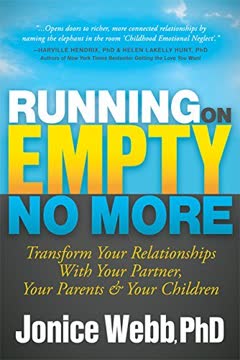
Reviews of Running on Empty No More are largely positive, with many readers praising its practical advice for healing relationships affected by Childhood Emotional Neglect (CEN). Readers appreciate the relatable case examples, compassionate tone, and actionable exercises. Several note it works best as a follow-up to Webb's first book. Common praise includes its non-judgmental approach and real-world applicability. Critics, however, warn of oversimplification, suggesting CEN may be over-diagnosed through the power of suggestion, and some feel the symptoms overlap with other conditions like ADHD or anxiety.
People Also Read