

Key Takeaways
Your longest love affair is the one with yourself
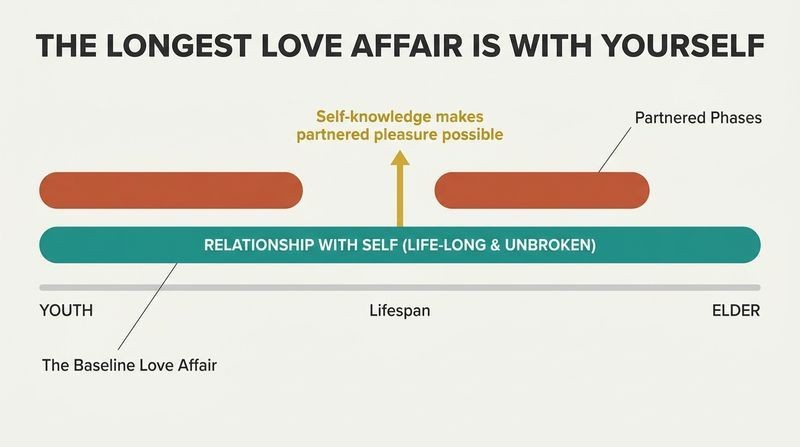
Masturbation is sex, not rehearsal for it. Dodson reframes self-pleasure as a primary, lifelong form of sexual expression rather than a stopgap for the partnerless or a juvenile phase to outgrow. She argues the honest answer to "when did you first have sex?" is your first memory of masturbating, not your first partnered encounter.
She lists who this serves: teenagers avoiding pregnancy, separated couples, the ill, the widowed, the imprisoned, and anyone whose partner cannot or will not. In the era of AIDS it is also the safest sex available. Critically, learning to bring yourself to orgasm is what later makes partnered pleasure possible, because you can finally tell a lover what actually works instead of murmuring the white lie that everything feels good.
Written in 1974 and revised through the 1980s, this thesis still cuts against a culture that treats solo sex as consolation. What's striking is how Dodson inverts the hierarchy: partnered sex depends on self-knowledge, not the reverse. Modern sex therapy echoes her, prescribing "directed masturbation" as the most evidence-backed treatment for anorgasmia. The framing also anticipates the self-compassion research of Kristin Neff, where treating oneself as a worthy recipient of care, including pleasure, predicts wellbeing. The weak point is overstatement: claiming masturbation "holds the key" to reversing repression risks treating one practice as a cure for structural and relational problems it can only partly touch.
Shame about self-touch is how repression gets installed

Cultural denial keeps people compliant. Dodson's political claim is that teaching children guilt over masturbation severs them from their own bodies, and people deprived of a sexual relationship with themselves are easier to manipulate and quicker to accept the status quo. To be sexually repressed, she argues, is the truly antisocial condition, not to be aroused.
She gathers evidence from the stories strangers told her at gallery shows. One woman's mother sniffed her seven-year-old's fingers and slapped her, saying they smelled like a garbage pail. Decades later that woman still could not touch her own genitals and had never climaxed in twenty years of marriage. Dodson treats such episodes as ordinary, not freak cases, mapping how organized religion and "sexual guilt" produce lifelong dysfunction.
Dodson's link between sexual control and political docility runs parallel to Wilhelm Reich and Michel Foucault, who both argued that regulating bodies is a primary technology of power. Her anecdote about the slapped child reads like a clinical case of conditioned aversion: a single traumatic pairing producing decades of avoidance, exactly the acquisition pattern behaviorists document for phobias. The bolder claim, that erotic liberation would dissolve broader oppression, is harder to defend; plenty of sexually permissive societies remained hierarchical. The durable insight is narrower and well-supported: early shame leaves measurable, lasting marks on adult sexual function.
The fantasy of orgasm-through-intercourse sets women up to fail
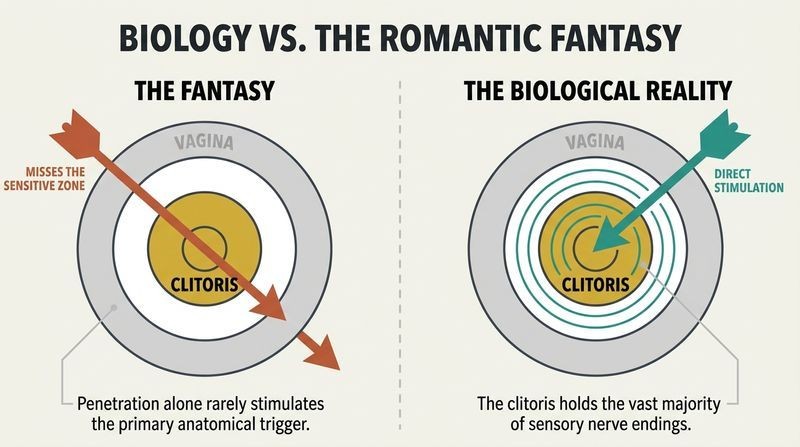
The romantic ideal is a trap. Dodson attacks the Hollywood script of the passive beautiful woman climaxing from a man's thrusting alone. She cites Kinsey's finding that the national average is roughly two and a half minutes of thrusting after penetration, not enough time for most people to get anywhere, and notes that very few women reach orgasm from intercourse without added clitoral stimulation.
She leans on Masters and Johnson, who demolished Freud's notion of a "mature vaginal orgasm" by showing orgasm is centered in the clitoris. Her reframe of "frigid": it is a man's word for a woman who cannot climax in the missionary position in a few minutes using only the stimulation that suits him. Expecting a woman to come untouched, she quips, is like expecting a man to climax without anyone touching the head of his penis.
The clitoral analogy is rhetorically devastating and anatomically fair. Decades of survey data since vindicate her: large studies consistently find only about a fifth to a third of women reliably orgasm from penetration alone, while the vast majority need direct clitoral contact. Dodson was popularizing this when the culture still pathologized such women as defective. One nuance she underplays: the clitoral-versus-vaginal binary she helped retire has itself been complicated by later anatomy showing the clitoris as a large internal structure that penetration can engage. Her core practical message survives intact: redesign the encounter around what actually produces orgasm rather than around a cinematic ideal.
Looking closely at your genitals can rewrite your self-worth
Becoming "cunt positive" is transformative. At ten, Dodson decided her inner labia were a deformity resembling a chicken's wattles and spent decades in secret body loathing, even after therapy. The cure was visual information: a lover showed her magazines of varied vulvas, and thirty minutes of looking did what years of analysis could not.
She turned this into method. At a 1973 NOW conference she showed feminists a slide show of women's genitals, reframing "split beaver" porn slang into an aesthetic celebration, sorting vulvas into Classical, Baroque, Gothic, and Valentine styles. The room gave a standing ovation; one woman asked her boss for a raise the next day and got it. Dodson's point: when no one grows up believing herself genitally deformed, sexual self-esteem follows, and a woman who understands her clitoris can always show a lover how to please her.
The cognitive mechanism here is exposure plus normalization, the same principle behind body-image interventions that show people the natural range of real bodies to counter distorted internal templates. Dodson essentially ran an early, communal version of what clinicians now call genital self-image work, now linked in research to sexual satisfaction and willingness to seek care. Her reclamation of a slur prefigures later linguistic-reappropriation movements. The fascinating, underexamined detail is the raise: she treats erotic self-acceptance as bleeding directly into professional assertiveness, a bold causal leap, though plausible if shame in one domain leaks into self-advocacy across all of them.
Sexual skill is learned and practiced, never inherited
"Doing what comes naturally" means staying inhibited. Dodson insists sexual responsiveness is a skill like any other, not a magic gift that switches on with adulthood. In a sex-negative culture, what comes "naturally" is shame, so erotic ability has to be deliberately built.
Her friend Nancy, twenty-five and unsure after six years of intercourse whether she had ever climaxed, illustrates the learning curve. Dodson coached her: spend an hour, not ten minutes; try oil, varied pressure, fantasy; experiment with a vibrator or running bathwater. Nancy finally came in the bathtub, then progressed to a vibrator, then to orgasm with a partner once she refused to fake. The lesson is patience and reps. Dodson reminds students that some women do not climax until their forties, and that little quick orgasms grow longer and stronger with practice, the same way men learn ejaculatory control.
Treating sexuality as a trainable competence rather than an inborn trait is quietly radical and aligns with the skill-acquisition literature: deliberate, attentive practice beats passive expectation. It also defuses the shame spiral, because "I haven't learned this yet" is a far more workable frame than "I am broken." The approach mirrors graded-exposure protocols in modern sex therapy, where homework assignments build response incrementally. The caveat worth naming is that not all anorgasmia is a practice deficit; medical, pharmacological, and trauma factors can require different interventions. Dodson's optimism is empowering but occasionally risks implying that enough diligent effort guarantees results.
Owning your own orgasm dismantles couple performance anxiety
Share masturbation to become a sexual equal. Dodson and her post-divorce lover Blake celebrated what they called Sexual Independence Day by masturbating in front of each other, proving each could reach first-rate orgasm alone. The effect was paradoxical and liberating: once she made clear she was not dependent on him for climax, the pressure lifted from both.
The practical gains were concrete. Her buildup took nearly thirty minutes; once Blake knew she could finish herself, he stopped feeling responsible and she stopped rushing. Either partner could decline sex without the other feeling rejected, since masturbating was an option, and watching each other taught them precisely which strokes worked. She frames becoming responsible for your own orgasm as a basic statement of equality, moving a couple from possessive "romantic" sex toward what she calls erotic loving.
This reframes a private act as a couple's intimacy practice, which contradicts the common fear that solo sex signals relational deficiency. Research on sexual communication supports her mechanism: explicit, observed information about a partner's preferences predicts higher satisfaction far better than guesswork or politeness. Detaching from "I must give you your orgasm" also dissolves the spectatoring and pressure that Masters and Johnson identified as central to dysfunction. The challenge is cultural rather than logical: many partners still read a lover's self-sufficiency as rejection, so the practice demands the very security it helps build. Dodson treats that vulnerability honestly, noting how exposed the first shared session felt.
For women who've never climaxed, the vibrator is rehabilitation
Steady electric stimulation overcomes years of sensory shutdown. Dodson is unromantic about the device. Extreme repression, she argues, can literally block the nervous-system pathways that carry genital sensation to the brain, and a vibrator delivers the strong, tireless, consistent input a numbed body needs to relearn pleasure.
Her letters and workshops are full of breakthroughs: a married woman who first climaxed at forty-eight after her vibrator finally outlasted her and her husband's stamina; another who, after years, made the bridge from machine to hand by adding fantasy. Dodson counters the "addiction" fear directly, noting she was far more antisocial when love-addicted than she ever was with a vibrator, and citing maze studies where mice conditioned with pain stay stuck while those conditioned with pleasure explore new paths. She also flags the practical rule: keep any electric vibrator away from water.
Dodson reads as prescient. Clinical work now routinely uses vibrators in treating anorgasmia, precisely for the reliable high-intensity stimulation she describes, and the worry about "dependence" or desensitization has little empirical support. Her pleasure-versus-pain conditioning analogy maps onto approach-versus-avoidance learning: aversive associations narrow behavior, rewarding ones expand exploration. What dates the chapter is hardware nostalgia, the named machines and their quirks, but the underlying principle, that a body shut down by shame may need an external jumpstart before manual or partnered methods work, remains sound and humane. She wisely frames the device as a bridge, not a destination.
When sex buys security, marriage becomes a business deal
Name the bargain instead of denying it. Dodson dissects her own first marriage: she said she married for love, but living in a society that underpaid women, she was unconsciously trading sex for economic security. When female genitals carry economic value rather than sexual value, she argues, marriage becomes a legalized form of prostitution, leaving some wives feeling like underpaid hookers and some husbands like overworked johns.
Her remedy is candor. Since marriage means sharing sex, money, property, and likely children, it deserves the dignity of a real contract with clarified terms, the way any serious partnership would. She also champions "separateness": after divorce she and Blake refused to remarry or cohabit, building instead an erotic family of friends, treating sexual love as inclusive rather than exclusive and finding security in living fully in the present rather than in possession.
The economic critique echoes Engels and second-wave thinkers who read traditional marriage as a property arrangement dressed in romance, and it landed hard because Dodson grounds it in her own confessed self-deception rather than abstract theory. The call for explicit negotiation prefigures today's normalized prenups and intentional relationship agreements. Her "separateness" experiment anticipates contemporary non-monogamy discourse decades early. The honest tension: she universalizes from her own affluent, childless, urban vantage, where opting out of dependency was feasible. For many women then and now, the economic bargain was less a delusion to shed than a survival strategy with few alternatives, a constraint her individualist solution glides past.
Conscious masturbation is a meditation, and brain scans agree
Orgasm rituals produce meditative brain states. Dodson long intuited that self-loving done as a deliberate ritual created the same body-mind harmony as meditation, then got data. As a subject in a Rutgers EEG study, she watched her brain waves drop from ordinary waking beta into alpha the moment she switched on her vibrator, and dip into theta, a deep trance level, around orgasm. The technicians actually halted her, fearing a heart attack; she calls that scientific nonsense.
The distinction she draws is everything: hurried, secretive, guilt-laden masturbation reinforces repression, while a slow conscious ritual creates a celebration. She connects this to tantra, an ancient practice that channels sexual energy for spiritual growth through prolonged activity and repeated orgasm, and reframes her own guided group rituals as a form of tantric group sex.
The EEG color commentary is anecdotal and decades old, so the specific neuroscience should be held loosely; later imaging of orgasm shows a far messier, more activated brain than a simple slide into theta. Yet the broader claim aligns with current findings that orgasm and meditation both downregulate the prefrontal self-monitoring that fuels anxiety, producing a transient ego-quieting state. Her crucial move is qualitative, not biological: the same act becomes either repression or sacrament depending on intention and attention. That mindfulness reframe, doing one thing slowly and without judgment, is exactly what distinguishes meditative practice from mechanical habit across every contemplative tradition.
Build a self-loving ritual: mirror, bath, touch, fantasy, climax
Treat yourself like a special lover. Dodson lays out a staged practice anyone can adapt. The throughline is deliberate self-courtship rather than a quick release.
1. Say "I love you" to yourself in the mirror daily, forgiving every self-critical thought.
2. Take a sensuous oiled bath as private, candlelit foreplay.
3. Stand nude before a mirror and find features to praise instead of flaws.
4. Give yourself a slow head-to-genitals massage, then examine your genitals with the same interest you give your face.
5. "Mirror dance" to practice the moves of sex, set an erotic stage, and take at least thirty minutes building toward orgasm, backing off by deepening your breathing to extend pleasure.
She stresses there is no single right way and folds in sensate focus, simply attending to bodily sensation when fantasy stalls, like returning to a mantra.
The ritual reads as a structured self-compassion and mindfulness protocol decorated with eros. The mirror affirmation is essentially a positive self-talk intervention; the body-appreciation stage maps onto evidence-based body-image exercises; the breathe-to-extend technique is arousal regulation, learning to ride the edge rather than rushing to discharge. Framing the whole thing as courting yourself counters the perfunctory, shame-shadowed style of solo sex Dodson blames for stunted response. The thirty-minute minimum is the quiet radical instruction: it reclassifies pleasure as something deserving of unhurried time and attention rather than a furtive errand, which is precisely the cultural reversal her book is built to provoke.
Sex stays vibrant into old age if you tone the right muscle
Aging need not end orgasm. Dodson, writing into her sixties, refuses the cultural script that makes sex for older people seem obscene. After menopause thinned her vaginal lining and made intercourse uncomfortable, she rejected hormone replacement, chose to age naturally, and built a full erotic life around oral sex, shared masturbation, and her own reliable orgasms.
When a giant sneeze leaked urine in her mid-fifties, she diagnosed not decay but a neglected PC muscle (the pubococcygeus, which supports the pelvic floor). She bought small dildos and a vaginal barbell and did fifty to a hundred squeezing repetitions several times a week, often finishing with a vibrator orgasm. Within weeks the leaking stopped and her orgasms grew fuller. Her mother, widowed and masturbating to orgasm in her late sixties at Betty's urging, is the through-line proof that pleasure is a lifelong capacity.
The anatomy is sound and ahead of its time. Pelvic-floor training, what clinicians call Kegel exercises, is now first-line treatment for stress incontinence and is documented to improve orgasm intensity, exactly the dual benefit Dodson reports. Her instinct to treat a leak as a fixable conditioning problem rather than an inevitable decline reframes aging as maintainable. The phone call to her widowed mother quietly demolishes the deepest taboo in the book, that desire belongs to the young. Her blanket rejection of hormone therapy is a personal choice presented a touch universally; for many women HRT addresses symptoms her exercises cannot, so the takeaway is the agency, not the specific protocol.
Analysis
Betty Dodson's Sex for One is a hybrid that resists tidy summary: part erotic memoir, part feminist manifesto, part illustrated how-to manual, capped by a chapter of reader letters. Originally circulated as Liberating Masturbation in 1974, it is among the founding documents of the women's sexual self-help movement, and its argument is deceptively simple: solo sex is not a substitute for the real thing, it is the foundational sexual relationship of a human life. Everything else, partnered pleasure, self-esteem, even political agency, builds on that base.
What makes the book historically significant is its method as much as its message. Dodson, a trained fine artist with no academic credentials, ran nude Bodysex workshops, drew vulvas as portraiture, and reclaimed clinical and pornographic vocabulary into an aesthetic of celebration. She translated Masters and Johnson's clitoral findings into a usable ethic decades before such knowledge was mainstream, and she insisted, against Freud and against her own therapists, that sexual response is a learnable craft rather than a romantic gift.
The book's limitations are the limitations of its standpoint and its era. Its causal ambitions occasionally outrun the evidence: erotic liberation is offered as a near-cure for repression, docility, even global conflict. Its individualism, the erotic family of friends, the freedom to opt out of economic dependency, reflects an affluent, urban, child-free vantage not available to most. Some science, notably the EEG claims, is anecdotal and dated.
Yet the core endures with surprising force. Contemporary sex therapy validates directed masturbation, vibrator-assisted treatment for anorgasmia, pelvic-floor training, and the centrality of clitoral stimulation, all of which Dodson championed in plain, unembarrassed language. Stripped of its period décor, the book is a sustained argument for treating one's own body as worthy of unhurried attention, patience, and tenderness, a self-compassion practice disguised as a sex guide.
Review Summary
Sex for One receives mostly positive reviews for its empowering message about self-love and masturbation. Readers appreciate Dodson's openness, humor, and efforts to destigmatize female sexuality. Many find the book liberating and educational, particularly for those struggling with body image or sexual repression. Some criticize outdated content and repetitiveness, while others disagree with certain viewpoints on pornography or relationships. Despite its age, many readers still find the book relevant and recommend it for its sex-positive approach and emphasis on self-acceptance.
People Also Read





Glossary
Bodysex Groups
Nude workshops teaching women masturbationGroup workshops Dodson founded in 1973 in which women met nude to do body movement, share masturbation histories, examine their genitals, and practice masturbation together. She estimated guiding over five thousand women through orgasm rituals. The format evolved into weekend sessions of up to fifteen women, emphasizing freedom of personal choice and demystifying sex through live demonstration.
Cunt positive
Accepting and celebrating female genitalsDodson's term for the psychological shift from viewing one's genitals as ugly, deformed, or shameful to seeing them as beautiful and varied. She fostered it through genital self-examination, viewing images of diverse vulvas, and reclaiming the word "cunt" itself, arguing that genital self-acceptance directly raises sexual self-esteem and overall confidence.
Guided Masturbation Ritual
Group orgasm with shared energyThe culminating Bodysex exercise in which women stood or sat in a circle and were verbally guided through breathing, pelvic movement, and stimulation toward orgasm together, often with vibrators. Dodson framed it as her design for tantric group sex, intended to move participants through a lifetime of sexual repression in roughly an hour.
Sexual Independence Day
Showing a partner you climax soloDodson's phrase for the milestone when she and her lover Blake first masturbated in front of each other, each proving they could reach full orgasm alone. It marked a shift from dependent romantic sex toward equality, removing the pressure on either partner to be responsible for the other's climax.
Transcendental Masturbation
Masturbation combined with meditationDodson's playful term for combining self-pleasure with meditative practice, originally pairing a TM mantra with vibrator use in a single nightly session. The concept was later supported by an EEG study showing her brain dropped into meditative alpha and theta states during arousal and orgasm.
Pleasure anxiety
Fear of too much pleasureThe fear of having too much of a good thing, which Dodson experienced when her post-divorce orgasms became unexpectedly intense. She found herself needing reassurance that strong pleasure was safe and not damaging, a conditioned hesitation rooted in sex-negative upbringing that she learned to override by breathing into rather than away from sensation.
Erotic family of friends
Non-possessive web of loversDodson's alternative to monogamous marriage: a network of friends who could also be lovers, treating sexual love as inclusive rather than exclusive. Built on her concept of "separateness," it located security in present-moment living and many relationships rather than in owning or depending on one partner forever.
FAQ
What's "Sex for One: The Joy of Selfloving" about?
- Focus on Self-Love: The book by Betty Dodson emphasizes the importance of self-love and self-pleasure, advocating for masturbation as a healthy and fulfilling sexual practice.
- Historical Context: It explores the history and politics of masturbation, challenging societal taboos and encouraging open discussions about self-pleasure.
- Empowerment Through Knowledge: Dodson provides educational insights into female anatomy and sexual response, aiming to empower individuals with knowledge about their own bodies.
- Personal and Collective Liberation: The book is both a personal narrative and a call to action for sexual liberation, encouraging readers to embrace their sexuality without shame.
Why should I read "Sex for One: The Joy of Selfloving"?
- Empowerment and Confidence: Reading this book can help you gain confidence in your sexuality and body, promoting a positive self-image.
- Educational Value: It offers detailed information about female anatomy and sexual health, which can be enlightening for both women and men.
- Breaking Taboos: The book challenges societal norms and taboos surrounding masturbation, encouraging open and honest conversations about self-pleasure.
- Personal Growth: It provides tools and insights for personal growth and self-discovery, making it a valuable resource for anyone looking to enhance their sexual well-being.
What are the key takeaways of "Sex for One: The Joy of Selfloving"?
- Masturbation is Natural: Dodson emphasizes that masturbation is a natural and essential part of human sexuality, beneficial for both physical and mental health.
- Self-Love is Crucial: The book highlights the importance of self-love and acceptance as foundational to a fulfilling sexual life.
- Education and Awareness: Understanding one's own body and sexual responses is crucial for empowerment and sexual satisfaction.
- Challenging Norms: It encourages readers to question societal norms and embrace their sexuality without guilt or shame.
How does Betty Dodson redefine masturbation in "Sex for One"?
- Primary Sexual Activity: Dodson presents masturbation as a primary form of sexual expression, not just a substitute for partnered sex.
- Lifelong Practice: She advocates for masturbation as a lifelong practice that maintains a loving relationship with oneself.
- Safe Sex Alternative: Especially in the context of STDs, masturbation is highlighted as the safest form of sexual activity.
- Empowerment Tool: By embracing masturbation, individuals can take control of their sexual satisfaction and reduce dependency on partners for pleasure.
What are the best quotes from "Sex for One" and what do they mean?
- "Masturbation is the primary form of sexual expression." This quote underscores the idea that self-pleasure is a legitimate and important aspect of sexuality.
- "Self-love is the foundation of all love." Dodson emphasizes that loving oneself is crucial for healthy relationships with others.
- "The only way to free ourselves from sexual repression is to embrace our sexuality." This highlights the book's central theme of liberation through self-acceptance and exploration.
- "Masturbation is meditation." Dodson equates the practice of self-pleasure with meditation, suggesting it can be a path to self-discovery and peace.
How does "Sex for One" address societal taboos around masturbation?
- Historical Context: Dodson provides a historical overview of how masturbation has been stigmatized, particularly by religious and cultural institutions.
- Personal Stories: The book includes personal anecdotes and stories from others to illustrate the widespread nature of these taboos and their impact.
- Educational Approach: By educating readers about the benefits and normalcy of masturbation, Dodson aims to dismantle these taboos.
- Call to Action: She encourages readers to speak openly about masturbation, helping to normalize the conversation and reduce stigma.
What specific methods or advice does Betty Dodson offer in "Sex for One"?
- Exploration and Experimentation: Dodson encourages readers to explore their bodies and experiment with different techniques to discover what feels best.
- Use of Tools: She discusses the use of vibrators and other tools to enhance the experience of self-pleasure.
- Mindfulness and Presence: The book suggests being present and mindful during masturbation to fully enjoy the sensations and benefits.
- Creating a Ritual: Dodson advises creating a personal ritual around masturbation, treating it as a special and sacred practice.
How does "Sex for One" empower women specifically?
- Body Positivity: Dodson promotes a positive view of female anatomy, encouraging women to appreciate and love their bodies.
- Knowledge is Power: By providing detailed information about female sexual anatomy and response, the book empowers women with knowledge.
- Breaking Stereotypes: It challenges stereotypes about female sexuality, advocating for women's right to sexual pleasure and autonomy.
- Community and Support: The book fosters a sense of community among women, encouraging them to share experiences and support each other in their sexual journeys.
What role does self-love play in "Sex for One"?
- Foundation of Sexual Health: Self-love is presented as the foundation of a healthy sexual life, essential for both self-pleasure and relationships with others.
- Acceptance and Confidence: Dodson emphasizes that accepting and loving oneself leads to greater confidence and satisfaction in all areas of life.
- Healing and Growth: Self-love is portrayed as a healing force, helping individuals overcome shame and negative body image.
- Empowerment: By cultivating self-love, readers can empower themselves to take control of their sexual and emotional well-being.
How does Betty Dodson incorporate art and creativity in "Sex for One"?
- Artistic Expression: Dodson uses her background as an artist to explore and express themes of sexuality and self-love.
- Visual Aids: The book includes illustrations and visual aids to help readers better understand female anatomy and sexual response.
- Creative Exploration: She encourages readers to view masturbation as a creative act, an opportunity to explore and express their sexuality.
- Art as Liberation: Dodson sees art as a tool for liberation, using it to challenge norms and inspire others to embrace their sexuality.
What impact has "Sex for One" had on the feminist movement?
- Challenging Norms: The book has been influential in challenging traditional norms around female sexuality and advocating for women's sexual autonomy.
- Empowering Women: It has empowered countless women to embrace their sexuality and demand equal rights to sexual pleasure.
- Influence on Sex Education: Dodson's work has influenced sex education, encouraging more open and comprehensive discussions about masturbation and self-love.
- Legacy of Liberation: "Sex for One" is considered a seminal work in the feminist movement, contributing to the ongoing fight for sexual liberation and equality.
How does "Sex for One" address the intersection of sexuality and spirituality?
- Masturbation as Meditation: Dodson presents masturbation as a form of meditation, a spiritual practice that connects body and mind.
- Holistic Approach: The book takes a holistic approach to sexuality, viewing it as an integral part of overall well-being and spiritual health.
- Transcendence Through Pleasure: Dodson suggests that through self-pleasure, individuals can achieve a sense of transcendence and inner peace.
- Integration of Self: By integrating sexuality and spirituality, the book encourages readers to embrace their whole selves, fostering a deeper connection to their inner being.
Download PDF
Download EPUB
.epub digital book format is ideal for reading ebooks on phones, tablets, and e-readers.








































