


Key Takeaways
The spark doesn't die from lost chemistry; it dies from silence
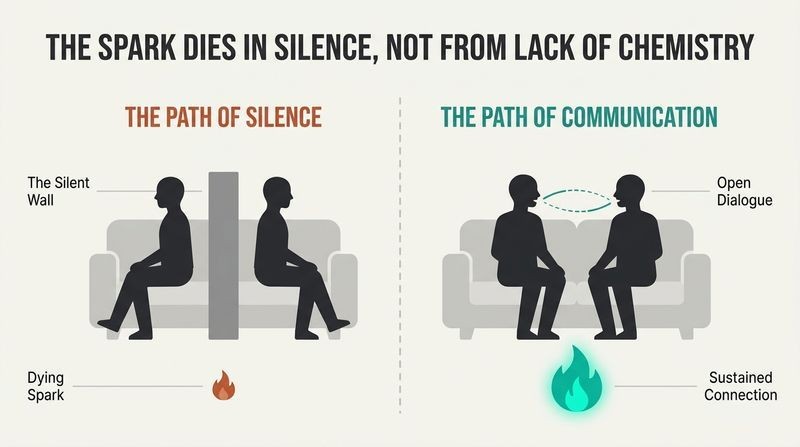
Communication, not chemistry, is the real culprit. Vanessa Marin, a sex therapist, nearly lost her relationship with Xander despite explosive early chemistry (six hours of making out the night they met, daily sex). Within a few years they were roommates who fumed in silence. The turning point in couples therapy revealed the truth: the fading of desire wasn't about vanished attraction, it was about the total absence of conversation about sex.
We are taught sex is unspeakable. From awkward parental talks to abstinence-focused sex ed to Hollywood scenes where nobody ever discusses what they're doing, most people reach adulthood with zero models for talking about physical intimacy. Marin faked orgasms for ten years rather than speak up. Shame isolates, and that silence slowly poisons intimacy.
What's compelling here is the reframe: couples treat dead bedrooms as a symptom of incompatibility, when it's often a communication deficit. This aligns with research from the Gottman Institute showing that conflict avoidance predicts divorce better than conflict itself. The claim has limits though. Some desire discrepancies stem from mismatched libidos, medical issues, or genuine incompatibility that talking alone won't fix. Still, the insight that silence compounds like debt is powerful. Sociologist Erving Goffman's work on stigma explains why: when a topic feels shameful, people manage it through concealment, which prevents the corrective feedback that would dissolve the shame in the first place.
Torch the fairy tale that great sex should feel effortless
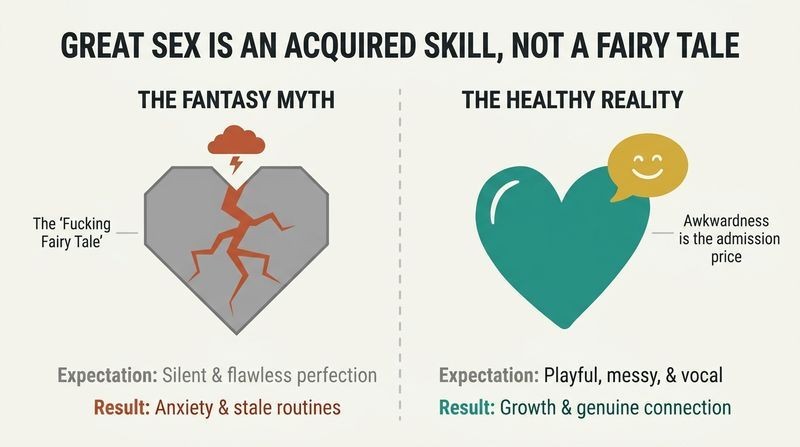
Hollywood sells a destructive myth. Marin calls it the Fucking Fairy Tale: the belief that real love means spontaneous, wordless, simultaneously-orgasmic sex requiring zero effort. When couples' actual sex lives don't match this (they never do), people feel broken and resentful. Real sex is awkward, messy, and involves farts, queefs, and bumped heads.
This myth breeds Sexual Perfectionism. That's the compulsion to seem flawless in bed, controlling every moment so you appear polished to your partner and yourself. It kills sex drive (why crave anxiety?), and traps people in stale routines because trying something new risks imperfection. Marin's antidotes include naming your inner critic (one client called hers Barb and talked back), examining unrealistic expectations, and accepting that awkwardness is the price of admission for genuinely hot sex.
The parallel to performance psychology is direct. Perfectionism correlates with worse outcomes across domains, from athletics to public speaking, because self-monitoring hijacks attention needed for the task itself. Barbara Fredrickson's research on sexual objectification shows that women who habitually view themselves from an external observer's perspective (spectatoring, a term coined by Masters and Johnson) report reduced arousal and satisfaction. Marin's fix, radical acceptance of imperfection, echoes ACT (Acceptance and Commitment Therapy). The naming-your-critic technique borrows from Internal Family Systems therapy, externalizing a harsh internal voice so it loses authority. Practical and evidence-adjacent, even if Marin presents it more casually than clinically.
You have one of two desire types, and neither is broken
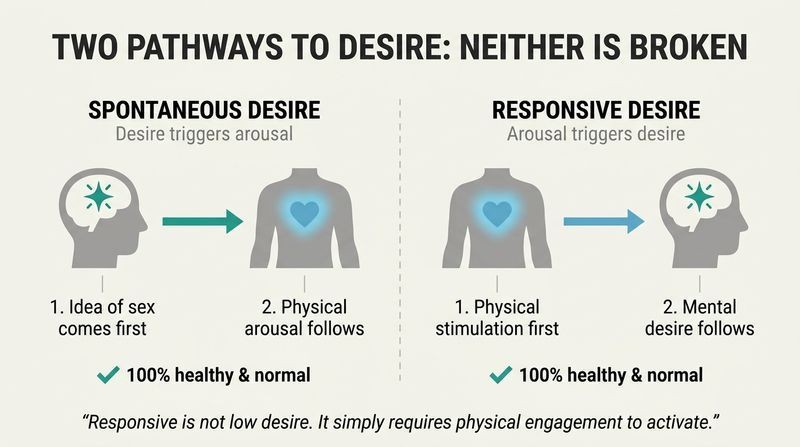
Desire and arousal are separate systems. Building on Emily Nagoski's research, Marin explains that mental desire (sex sounds good) and physical arousal (bodily response) operate independently. Your sex drive type depends on which comes first:
1. Spontaneous types feel mental desire first, arousal follows. They think about sex randomly throughout the day.
2. Responsive types feel physical arousal first, then desire follows. They rarely think about sex until things are already underway.
Responsive isn't low desire. Because Hollywood only shows spontaneous desire, responsive types (more often women) assume they're defective. They aren't. They just need physical stimulation as a starting point. Marin's fix: get libido out of Reverse (identify turn-offs like exhaustion, full stomach, feeling unsexy) before shifting into Drive (turn-ons across all five senses).
This distinction may be the single most therapeutically useful idea in modern sex education, and it deserves credit to Nagoski's dual control model, which itself builds on Bancroft and Janssen's work at the Kinsey Institute. The framework relieves enormous shame by reframing a supposed deficit as a normal variant. One nuance worth flagging: the spontaneous/responsive binary is really a spectrum, and desire type can shift with context, relationship stage, and hormones. The gendered framing (men spontaneous, women responsive) also risks reinforcing stereotypes, though Marin notes everyone experiences both. The Reverse-before-Drive sequencing is genuinely original and mirrors behavioral activation: remove barriers before adding incentives.
Draft a User Manual for your own body before expecting your partner to read it
You are a stranger to yourself sexually. Most people freeze when asked what they want in bed. Marin's remedy is building a personal User Manual through self-exploration before ever talking to a partner. It covers what turns you off, what turns you on, your boundaries, and what brings you pleasure.
Anticipation is a practical desire hack. Because dopamine spikes more from anticipating pleasure than experiencing it, simply visualizing great sex with your partner increases your motivation to have it. Marin's client Aaliyah realized she spent all day anticipating her new partner Bryce but never thought about her long-term partner Sebastian. Marin also champions masturbation (broadly defined as any pleasurable self-touch) and studying your own sexual history, favorite memories, and even unsatisfying encounters for clues about what you actually enjoy.
The emphasis on self-knowledge as a prerequisite for partnered communication is psychologically sound. You cannot articulate a need you haven't identified. The anticipatory dopamine point draws on Wolfram Schultz's landmark neuroscience showing dopamine neurons fire on reward prediction, not just reward receipt. This is why anticipation-building (scheduling, teasing) works. Aaliyah's insight (mental attention follows novelty) intersects with the Coolidge effect in behavioral biology, where novel partners reliably reignite arousal. The challenge for long-term couples is manufacturing anticipation for the familiar. Marin's answer, deliberate mental rehearsal of good past experiences, is essentially a gratitude practice applied to sex, and gratitude interventions have robust support in positive psychology.
Interrogate your boundaries: is it a value, or is it shame?
Boundaries come in three colors. Marin uses red lights (hard no), yellow lights (maybe, depends on circumstances), and green lights (enthusiastic yes). Green lights matter because boundaries aren't only about the negative. Valid boundaries fall into three buckets: things that don't sound pleasurable, things that don't feel safe, and things that violate your values.
But not every no is authentic. Some limits are internalized shame masquerading as boundaries. Sunil, a man exploring his sexuality at 36, resisted anal play, but Marin gently probed whether cultural shame about homosexuality, not genuine preference, drove the refusal. A woman refusing oral sex because of childhood jokes about her body is reacting to external shame, not internal truth. The goal isn't to erase boundaries but to hold them with more conviction after examining their origins.
This is a subtle and important move: distinguishing autonomy-preserving boundaries from shame-driven avoidance. The risk in boundary discourse is that it can ossify avoidance patterns rooted in trauma or cultural conditioning, treating every aversion as sacred. Marin threads the needle by insisting on the absolute right to say no while inviting curiosity about the no's source. This mirrors exposure-therapy logic, where avoidance maintains anxiety and gentle examination expands the window of tolerance. The framework also echoes philosopher Harry Frankfurt's distinction between first-order desires (I don't want this) and second-order desires (do I want to want this?). Genuine self-authorship requires asking the second question.
Sex is rarely about sex; it's a bid for connection in disguise
The Physical-Emotional Conundrum traps most couples. There are two types of people: those who need emotional connection before sex, and those who need sex to feel connected. Most relationships pair one of each, so each partner's need is the mirror opposite. Marin's client Liam kept requesting more sex despite getting his agreed-upon twice-weekly quota. The real issue: he didn't want release (he had hands for that), he wanted to feel Ava was present with him. Both partners were actually seeking the same thing, connection, through different doors.
When disconnected, lead with emotional intimacy. Marin takes the controversial stance that emotional connection should come first, because disconnected sex feels icky and creates more distance. Nonsexual touch (a daily thirty-second hug, a six-second kiss) rebuilds the bridge.
The reframe that even seemingly release-driven partners crave emotional presence is a compassionate and largely accurate corrective to the crude stereotype of male sexuality. It resonates with attachment theory: sex functions as a proximity-seeking behavior that regulates the attachment system. Sue Johnson's Emotionally Focused Therapy makes exactly this case, that sexual disconnection is usually an attachment protest. Marin's ranking (emotional first) is defensible for distressed couples but debatable as a universal rule. For some, especially responsive-desire partners, physical contact is the on-ramp to emotional closeness, so rigidly gating sex behind emotional connection could backfire. The thirty-second hug draws on oxytocin research, though the exact timing thresholds are more heuristic than hard science.
Keep desire on a low simmer instead of firing up a cold pot
Foreplay begins when the last sex ends. Marin's Sex Drive Simmer reframes desire as something maintained all day, not summoned in the moment. Trying to get aroused from a cold start is like boiling ice water: painfully slow. Couples who flirt, tease, leave notes, and touch throughout the day keep the pot warm and heat up fast. Serene and Jarron rediscovered the winks, butt slaps, and saucy love notes from their early days.
The Bristle Reaction sabotages the simmer. That's when your body recoils from your partner's touch because you've learned all touch leads to a sex request. Genevieve tensed at every hug from Navarro. The fix is structured nonsexual touch time, where touch exists purely for its own sake, explicitly not leading to sex.
The simmer concept operationalizes what relationship researchers call responsiveness, the small daily bids for connection that Gottman found distinguish thriving couples (masters) from failing ones (disasters). The Bristle Reaction is a sharp piece of clinical observation with a clear behavioral mechanism: classical conditioning. If touch reliably predicts a sex request that feels like pressure, touch itself becomes an aversive cue. Decoupling the association through non-goal-directed touch is textbook counterconditioning, the same principle used in Masters and Johnson's sensate focus exercises from the 1970s. Marin's contribution is packaging a fifty-year-old clinical technique in language couples will actually use at home.
Ask what's on the menu, not just "do you want to?"
Initiation is a vulnerable, botched art. Fear of rejection drives people to either stop initiating entirely or initiate as a joke (the dreaded Boob Honk, the Random Humper, the Dramatic Sigher). Half-hearted initiation hurts less if refused, but it never feels like the genuine invitation it should be. Marin maps six Initiation Styles (Excite Me, Take Care of Me, Play with Me, Desire Me, Connect with Me, Touch Me), because partners usually crave different approaches.
Upgrade the ask with Sex Menus. Instead of the vague "want to have sex?", specify what you're inviting: a quickie, a long slow evening, oral only. Like asking someone on a trip, people want details before saying yes. And expect that you often won't be turned on the instant your partner initiates. The Consideration process invites you to stay open rather than reflexively decline.
The menu concept solves a real cognitive problem: open-ended questions impose decision fatigue and ambiguity, whereas constrained choices are easier to evaluate. This mirrors findings from choice architecture (Thaler and Sunstein) that too many undefined options paralyze people. The six Initiation Styles resemble a sexual application of Gary Chapman's Love Languages, which Marin explicitly cites. The styles lack empirical validation and may be somewhat arbitrary, but as a conversation scaffold they're useful. The most quietly radical claim is that being able to say no freely increases the amount of sex a couple has, backed by research showing punished refusals reduce future willingness. Consent culture is desire culture.
Give feedback as a compliment, never as a complaint
Your partner cannot read your mind. Feedback is simply reporting your in-the-moment experience, not criticism. Marin's Positively Pleasurable Feedback frames everything through what feels good: say "it feels amazing when you touch me here" rather than "not like that." It's useful, it's flattering, and it's genuinely sexy in practice. A request is not a promise you'll love it, just as ordering unfamiliar food at a restaurant isn't a vow.
Replace "what do you want?" with the Eye Exam Test. That question puts partners on the spot. Instead, offer two concrete options like an optometrist: "Does this feel better, or this?" Early in their relationship Xander ignored Vanessa's pleasure entirely because an ex had told him women don't reliably orgasm and he should focus on himself. One honest conversation fixed years of misunderstanding.
The positive-framing technique is well-supported by behavior-change science. Positive reinforcement shapes behavior more durably than punishment, and criticism triggers defensiveness that shuts down learning. Gottman's harsh startup research shows how the first three minutes of feedback predict the whole conversation's trajectory. The Eye Exam Test is a clever application of the same choice-architecture logic seen with Sex Menus: binary comparison is cognitively cheaper than open generation. One caveat: relentless positivity can occasionally obscure genuine problems that need direct address, which Marin acknowledges by carving out pain and discomfort as exceptions requiring blunt honesty. The Xander anecdote also illustrates how a single misinformed script can silently distort behavior for years.
Close the Orgasm Gap: the clitoris has 8,000 nerve endings, penetration ignores them
Heterosexual sex is built around the wrong organ. In a 2009 national survey, 91% of men but only 64% of women orgasmed during their last encounter, yet 85% of men believed their female partner had. Marin argues this gap stems from misinformation: most couples treat penis-in-vagina intercourse as the main event, but the vagina has few nerve endings while the clitoris (with roughly 8,000 to 9,000, versus 2,000 to 3,000 in the penis) exists solely for pleasure.
Three mantras for equity:
1. Anyone who wants an orgasm gets one (as a team effort).
2. ABC: Always Be touching the Clit, prioritizing clitoral pleasure equally.
3. Everything counts as sex, expanding beyond intercourse. Women who engaged in five or more activities orgasmed 89% of the time.
The orgasm gap is one of the most replicated findings in sex research, and Marin's anatomical explanation is broadly correct. Studies by Elisabeth Lloyd and others confirm most women don't reliably orgasm from penetration alone. The framing that intercourse is anatomically analogous to stimulating a man's testicles is a memorable pedagogical device. What deserves emphasis is the cultural dimension: the gap nearly vanishes in lesbian couples (who orgasm at rates close to men's), which points to script and attention, not biology, as the driver. The 85% perception gap also reveals a communication failure amplified by faked orgasms, a self-perpetuating cycle where silence teaches partners the wrong lesson.
Ask "what are you curious about?" not "what's your fantasy?"
The word fantasy shuts people down. When Marin asked Xander his fantasies, he said he had none, and 70% of her Instagram audience said the same. The word implies an elaborate, guaranteed-to-thrill scenario. Swapping in "what's one thing you're curious about trying?" unlocks answers, because curiosity doesn't demand certainty.
Escape the White Toast Problem with small steps. Long-term couples default to the same routine because it's safe, like eating plain toast daily. Marin's Yes/No/Maybe list surfaces new possibilities, and the Maybe column is where growth happens. Adopt the First Pancake rule (the first attempt at anything new is always weird, don't judge it) and the Third Time's the Charm guideline (try something thrice before deciding). The Dream Scheme ("I had the most interesting dream...") lets you float a desire while gauging reaction.
The reframe from fantasy to curiosity is a masterclass in how language shapes psychological accessibility. Fantasy demands a fully formed, high-stakes answer; curiosity invites low-commitment exploration. This mirrors design-thinking's prototyping mindset, where cheap experiments beat grand plans. The First Pancake rule is essentially a growth-mindset intervention (Carol Dweck): treating early failure as data rather than verdict. The Coolidge effect looms over this chapter, novelty reliably reignites arousal, which is why habituation flattens long-term desire. Esther Perel's work on eroticism argues the same: desire needs distance, mystery, and novelty, which domestic familiarity erodes. Marin's baby-steps method is a practical antidote to the paralysis that ambitious fantasy-talk induces.
Schedule sex like you schedule everything else that matters
Spontaneity is a myth you're clinging to. Marin dismantles the resistance to scheduling: even early-relationship sex wasn't truly spontaneous, it was fueled by anticipation, flirting, and dates. If it's not on the calendar, it won't happen. Waiting for spontaneous mutual desire is like waiting for Publishers Clearing House instead of getting a job.
Make scheduled sex pressure-free. The Easy Win means agreeing only to one simple physical act (cuddling, kissing) with the option, never obligation, to do more. Fuck First (a term from Dan Savage) means having sex early, before the big meal or exhausting evening, when you actually have energy. Marin also urges couples to talk about sex daily. She credits doing exactly that, publicly on social media, with transforming her already-good sex life into a spectacular one.
The scheduling argument confronts a deep cultural bias equating planning with inauthenticity, especially around sex and romance. But the premise (importance warrants intentionality) is unassailable and applies to exercise, friendship, and creative work alike. Behavioral science backs implementation intentions: specifying when and where a behavior happens dramatically raises follow-through (Peter Gollwitzer's research). The Easy Win cleverly lowers the activation threshold, mirroring the tiny-habits approach where reducing the minimum commitment increases consistency. The daily-talk finding is the book's thesis in miniature: frequency of communication, not frequency of sex, is the lever. One honest tension: scheduling can feel like one more chore on an already crushing mental load, which the book elsewhere acknowledges taxes women disproportionately.
Analysis
Sex Talks belongs to a maturing genre of communication-first sex advice, positioning itself explicitly against the recycled-tips tradition (no penis donuts, as Marin quips). Its structure is a clean five-conversation framework (Acknowledgment, Connection, Desire, Pleasure, Exploration) bracketed by self-discovery work and maintenance strategies. The book's animating thesis is that lost desire is almost always a communication failure wearing the costume of lost chemistry.
Marin's intellectual debts are worn openly and honestly: Emily Nagoski's dual-control model of desire, Gary Chapman's Love Languages, John Gottman's conflict research, Dan Savage's Fuck First, Brene Brown on vulnerability. Her original contributions are mostly translational, taking clinical concepts (sensate focus becomes Touch Time, spectatoring becomes Sexual Perfectionism) and repackaging them in language ordinary couples will actually deploy at the kitchen table. This is not a knock. Translation is genuinely valuable, and Marin's coinages (Sex Drive Simmer, Bristle Reaction, Eye Exam Test, White Toast Problem) are sticky and memorable.
The book's greatest strength is its de-shaming project. By normalizing responsive desire, awkwardness, rejection, and imperfection, Marin dismantles the perfectionism that sabotages the very intimacy people crave. The Xander sections are structurally smart, modeling male vulnerability and preempting the defensiveness the book's target reader may face from a partner.
The limitations are worth naming. The evidence base is thin in places, leaning on non-scientific Instagram polls (however large) and clinical anecdote over controlled research. The gendered framing, while caveated, risks reinforcing stereotypes. The stance that emotional connection must always precede physical intimacy is presented as controversial and then somewhat overstated as universal. And the sheer volume of frameworks, styles, menus, and mantras could overwhelm the exhausted, mental-load-burdened couples it most wants to help. Still, as a practical manual for turning silence into speech, it delivers disproportionate value from a single reframe: talk about it, badly if necessary, but talk.
Review Summary
Sex Talks receives mostly positive reviews, with readers praising its practical advice, inclusivity, and approachable writing style. Many found it helpful for improving communication and intimacy in relationships. Reviewers appreciated the dual perspectives from Vanessa and Xander, as well as the relatable examples. Some critiques include oversimplification of complex topics and reliance on Instagram polls for data. Overall, readers recommend it as a valuable resource for couples seeking to enhance their sex lives and communication skills.
People Also Read










FAQ
What's Sex Talks: The Five Conversations That Will Transform Your Love Life about?
- Focus on Communication: Sex Talks by Vanessa Marin emphasizes the importance of open communication in intimate relationships. It provides a framework for couples to engage in five crucial conversations to enhance intimacy and connection.
- Transformative Conversations: The book addresses different aspects of intimacy, including acknowledgment, connection, desire, pleasure, and exploration, helping couples understand each other better.
- Practical Tools: Marin offers practical exercises and frameworks, such as the "Yes, No, Maybe Test," to help couples navigate their sexual preferences and desires.
Why should I read Sex Talks by Vanessa Marin?
- Enhance Intimacy: The book is essential for anyone looking to deepen their emotional and physical connection with their partner, offering tools to navigate the complexities of sexual relationships.
- Address Common Issues: It tackles common relationship challenges, such as mismatched sex drives and routine sex, providing strategies to rekindle passion.
- Expert Guidance: Vanessa Marin, a licensed sex therapist, brings professional expertise and relatable writing to make complex topics accessible and engaging.
What are the key takeaways of Sex Talks by Vanessa Marin?
- Five Essential Conversations: The book outlines five key conversations—Acknowledgment, Connection, Desire, Pleasure, and Exploration—that address specific challenges in sexual relationships.
- Understanding Sexual Dynamics: It emphasizes understanding different sexual dynamics, such as responsive vs. spontaneous desire, to help partners navigate their relationship effectively.
- Practical Exercises: Includes exercises like "Touch Maps" and "Sex Menus" to help couples articulate their preferences and desires, encouraging open dialogue and exploration.
What is the "Yes, No, Maybe Test" in Sex Talks?
- Categorizing Preferences: This test helps couples categorize their sexual interests and boundaries into activities they are open to (Yes), not interested in (No), and uncertain about (Maybe).
- Facilitating Discussion: It encourages open communication about sexual preferences without judgment, helping partners understand each other's comfort levels.
- Revisiting Preferences: Couples are encouraged to revisit their lists regularly as interests and comfort levels may change over time.
How does Sex Talks address mismatched sex drives?
- Understanding Different Drives: The book explains responsive vs. spontaneous desire, helping couples understand why one partner may have a higher or lower sex drive.
- Encouraging Open Dialogue: Marin fosters an environment where both partners feel heard and valued, leading to more satisfying sexual experiences.
- Practical Solutions: Offers advice on navigating mismatched drives, such as scheduling intimacy and finding common ground for a balanced relationship.
What is the "White Toast Problem" in Sex Talks?
- Boring Sex Analogy: This concept refers to the idea that if sex becomes boring and predictable, partners will lose interest, similar to how no one craves bland food.
- Encouraging Quality Over Quantity: Marin emphasizes focusing on the quality of sexual experiences to reignite desire and enhance connection.
- Breaking Routines: Suggests actively breaking out of sexual routines by trying new activities to keep things fresh and exciting.
What is the User Manual in Sex Talks?
- Personalized Guide: The User Manual is a tool for individuals to outline their sexual preferences, desires, and needs, serving as a guide for partners.
- Facilitates Communication: Sharing this manual helps initiate structured conversations about the sexual relationship, clarifying what each partner enjoys.
- Evolving Document: It should be updated as individuals grow and preferences change, encouraging ongoing dialogue about intimacy.
How does Sex Talks address the issue of desire in relationships?
- Understanding Desire Dynamics: Explains the difference between Spontaneous and Responsive desire types, helping couples understand their unique dynamics.
- Sex Drive Simmer Concept: Introduces maintaining emotional and physical connection throughout the day to foster desire, encouraging small acts of affection.
- Addressing Turn-Offs: Provides strategies for discussing and addressing turn-offs constructively, creating a more inviting atmosphere for intimacy.
What is the Physical-Emotional Conundrum in Sex Talks?
- Two Types of Intimacy: Refers to differing needs for emotional and physical intimacy, where one partner may need emotional connection before sex, and the other may seek physical intimacy to feel connected.
- Navigating Differences: Helps couples recognize valid desires and work together to meet each other's needs, encouraging open dialogue about intimacy.
- Importance of Emotional Connection: Advocates prioritizing emotional intimacy to create a solid foundation for physical intimacy, enhancing overall relationship satisfaction.
What are some practical exercises from Sex Talks?
- Touch Maps: Couples create maps identifying areas they enjoy being touched, enhancing physical intimacy by understanding preferences.
- Sex Menus: Outlines different sexual activities for couples to choose from, allowing exploration of desires without pressure.
- Daily Check-ins: Regular check-ins to discuss feelings and needs regarding intimacy, fostering ongoing communication and connection.
What are the best quotes from Sex Talks and what do they mean?
- “The loss of the spark isn’t actually about the loss of the spark. It’s about the lack of communication.”: Highlights that many issues in sexual relationships stem from poor communication rather than a genuine loss of attraction.
- “You’re never going to feel like you know exactly what you’re doing or have it all together. Awkwardness is the price of admission for a smoking-hot sex life.”: Emphasizes that discomfort is normal in exploring intimacy, leading to a more fulfilling experience.
- “Sex is whatever it means and looks like in your life.”: Encourages readers to define sex personally, acknowledging that it varies for each couple.
How can I apply the concepts from Sex Talks to my relationship?
- Start Conversations: Initiate the five key conversations outlined in the book, focusing on one at a time to build a strong foundation for intimacy.
- Use Practical Tools: Implement exercises like the "Yes, No, Maybe Test" and "Touch Maps" to facilitate open communication about desires and preferences.
- Prioritize Intimacy: Make a conscious effort to prioritize intimacy, scheduling regular date nights and exploring new activities to keep the connection alive.
Download PDF
Download EPUB
.epub digital book format is ideal for reading ebooks on phones, tablets, and e-readers.








































