

Key Takeaways
We overprotect kids in the real world and underprotect them online
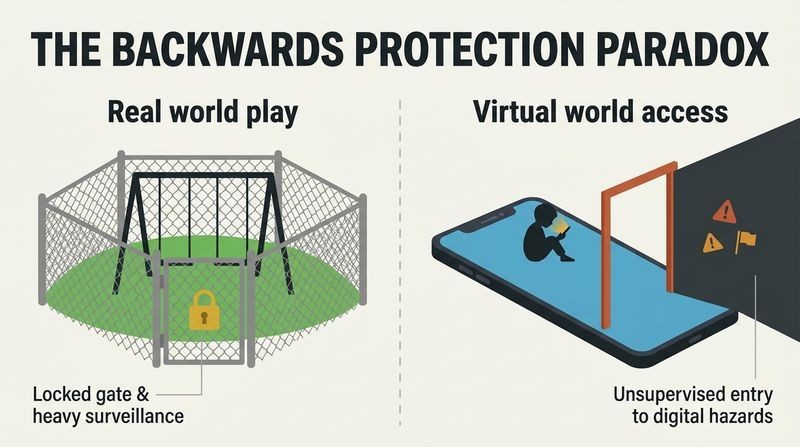
The central diagnosis. Haidt argues that two well-meaning mistakes collided to produce a mental health catastrophe. Beginning in the 1980s and 1990s, parents in the US, UK, and Canada grew terrified of kidnappers and traffic, so they yanked children indoors and eliminated unsupervised play. Then, in the early 2010s, they handed those same children smartphones with unfettered access to social media, pornography, and strangers, imposing almost no limits.
The result is backwards protection. Children lost the physical risks they need to grow strong, and gained the virtual risks they are least equipped to handle. A 14-year-old girl once wrote that she found Pornhub at age ten, in the next room from an attentive, nearly helicopter mother. We guard the playground and abandon the phone.
What makes this framing powerful is its symmetry: the same anxious impulse that childproofs the physical world neglects the digital one. This echoes Nassim Taleb's concept of antifragility, which Haidt borrows explicitly. It also resonates with Lenore Skenazy's Free-Range Kids movement. A fair challenge: causation is genuinely hard to prove, and critics like Candice Odgers argue the correlations are modest. But Haidt's move is clever: he does not rest the case on social media alone, but on a broader transformation of childhood that independently harms development. That breadth is both the argument's strength and its slipperiness, since a thesis explaining everything risks explaining nothing.
Teen depression and self-harm spiked suddenly around 2012, not gradually
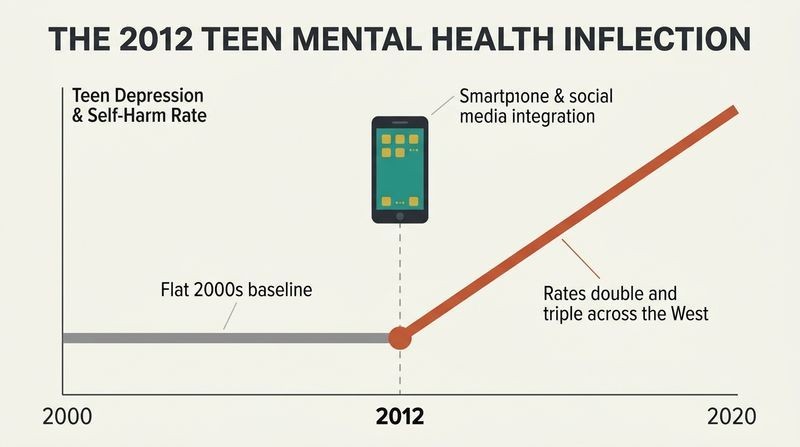
A hockey-stick, not a slope. Rates of major depression among US teens were flat through the 2000s, then bent sharply upward around 2012. Depression roughly doubled to two and a half times its prior level. By 2020, one in four American teen girls had experienced a major depressive episode. Emergency room visits for self-harm among girls aged 10 to 14 nearly tripled from 2010 to 2020.
It was not just American self-reports. The same abrupt turn appeared in Canada, Britain, Australia, and the five Nordic nations, and school loneliness rose across the West after 2012. Because this happened in many countries simultaneously, Haidt rules out US-specific causes like school shootings, the 2008 financial crisis, or political polarization. The synchronized timing points to one shared trigger: the smartphone and social media.
The synchronized international timing is the single most persuasive plank in Haidt's case, and it deserves emphasis because it defeats most rival explanations. If the cause were American politics or the Great Recession, why would Norwegian and New Zealand teens crash at the same moment? Skeptics counter that survey instruments and diagnostic awareness also changed around then, inflating self-reports. Haidt anticipates this by pairing self-reports with behavioral data like hospitalizations, which cannot be explained by increased willingness to disclose. A broken wrist is a broken wrist. That triangulation of subjective and objective measures is methodologically sound and separates his argument from a mere moral panic.
Free play is not a luxury; it is neurological nutrition
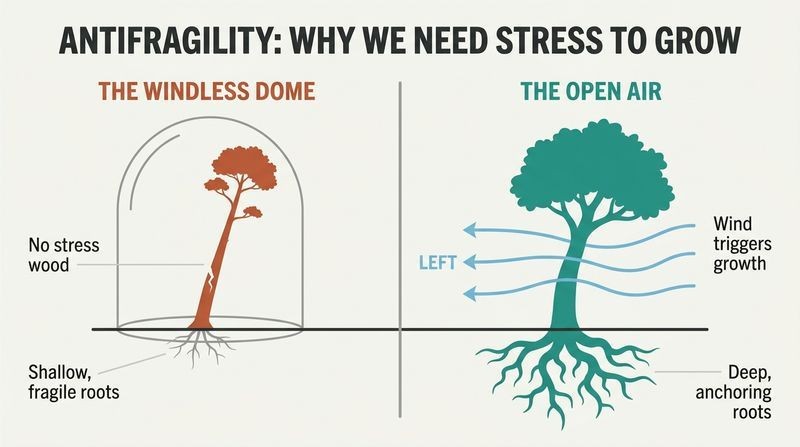
Children are antifragile. Like an immune system that needs germs or a tree that needs wind to grow strong roots, children need frustration, conflict, and minor injury to develop competence. Haidt cites Biosphere 2, where trees grew tall then collapsed because the windless dome never triggered the stress wood that anchors them. Overprotected kids are those windless trees.
Risky play has anti-phobic effects. Researchers Sandseter and Kennair found children seek out six thrills: heights, speed, dangerous tools, dangerous elements, rough-and-tumble, and getting lost. A child who climbs too high and feels fear, then masters it, inoculates himself against later anxiety. Haidt's own puppy, Wilma, sprinting toward and away from a German shepherd, was calibrating her own fear dosage, exactly what children do when adults stop hovering.
The antifragility frame usefully reframes safety as a developmental poison when overdone. It converges with exposure therapy, the gold-standard anxiety treatment, which works by graduated confrontation with feared stimuli rather than avoidance. By preventing small fears, hovering parents block the natural exposure therapy of childhood. Peter Gray's decades of play research and Jean Piaget's constructivism both support learning through self-directed trial and error. One nuance worth adding: not all children are equally antifragile, and kids in genuinely dangerous or chaotic environments may need more protection, not less. Antifragility assumes a baseline of security, the secure base from attachment theory, from which to venture out.
Social media hijacks the ancient learning tools of conformity and prestige
Kids are wired to copy. Evolution installed two learning shortcuts: conformist bias (do what most people do) and prestige bias (copy whoever is most admired). In a real community, gauging the majority takes weeks of observation. On a feed, a child scrolls a thousand data points an hour, each stamped with likes and comments, making platforms the most efficient conformity engines ever built.
Prestige got severed from excellence. Traditionally you admired the best hunter or storyteller in your village. Now algorithms lock adolescent attention onto influencers famous mainly for amassing followers. Facebook's early president Sean Parker admitted the like button was designed to exploit a vulnerability in human psychology. Kim Kardashian, Haidt notes, redefined fame itself, prestige with no underlying skill to learn from.
This is one of the book's most original contributions: applying gene-culture coevolution theory, drawn from Joe Henrich and Robert Boyd, to explain why social media is uniquely toxic to the young rather than merely distracting. The insight that platforms weaponize evolved social-learning instincts is more sophisticated than the usual addiction narrative. It connects to Rene Girard's mimetic desire, the idea that humans want what others want, now industrialized at planetary scale. A question Haidt leaves open: if prestige bias is so powerful, could it be redirected toward prosocial models rather than eliminated? The mechanism is neutral; the current incentive structure, not the instinct itself, is the villain.
Social media harms girls most through relentless visual comparison
The evidence is not weak, it is buried. Critics claimed digital media's link to harm was as trivial as eating potatoes. But when Haidt and Twenge isolated girls and social media specifically (rather than lumping all teens and all screen time), the correlation jumped to the range of binge drinking. Heavy-using girls are three times as likely to be depressed as non-users.
Four mechanisms hit girls harder.
1. Visual social comparison and perfectionism, amplified by beauty filters
2. Relational aggression, since girls attack reputations rather than bodies, now weaponized by anonymous accounts
3. Emotional contagion, since anxiety and disorders spread faster among girls sharing feelings
4. Sexual predation and harassment from adult men and pressure for nude photos
Experiments confirm causation: college students who quit social media for three weeks grew measurably less depressed.
The distinction between individual-level and group-level effects is a genuinely important methodological point that critics often miss. If one girl quits Instagram while her whole school stays on, she becomes isolated, masking the true harm. The real damage is cultural and only visible when whole communities are studied, as in the Facebook college-rollout research. This mirrors network externalities in economics: the cost of abstaining rises as adoption spreads. On social contagion of disorders, Haidt's citation of Christakis and Fowler's Framingham findings, that emotions spread through networks, is provocative but the sociogenic-illness claims about Tourette's and dissociative identity disorder are more speculative and deserve cautious reading.
Boys withdrew into virtual worlds while quietly failing in real ones
A slower, more diffuse collapse. Girls' decline compressed into 2010 to 2015 and pointed clearly at social media. Boys' story stretches back to the 1970s: falling engagement in school, work, and family as physical strength lost economic value. Boys now earn 41% of bachelor's degrees, down from parity in 1982.
Push and pull. The real world grew less hospitable to boys just as the virtual world offered frictionless substitutes for their agency drives: multiplayer video games, YouTube, and hardcore pornography, all free and pocket-sized. Roughly 7% of adolescent boys, about one in thirteen, show signs of gaming addiction or problematic use. Japan's hikikomori, young men who retreat into their bedrooms for years, are the extreme case, and versions now appear across the West. Porn separates sexual desire from the risky work of real relationships.
Haidt is careful and honest here, conceding that the boy story is more speculative and that video games, unlike porn, carry real cognitive and social benefits in moderation. This intellectual humility strengthens the book. Richard Reeves's work on structural male decline provides the economic backbone. The Durkheim connection, that anomie or normlessness breeds despair, elegantly unifies the boy and girl narratives: both sexes end up rootless. One tension: Haidt treats video games ambivalently while condemning porn sharply, yet both offer the same frictionless dopamine substitute for real-world striving. The asymmetry may reflect that gaming has social and skill dimensions porn lacks, but the line is blurrier than the book suggests.
The phone-based life quietly degrades everyone spiritually, not just teens
A cost even for the mentally healthy. Drawing on his study of moral emotions, Haidt maps a vertical dimension of experience from degradation to elevation. Witnessing moral beauty lifts us; pettiness and disgust pull us down. He argues the phone-based life systematically drags us downward, and identifies six ancient practices it blocks:
1. Shared sacredness (collective rituals that bond communities)
2. Embodiment (moving and eating together)
3. Stillness and silence (calming the jumping-monkey mind)
4. Self-transcendence (quieting the ego's default mode network)
5. Being slow to anger, quick to forgive
6. Finding awe in nature
Social media inverts all six. It is disembodied, fragmenting, ego-inflating, and trains instant public judgment, the opposite of what Buddhist, Stoic, and Abrahamic traditions counsel for flourishing.
This chapter is the book's most unexpected turn: an avowed atheist arguing that religious practices encode hard-won wisdom about human flourishing. It aligns with a growing empirical literature, David DeSteno's work on ritual, research showing synchronous movement builds trust, and studies of meditation reducing default-mode-network activity. Haidt's claim that platforms are engineered to maximize self-focus is compelling given that a social media profile is, by design, all about you. The weaker link is proving the phone causes spiritual harm to adults, since adult depression rates did not spike. Haidt concedes this, framing it as frazzlement rather than clinical illness, an honest boundary on the claim.
You are trapped by collective action, so escape together, not alone
Why no single parent can win. A collective action problem is a trap where each person doing what seems individually rational produces a bad outcome for all, like everyone overfishing a shared pond. When a few sixth-graders get Instagram, the rest feel excluded, so their parents cave, until every child has a phone and nobody wanted this outcome.
Coordination breaks the trap. Haidt highlights Wait Until 8th, where a parent's pledge to delay smartphones activates only once ten families in the same grade sign, guaranteeing no child is the lone holdout. The costs of doing the right thing plummet when neighbors act in unison. This is why he stresses linking up with other families rather than heroically going it alone, which merely condemns your child to isolation.
Framing the crisis as a collective action problem, rather than a failure of individual willpower or parenting, is both accurate and liberating. It removes the shame that paralyzes parents and reframes the solution as coordination, a tractable political and social problem. This draws on classic game theory (the prisoner's dilemma, the tragedy of the commons) and Elinor Ostrom's Nobel-winning work on how communities self-govern shared resources. The practical genius of the Wait Until 8th trigger mechanism, that pledges bind only above a threshold, mirrors assurance contracts used in crowdfunding. It solves the first-mover problem elegantly: nobody sacrifices unless enough others commit simultaneously.
Adopt four norms: no smartphone till 14, no social media till 16
The four foundational reforms. Haidt distills his prescription into four rules that cost almost nothing and work even without new legislation:
1. No smartphones before high school (give basic phones before roughly age 14)
2. No social media before 16, past the most vulnerable window of brain rewiring
3. Phone-free schools, with devices locked in pouches or lockers all day
4. Far more unsupervised play and real-world independence
Timing matters because of sensitive periods. A British study by Amy Orben found social media's harm peaks during puberty, ages 11 to 13 for girls and 14 to 15 for boys, when the brain's cultural-learning window is most open. The current age-13 minimum, set by a 1998 privacy law as a political compromise, was never based on child development. Its author admits it was too young.
The strength of these four norms is their independence from gridlocked legislatures: parents and schools can enact them tomorrow. Haidt predicts communities adopting all four would see improvement within two years, a falsifiable claim that invites testing. The age-13 origin story is a striking piece of policy archaeology, revealing how an arbitrary compromise in the Children's Online Privacy Protection Act became the de facto global standard for internet adulthood. A reasonable objection: enforcement is hard, and affluent, high-attention families will comply more easily than stressed single-parent households, potentially widening inequality. Haidt acknowledges the digital divide has flipped, poorer kids now get less protection from screens, not less access.
Phone-free schools reclaim attention that class-time-only bans never do
Bans that only cover class fail. 77% of US schools claim to ban phones, but usually only during instruction, so students hide them in laps and pounce the instant class ends, ignoring the peers beside them. The fix is going phone-free for the entire day via lockers or locked pouches, as Mountain Middle School in Colorado did in 2012, rising to the state's top performance rating.
The average teen gets 192 notifications a day. That is roughly one interruption every five minutes of waking life, a real-life version of Vonnegut's dystopia where earpieces disrupt thought. Even a phone sitting face-down and silent on a desk measurably drains cognitive capacity, a finding researchers named brain drain. Since 2012, test scores fell most for lower-income students who have the least supervised screen time.
The brain-drain research, that mere phone presence degrades working memory even when unused, is one of the most actionable findings in the book, extending beyond teenagers to any knowledge worker. It suggests the productivity cost of phones is not just time lost to checking but a constant background tax on attention. The educational-inequality angle deserves emphasis: Haidt inverts the old digital-divide worry. The concern is no longer that poor kids lack devices but that they lack protection from them. This reframing has justice implications that cut across partisan lines and helps explain why phone-free-school policies have attracted rare bipartisan support in fractured legislatures.
Parent like a gardener, not a carpenter
Two mindsets. Borrowing from psychologist Alison Gopnik, Haidt contrasts the carpenter, who measures and shapes a child into a predetermined product, with the gardener, who creates protected space where many outcomes can flourish. Modern anxious parenting is carpentry: enrichment classes, constant supervision, tracking apps.
Concrete gardening moves by age. Assign the Let Grow Project, homework telling kids to do one new thing alone (walk the dog, run an errand). Practice letting children out of sight without a way to reach you. Encourage walking to school, sleepovers, camping, and phone-free sleepaway camps. Haidt describes letting his own son, at 13, navigate the New York subway alone to a night tennis match; when a train was cancelled, the boy hailed a cab and came home transformed, more confident, and treated with more trust thereafter.
The gardener-carpenter metaphor is memorable precisely because it reframes control as a failure of trust rather than an expression of love. Gopnik's developmental research supports it: children explore more and learn faster under autonomy-supportive parenting. Self-determination theory (Deci and Ryan) independently confirms that autonomy, competence, and relatedness drive intrinsic motivation and well-being. Haidt's personal subway anecdote illustrates a subtle mechanism: independence is not just a gift to the child but a recalibration of the parent's perception, which then feeds back into more trust. One caution he raises himself: tracking apps, the umbilical cord that never cuts, may quietly undermine the very autonomy he prescribes, a tension he admits he has not resolved.
Speak up; when nobody acts, everyone assumes there's no emergency
The smoke-filled room. Haidt closes with a 1968 experiment by Latane and Darley. When students sat alone in a room filling with smoke, 75% reported it. When seated with two passive strangers, only 10% acted, each reading the others' calm as evidence there was no danger. This is pluralistic ignorance: ambiguity plus silence produces collective paralysis.
The digital smoke is pouring in. Most parents suspect something is wrong but see no one else acting, so they conclude it must be fine. The remedy is to speak up and link up: tell friends, neighbors, and representatives you want a play-based childhood back, and join with other families so no child is the lone holdout. Haidt is betting that private doubt is nearly universal and only needs a voice.
Ending on the bystander-effect research is rhetorically shrewd: it converts private anxiety into a call for public voice and diagnoses precisely why a widely shared concern has produced so little collective response. Pluralistic ignorance, the gap between private belief and perceived public opinion, is well documented in social psychology and explains everything from unpopular norms persisting to authoritarian regimes collapsing suddenly when people realize their neighbors agree. The optimistic implication is that norm change can be nonlinear: once a few people speak, the cascade can be swift. The risk is that Haidt may overestimate consensus; some parents genuinely value early digital fluency, and the debate is less settled than the smoke metaphor implies.
Analysis
The Anxious Generation is a thesis-driven work of social psychology aimed at parents, educators, and policymakers, and its greatest strength is epidemiological: the synchronized international onset of teen mental illness around 2012 is a fact that demands explanation, and Haidt's candidate, the Great Rewiring from play-based to phone-based childhood, fits the timing better than rivals. The book's structure is disciplined, moving from evidence of harm, to developmental theory (why childhood needs play, attunement, and sensitive-period learning), to mechanisms of harm by gender, to spiritual costs, to a policy program.
The central scientific controversy is causation versus correlation. Researchers like Candice Odgers and Amy Orben have argued the effect sizes are small and the data correlational. Haidt's rebuttals are among the book's most valuable methodological contributions: isolating girls-plus-social-media rather than averaging all teens and all screens; distinguishing individual-level from group-level effects (the true harm is the collapse of a shared real-world social fabric, invisible in studies of lone abstainers); and marshalling quasi-experiments like the Facebook college rollout and natural experiments in broadband arrival. This is more rigorous than critics often grant.
The book's vulnerabilities are worth naming. A thesis that explains falling grades, rising anxiety, loneliness, political polarization, and spiritual malaise risks overreach. The boy narrative, as Haidt concedes, is speculative and cannot pin blame on a single technology. The sociogenic-illness sections stretch the evidence. And the phone's role in adult decline is asserted more than demonstrated.
Yet the practical program is robust precisely because it does not require winning every scientific argument. The four norms, delay smartphones, delay social media, phone-free schools, and restored independence, are low-cost, reversible, and beneficial even if Haidt has the causal weighting partly wrong. Framed as collective action problems solvable through coordination rather than individual willpower, they transform a paralyzing cultural drift into a tractable civic project. That reframing may prove the book's most durable legacy.
Review Summary
The Anxious Generation receives mostly positive reviews, with readers praising its research on the impact of smartphones and social media on youth mental health. Many find it eye-opening and essential for parents and educators. Haidt's proposed solutions, including delaying smartphone access and increasing free play, resonate with readers. Some criticize the book's gendered approach and potential oversimplification of complex issues. Despite these concerns, most reviewers consider it an important contribution to understanding modern childhood challenges.
People Also Read









FAQ
What's The Anxious Generation about?
- Focus on Gen Z: The book examines the impact of transitioning from a play-based to a phone-based childhood on Gen Z, those born after 1995.
- Technological Influence: It highlights how smartphones and social media contribute to anxiety, depression, and other mental health issues among adolescents.
- Call to Action: Jonathan Haidt urges parents, schools, and tech companies to take collective action to mitigate the negative effects of this "Great Rewiring" of childhood.
Why should I read The Anxious Generation?
- Understanding Modern Childhood: The book provides insights into the unique challenges faced by today's youth, crucial for parents, educators, and policymakers.
- Research-Based Evidence: Haidt supports his arguments with extensive research, making it a credible source for those interested in child development and psychology.
- Practical Solutions: It offers actionable advice for creating healthier environments for children and adolescents.
What are the key takeaways of The Anxious Generation?
- Impact of Technology: The rise of smartphones and social media has led to increased rates of anxiety and depression among adolescents.
- Need for Free Play: Haidt emphasizes the importance of unsupervised, risky play for developing social skills and resilience.
- Collective Responsibility: The author calls for a collective effort to address these issues, suggesting reforms to restore a healthier childhood experience.
What is the "Great Rewiring" mentioned in The Anxious Generation?
- Concept of Great Rewiring: It refers to the significant changes in childhood experiences due to the rise of smartphones and social media between 2010 and 2015.
- Impact on Development: This rewiring has altered how children develop socially and emotionally, leading to increased anxiety and depression.
- Historical Context: The roots of this change trace back to the late 1980s and 1990s, with shifts in parenting styles towards overprotection.
How does The Anxious Generation define a "phone-based childhood"?
- Definition of Phone-Based Childhood: Children spend most of their time engaged with internet-connected devices, leading to a decline in physical play and real-world interactions.
- Comparison to Play-Based Childhood: This contrasts with a play-based childhood, which emphasizes outdoor play and social interaction.
- Consequences: The shift has profound implications for mental health, as children miss out on critical developmental experiences.
What are the foundational harms discussed in The Anxious Generation?
- Social Deprivation: Less face-to-face interaction among peers, crucial for social development, is a significant harm.
- Sleep Deprivation: Smartphone use, especially at night, disrupts sleep patterns, affecting mental health and cognitive function.
- Attention Fragmentation: Constant notifications hinder adolescents' ability to focus, impacting academic performance and emotional well-being.
- Addiction: Social media and gaming can create addictive behaviors, drawing children away from real-life experiences.
How does The Anxious Generation address the issue of overprotective parenting?
- Shift in Parenting Styles: Parenting became more fearful in the late 20th century, leading to a decline in children's autonomy and opportunities for free play.
- Consequences of Overprotection: Overprotective parenting deprives children of experiences needed to develop resilience and social skills, increasing anxiety.
- Call for Balance: Haidt advocates for a balanced approach that allows children to explore and take risks in safe environments.
What specific methods does The Anxious Generation recommend for parents?
- Delay Smartphone Use: Parents should delay giving smartphones to children until high school to reduce exposure to harmful online content.
- Encourage Free Play: Facilitate more opportunities for children to play freely and independently, essential for development.
- Implement Digital Sabbaths: Set aside specific times for families to disconnect from screens, fostering deeper connections.
How does The Anxious Generation suggest schools can improve student well-being?
- Implement Phone-Free Policies: Schools should ban phones during the school day to reduce distractions and promote social interaction.
- Increase Opportunities for Free Play: Longer recess periods and play clubs can enhance social skills and emotional well-being.
- Encourage Outdoor Activities: Incorporate more outdoor and nature-based activities into curricula to improve mental health.
How does The Anxious Generation explain the differences in social media's impact on girls versus boys?
- Greater Vulnerability for Girls: Girls are more affected by social media due to higher engagement with visually oriented platforms like Instagram.
- Different Usage Patterns: Boys gravitate towards gaming, while girls experience more negative mental health outcomes from social media.
- Cultural Pressures: Societal expectations around beauty and social validation disproportionately impact girls, leading to higher anxiety and depression.
What role do parents play in addressing the issues raised in The Anxious Generation?
- Model Healthy Behavior: Parents should model healthy technology use for their children, setting a positive example.
- Create a Supportive Environment: Foster an environment that prioritizes real-world interactions and play to build resilience and social skills.
- Engage in Open Conversations: Discuss the risks of social media and technology with children to help them navigate the digital landscape safely.
What are the best quotes from The Anxious Generation and what do they mean?
- "Let children grow up on Earth first, before sending them to Mars.": Emphasizes the need for real-world experiences before digital immersion.
- "Children are antifragile.": Highlights that children grow stronger through challenges, underscoring the need for risk-taking opportunities.
- "The Great Rewiring is not just about changes in technology.": Underscores that societal changes, including parenting styles, have significantly impacted childhood development.
About the Author



Download PDF
Download EPUB
.epub digital book format is ideal for reading ebooks on phones, tablets, and e-readers.








































