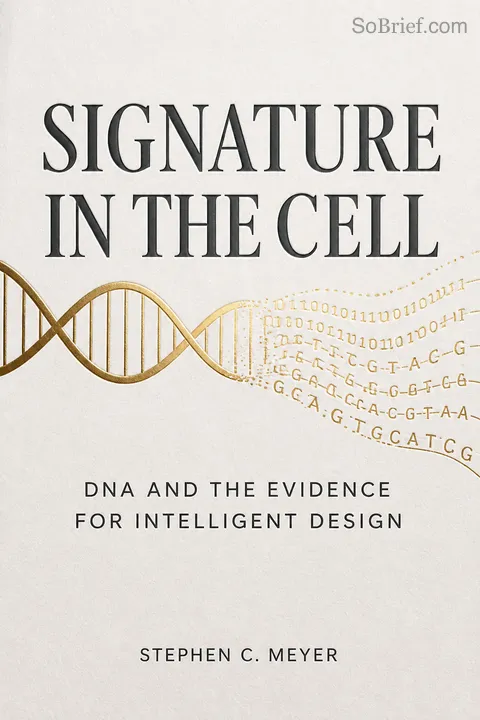
Key Takeaways
1. DNA's Digital Code Reveals Functionally Specified Information
DNA is like a computer program but far, far more advanced than any software ever created.
Information's essence. The discovery of DNA's structure by Watson and Crick in 1953 unveiled a profound mystery: DNA stores information using a four-character chemical alphabet, much like a computer code. This isn't just any information; it's "specified complexity" or "functional information," meaning the precise arrangement of chemical bases conveys instructions for building proteins, essential for life. Unlike random sequences, these arrangements are highly improbable yet perform a specific, vital function.
Beyond mere complexity. While Shannon's information theory can quantify the amount of information (or improbability) in a sequence, it cannot distinguish meaningful, functional sequences from random gibberish. DNA, however, possesses functional specificity—its sequences are arranged in a particular way to produce a specific biological effect. This is akin to the difference between a random string of letters and a meaningful sentence, or a random phone number and one that connects to a specific person.
A unique signature. This functionally specified information is a hallmark of living systems. As origin-of-life biochemist Leslie Orgel observed, "Living organisms are distinguished by their specified complexity. Crystals…fail to qualify as living because they lack complexity; mixtures of random polymers fail to qualify because they lack specificity." This unique property of DNA, its digital code carrying precise instructions, demands an explanation beyond simple physical or chemical laws.
2. Life's Origin Faces an Integrated Complexity Dilemma
The code is meaningless unless translated. The modern cell’s translating machinery consists of at least fifty macromolecular components which are themselves coded in DNA: the code cannot be translated otherwise than by products of translation.
The "chicken-and-egg" problem. The cell's information-processing system, which translates DNA's digital code into proteins, is a marvel of integrated complexity. DNA stores the instructions for proteins, but proteins are required to read, copy, and translate that DNA. This creates a fundamental "chicken-and-egg" dilemma: which came first, the DNA (the information) or the proteins (the machinery to process it)?
Interdependent systems. The process of gene expression involves intricate steps like transcription (DNA to mRNA) and translation (mRNA to protein), each requiring dozens of specialized proteins and RNA molecules. For example:
- RNA polymerase (a protein complex) transcribes DNA.
- Ribosomes (protein-RNA complexes) translate mRNA.
- tRNA synthetases (enzymes) attach specific amino acids to tRNA.
All these components are themselves built from information encoded in DNA, processed by this very system.
A closed loop. This functional interdependence extends beyond just DNA and proteins. The cell needs ATP for energy, but ATP production (via glycolysis) requires a ten-enzyme pathway, and these enzymes are proteins, which require DNA. This creates a "closed loop" where the end result of protein synthesis is required before it can even begin, posing a formidable challenge for any theory attempting to explain life's origin from undirected processes.
3. Chance Alone Cannot Explain Biological Information
The probability of producing the proteins necessary to build a minimally complex cell—or the genetic information necessary to produce those proteins—by chance is unimaginably small.
Astronomical odds. The sheer improbability of functional proteins or DNA arising by chance is a major hurdle for origin-of-life theories. To form a functional protein, amino acids must link via specific peptide bonds, be exclusively left-handed (L-form), and arrange in a functionally specified sequence. For a modest 150-amino-acid protein, the probability of these three conditions being met by chance is roughly 1 in 10^164.
Limited probabilistic resources. Even considering the vastness of the universe and the time since the Big Bang, the "probabilistic resources" (total number of possible events) are insufficient to make such an event likely. The maximum number of events in the observable universe is estimated at 10^139. This means the odds of a single functional protein arising by chance are trillions of trillions of times smaller than the universe's total probabilistic capacity.
Beyond a single protein. A minimally complex cell requires hundreds of such proteins, plus DNA, RNA, and other components. The probability of all these arising by chance is even more staggering, estimated at 1 in 10^41,000. This makes the chance hypothesis not just improbable, but "vanishingly small," leading many scientists to conclude that chance alone is an inadequate explanation.
4. Self-Organization Fails to Generate Information, Only Order
Whatever may be the origin of a DNA configuration, it can function as a code only if its order is not due to the forces of potential energy. It must be as physically indeterminate as the sequence of words is on a printed page.
Order vs. information. Self-organizational theories propose that physical or chemical laws could spontaneously generate the order in living systems, much like a vortex forms in draining water. However, this confuses order (repetitive, symmetrical patterns) with information (complex, aperiodic, specified sequences). Laws produce predictable, redundant patterns, but information requires contingency and unpredictability in its arrangement.
No chemical determinism. Michael Polanyi argued that DNA's capacity to convey information requires freedom from chemical determinism. If chemical bonding properties dictated the sequence of bases, DNA would be a repetitive crystal, incapable of storing complex instructions. Indeed, there are no chemical bonds between the information-bearing bases along the longitudinal axis of DNA, nor differential affinities between bases and the backbone that would favor one sequence over another.
The "magnetic letters" analogy. Imagine magnetic letters on a refrigerator. Magnetic forces explain why letters stick, but not which letters stick where to form a message. Similarly, chemical forces explain why DNA bases attach to the backbone, but not their specific, information-rich sequence. Self-organizational forces, by their very nature, produce redundancy, which diminishes information-carrying capacity, making them incapable of generating specified complexity.
5. Combined Chance and Necessity Models Displace the Information Problem
The information produced by an evolutionary simulation does not arise for “free,” that is, without an input from the programmer.
Begging the question. Theories combining chance and necessity, like early models of prebiotic natural selection or the RNA world, often attempt to explain the origin of biological information by invoking processes that presuppose the very information they are trying to explain. Prebiotic natural selection, for instance, requires self-replicating molecules to operate, but self-replication itself depends on complex, information-rich molecules. This creates a circular argument, pushing the "pink ring" of the problem elsewhere.
The "displacement problem." Even sophisticated computer simulations, such as genetic algorithms (e.g., Dawkins's "Weasel" program, Ev, Avida), fail to generate significant new specified information "from scratch." These programs succeed only because human programmers embed "active information" into them:
- Target sequences: Guiding the search towards a predefined functional outcome.
- Fitness functions: Selecting sequences based on their proximity to a desired, future function.
- Preexisting instructions: Providing complex digital "organisms" with the capacity to self-replicate and evolve.
These inputs from intelligent designers are precisely what allow the simulations to appear successful, effectively displacing the information problem from the simulated environment to the programmer.
Conservation of information. This phenomenon led to the "no free lunch" theorems and the "conservation of information" principle in computer science, stating that information outputs generally do not exceed informational inputs (beyond a small, quantifiable amount from chance). This principle, observed in both computational and prebiotic experiments, suggests that specified information does not arise spontaneously from undirected material processes, but rather requires an intelligent source.
6. Intelligent Design is the Only Known Cause of Specified Information
Experience shows that large amounts of specified complexity or information (especially codes and languages) invariably originate from an intelligent source—from a mind or a personal agent.
Causal adequacy. The argument for intelligent design is not an argument from ignorance, but an "inference to the best explanation" based on positive evidence. We know from uniform and repeated experience that intelligent agents—conscious, rational beings—are capable of producing large amounts of specified information. Programmers write code, authors write books, and engineers design complex systems. This makes intelligence a "causally adequate" explanation for the specified information in DNA.
Uniquely adequate cause. A thorough examination of alternative explanations (chance, necessity, and their combination) reveals their universal inadequacy in generating specified biological information. Since intelligence is the only known cause that has demonstrated the power to produce such information, its presence in DNA points decisively to a designing intelligence. This reasoning is akin to:
- Archaeologists inferring scribes from ancient inscriptions.
- Forensic scientists inferring a bomb from specific destruction patterns.
- SETI scientists looking for intelligent signals from space.
In each case, the effect (specified information/complexity) reliably indicates an intelligent cause, even if the cause itself is not directly observed.
Integrated systems point to design. The cell's information-processing system, with its digital storage, machinery for processing, and hierarchical regulatory information, mirrors the design patterns found in human-engineered systems like computer hardware and software. This functional integration and interdependence of parts is a hallmark of intelligent design, further strengthening the inference that intelligence is the best explanation for life's intricate informational architecture.
7. Intelligent Design is a Scientifically Testable Explanation
The theory of intelligent design, like other theories about the causes of past events, is testable, and has been tested, in just this way.
Beyond definitions. The claim that intelligent design is "not science" often stems from narrow, often inconsistent, definitions of science. However, intelligent design is based on empirical evidence and employs established scientific methods, particularly those of the historical sciences. It seeks to answer questions about past causes from present effects, much like geology or archaeology.
Testability through comparison. Intelligent design is testable by comparing its explanatory power against competing theories. It posits that specified information in DNA is best explained by an intelligent cause, implying that materialistic mechanisms will fail to demonstrate this capacity. This is a testable claim. For example, if a natural process were discovered that could generate large amounts of specified information, the ID hypothesis would be challenged.
Predictive power. Intelligent design also generates discriminating predictions. For instance, it predicted that "junk DNA" (non-protein-coding regions) would be found to have function, contrary to neo-Darwinian expectations. Recent discoveries confirming widespread function in these regions support the ID prediction. Other predictions include:
- Limits to the information-generating capacity of undirected processes.
- Algorithmic logic in cellular regulatory systems.
- Hierarchical organization of biological information.
These predictions demonstrate that ID is a "living science" that guides empirical inquiry.
8. The "Who Designed the Designer?" Objection is Flawed
The whole problem we started out with was the problem of explaining statistical improbability. It is obviously no solution to postulate something even more improbable.
Infinite regress fallacy. Critics like Richard Dawkins argue that if complexity implies a designer, then the designer must also be complex, requiring another designer, leading to an infinite regress. This objection is flawed because it demands a comprehensive explanation for the cause of the cause to validate the initial explanation. However, explaining a specific event (like the origin of DNA's information) does not require explaining the ultimate origin of its cause.
Ultimate explanatory principles. Every worldview, including materialism, must posit some ultimate, uncaused reality from which everything else derives. For materialists, matter and energy are the ultimate, self-existent realities. For theists, it is God (an uncaused mind). Dawkins's objection implicitly assumes that only material processes can be ultimate explanations, begging the fundamental question of whether mind or matter is primary.
Mind as a fundamental cause. Our direct experience shows that minds can initiate new causal chains and produce specified information without themselves being "designed" in the same way as material artifacts. An uncaused, self-existent mind is a logically coherent ultimate cause for biological information. To reject this possibility while accepting an uncaused material universe is inconsistent. The ability to ask "why" about a cause does not invalidate the initial causal explanation.
9. Intelligent Design Offers a Robust Framework for New Discoveries
Intelligent design has deep roots in the history of cosmology, and in the earth and life sciences.
Explaining anomalies. Intelligent design provides a powerful interpretive framework for understanding new scientific discoveries, especially those that challenge conventional materialistic explanations. Recent findings in genomics, such as the dense concentration of functional information, hierarchical organization, and nested coding within DNA, are precisely what one would expect from an intelligently designed system, but are puzzling from a purely undirected evolutionary perspective.
Guiding research. Far from being a "science stopper," intelligent design generates numerous fruitful research questions and lines of inquiry. It encourages scientists to look for:
- Sophisticated design patterns and engineering logic in biological systems.
- Limits to the creative power of mutation and selection.
- Evidence of hierarchical information structures beyond DNA.
- Functional explanations for supposedly "junk" or "poorly designed" biological features.
This perspective actively directs investigation towards understanding the intricate functional logic and information architecture of life.
A living science. The theory of intelligent design is a dynamic, "living science" that offers a compelling explanation for the origin of biological information and provides a robust framework for future scientific exploration. It challenges the prevailing materialistic paradigm by suggesting that the "signature in the cell" points to a conscious, rational agent, re-opening profound questions about purpose and meaning in the universe. This intellectual shift can invigorate scientific inquiry by allowing consideration of all plausible causal explanations.
Review Summary
Reviews of Signature in the Cell are deeply divided. Supporters praise Meyer's thorough, well-organized argument for Intelligent Design, his accessible explanation of DNA's complexity, and his case that information in cells requires an intelligent cause. Critics argue the book is pseudoscientific, relies on "god of the gaps" reasoning, misrepresents opposing research, and fails to meet standards of falsifiability. Both sides acknowledge Meyer's engaging prose and comprehensive scope. Several reviewers note the book's length as challenging, while others see its depth as a strength.
People Also Read





Signature in the Cell Series Series
About the Author
Other books by Stephen C. Meyer
Download PDF
Download EPUB
.epub digital book format is ideal for reading ebooks on phones, tablets, and e-readers.








































