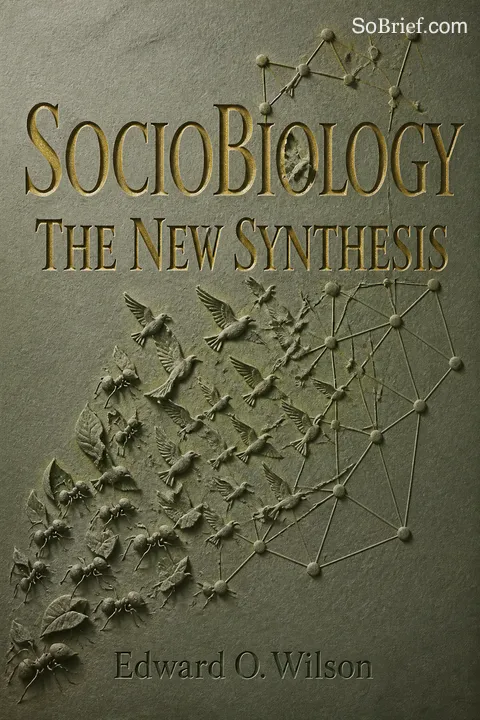
Key Takeaways
1. Sociobiology: Bridging Biology and Social Behavior
Sociobiology is defined as the systematic study of the biological basis of all social behavior.
Unifying Science. Sociobiology seeks to integrate the social sciences and humanities with the natural sciences, particularly evolutionary biology and population genetics. It posits that social behaviors, like physical traits, are products of natural selection and can be understood through the principles of evolutionary theory.
From Insects to Humans. The goal is to develop a unified framework for understanding social behavior across all species, from termites to chimpanzees to humans. This involves identifying common principles and quantitative theories that can explain the organization and dynamics of diverse societies.
Beyond Description. Sociobiology aims to move beyond mere empirical description of social phenomena to provide causal explanations rooted in evolutionary biology. It seeks to understand how social behaviors contribute to the survival and reproduction of individuals and groups.
2. Emergent Properties and the Holism of Societies
Genes, like Leibnitz’s monads, have no windows; the higher properties of life are emergent.
Beyond Reductionism. While reductionism is a valuable tool, it's insufficient for understanding complex systems like societies. Societies exhibit emergent properties that cannot be predicted solely from the characteristics of individual organisms.
Holistic Approach. Sociobiology embraces a holistic approach, recognizing that the whole is more than the sum of its parts. This involves studying the interactions and relationships among individuals within a society, as well as the demographic and genetic structure of the population.
Quantitative Models. The new holism utilizes mathematical models to analyze emergent properties, moving beyond philosophical retrospection to test the validity of assumptions and extend understanding. This allows for a more rigorous and predictive approach to studying social behavior.
3. The Multiplier Effect: Small Changes, Big Social Impacts
A small evolutionary change in the behavior pattern of individuals can be amplified into a major social effect by the expanding upward distribution of the effect into multiple facets of social life.
Behavior as a Lever. Behavior is often the most labile part of an organism's phenotype, meaning it can change more readily in response to environmental pressures. This makes behavior an "evolutionary pacemaker," driving subsequent changes in morphology and physiology.
Social Amplification. Small changes in individual behavior can be amplified into significant social effects through various mechanisms, such as socialization and dynamic programming. This means that seemingly minor genetic or environmental influences can have profound consequences for social organization.
Examples of the Multiplier Effect:
- The hamadryas baboon's proprietary attitude toward females leads to vastly different social structures compared to the olive baboon.
- Termite nest architecture, though diverse, may stem from relatively small variations in individual building behavior.
- Socialization in primates amplifies differences in temperament and rank, shaping the overall social structure of the troop.
4. Adaptive Demography: Societies Shaped by Population Structure
All true societies are differentiated populations.
Demography Matters. The age and size distribution of a population significantly influences its social behavior and fitness. The proportions of breeding females, helpless infants, and experienced soldiers all contribute to the overall dynamics of a society.
Beyond Individual Selection. While individual selection shapes the traits of organisms, group selection can act directly on demographic distributions, optimizing the proportions of different classes to enhance group survival and reproduction.
Adaptive vs. Non-Adaptive Demography:
- Non-adaptive demography: Age distribution is a secondary effect of individual-level selection.
- Adaptive demography: Age distribution is directly tested by natural selection and contributes to group fitness.
Adaptive demography requires a holistic analysis to understand how the behavior and life cycles of individuals contribute to the overall organization and success of the society.
5. Sociality's Many Dimensions: A Multifaceted View
A society … is an aggregation of socially intercommunicating, conspecific individuals that is bounded by frontiers of far less frequent communication.
Beyond Simple Definitions. Sociality is a complex phenomenon that cannot be captured by a single definition or classification. Instead, it is best understood by considering multiple dimensions or qualities.
Ten Key Qualities of Sociality:
- Group size
- Demographic distributions
- Cohesiveness
- Amount and pattern of connectedness
- Permeability
- Compartmentalization
- Differentiation of roles
- Integration of behavior
- Information flow
- Fraction of time devoted to social behavior
These qualities can be measured and incorporated into models of particular social systems, providing a more nuanced and comprehensive understanding of social organization.
6. Behavioral Scaling: Adapting to Changing Conditions
Behavioral scaling is variation in the magnitude or in the qualitative state of a behavior which is correlated with stages of the life cycle, population density, or certain parameters of the environment.
Flexibility is Key. Social organization is not a fixed trait but rather a dynamic response to changing environmental conditions. This flexibility, known as behavioral scaling, allows societies to adapt to varying circumstances.
Density-Dependent Responses. Population density is a major driver of behavioral scaling. As density increases, societies may shift from territoriality to dominance hierarchies, or exhibit other changes in aggressive behavior.
Environmental Influences. Other environmental factors, such as food availability, habitat structure, and group size, can also evoke strong variation in social behavior. This highlights the importance of understanding the ecological context in which social behavior evolves.
7. Evolutionary Dualities: Navigating Ambiguity in Sociobiology
Genes, like Leibnitz’s monads, have no windows; the higher properties of life are emergent.
Adaptive vs. Nonadaptive Traits. A trait's adaptiveness depends on the environment. What's beneficial in one context can be detrimental in another.
Monadaptive vs. Polyadaptive Traits. While ideally, each behavior would have a single function, our understanding often leads to behaviors being construed as serving multiple purposes.
Ultimate vs. Proximate Causation. Evolutionary biology focuses on ultimate causes (environmental pressures), while functional biology examines proximate causes (physiological mechanisms). Both perspectives are necessary for a complete understanding.
8. Phylogenetic Inertia: The Constraints of Evolutionary History
High inertia implies resistance to evolutionary change, and low inertia a relatively high degree of lability.
Evolutionary Momentum. A species' evolutionary history and genetic makeup can constrain its ability to adapt to new environments. This "phylogenetic inertia" can limit the range of possible social organizations.
Examples of Inertia:
- The prevalence of eusociality in Hymenoptera due to haplodiploidy.
- The tendency of some invertebrates to form aggregations by asexual budding.
- The lack of certain preadaptations in some species, preventing them from evolving particular social behaviors.
Understanding phylogenetic inertia is crucial for explaining why certain social traits are more common in some groups of organisms than others.
9. Ecological Pressure: The Environment's Guiding Hand
Environmental pressure is simply the set of all the environmental influences, both physical conditions such as temperature and humidity and the living part of the environment, including prey, predators, and competitors, that constitute the agents of natural selection and set the direction in which a species evolves.
Environmental Forces. The environment exerts a powerful influence on social evolution, shaping the behavior and organization of societies. These ecological pressures include physical conditions, prey availability, predator threats, and competition with other species.
Adaptive Responses. Species respond to environmental challenges by evolving social behaviors that enhance their survival and reproduction. These adaptations can include group defense, cooperative hunting, and efficient resource utilization.
Examples of Ecological Pressure:
- Defense against predators: Bird flocks, musk oxen formations, and alarm calls.
- Increased competitive ability: Aggression, territoriality, and resource control.
- Increased feeding efficiency: Cooperative foraging and specialized hunting techniques.
10. The Morality of the Gene: Altruism and Kin Selection
In a Darwinist sense the organism does not live for itself…it reproduces genes, and it serves as their temporary carrier.
The Gene's Perspective. From a gene's-eye view, the goal is to replicate itself, even if it means sacrificing the individual organism. This perspective helps explain the evolution of altruism, which seems paradoxical from an individual-centric viewpoint.
Kin Selection. Altruism can evolve if the genes causing it are shared by two organisms due to common descent. If an altruistic act increases the joint contribution of these genes to the next generation, the propensity for altruism will spread, even if the altruist makes less of a solitary contribution.
The Central Problem. The central theoretical problem of sociobiology is how can altruism, which by definition reduces personal fitness, possibly evolve by natural selection? The answer is kinship.
11. Communication: The Foundation of Social Coordination
Sociobiology is fundamentally the study of the means of communication.
The Essence of Society. Communication is the glue that holds societies together, enabling cooperation, coordination, and social organization. It is the action on the part of one organism that alters the probability pattern of behavior in another organism in an adaptive fashion.
Beyond Language. Communication encompasses a wide range of signals, from simple chemical cues to complex vocalizations and visual displays. The effectiveness of a communication system can be measured by the number of signals, the amount of information per signal, and the rate of information flow.
The Importance of Information Flow. The magnitude of a communication system can be measured in three ways: the total number of signals, the amount of information in bits per signal, and the rate of information flow in bits per second per individual and in bits per second for the entire society.
12. The Future of Sociobiology: Consilience and Self-Understanding
To grasp human nature objectively, to explore it to the depths scientifically, and to comprehend its ramifications by cause-and-effect explanations leading from biology into culture, would be to approach if not attain the grail of scholarship, and to fulfill the dreams of the Enlightenment.
The Promise of Consilience. Sociobiology offers the prospect of uniting the natural sciences, social sciences, and humanities through a shared understanding of human nature. This conjunction is important because it offers the prospect of characterizing human nature with greater objectivity and precision, an exactitude that is the key to self-understanding.
Epigenetic Rules. Human nature is not simply determined by genes or culture, but rather by the interaction of both. Epigenetic rules, the inherited regularities of mental development, bias mental development but cannot abolish culture.
The Path Forward. By embracing interdisciplinary approaches and integrating insights from cognitive neuroscience, human genetics, and evolutionary biology, we can gain a deeper understanding of ourselves and our place in the natural world.
Review Summary
Sociobiology: The New Synthesis receives mostly positive reviews for its groundbreaking approach to studying animal and human behavior through an evolutionary lens. Readers praise Wilson's comprehensive analysis and encyclopedic knowledge, though some find it dense and dated. The book's application of sociobiological principles to humans sparked controversy, with critics arguing against genetic determinism. Despite criticisms, many acknowledge its significance in founding the field of sociobiology and influencing subsequent research in evolutionary psychology.
People Also Read










FAQ
What is Sociobiology: The New Synthesis by Edward O. Wilson about?
- Comprehensive study of social behavior: The book systematically explores the biological basis of social behavior across a wide range of species, from insects to humans, integrating genetics, ecology, ethology, and evolutionary biology.
- Introduction of sociobiology as a discipline: Wilson defines sociobiology as the systematic study of the biological basis of all social behavior, arguing that social traits are shaped by evolutionary forces just like physical traits.
- Focus on social insects and vertebrates: A significant portion details the social structures of ants, bees, wasps, termites, and vertebrates, drawing parallels and contrasts to human societies.
- Unification of disciplines: The work bridges biology, anthropology, and sociology, aiming to present a unified theory of social evolution and organization.
Why should I read Sociobiology: The New Synthesis by Edward O. Wilson?
- Foundational text in sociobiology: The book is considered a seminal work that established sociobiology as a scientific field, offering a thorough theoretical framework and extensive empirical data.
- Interdisciplinary insights: Wilson integrates concepts from genetics, ecology, ethology, and anthropology, making it valuable for readers interested in both biological and social sciences.
- Understanding human nature: The book extends its analysis to human societies, providing a biological perspective on human social structures, altruism, dominance, and cultural evolution.
- Guidance for future societies: Wilson discusses the implications of sociobiology for planning and understanding future human societies, emphasizing the importance of genetic and cultural evolution.
What are the key takeaways from Sociobiology: The New Synthesis by Edward O. Wilson?
- Biological roots of social behavior: Social behaviors, including altruism, dominance, and communication, have deep evolutionary and genetic foundations across species.
- Kin selection and inclusive fitness: Altruism is explained through kin selection theory, where genes promoting self-sacrifice can spread if they benefit related individuals.
- Complexity of social organization: The book details how division of labor, castes, and communication systems evolve to enhance group efficiency and survival.
- Human sociality as both biological and cultural: Wilson argues that human social behavior is shaped by both genetic predispositions and cultural learning, resulting in high behavioral plasticity.
What are the most important concepts and definitions introduced in Sociobiology: The New Synthesis by Edward O. Wilson?
- Sociobiology defined: The systematic study of the biological basis of all social behavior, integrating evolutionary biology, population genetics, and ecology.
- Society, sociality, and castes: Societies are groups of the same species organized cooperatively, with sociality measured by traits like group size, role differentiation, and information flow; castes are specialized roles, especially in insects.
- Altruism and kin selection: Altruism is behavior benefiting others at a cost to oneself, explained by kin selection and inclusive fitness.
- Communication and ritualization: Animal communication is analyzed through signal types, channels, and the process of ritualization, with information theory applied to measure signal efficiency.
How does Edward O. Wilson explain altruism and kin selection in Sociobiology: The New Synthesis?
- Gene-centered view: Organisms act as vehicles for genes, and altruistic behaviors can evolve if they increase the reproductive success of relatives sharing those genes.
- Kin selection theory: Altruism is favored when the genetic benefit to relatives outweighs the cost to the individual, formalized by Hamilton’s rule.
- Inclusive fitness: The concept includes both direct fitness (personal reproduction) and indirect fitness (helping relatives), providing a unifying explanation for self-sacrificial behaviors.
- Application to social insects: High genetic relatedness in haplodiploid insects like ants and bees facilitates the evolution of sterile worker castes and extreme altruism.
What is the role of communication and signaling in social behavior according to Sociobiology: The New Synthesis by Edward O. Wilson?
- Communication as social glue: Effective communication is essential for coordinating activities, maintaining hierarchies, and ensuring group cohesion in animal societies.
- Diverse communication modes: Wilson explores chemical, visual, auditory, tactile, and electrical signals, showing how species evolve specialized systems suited to their ecological needs.
- Ritualization and efficiency: Many signals evolve from functional behaviors through ritualization, becoming more stereotyped and efficient for social purposes.
- Information theory application: The book uses information theory to quantify the efficiency and complexity of animal communication, analyzing signal diversity and redundancy.
How does Sociobiology: The New Synthesis by Edward O. Wilson explain the evolution of social behavior in insects?
- Origin of insect sociality: Wilson traces the transition from solitary ancestors to complex eusocial societies, emphasizing the roles of genetic relatedness and ecological pressures.
- Caste differentiation and ergonomics: The evolution of distinct castes (workers, soldiers, queens) is explained as an adaptive division of labor, with colony efficiency driving caste evolution.
- Chemical communication: Pheromones are key mediators of social coordination, used for alarm, recruitment, and reproductive regulation in insect colonies.
- Multiple evolutionary routes: Eusociality in bees, ants, and termites has arisen independently through both parasocial and subsocial pathways, illustrating convergent evolution.
What are the main patterns of social evolution in vertebrates described by Edward O. Wilson in Sociobiology: The New Synthesis?
- Diversity of social systems: Vertebrates display a wide range of social organizations, from solitary living to complex group structures with dominance hierarchies and cooperative breeding.
- Ecological and evolutionary drivers: Factors like predation, resource distribution, and parental care shape the evolution of sociality in fish, amphibians, reptiles, birds, and mammals.
- Kin selection and cooperation: Helpers in bird and mammal societies often increase their inclusive fitness by aiding relatives, linking vertebrate sociality to sociobiological theory.
- Human uniqueness: Humans represent a pinnacle of social complexity, with language, culture, and flexible social structures distinguishing them from other vertebrates.
How does Edward O. Wilson address human social behavior and culture in Sociobiology: The New Synthesis?
- Biological basis of human behavior: Wilson argues that many human social behaviors, including kinship, altruism, and dominance, have evolutionary roots.
- Cultural evolution and plasticity: Human societies exhibit extreme variability and adaptability, with culture evolving alongside biology through learning, tradition, and socialization.
- Language and symbolic communication: The evolution of language is highlighted as a unique human trait, enabling complex social organization and cultural transmission.
- Ethics and morality: Wilson discusses human ethics and social conventions as products of both evolutionary and cultural processes, shaped by genetic predispositions and environmental influences.
What is the significance of dominance systems and aggression in animal societies according to Sociobiology: The New Synthesis by Edward O. Wilson?
- Dominance hierarchies: Social organizations where individuals have ranked status regulate access to resources and mating opportunities, reducing conflict and stabilizing groups.
- Aggression as a social tool: Aggression is analyzed for its proximate causes (hormonal, neurological) and ultimate evolutionary functions, often being ritualized to minimize injury.
- Hormonal regulation: Hormones like testosterone and adrenal corticoids modulate aggressive behavior, with dominance often correlating with physiological changes.
- Adaptive value and constraints: Dominance systems and aggression have adaptive value but are limited by ecological and evolutionary constraints, varying across species.
How does Sociobiology: The New Synthesis by Edward O. Wilson explain the evolution of mating systems and sexual selection?
- Diversity of mating systems: Wilson categorizes systems such as monogamy, polygyny, and lekking, explaining how ecological and social factors influence their evolution.
- Sexual selection mechanisms: Intrasexual competition and intersexual choice drive the evolution of sexual dimorphism and mating behaviors, including courtship displays and mate guarding.
- Parental investment theory: The parent investing more in offspring (usually females) influences mating systems, sexual conflict, and the evolution of secondary sexual characteristics.
- Human sexual behavior: The book extends sexual selection theory to humans, discussing the interplay of biological and cultural influences on mating patterns and parental care.
What are the best quotes from Sociobiology: The New Synthesis by Edward O. Wilson and what do they mean?
- On social evolution: “The insect societies are the most complex and highly organized animal societies known, and their study is essential to understanding social evolution.” This underscores the importance of social insects as models for sociobiology.
- On altruism: “Altruism is a behavior that benefits another individual at a cost to oneself, and its evolution is best explained by kin selection.” This encapsulates the genetic basis of self-sacrificial behavior.
- On communication: “Communication is the foundation of social organization, enabling individuals to coordinate and cooperate.” This highlights the central role of signaling in maintaining social systems.
- On human nature: “Human social behavior is deeply rooted in biology, yet profoundly shaped by culture and learning.” This reflects Wilson’s integrative approach to understanding human sociobiology.
About the Author


Download PDF
Download EPUB
.epub digital book format is ideal for reading ebooks on phones, tablets, and e-readers.








































