Key Takeaways
1. The "One Right Answer" Trap: Why Traditional Problem-Solving Fails
We understood that there is only one right answer.
Early career mindset. The author's initial journey through honors physics and theoretical economics instilled a deep-seated belief in singular, objective solutions. This approach, where problems were broken down, analyzed, and solved with a definitive "right answer," worked perfectly for predictable, controlled systems like circuit troubleshooting or mathematical proofs. This mindset shaped his early professional life as an expert analyst and policy "wonk."
Policy "wonk" approach. Applying this conviction to public policy and corporate strategy, the author built complex computer models and wrote papers advocating for "optimal" solutions. The assumption was that decision-makers, once presented with the calculated truth, would simply implement these prescriptions, curing societal or organizational ills. This rationalist school of thought codified thinking and action separately, with strategists dictating and others following.
Disillusionment sets in. Real-world experiences at Pacific Gas and Electric (PG&E) shattered this illusion. He witnessed executives ignoring analytical material, playing power games, and settling old scores in boardrooms, revealing that complex problems involved messy human dynamics, not just rational calculations. The world did not work the way his "one-right-answer" textbooks said it did, leading to a profound disillusionment and a desire to understand the messier reality.
2. Tough Problems are Inherently Complex: Dynamic, Generative, and Social
Problems are tough because they are complex in three ways.
Three dimensions of complexity. Tough problems are not simple, familiar, or uncontentious; they are multifaceted challenges that defy straightforward solutions. They are dynamically complex, meaning cause and effect are far apart in space and time, making systemic understanding crucial. They are generatively complex, unfolding in unfamiliar and unpredictable ways, requiring emergent solutions rather than pre-calculated ones. Finally, they are socially complex, involving people with vastly different perspectives, values, and objectives, leading to polarization and stuckness.
Traditional methods fail. The common approach of applying piece-by-piece, tried-and-true "best practices" or relying on expert authority works for simple problems but is utterly inadequate for complex ones. When these traditional methods are applied to highly complex issues, the problems inevitably get stuck in stalemate or are "solved" only through the imposition of force. This highlights the urgent need for a different, more open way of engagement.
South Africa's example. The transition from apartheid in South Africa served as a powerful illustration of all three complexities. It was a dynamically complex "mess" with distant causes and effects, generatively complex as it moved into an unpredictable post-Cold War world, and socially complex with deeply divided racial and political factions. This context demanded a systemic, emergent, and participatory approach, rather than a dictated solution, to achieve peaceful transformation.
3. The "Apartheid Syndrome": Stuckness and Force as Default Outcomes
Either the people involved in a problem can't agree on what the solution is, or the people with power—authority, money, guns—impose their solution on everyone else.
Default outcomes. When faced with highly complex problems, human systems often default to two undesirable outcomes: perpetual stalemate, where issues remain "stuck" in endless arguments, or solutions imposed through coercion, violence, or authoritarian decree. These frustrating and frightening outcomes are pervasive, from families replaying arguments to countries going to war.
Authoritarianism's reach. This "apartheid syndrome"—trying to solve complex problems with piecemeal, backward-looking, and authoritarian processes—is not limited to nations like South Africa or the Basque Country. It permeates families, organizations, and communities where bosses dictate, and employees are afraid to speak up. This top-down, command-and-control management of complex systems leads to fragmentation and resistance.
Costs of closed systems. Dictatorial or authoritarian systems, whether political or corporate, breed pessimism, cynicism, and a lack of self-confidence. People are silenced or seduced into subservience, preventing genuine innovation and progress. The "people above me won't let me do anything" refrain, heard across all levels of organizations, is a symptom of this pervasive and internalized authoritarianism, where fear and control stifle creativity.
4. Talking: From Dictating to Speaking Up
Often when it is most important for us to speak up, we find it most difficult.
The spectrum of talking. Communication exists on a spectrum, from closed to open. At one end, we find dictating (bosses telling subordinates what to do) and cautious politeness (avoiding sensitive subjects to maintain superficial peace). These closed forms of talking prevent genuine engagement and keep problems stuck, as seen in Paraguay's post-dictatorship hesitancy or Canada's constitutional politeness.
Paraguay and Canada. In Paraguay, decades of dictatorship bred deep suspicion and a fear of speaking openly, leading to slow progress and a lack of initiative. In Canada, a culture of politeness meant people hesitated to express true feelings, obscuring underlying conflicts and smothering potential change. Both scenarios demonstrated how a reluctance to speak up, whether from fear of reprisal or fear of offending, keeps problems unresolved.
Courage to speak. The first crucial step along an open way is for individuals to articulate their true thoughts, feelings, and wants, even when it is difficult or controversial. This act of "speaking up," often demonstrated by those who have suffered most directly from conflict, can break stalemates and reveal important underlying dynamics. It requires overcoming fears of losing control, identity, or even one's life, and is essential for moving beyond the status quo.
5. Listening: From Not Listening to Openness
If talking openly means being willing to expose to others what is inside of us, then listening openly means being willing to expose ourselves to something new from others.
Beyond mere talking. While speaking up is vital, open talking alone is insufficient; it can devolve into "only talking" or a "dialogue of the deaf," where people merely present pre-formed ideas without genuine engagement. The missing element is listening—the willingness to take in something new and be unsettled and changed by it.
The Houston revelation. A group of powerful Houston businessmen, initially insular and reluctant to include non-business leaders, experienced a transformative shift. A simple exercise of interviewing "outsiders" (tattooists) made them realize the value of diverse perspectives and the issue of inclusion. This encounter allowed them to glimpse a part of the Houston system that had been invisible, leading to a commitment to "widen the circle" of leadership.
Stretching beyond comfort. To solve complex problems, we must immerse ourselves in and open up to their full complexity. This means listening not just to experts or those who agree with us, but to people on the periphery, those with different, even opposing, perspectives, and those we don't like. It requires stretching far beyond our comfort zones, as exemplified by Torkel Opsahl's "listening to the IRA" or Gene Knudsen Hoffman's call to listen to "the enemy" with openness and compassion.
6. Reflective Listening: Seeing Your Role in the Problem
If you're not part of the problem, you can't be part of the solution.
Beyond objective observation. Reflective listening is more than just hearing new ideas; it's being willing to be influenced and changed by them. It involves holding one's own ideas lightly, noticing and questioning one's thinking, and separating oneself from one's ideas. This allows for "suspending" ideas and examining them from multiple perspectives, fostering receptivity to new insights.
Mont Fleur's transformative power. In South Africa, the Mont Fleur scenario process encouraged leaders from opposing sides to listen reflectively. They were able to "look into the future without blinkers on," challenging their own paradigms and even arguing the "enemy's" case. This openness, fueled by the country's moment of high generative complexity, allowed them to see the world from others' points of view and understand their own role in creating the situation.
Self-critical awareness. True progress requires recognizing one's own contribution—by commission or omission—to the problem situation. This self-reflective shock, as experienced by Shell managers realizing how public perception differed from their self-perception, or by individuals in T-group training seeing their own patterns, is a powerful catalyst. It shifts one from being a detached observer to a committed actor, acknowledging that changing the system requires changing oneself.
7. Empathetic Listening: Connecting Heart-to-Heart
We cannot develop creative solutions to complex human problems unless we can see, hear, open up to, and include the humanity of all the stakeholders and of ourselves.
Deeper than reflection. Empathetic listening transcends intellectual understanding; it's about connecting with another person's feelings, values, and intentions from within. It means participating in their experience, not just observing it from alongside. This profound level of listening encourages others to realize their own potential and the potential in their situation, fostering creativity and new ideas.
Mkhabela's lesson. The author learned from Ishmael Mkhabela, a South African community organizer, the power of "one-on-one" heart-to-heart conversations. Mkhabela spent hours helping a student activist connect to his authentic "I" rather than just his party line, demonstrating that deep change often happens by seeing and engaging with the full humanity of another person. This is the essence of the Zulu greeting "Sawu bona," meaning "I see you."
The "I see you" principle. Empathetic listening acknowledges the full humanity of the other, fostering trust and enabling the generation of truly new, creative solutions that tap into collective potential. It's not about sympathy, but about a deep, subjective sensing of another's reality. This kind of listening, often emotionally taxing, is crucial for moving beyond inert facts and ideas to engage with the living, feeling aspects of complex human problems.
8. Generative Dialogue: Cracking the Eggshell to Create New Realities
The thin shell of the egg broke and everything spilled out!
Beyond existing ideas. Generative dialogue is the highest form of listening, where participants listen not just from within themselves or others, but from "the whole of the system." It's a creative, emergent process where new, unanticipated solutions "cook" and "click" into being, rather than being debated or decided from pre-existing alternatives. This process moves through divergence, emergence, and convergence.
Argentina's justice reform. In crisis-ridden Argentina, a diverse group of justice leaders, initially fragmented and despairing, experienced a dramatic shift during a candlelit storytelling session. Personal narratives of injustice and near-death experiences created a profound emotional opening—"the thin shell of the egg broke." This allowed them to see each other as fellow humans and actors, and to sense what the situation as a whole demanded of them.
The power of shared purpose. This shift from observer to committed actor, from merely compromising on ideas to agreeing on a shared purpose, enabled the group to "generate change" rather than just "force change." They reclaimed and shifted the future of their justice system, planting "seedlings of a new ecology." This deep agreement on purpose, rooted in a collective sensing of the whole, is what enables groups to "sense and actualize emerging new realities."
9. The Power of Silence and Presence
The biggest challenge of listening is quieting down our internal chatter.
Quieting the mind. To truly listen, one must quiet the incessant internal chatter—the reactions, judgments, anticipations, and worries—that drown out others' voices and prevent full presence. This internal silence creates space for deeper insights and allows one to be fully receptive to what is arising in and around them.
Mountain solitude. A workshop for a European multinational company, including a full day of silent solitude on a mountain ridge, profoundly impacted the team's subsequent conversations. Without an assignment, simply relaxing and being present allowed ideas and worries to subside, leading to a radically new character of open, honest, and generative dialogue. Breakthroughs often come not from working harder, but from stepping back and allowing intuitive insights to emerge.
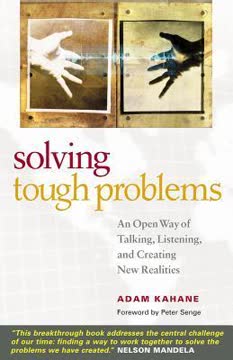
Yin and Yang of communication. The "closed fist, open palm" mudra symbolizes the balance needed: the right hand (yang, masculine, "The Creative") represents open talking, while the left hand (yin, feminine, "The Receptive") represents open listening. Silence enhances listening, but it must be balanced with open talking and action. Being present and relaxed allows one to hear what is happening in the system and what is needed, rather than being preoccupied with forcing an outcome.
10. The Wound That Wants to Be Whole: Healing Through Radical Connection
The participants and the human systems they are part of want to be whole. Our job as facilitators and leaders is simply to help create a clean, safe space. Then the healing will occur.
Guatemala's healing journey. In post-genocide Guatemala, the Visión Guatemala team, comprising former adversaries, embarked on a profound journey of healing. Through deep dialogue, personal storytelling, and confronting brutal truths, they began to repair a social fabric shredded by decades of civil war and genocide. This process allowed them to "recover their capacity to dream together."
Communion in silence. A harrowing story of mass graves and pregnant women, told without emotion, led to a profound, extended silence in the group. This silence created a "communion"—a palpable feeling of radical connectedness and oneness—where the team collectively glimpsed the essence of the Guatemalan reality. In that moment, they understood their shared purpose: "We must struggle to prevent this from happening again."
Creating safe spaces. Like a physical wound that naturally seeks to close, human systems yearn for wholeness. Leaders and facilitators can foster this healing by creating clean, safe spaces for dialogue, where people can speak their truths without fear and listen to "the sacred within each of us." This enables the building of trusting relationships, shared purpose, and the emergence of a better future, even amidst ongoing challenges.
11. An Open Way: A Simple, Not Easy, Practice
When we choose an open way, we participate in creating another, better world.
The core injunction. Solving our toughest problems peacefully requires a fundamental shift from closed, adversarial modes to an "open way" of talking and listening. This means moving beyond downloading (reproducing old files) and debating (listening to refute) to reflective (listening to be changed) and generative dialogue (listening to the whole system for what wants to emerge). This simple shift unlocks complex, stuck situations and creates miracles.
Ten practical suggestions. To embark on this open way, one must:
- Pay attention to one's state of being and internal reactions.
- Speak up authentically, expressing thoughts, feelings, and wants.
- Question certainty, adding "in my opinion" to strong assertions.
- Engage with diverse, even opposing, perspectives.
- Reflect on one's own role in creating the problem.
- Listen with empathy, imagining oneself in others' shoes.
- Listen to the whole system, sensing what is emerging.
- Embrace silence, allowing answers to come.
- Relax and be fully present, opening mind, heart, and will.
- Practice consistently, bringing attention back to openness.
Personal transformation, global impact. This path is challenging because it demands lowering defenses, giving up control, and allowing one's certainties and identities to be challenged and changed. Yet, by practicing this open way in every conversation, every day, we transform ourselves. As individuals change, their families, communities, countries, and ultimately the world, also begin to change, fostering hope and contributing to the creation of a better future.
Review Summary
Reviews of Solving Tough Problems are generally positive, averaging 3.98 out of 5. Many readers appreciate Kahane's personal storytelling and real-world examples of conflict resolution, particularly his work in post-apartheid South Africa. His framework for understanding dynamic, generative, and social complexity resonates with readers interested in facilitation and community problem-solving. However, some critics feel the book lacks concrete techniques and actionable strategies, reducing its guidance to simply "talk and listen." Most agree it's a quick, thought-provoking read, better suited as philosophical inspiration than a practical how-to manual.