Key Takeaways
1. The Right-Wing Troika: A Coordinated Force Reshaping States
Together, this advocacy has produced a stark rightward shift across the states, ultimately contributing to a dramatic redistribution of political power.
A New Political Landscape. The 2010 midterm elections, dubbed a "shellacking" by President Obama, marked a pivotal moment, not just for Congress but for state politics. Republicans gained significant control of state legislatures and governorships, leading to a rapid introduction of remarkably similar conservative policies across the nation. This shift was orchestrated by a powerful, interconnected network: the "right-wing troika."
Introducing the Troika. This troika comprises three key organizations: the American Legislative Exchange Council (ALEC), the State Policy Network (SPN), and Americans for Prosperity (AFP). Each plays a distinct yet complementary role. ALEC, with its network of legislators and corporate members, drafts and disseminates model legislation. SPN, an association of state-level conservative think tanks, provides research and media advocacy. AFP, a Koch-funded grassroots organization, mobilizes activists and runs electoral campaigns.
Beyond Washington D.C. The troika's focus on state capitols, rather than solely federal politics, represents a strategic recognition that states offer multiple battlegrounds for policy change. This decentralized approach allows them to advance conservative and pro-business agendas, such as stand-your-ground laws, right-to-work legislation, and voter ID requirements, often with less public scrutiny and greater legislative receptivity due to under-resourced state governments.
2. ALEC's Strategic Appeal to Under-Resourced Legislators
Without formal help, how does a state legislator like Whisnant get the ideas, research, legislative language, talking points, polling, and expert witnesses that are needed to make policy? That’s where ALEC comes in.
Filling a Void. Many state legislators, like Oregon's Gene Whisnant, serve part-time, are underpaid, and lack adequate staff or research support. This creates a significant demand for policy ideas and legislative assistance. ALEC strategically fills this void by offering a comprehensive package of services, making it an attractive resource for lawmakers seeking to develop and advance legislation.
Comprehensive Support. For a modest annual fee, ALEC provides legislators with:
- Nearly 1,000 prewritten model bills on various issues.
- Access to policy researchers and experts to build cases for bills.
- Legislative language, talking points, and polling data.
- Opportunities to meet experts and network at subsidized annual conferences held at appealing resorts.
Defining Conservative Policy. ALEC's offerings reduce the cost for state legislators to pursue specific policy agendas. This has allowed ALEC to effectively define what it means to be a conservative, pro-business state legislator. When newly elected conservative lawmakers seek concrete policy ideas, ALEC often becomes their primary resource, shaping their legislative priorities and platforms.
3. Corporations Invest in ALEC for Cross-State Policy Influence
“In the states, if you’re trying to get [something] passed and you’ve lost in Kansas, Nebraska and Texas, it’s not a total failure. You may well win in Arizona, California and New York that year. You’ve got 50 shots,” stressed one of ALEC’s early executive directors in making a sales pitch to potential members.
The "Best of Both Worlds." For large, often multinational corporations, ALEC offers a unique advantage in navigating the fragmented American federal system. Instead of facing a patchwork of 50 different state regulations, businesses can use ALEC to promote a relatively uniform set of corporate-friendly rules across multiple states simultaneously, while keeping policymaking at a state level where lawmakers are often more receptive to business demands.
Addressing Regulatory Threats. Companies are more likely to join and actively participate in ALEC when they face significant cross-state regulatory threats. Examples include:
- Enron's push for electricity deregulation in the 1990s.
- Fossil fuel companies' efforts to repeal renewable energy portfolio standards.
- Online retailers like Amazon and eBay seeking to prevent state internet sales taxes.
- Healthcare and pharmaceutical industries opposing federal health reform.
Beyond Policy: ALEC's appeal extends beyond direct policy influence. Its lavish, often subsidized, conferences provide unparalleled networking opportunities for corporate executives to build relationships with state legislators. This access, combined with the ability to shape legislative agendas, makes ALEC a "great investment" for businesses, even those with public-facing brands sensitive to controversy.
4. The Troika's Coordinated Policy Advocacy in Action
Table 0.1 introduces the size, scope, and function of each of the three members of the conservative troika that I will explore in this book.
A Unified Front. The right-wing troika operates as a tightly integrated network, with each member reinforcing the others' efforts. ALEC develops and disseminates model legislation, SPN provides the intellectual and research backing, and AFP mobilizes grassroots support and applies electoral pressure. This coordinated approach allows them to pursue a common agenda with significant impact across the states.
SPN's "IKEA Model." SPN, an association of over 60 state-level conservative think tanks, functions like an "IKEA model" for policy advocacy. It provides "raw materials" and "services" from a "catalogue" to its affiliates, enabling them to customize legislative campaigns for their local contexts. SPN also steers affiliates towards specific policy agendas through grants and encourages collaboration with ALEC, with many SPN members serving on ALEC's task forces.
AFP's Grassroots Muscle. Americans for Prosperity (AFP), the "800-pound gorilla" of the Koch network, provides the grassroots and electoral power. With millions of activists and hundreds of paid staff across states, AFP mobilizes citizens for rallies, contacts lawmakers, and runs ads to support or oppose legislation and candidates. This "bare-knuckled approach" complements ALEC's legislative drafting and SPN's research, creating a formidable force for policy change.
5. Weakening Public-Sector Unions: A Troika Priority with Lasting Impact
Reforms like right to work, cuts to public employee collective bargaining, and efforts to make it harder for government employee unions to collect dues and retain members will “defund and defang one of our freedom movement’s most powerful opponents, the government unions” while also “clear[ing] pathways toward passage of so many other pro-freedom initiatives in the states” (original emphasis).
A Strategic Target. From its inception, ALEC, and later SPN and AFP, identified public-sector labor unions as a primary obstacle to their conservative agenda. They viewed unions as incompatible with democratic government, contributors to excessive public spending, and powerful funders of liberal causes. Weakening unions became a deliberate strategy to reshape the political landscape in their favor.
The Wisconsin and Iowa Blueprints. The troika's coordinated efforts led to significant legislative victories, notably in Wisconsin (Act 10, 2011) and Iowa (2017), where sweeping laws curtailed public employee collective bargaining rights, limited automatic dues collection, and imposed recertification requirements. These measures, often based on ALEC model bills, were supported by SPN's research and AFP's grassroots mobilization and ad campaigns.
Demobilizing the Opposition. The impact of these troika-backed laws has been profound:
- Membership Decline: Public union membership and revenue plummeted in affected states.
- Reduced Political Clout: Unions had fewer resources for lobbying and campaign contributions.
- Lower Participation: Individual public employees showed a significant decline in political participation.
This strategic use of policy to demobilize political opponents demonstrates the troika's long-term vision for building and retaining conservative power.
6. Medicaid Expansion: A Battleground Revealing Troika-Business Tensions
The troika, in contrast, was unwilling to consider that there would be a business case for expansion, instead rooting their opposition to the program in their ideological commitment to smaller government at any and all costs.
Opposing the ACA. The Affordable Care Act's (ACA) Medicaid expansion became a major battleground for the troika. After the Supreme Court ruled states could opt out without losing existing federal funds, ALEC, SPN, and AFP launched a concerted campaign to block expansion, viewing it as an ideological affront to smaller government and a costly federal overreach.
Troika's Unified Opposition.
- ALEC: Developed model bills and guides like "The State Legislators Guide to Repealing Obamacare," urging states to "opt out" of Medicaid.
- SPN: Directed grants to affiliates to publish reports and media commentary decrying expansion, often coordinating with ALEC.
- AFP: Mobilized activists, ran ads, and used legislative scorecards to pressure lawmakers against expansion, even flying national leaders to key states.
This unified front significantly influenced state decisions, with troika strength correlating strongly with non-expansion.
Clash with Mainstream Business. Surprisingly, the troika's hardline stance on Medicaid expansion often put them at odds with mainstream business interests, particularly state Chambers of Commerce and healthcare providers. These business groups, recognizing the billions in federal funds and economic benefits for local communities and hospitals, actively lobbied for expansion. This revealed a key tension: the troika's ideological commitment to small government sometimes overrides the profit-maximizing interests of even center-right businesses.
7. The Left's Persistent Failure to Build Countervailing State Power
“These are feisty Chihuahuas. I don’t know if having six feisty Chihuahuas against one big gorilla does much,” Pocan colorfully concluded.
A Historical Imbalance. While conservatives systematically built the troika over decades, progressive efforts to create similar cross-state networks have largely floundered. Early bipartisan "good government" associations like the American Legislators' Association (ALA) and National Conference of State Legislatures (NCSL) were abandoned by conservatives, who found them too liberal, leaving progressives without a dedicated, ideologically aligned state-level infrastructure.
Cycles of Neglect and Fragmentation. Left-wing attempts to counter ALEC, such as the National Conference on Alternative State and Local Policies (CASLP), Center for Policy Alternatives (CPA), and Progressive States Network (PSN), suffered from:
- Inconsistent Funding: Liberal foundations and wealthy donors often preferred national-level advocacy or direct service, viewing state politics as less "sexy" or impactful.
- Duplication of Efforts: Multiple groups competed for scarce resources, preventing any single organization from achieving scale.
- "D.C. or Bust" Mentality: Progressive attention and funding for state organizing waned when Democrats controlled federal government, only to resurface during Republican presidencies.
This stop-and-start approach left the left far behind the troika's continuous, integrated growth.
The Limits of Urban Power. In recent years, progressives have increasingly focused on cities as bastions of liberal policy. However, this strategy faces a major hurdle: state legislative preemption. The troika actively promotes model bills that allow state legislatures to overrule city ordinances on issues like minimum wage, paid sick leave, and environmental regulations, effectively neutralizing urban progressive victories.
8. Wealthy Donors Drive the Troika's Growth and Coordination
Funder decisions can mean the creation of new reserves of political power, as with the example of the troika, or the absence of such power, as with the case of the liberal donors who were reluctant to support the creation of organizations that could counter the troika.
The Rise of Political Philanthropy. The growth and coordination of the right-wing troika are deeply intertwined with the strategic investments of wealthy individual donors and charitable philanthropies. Figures like Charles and David Koch, and foundations like the Bradley Foundation, recognized the potential for sustained policy change through state-level organizing and channeled massive funds into building this infrastructure.
Beyond Individual Giving. The Koch network, for instance, evolved from supporting academic libertarianism to creating a fully integrated political machine. Their twice-yearly "seminars" bring together hundreds of conservative millionaires and billionaires, raising hundreds of millions of dollars per election cycle. This funding, often exceeding that of entire political parties, primarily flows to core Koch-directed groups like AFP, ensuring tight control and aligned agendas.
Strategic Coordination. Donors play a crucial role in fostering collaboration between troika members. For example, the Bradley Foundation explicitly funded SPN affiliates to work with ALEC on specific projects, like education reform or Medicaid opposition. This strategic funding incentivizes institutionally separate groups to align their efforts, creating a powerful, cohesive force that transcends individual organizational boundaries.
9. State Capture: A Threat to Democratic Representation
In sum, across many of the troika’s priorities, when ALEC, AFP, and SPN succeed, they are doing so against, not in line with, what majorities of American citizens say they want from government.
Erosion of Responsiveness. The troika's success raises significant concerns for American democracy, particularly regarding political representation and accountability. By consistently pushing policies that run counter to the preferences of most Americans—such as opposing minimum wage hikes, restricting voting rights, or cutting environmental regulations—the troika contributes to an "elite skew" in representation, where the preferences of wealthy donors and businesses prevail over those of the broader public.
Skewed Perceptions. Research indicates that legislators who frequently rely on ALEC are significantly less accurate in perceiving their constituents' policy preferences, often overestimating their conservatism. This suggests that the troika's influence may not only shape policy but also distort lawmakers' understanding of public opinion, further widening the gap between citizens and their elected officials.
Undermining Accountability. The troika's operational methods, including the deliberate obfuscation of corporate involvement and the lack of transparency in funding and legislative drafting, make it harder for citizens to hold their elected officials accountable. When lawmakers copy legislation verbatim from ALEC without public disclosure, it obscures who is truly writing the laws and whose interests are being served, thereby weakening the democratic process.
Review Summary
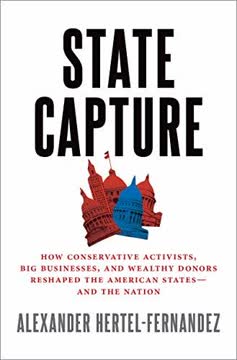
State Capture receives generally positive reviews, averaging 4.02/5. Readers praise its thorough research into conservative policy organizations like ALEC, Americans for Prosperity, and the State Policy Network, and how they influence state legislatures. Many find it eye-opening and important, particularly regarding the strategic conservative focus on state-level politics. Criticisms include an overly academic writing style, occasionally conspiratorial tone, and insufficient emphasis on the implications for democracy. Most recommend it for those interested in state politics, interest groups, and policy advocacy.