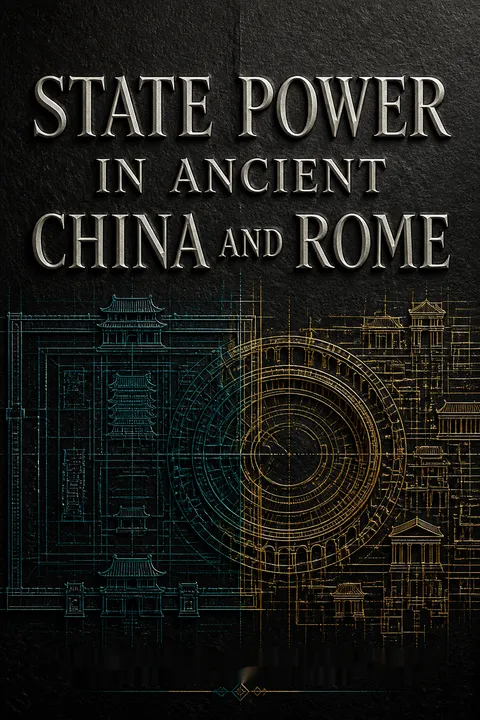

Key Takeaways
1. The Illusion of Absolute Power
The negotiation of rank and privilege took place within these basic parameters.
Patrimonial power dynamics. Both the Han and Roman Empires operated within the framework of patrimonial politics, where rulers and landowning elites constantly negotiated power. Despite their vast territorial claims, neither court possessed the communication technologies to rule directly without delegating authority. To secure stability, both systems developed a class of honoratiores (honorable elites) who traded their local cooperation for imperial recognition, titles, and legal immunities.
Taming the aristocracy. Rulers utilized their courts as theaters of domestication, drawing powerful regional families into the imperial orbit to neutralize their independent military capacity.
- Han emperors forcibly relocated wealthy provincial clans to the capital region to keep them under close surveillance.
- Roman emperors gradually integrated provincial elites into the Senate, transforming potential regional rebels into stakeholders of the empire.
- Both courts relied heavily on "socially dead" agents—such as eunuchs in China and imperial freedmen in Rome—to bypass aristocratic networks.
Ideological alignment. To legitimize this delicate balance, both regimes adopted antityrannical founding myths. The Han positioned themselves as a benevolent alternative to the ruthless Legalism of the Qin, while Augustus feigned a restoration of the Roman Republic to mask his autocratic military dictatorship. This shared discourse of exemplary, paternalistic kingship allowed both elites and rulers to speak a common moral language.
2. The Deliberative Habit
Even though a council’s resolutions were in principle nonbinding on the executive, they did help brake overhasty decisions by the commander or emperor...
The deliberative habit. Autocratic power in both Rome and China was structurally constrained by a deeply ingrained culture of consultation. Rulers in both empires rarely made major executive decisions regarding war, law, or ritual without convening formal advisory councils. This "deliberative habit" was backed by the force of custom and served as a vital mechanism for building consensus among the ruling class.
Institutionalized advice. The mechanics of consultation differed in form but shared the same underlying goal of mitigating executive error and sharing political responsibility.
- In Rome, the consilium (advisory council) of friends (amici) and jurists helped the emperor navigate complex legal and administrative decisions.
- In China, court conferences (tingyi) allowed ministers to debate contentious policies, such as the famous 81 bce salt and iron monopolies.
- Dissenting opinions were formally recorded in both systems, allowing officials to put their positions on the line.
Preserving imperial face. While the advice of these councils was technically nonbinding, ignoring them carried severe political risks. By routing decisions through these deliberative bodies, emperors could deflect blame for policy failures onto their ministers while reaping the glory of successful outcomes. This collaborative facade was essential for maintaining the illusion of a harmonious, rule-bound state.
3. Divergent Paths of Bureaucratization
Early Chinese bureaucratization should not be taken as a sign of precocious 'modernity': it could emerge under a variety of circumstances independent of other features that characterized later Western modernization.
Precocious statecraft. The Han Empire inherited a highly centralized, sophisticated civilian bureaucracy that had its roots in the lineage laws of the Western Zhou and the total-war mobilization of the Warring States. This system allowed the central state to penetrate deeply into local society, employing over 120,000 registered officials by the end of the Western Han. This early bureaucratization was not a precursor to Western modernity, but rather a highly successful tool for resource extraction and social control.
The Roman contrast. In stark contrast, the early Roman Empire operated with a remarkably small administrative apparatus, relying instead on local municipal autonomy.
- The early Roman provincial administration consisted of only a few hundred elite equestrian and senatorial officials.
- Rome delegated the burdens of tax collection and local policing to the elites of its roughly two thousand self-governing city-states.
- It was only during the military crises of the third century ce that Rome began to develop a larger, more structured "personal bureaucracy."
Recruitment and ideology. The two empires also developed radically different methods for managing and motivating their state agents. The Han state utilized Confucianism as a unifying bureaucratic ideology, training candidates in the Imperial Academy and selecting them through a formal recommendation system. Rome, conversely, lacked a standardized ideological training system for its administrators, relying instead on shared aristocratic culture, legal expertise, and seniority to structure its civil service.
4. The Fiscal Skeleton
The flow of taxes lays bare the 'skeleton' of the state.
Fiscal priorities. A comparative analysis of state budgets reveals the contrasting structural priorities of the Han and Roman states. The Roman Empire was essentially a military-tributary complex, where over half of all state revenues were directly consumed by a massive, professional standing army. The Han Empire, by contrast, prioritized spending on its extensive civilian administrative apparatus, reflecting its commitment to deep state penetration and direct rule.
Taxation mechanisms. The methods of extraction in each empire reflected their respective administrative capacities and political bargains.
- Han China relied heavily on direct taxation, including land taxes and universal poll taxes that targeted the general peasantry.
- Rome focused on indirect taxes, customs duties, and revenues from state-owned mines and imperial domains to avoid overtaxing its politically sensitive elites.
- Both empires, however, faced powerful premodern constraints that limited their total tax take to roughly 5 to 10 percent of GDP.
The cost of agency. The distribution of state revenues also highlights different patterns of elite compensation. Roman senior officials and military officers were paid extravagant salaries compared to their Han counterparts, a reflection of Rome's aristocratic heritage and the constant threat of military usurpation. The Han state maintained a much flatter wage structure, compressing senior salaries while providing a modest living wage to a vast army of junior clerks.
5. Urbanization as an Instrument of State Power
Roman and Han Empires thus crafted their cityscapes to display the nature of the ruler, the role of the army, the place of local elites, and the defining characteristics of civilization.
State-driven urbanization. Urbanization in both empires was heavily structured by state power, but the mechanisms of this influence differed fundamentally. In the Han Empire, the state acted as a direct, interventionist builder of cities. The capital, Chang'an, was planned and constructed from scratch as a monumental expression of dynastic authority, while the surrounding landscape was reshaped by the forced creation of "artificial" tomb towns.
Organic and military growth. In the Roman world, urbanization was largely an indirect consequence of imperial expansion and fiscal-military logistics.
- Roman cities in the West often grew organically around military garrisons (vici and canabae) to exploit the spending power of soldiers.
- The central state rarely founded cities directly, preferring to incentivize local elites to build and manage their own urban centers.
- This resulted in a highly dense, self-replicating network of autonomous municipalities across the Mediterranean basin.
Social control through space. These different urban systems had profound implications for social control. By directly controlling the layout, administration, and population of its cities, the Han state successfully prevented urban centers from becoming independent bases of social power. The Roman state, by contrast, conceded immense autonomy to municipal elites, leaving the empire vulnerable to fragmentation when those local elites eventually withdrew their support from the central state.
6. Public Space and the Architecture of Power
In contrast with the city of Rome, where the gathering of crowds and their controlled encounters with the emperor were a matter of policy, public spaces in Han China were defined precisely as excluded spaces into which entry was granted only as a privilege.
The architecture of exclusion. The physical layout of Han and Roman cities reflected fundamentally different concepts of political authority. Han cities were designed around the principle of exclusion, where power was concentrated in hidden, inner spaces sealed off behind massive walls and guarded gates. The public was systematically excluded from the centers of power, and the only legal gathering spaces for the masses were highly policed, walled markets.
The theater of assembly. Roman urbanism, conversely, was defined by open, monumental public spaces designed for mass assembly and spectacular display.
- Forums, basilicas, and porticoes provided open venues for political deliberation, legal transactions, and social networking.
- Massive entertainment complexes, such as the Colosseum and the Circus Maximus, allowed the emperor to interact directly with his subjects.
- Public baths (thermae) served as luxurious, state-provided spaces where citizens of all classes could mingle freely.
Visualizing status. While Roman public spaces celebrated the visibility of the ruler and the active participation of the citizenry, Han cityscapes emphasized the invisibility and sacrality of the emperor. In Rome, power was generated through the spectacular display of the self to assembled crowds. In China, power was maintained by keeping the ruler hidden, transforming the state into an aloof, awe-inspiring force that operated far above the daily lives of its subjects.
7. The Political Theology of Divine Rulership
The ruler would himself become divinized, become associated with the Great One, and gain direct power over the ghosts and spirits.
The theology of empire. The creation of both the Han and Roman Empires was accompanied by radical claims of divine rulership. In both cultures, traditional religious practices were centered on domesticating capricious spirits and ancestors through sacrifice. By claiming divine status, the first emperors sought to break free from these traditional ritual constraints and project an absolute, eternal authority that transcended the natural decay of human dynasties.
Ascending the pantheon. The mechanisms of imperial divinization were carefully crafted to position the ruler at the absolute apex of the cosmic order.
- The First Emperor of Qin and Emperor Wu of the Han aligned themselves with the "Great One" (Taiyi), a deity more primordial than Heaven.
- Roman emperors, beginning with Augustus, carefully navigated traditional republican anxieties by associating themselves with the imperial cult and the genius of the ruler.
- Both systems used these divine claims to establish a direct, unmediated relationship between the sovereign and the cosmos.
The humanistic reaction. These radical claims of divine kingship were highly controversial and triggered powerful conservative backlashes. In China, the ritual reforms of the late Western Han stripped the emperor of his divine status, redefining him as a moral, human "Son of Heaven" who ruled within a patriarchal, ritual lineage. In Rome, the tension between the divine reality of the emperor's power and the republican facade of the princeps remained a constant source of political hypocrisy and elite anxiety.
8. The Rise of Millenarian Resistance
The Way established life in order to reward the good, and established death in order to punish the bad.
Apocalyptic resistance. The consolidation of centralized imperial power in both Rome and China eventually triggered massive, popular millenarian movements. These movements arose in direct opposition to the state's religious and political structures, which they accused of corrupting the natural order. By claiming direct revelations from a high, moral deity, these movements offered their followers a vision of a coming apocalypse and the subsequent creation of a perfect, egalitarian society.
Alternative social orders. The millenarian movements of the late Han period, such as the Celestial Masters and the Taiping, rejected the traditional sacrificial cults of the state.
- They proclaimed that the cosmos was governed by a moral high deity (the Way or Laozi) who demanded ethical behavior rather than animal sacrifices.
- They established highly structured, self-governing communities based on strict principles of moral meritocracy.
- They offered the possibility of physical transcendence and self-divinization to the entire populace, bypassing the elite-dominated state.
Imperial co-optation. This revolutionary religious wave closely mirrored the development of early Christianity in the Roman Empire. In both cases, what began as a radical, anti-imperial movement of the marginalized was eventually co-opted by the state to serve as a new source of imperial legitimacy. The conversion of the Wei Dynasty to the Way of the Celestial Masters and the Constantinian shift to Christianity fundamentally transformed both the empires and the religions themselves.
9. The First Great Divergence
Did the Qin-Han mode of deeper civilian penetration provide a more robust foundation for imperial continuation (though not ongoing continuity) than Rome’s prioritizing of more socially marginal military power?
The great divergence. The most striking difference between the Han and Roman Empires lies in their respective afterlives. Following its collapse in the fifth century ce, the Western Roman Empire vanished permanently, leaving Europe politically fragmented for over a millennium. The Han Empire, by contrast, established a highly resilient template of centralized, bureaucratic rule that was cyclically reconstituted by subsequent Chinese dynasties for two thousand years.
Structural resilience. This divergence was deeply rooted in the different administrative and social structures of the two empires.
- The Han state's deep civilian penetration created a highly standardized, homogeneous elite culture bound by Confucian classics and imperial law.
- Rome's reliance on local municipal autonomy left the central state structurally weak and dependent on a socially isolated military apparatus.
- When the Roman military collapsed, the autonomous local elites had no structural incentive to rebuild the central imperial state.
The legacy of statecraft. The Han model of direct rule and centralized bureaucracy proved to be an incredibly robust tool for state survival. Even during long periods of political disunion, the ideal of a unified, bureaucratic empire remained the undisputed norm among Chinese elites. In the West, the memory of Rome persisted as a powerful cultural symbol, but the structural capacity to rebuild a universal empire on a Mediterranean scale was lost forever.
Review Summary
About the Author
Download PDF
Download EPUB
.epub digital book format is ideal for reading ebooks on phones, tablets, and e-readers.








































