

Key Takeaways
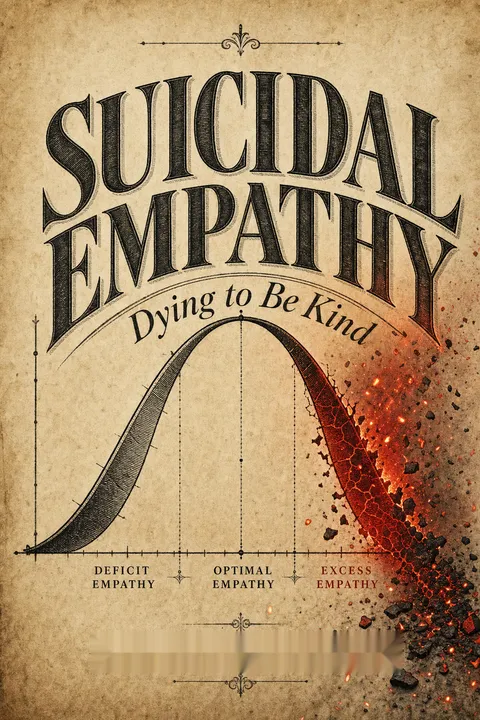
Empathy is a noble virtue that can metastasize into civilizational suicide
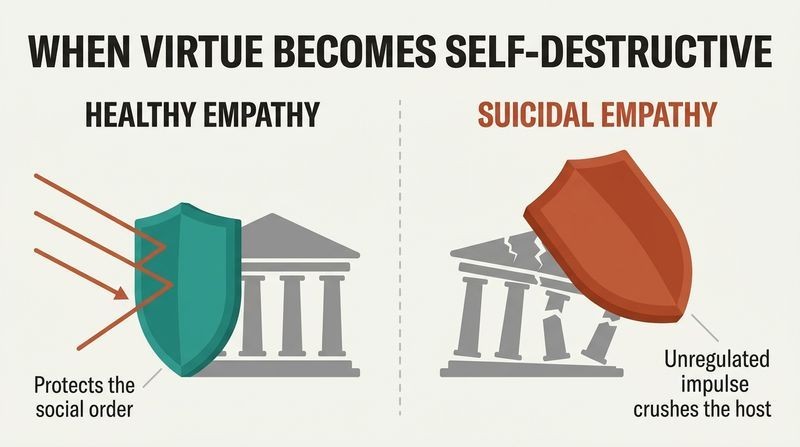
The core thesis. Gad Saad argues that empathy, an evolutionarily selected virtue that bonds our deeply social species, can misfire so badly that it threatens a society's survival. He calls this dysregulated state "suicidal empathy," the emotional equivalent of flesh-eating bacteria that turns a culture against itself. The proverb that the road to hell is paved with good intentions becomes, at civilization scale, a death sentence.
The misfiring takes specific forms. Saad claims the West's progressive class systematically inverts moral priorities: criminals over victims, illegal migrants over citizens, squatters over homeowners, the feelings of marginalized groups over objective truth. Empathy stops being a private kindness and becomes the engine of policy. When a noble emotion is deployed indiscriminately, to the wrong targets, in the wrong amounts, it ceases to protect and begins to destroy.
What's provocative here is the move from individual psychology to collective diagnosis. Saad borrows from Thomas Sowell's "vision of the anointed," elites who feel virtuous while bearing none of their policies' costs. The framing echoes Paul Bloom's "Against Empathy," which argues empathy is a poor moral guide because it spotlights identifiable victims while ignoring statistical ones. The weakness is falsifiability: nearly any policy Saad dislikes can be labeled "suicidal empathy," which risks making the concept unfalsifiable rather than diagnostic. Still, the underlying tension between compassion and consequence is genuine and ancient.
Empathy follows an inverted-U: too little breeds psychopaths, too much breeds paralysis
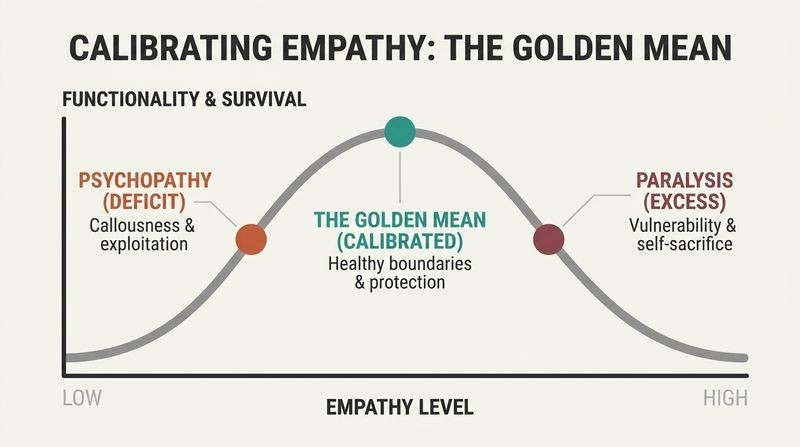
Calibration is everything. Saad anchors his argument in Aristotle's golden mean and the inverted-U curve that recurs across human traits. Insufficient empathy produces the callous psychopath. Excessive, indiscriminate empathy stunts your ability to navigate life's threats. The sweet spot lies in the middle, and our emotional system evolved to be calibrated, not maximized.
Empathy has a dark side. Saad cites research showing empathy can be weaponized: serial killer Ted Bundy faked an arm cast to trigger victims' helpfulness, and psychopaths "kill through kindness" rather than killing with it. Even sperm whales, who form protective circles around injured podmates, become easier targets for hunters because of their compassion. Empathy entangled with deception and violence is not a contradiction but a known vulnerability that predators exploit.
The inverted-U is one of the most robust patterns in psychology, appearing in the Yerkes-Dodson law on arousal and performance, dose-response curves in medicine, and optimal stress research. Applying it to empathy is intellectually sound and underappreciated. The clinical literature supports the dark-side claim: "pathological altruism" and "compassion fatigue" among nurses are documented phenomena. Where Saad could go deeper is distinguishing cognitive empathy (understanding another's state) from affective empathy (feeling it). Con artists and psychopaths often score high on the former and low on the latter, which is precisely why they exploit ours.
Suicidal empathy is a hyperactive emotion targeting the wrong people
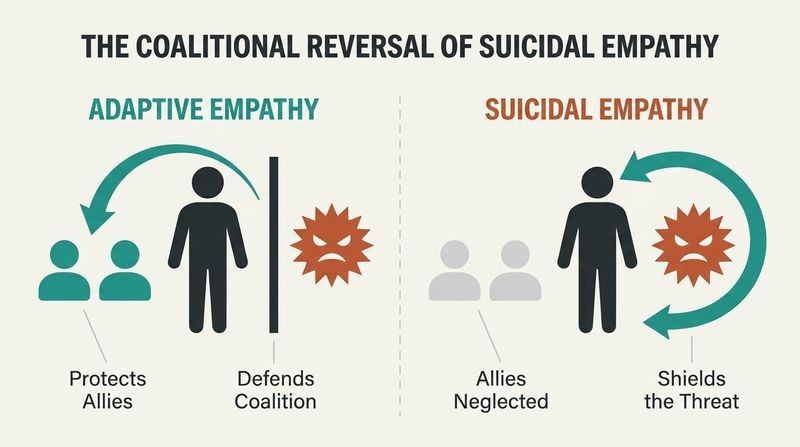
Adaptive processes gone haywire. Saad models suicidal empathy on disorders like OCD, where an evolutionarily useful behavior (checking for germs or threats) gets stuck in a destructive loop. Drawing on evolutionary psychiatrist Randolph Nesse's framework of emotional malfunctions, he locates suicidal empathy in three failures: the response is too high, too excessive, and triggered by inappropriate cues.
The wrong-target problem. Humans evolved to discriminate in their care: parents protect their own children before strangers, kin before cousins. Saad's most jarring example is a Norwegian man, raped by a Somali immigrant, who felt wracked with guilt when his rapist faced deportation. This, Saad argues, is empathy pointed at exactly the person who harmed you, a violation of the coalitional psychology that distinguishes kin from foe, friend from threat.
The evolutionary framing is the book's strongest analytical scaffolding. Nesse's "good reasons for bad feelings" inverts neatly into Saad's "bad reasons for good feelings." The in-group bias of empathy is well established: neuroimaging shows reduced empathic response to out-group pain. But the Norwegian anecdote raises a question Saad underexplores. Is the rape survivor's guilt evidence of social contagion, or of a genuine moral conviction that deportation to a dangerous country is itself unjust? Hard cases can be real moral dilemmas, not just pathology. The model is illuminating but can flatten genuine ethical complexity into mere malfunction.
When truth feels unkind, ideologues reclassify it as forbidden knowledge
Epistemological empathy. Saad argues that uncomfortable facts get suppressed not because they are false but because they might harm favored groups. He calls this treating truth as forbidden knowledge. If research on group differences, immigration and crime, or biological sex yields politically inconvenient results, it gets buried or attacked. The scientific method becomes subordinate to an "epistemology of care."
Faulty consequentialism. Saad distinguishes deontological principles (truth should be pursued regardless of outcome) from consequentialist ethics (weigh costs and benefits). He accuses progressives of selectively abandoning principles like free speech and presumption of innocence whenever the consequences threaten their politics. Examples include social media suppression of the Hunter Biden laptop story and journalists increasingly reporting a murderer's race only when the perpetrator is white, a pattern he says intensified sharply after George Floyd's death.
The tension between truth-seeking and harm-avoidance is real and live in academia, captured in debates over "research that should not be done." Saad's defense of inquiry as a near-absolute echoes John Stuart Mill and Karl Popper. Yet the framing has a blind spot: science has always operated under ethical constraints (informed consent, the Tuskegee reckoning), and "the data simply speak" understates how framing, funding, and method shape what counts as a finding. The honest position is that suppressing inconvenient results corrupts science, but so does pretending measurement is free of values. Both failure modes deserve equal vigilance.
Treating all cultures and immigrants as interchangeable is a fatal category error
Cultural theory of mind. Extending the psychological concept of "theory of mind" (inferring others' mental states), Saad coins "cultural theory of mind": the ability to recognize that values like kindness and tolerance are interpreted differently across cultures. The West, he argues, lacks it. It assumes generosity extended to all immigrants will be reciprocated with gratitude and assimilation.
The categorization mistake. Saad's analogy: a hummingbird and a cassowary are both birds, but only one can disembowel you. Treating Elon Musk and a jihadist as equivalent simply because both are immigrants is, he says, a failure of basic cognitive categorization that even an amoeba avoids. He points to grooming-gang scandals in British cities, where authorities allegedly declined to act for fear of accusations of Islamophobia, as evidence that protecting a group's reputation was prioritized over protecting children.
The categorization point is logically valid: aggregating dissimilar things under one label and reasoning about the average obscures variance. This is the ecological fallacy in reverse. The cassowary analogy is vivid and the grooming-gang failures (documented in the Jay Report) were real institutional catastrophes. The contestable leap is from "cultures differ" to "some cultures cannot assimilate." Integration outcomes vary enormously by generation, education, economic opportunity, and host-country policy, not culture alone. Saad's framing tends toward cultural essentialism where the evidence often points to structural and situational factors. The valid insight (groups are not interchangeable) does not license the stronger determinist conclusion.
Blank-slate thinking recasts violent criminals as society's true victims
Blank slate felons. Saad argues that progressive criminology, rooted in the belief that humans are born equal and shaped entirely by environment, removes personal agency from criminals. If society or systemic racism caused the crime, punishing the offender becomes a second victimization. He illustrates with recidivism data: roughly a third of U.S. male prisoners have had five or more prior incarcerations, meaning "second chances" are often fortieth chances.
Empathy inversion in action. Saad recounts cases where forgiveness backfired fatally, including a woman who helped free her mother's killer and offered him a job, only to be murdered by him. He ties this to the rejection of heroism (the prosecution of subway intervener Daniel Penny) and the celebration of what he calls "sneaky f ker" male feminists who perform empathy to gain status, borrowing a term from zoology for males that mimic females to sneak past dominant rivals.
The nature-nurture framing maps onto Steven Pinker's "The Blank Slate," which argued that denying human nature distorts social policy. Recidivism is a genuine policy problem, and rehabilitation-versus-retribution is an unresolved tension in criminal justice. But Saad's account underweights evidence that punitive systems also fail: mass incarceration has high recidivism partly because prisons themselves are criminogenic. The honest middle ground, supported by Scandinavian models Saad elsewhere mocks, is that neither pure blank-slate nor pure retribution works. The "sneaky f**ker" concept (kleptogamy is real biology) is rhetorically sharp but functions more as insult than analysis.
"Settled science" is an oxymoron that smuggles ideology past scrutiny
Science is never settled. Invoking Karl Popper's falsification principle, Saad insists genuine science is always provisional. The phrase "settled science" is therefore anti-science, a conversation-stopper used to avoid weighing trade-offs. He cites the "Semmelweis reflex," named for the physician mocked for suggesting doctors wash their hands, and notes how many Nobel-winning ideas (H. pylori causing ulcers, kin selection) were first ridiculed by the orthodoxy.
Trade-off neglect. Saad argues COVID lockdowns, climate policy, and trans activism all relied on suppressing cost-benefit analysis via appeals to empathy. His sharpest example: 1,288 public health officials signed a letter declaring it too dangerous to attend funerals, yet endorsed mass Black Lives Matter protests as essential. As economist Thomas Sowell put it, there are no solutions, only trade-offs. Suicidal empathy optimizes a single variable (compassion now) subject to no constraints.
The Popperian point is philosophically solid and the COVID-protest contradiction was a real credibility wound for public health institutions. The trade-off framing borrows from operations research and is genuinely useful: most policy is multi-objective optimization, and pretending otherwise produces brittle decisions. Where caution is warranted: "science is never settled" is true in principle but can be abused to manufacture doubt about robust findings (tobacco, evolution, climate basics). Provisionality does not mean all positions are equally uncertain. The skill is distinguishing live scientific debate from manufactured controversy, a line Saad navigates inconsistently across his examples.
Abandoning meritocracy functions like the Church selling indulgences
Selling indulgences. Saad likens diversity, equity, and inclusion initiatives (which he relabels the "DIE cult") to the medieval Catholic practice of buying forgiveness for sins. Privileged elites expiate guilt over colonialism, slavery, and "existential privilege" by elevating identity over competence. He documents job postings restricted to specific gender or racial identities, university projects to "decolonize" physics, and medical training that he says proposes centering anti-racism over medical expertise.
The equality confusion. Saad sharply separates equality of opportunity (no institutional barriers) from equality of outcome (everyone ends in the same place). He argues the latter, championed in speeches about people starting on different bases, treats all group differences as evidence of injustice requiring correction, even innate differences in talent or interest. The result, he warns, is meritocracy attacked as itself a form of white supremacy.
The indulgences analogy is clever and historically resonant: both involve purchasing moral standing without changing behavior, what social psychologists call "moral licensing." The opportunity-versus-outcome distinction is a genuine fault line in political philosophy, dividing Rawlsians from libertarians. Saad's strongest ground is high-stakes competence domains (surgery, aviation) where merit is non-negotiable. His weaker move is treating all observed group disparities as either innate or fair, which ignores well-documented structural barriers that genuinely do suppress opportunity. The most defensible version of his argument targets outcome-engineering in domains where it degrades safety, not the existence of disparity-reduction efforts as such.
The welfare state runs on empathy and never runs out of other people's money
Empathy fuels the leviathan. Saad argues that communism, socialism, and the welfare state all recruit empathy to justify expanding government. Research shows empathy correlates with support for wealth redistribution and government intervention. Because women score higher on empathy, he claims they are more drawn to socialism, and people tend to grow more conservative with age as experience corrects youthful idealism.
Parasitic taxation. Saad recounts paying over half his income to the Canadian and Quebec governments, including royalties on a book written from his own life, and feeling robbed. He invokes the boiling-frog parable: the U.S. income tax began in 1913 as a modest measure and the tax code ballooned from 27 pages to over 17,000. Citing Margaret Thatcher, socialist governments eventually run out of other people's money, while "free" Canadian healthcare leaves patients waiting years and dying on emergency-room benches.
The empathy-redistribution correlation is real in political psychology, and the age-conservatism drift is empirically supported, though Saad's claim that empathy itself does not change with age (only experience) is an interesting nuance worth flagging. The Thatcher line lands rhetorically but elides that every developed nation runs some welfare state and the highest-happiness societies (the Nordics he criticizes elsewhere) are generous ones. The strongest part is the trade-off realism about healthcare rationing, which single-payer defenders too often dodge. The weakest is treating taxation as theft tout court, a libertarian axiom, not a demonstrated conclusion, that reasonable people reject.
Resist the immediate dopamine hit of looking compassionate now
Empathy as instant gratification. Saad's first inoculation is recognizing that suicidal empathy is a failure of delayed gratification, akin to Walter Mischel's marshmallow studies. The person holding a #RefugeesWelcome sign gets an immediate emotional reward while ignoring downstream consequences borne by future generations. Train yourself to see past first-order effects to the second and third-order chain reactions, the butterfly effect of policy.
Three more mental guardrails. Saad prescribes: reject the singular-exemplar bias (one sympathetic deportee does not invalidate border enforcement, just as one surgical death does not condemn surgery); reject the false-equality bias (people are equal under law but not in talents, and cultures are not equally likely to assimilate); and demand reciprocity. Citing Robert Axelrod's tournaments, where the Tit-for-Tat strategy won, he argues relationships without reciprocity become parasitic. Choose your empathy's targets as deliberately as people choose whom to give gifts.
The prescriptions translate abstract diagnosis into usable heuristics, which strengthens the book practically. The delayed-gratification framing connects empathy to self-regulation research in a genuinely novel way. Tit-for-Tat is one of the most celebrated results in game theory, and its lesson (be nice first, then reciprocate, and never be a pushover) is a sound relational principle. The singular-exemplar warning is essentially a caution against the availability heuristic that Kahneman and Tversky documented. The risk in all four guardrails is that they can rationalize coldness as easily as they correct excess. Saad's own caveat (be kind as a default, ferocious only in defense of truth) is the necessary ballast.
Analysis
"Suicidal Empathy" is a thesis-driven polemic and the sequel to Gad Saad's "The Parasitic Mind." Where the earlier book diagnosed corrupted cognition, this one targets corrupted emotion: the claim that the West's empathy module has malfunctioned, producing policies that endanger the civilization extending the compassion. Saad, an evolutionary behavioral scientist, fuses Darwinian psychology, game theory, and cultural commentary with a deliberately incendiary, satirical voice.
The book's intellectual backbone is genuinely interesting. The inverted-U model of virtue, the application of evolutionary psychiatry's malfunction framework to a positive emotion, the opportunity-versus-outcome distinction, and the trade-off realism drawn from operations research are all legitimate analytical tools. Saad's coinages (cultural theory of mind, blank slate felons, epistemological empathy, empathy agnosia) give readers memorable handles for real phenomena. The strongest material concerns institutional failures that even sympathetic critics acknowledge: the public-health double standard during COVID, grooming-gang cover-ups, and the credibility costs of "settled science" rhetoric.
The book's central vulnerability is methodological. Suicidal empathy is defined so capaciously that nearly any policy Saad opposes can be filed under it, which threatens falsifiability. Evidence arrives almost entirely as anecdote, often the most extreme available case, and rarely as systematic data with base rates. This is selection by outrage. The relentless satire (Civilizational Seppuku, undocumented lovemakers, the DIE cult) energizes allies but forecloses persuasion of skeptics and sometimes substitutes mockery for argument.
Intellectually, the book sits in a lineage running through Sowell's "vision of the anointed," Pinker's blank-slate critique, and Bloom's "Against Empathy." Bloom, notably, makes a more rigorous version of the same core claim: empathy is a poor moral compass because it is innumerate and parochial, and rational compassion should govern policy. Saad's distinctive contribution is the evolutionary framing and the civilization-scale stakes. The most durable takeaway is the calibration principle: a virtue maximized without constraint becomes a vice. Whether one accepts Saad's politics or not, that warning about compassion uncoupled from consequence is worth sitting with.
Review Summary
Reviews of Suicidal Empathy are sharply divided. Supporters praise it as a courageous, intellectually engaging wake-up call, commending Saad's use of psychology, evolutionary science, and real-world examples to argue that unchecked empathy can be societally destructive. Fans appreciate its readability, humor, and timely cultural commentary, though some note it preaches to the choir. Critics, however, dismiss it as conservative propaganda, calling it poorly written, hate-filled, and lacking substantive analysis, accusing the author of racialized stereotyping and narcissism.
Download PDF
Download EPUB
.epub digital book format is ideal for reading ebooks on phones, tablets, and e-readers.








































