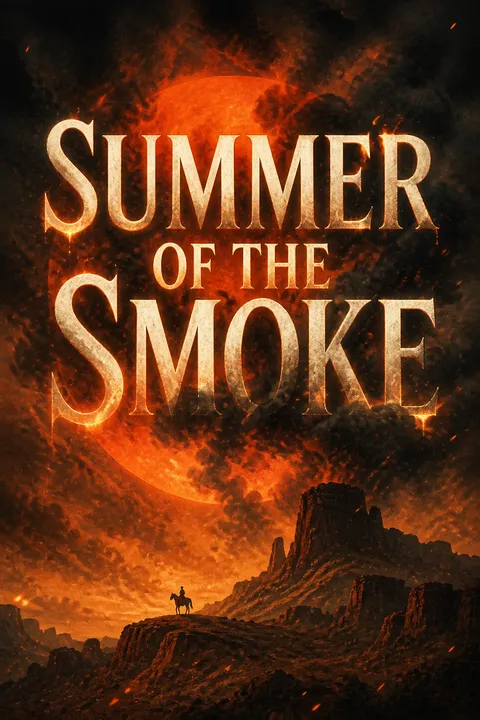

Plot Summary
Smoke Signals of Trouble
In the parched summer heat, Weymarn's Crossing sits on edge, the air thick with the threat of Apache unrest. The "smoke" is more than haze—it's the whisper of rebellion, carried from mesa to mountain, signaling that Maco, a young Apache renegade, has escaped military custody. The older Apaches dread the consequences, while the young are restless, their talk as volatile as the weather. Into this tension rides a battered cavalry patrol, wounded and weary, seeking refuge and aid from the wary townsfolk. The arrival of Lieutenant Benson and his men, especially the feverish guide Keefe Calhoun, sets the stage for a summer where every rumor could spark violence, and every stranger is a potential threat.
Wounded and Unwelcome
Keefe Calhoun, wounded and burning with fever, is left in the care of Hallie Thompson and her embittered father, Cap. The town's hospitality is grudging, and Calhoun's dismissal by Lieutenant Benson—after a moral stand against attacking a defenseless Apache camp—leaves him broke and uncertain. Hallie's gentle nursing contrasts with Cap's resentment, as Calhoun faces the reality that his injury and principles have cost him both his job and his place in the community. The Crossing's suspicion of outsiders and the ever-present threat of Apache attack make Calhoun's recovery as much a psychological battle as a physical one.
The Crossing's Uneasy Peace
Life in Weymarn's Crossing is a fragile routine, maintained by the likes of Will Weymarn, the powerful trader, and his pragmatic wife, Belle. The townsfolk, armed and anxious, watch every movement, every rumor, and every stranger. Calhoun, hobbling on a makeshift crutch, tries to find his footing—literally and figuratively—amidst the town's wary glances. The trading post is the hub of commerce and gossip, and Calhoun's interactions with Weymarn, Belle, and the townspeople reveal the complex web of dependence, resentment, and survival that binds the Crossing together, even as the threat of violence looms.
Hallie's Kindness, Cap's Bitterness
Hallie Thompson's quiet strength and kindness offer Calhoun a rare comfort, while her father Cap's bitterness and self-pity cast a shadow over their home. Hallie shoulders the burden of supporting them, taking in laundry and enduring the constant fear of Apache raids. Her relationship with Calhoun deepens through shared vulnerability, but Cap's resentment—fueled by poverty and pride—threatens to poison any hope of peace. The contrast between Hallie's resilience and Cap's defeatism highlights the emotional costs of frontier life, where survival often means hardening the heart.
Calhoun's Conscience and Conflict
Haunted by his role in the failed Army patrol, Calhoun wrestles with guilt and the consequences of his actions. His refusal to lead an attack on innocents cost him his job and nearly his life, but he remains steadfast in his belief that violence only begets more violence. As he recovers, Calhoun observes the town's dynamics—Weymarn's authority, Belle's ambiguous past, Hallie's quiet courage—and senses that beneath the surface, secrets and schemes are at work. His outsider status gives him a unique perspective, but also makes him a target for suspicion and manipulation.
Rumors, Whisky, and Secrets
Weymarn's Crossing thrives on rumor and barter, but beneath the commerce lies a darker trade: whisky sold to Apaches, secrets exchanged for survival. Calhoun discovers Weymarn's willingness to risk the town's safety for profit, and the arrival of Wilkie Brown—a frightened, drunken ranch hand—hints at deeper conspiracies. The town's fragile peace is maintained by uneasy alliances and unspoken threats, as Calhoun navigates the treacherous waters of loyalty, greed, and fear. The lines between friend and foe blur, and every transaction carries the risk of betrayal.
The Severed Arm's Warning
The discovery of Trooper Ryan's severed arm, left on the trading post's veranda clutching a silver dollar, sends shockwaves through the Crossing. The mutilation is both a warning and a mystery—was it Apaches, or something more sinister? The townsfolk, already on edge, are whipped into a frenzy of fear and talk of vengeance. Calhoun, disturbed by the symbolism and the calculated nature of the act, suspects that the killing is more than random violence. The incident exposes the town's divisions and the dangerous potential for mob justice, as old grievances and new suspicions collide.
Wilkie's Fear and Weymarn's Plot
Wilkie Brown's drunken terror and cryptic hints suggest he knows more about Maco's whereabouts than he admits. Calhoun's suspicions grow as he pieces together Wilkie's story, Weymarn's evasions, and the pattern of violence. The revelation that Weymarn may be holding Maco for ransom—negotiating with both the Army and the Apaches—casts the trader in a new, dangerous light. Wilkie's subsequent murder, staged to look like an Apache ambush, is the final clue Calhoun needs to see that the real threat to the Crossing comes from within, not without.
The Murder in the Mesa
Determined to find the truth, Calhoun tracks Wilkie's killer across the mesa, using his skills as a tracker to reconstruct the crime. He discovers that Weymarn, not the Apaches, ambushed Wilkie to silence him and protect his scheme. The evidence—tracks, timing, and motive—points unmistakably to Weymarn, who is willing to kill to keep his secrets. Calhoun realizes that the town's fate hangs on exposing Weymarn's treachery, but doing so will put him in mortal danger. The mesa becomes a crucible where loyalty, justice, and survival are tested.
Hallie's Heart Divided
As Calhoun's investigation deepens, Hallie finds herself torn between her loyalty to her family, her engagement to the dependable but dull Sam Avery, and her growing feelings for Calhoun. The threat to Calhoun's life—and the knowledge that Weymarn is hunting him—forces Hallie to confront her own desires and fears. Her decision to break off her engagement with Sam is both an act of self-assertion and a declaration of love for Calhoun. In the crucible of crisis, Hallie emerges as a woman of agency and courage, willing to risk everything for the man she loves.
The Army's Fatal March
Lieutenant McKelway's small Army escort, tasked with transporting the paymaster's gold payroll, ignores Calhoun's warning of an impending Apache attack. Bound by orders and pride, McKelway dismisses Calhoun's intelligence, leading his men into an ambush orchestrated by Santiago's band—spurred on by Weymarn's secret bargain. The massacre is swift and brutal, the payroll stolen, and the Army's authority shattered. The tragedy underscores the cost of arrogance and the deadly consequences of underestimating both the enemy and the duplicity within one's own ranks.
Weymarn's Deadly Bargain
With the Army payroll in hand, Weymarn prepares to deliver Maco to Santiago in exchange for the gold. Calhoun, hiding beneath the trading post's loading platform, witnesses the clandestine transfer and realizes the full extent of Weymarn's treachery. The trader's greed and cunning have brought ruin to both the Army and the town, and only Calhoun stands between Weymarn and his final, fatal transaction. The stage is set for a confrontation that will determine the fate of the Crossing and everyone in it.
Bolton's Arrival, Calhoun's Peril
Sensing Calhoun's threat, Weymarn brings in Wes Bolton, a brutal enforcer, to eliminate him. Calhoun, forewarned by Hallie and his own instincts, turns the tables on Bolton in a deadly showdown at the corral. The killing is self-defense, but it marks Calhoun as a hunted man, forcing him to act quickly to prevent further bloodshed. The town's simmering tensions boil over, and Calhoun's isolation becomes complete—he can trust no one but Hallie, and even she is at risk from the fallout.
The Payroll Ambush
Under cover of night, Santiago's Apaches deliver the stolen Army payroll to Weymarn's post, fulfilling their part of the bargain. Calhoun, hidden beneath the platform, discovers the gold and understands the full scope of Weymarn's plan: to ransom Maco for gold, unleashing chaos in the process. The exchange is a moment of high tension, as greed, desperation, and betrayal converge. Calhoun's resolve hardens—he must stop Weymarn and prevent Maco's return to power, no matter the cost.
Under the Platform, Over the Edge
With the gold secured, Weymarn rides out to complete the exchange. Calhoun, tracking him through the mountains, discovers that Apaches are also on Weymarn's trail, seeking vengeance and their leader. In a tense, deadly confrontation at an abandoned mine, Calhoun witnesses Weymarn's death at the hands of the Apaches and faces Maco in a final, brutal showdown. The violence is swift and decisive—Calhoun kills Maco, ending the cycle of betrayal and bloodshed that has haunted the Crossing all summer.
The Final Reckoning
Calhoun returns to the Crossing with Weymarn's body, the truth of the trader's crimes exposed. Belle Weymarn, stoic and sorrowful, must reckon with her husband's legacy and her own choices. The town, shaken by the revelations and the violence, begins to rebuild, chastened by the knowledge that their greatest threat came not from the Apaches, but from within. Calhoun's actions have saved the Crossing, but at great personal cost—he is marked by loss, exhaustion, and the burden of justice.
Hallie's Choice, Calhoun's Return
In the aftermath, Hallie and Calhoun find each other amid the ruins of the summer's violence. Hallie, having chosen her own path, welcomes Calhoun's return—not as a boarder or a fugitive, but as a partner. Their union is a hard-won hope, forged in adversity and sealed by mutual respect and love. The Crossing, scarred but surviving, stands as a testament to the resilience of its people and the possibility of redemption, even in the harshest of times.
Analysis
A modern lens on frontier morality and survival
"Summer of the Smoke" is a taut, character-driven Western that interrogates the myths and realities of frontier life. Luke Short crafts a narrative where violence is both ever-present and deeply personal, and where the greatest threats often come from within the community rather than from the "other." The novel explores the corrosive effects of greed, fear, and prejudice, while also celebrating resilience, compassion, and the possibility of redemption. Through Calhoun's journey—from wounded outsider to reluctant hero—the story examines the costs of moral courage and the necessity of standing against injustice, even when it means facing isolation or death. Hallie's evolution from caretaker to partner reflects the changing roles and agency of women in the West, while Weymarn's downfall serves as a cautionary tale about the dangers of unchecked ambition and the illusion of control. Ultimately, the novel suggests that survival on the frontier requires not just strength, but integrity, empathy, and the willingness to choose hope over despair. The lessons resonate today: justice is fragile, community is built on trust, and redemption is possible, even in the harshest of landscapes.
Review Summary
Characters
Keefe Calhoun
Calhoun is a former Army scout whose conscience and compassion set him apart from the hardened frontier. His refusal to participate in senseless violence against Apaches costs him his job, his health, and his standing in the community. Yet, his outsider status allows him to see through the town's facades and uncover the truth behind Weymarn's schemes. Calhoun's journey is one of physical and moral recovery—healing from his wounds, navigating suspicion, and ultimately risking everything to expose corruption and prevent further bloodshed. His relationship with Hallie reveals his capacity for tenderness and hope, while his confrontations with Weymarn and Maco test his resolve and ingenuity. Calhoun's arc is that of a man who, despite loss and betrayal, chooses justice and love over cynicism and self-preservation.
Hallie Thompson
Hallie is the heart of the Thompson household, supporting her embittered father and herself through hard work and quiet courage. Her compassion for Calhoun and her ability to see beyond his wounds mark her as a woman of empathy and strength. Torn between duty to her family, a tepid engagement to Sam Avery, and her growing love for Calhoun, Hallie's journey is one of self-discovery and agency. She ultimately rejects passivity, breaks off her engagement, and chooses a future with Calhoun, asserting her right to happiness and partnership. Hallie's evolution from caretaker to equal partner mirrors the broader theme of resilience and hope amid adversity.
Will Weymarn
Weymarn is the Crossing's dominant figure—a trader, employer, and manipulator whose authority is both respected and resented. Driven by greed and a desire for control, he orchestrates the town's commerce and its darker dealings, including illegal whisky sales and the secret imprisonment of Maco. Weymarn's willingness to kill to protect his interests reveals a ruthless pragmatism, but his schemes ultimately ensnare him. His death at the hands of the Apaches is both a reckoning and a release, exposing the dangers of unchecked ambition and the illusion of control. Weymarn's complexity lies in his blend of charisma, cunning, and self-destruction.
Belle Weymarn
Belle is Weymarn's wife, a woman with a checkered history and a keen sense of self-preservation. Her marriage to Weymarn is a contract of mutual need rather than romance, and her past as a gambler's companion haunts her attempts at respectability. Belle's interactions with Calhoun and Hallie reveal her intelligence, wit, and underlying sadness. She is both complicit in and critical of Weymarn's actions, ultimately forced to confront the consequences of his choices. Belle's arc is one of endurance and adaptation, embodying the compromises and costs of survival on the frontier.
Cap Thompson
Cap is Hallie's father, a man broken by hardship, loss, and pride. His inability to provide for his family and his reliance on Hallie's labor fuel his resentment and self-pity. Cap's interactions with Calhoun and Weymarn are marked by suspicion and defensiveness, and his relationship with Hallie is strained by his dependence and lack of gratitude. Cap serves as a cautionary figure—a reminder of the corrosive effects of bitterness and the importance of resilience. His arc is largely static, but his presence shapes Hallie's choices and Calhoun's sense of responsibility.
Sam Avery
Sam is Hallie's longtime friend and would-be husband, a man of steady habits and limited ambition. His kindness and reliability make him a safe choice, but his lack of initiative and emotional depth leave Hallie unfulfilled. Sam's inability to recognize or respond to Hallie's changing feelings leads to the dissolution of their engagement. He represents the comforts and limitations of conventional security, and his arc is one of quiet resignation as Hallie chooses a different path.
Maco
Maco is the escaped Apache leader whose presence haunts the Crossing. Feared and admired, he embodies the restless energy of the young Apaches and the cycle of violence that plagues the frontier. Maco's capture and imprisonment by Weymarn set off a chain of betrayals and reprisals, culminating in his violent death at Calhoun's hands. Maco is both victim and villain—a product of broken promises, cultural conflict, and personal ambition. His arc is a tragic one, ending in bloodshed but also in the closure of a destructive chapter for the Crossing.
Lieutenant Benson
Benson is the Army officer whose inflexible adherence to orders and disregard for nuance lead to disaster. His insistence on attacking an innocent Apache camp, and his subsequent dismissal of Calhoun, set the stage for the patrol's ambush and the escalation of violence. Benson's inability to adapt or empathize contrasts sharply with Calhoun's moral complexity, highlighting the dangers of authority divorced from understanding. Benson's role is brief but pivotal, illustrating the broader failures of military policy and leadership.
Trooper Ryan
Ryan is a wounded cavalryman whose bitterness and vulnerability make him susceptible to Weymarn's manipulation. Used as a messenger in Weymarn's plot to ransom Maco, Ryan is ultimately betrayed and murdered, his severed arm left as a warning. Ryan's fate underscores the expendability of individuals in larger schemes and the brutal realities of frontier justice. His arc is one of tragic victimhood, a casualty of forces beyond his control.
Wes Bolton
Bolton is Weymarn's enforcer, brought in to eliminate Calhoun when he becomes a threat. Brutal, cunning, and remorseless, Bolton represents the lawless violence that simmers beneath the Crossing's surface. His confrontation with Calhoun is a test of wits and nerve, ending in his death and marking a turning point in Calhoun's struggle against Weymarn. Bolton's arc is brief but impactful, a reminder of the ever-present danger of unchecked aggression.
Plot Devices
Smoke as Rumor and Warning
The motif of "smoke" serves as both literal and metaphorical communication—carrying rumors, warnings, and the threat of violence across the landscape. It foreshadows the coming conflict, heightens the sense of unease, and connects disparate characters and events. The smoke's ambiguity mirrors the uncertainty and paranoia that grip the Crossing, making it a powerful device for building suspense and thematic resonance.
The Outsider's Perspective
Calhoun's position as an injured, dismissed guide allows him to observe the town's dynamics with a critical eye. His outsider status enables him to question assumptions, challenge authority, and pursue the truth without the constraints of loyalty or fear. This narrative device positions Calhoun as both detective and moral arbiter, driving the plot's unraveling of secrets and the ultimate confrontation with Weymarn.
Symbolic Violence and Warnings
The severed arm clutching a silver dollar is a potent symbol—a calculated warning that escalates tensions and propels the narrative. Such acts of symbolic violence serve as plot catalysts, forcing characters to confront uncomfortable truths and make difficult choices. The use of tokens and mutilation underscores the themes of retribution, justice, and the costs of survival.
Hidden Motives and Double Lives
Nearly every major character harbors secrets or hidden motives—Weymarn's illegal dealings, Belle's ambiguous past, Hallie's divided loyalties, Calhoun's concealed investigation. The narrative structure relies on revelations, betrayals, and shifting alliances to maintain suspense and drive character development. The gradual uncovering of these secrets mirrors the process of justice and the struggle for redemption.
The Frontier as Moral Crucible
The harsh, isolated landscape of Weymarn's Crossing is more than a backdrop—it is a crucible that tests the characters' values, resilience, and capacity for change. The frontier's dangers and opportunities force characters to confront their own limitations, make hard choices, and ultimately define themselves through action. The setting amplifies the story's themes of survival, justice, and the search for meaning in a violent world.








































