Key Takeaways
1. Phoenix: The Prototypical Sunbelt Transformation
Phoenix, Arizona, clearly exemplifi ed, as journalists Peter Wiley and Robert Gottlieb noted, “the prototypical Sun Belt city.”
From humble beginnings. Phoenix transformed from a small railroad hub dependent on agriculture, mining, and ranching in the early 20th century to the fifth-largest U.S. city by the 1960s. This rapid growth, fueled by post-WWII investment, saw its population skyrocket from 65,000 in 1940 to 440,000 in 1960. The city's initial economy was structured around the "four C's":
- Cattle
- Copper
- Cotton
- Climate (tourism)
Economic diversification. The city shed its "domestic colony" status, moving beyond commodity-dependent industries to become a major center for high-tech consumer electronics, defense production, and research and development. This shift was a deliberate effort to escape the economic volatility tied to fluctuating commodity prices and attract new investment.
A new economic model. Today, Phoenix embodies a post-industrial service economy, symbolized by the presence of major corporate headquarters. Its journey from a struggling frontier outpost to a sprawling desert metropolis made it a prime example of the Sunbelt phenomenon, showcasing how strategic development could reshape a region's economic and political landscape.
2. The "Grasstops" Elite and Developmental Neoliberalism
The activism, agency, and ideas of a well- defi ned mid- century cohort of local business elites and high-level industrialists were responsible for this po litical, economic, and social transformation.
Local elites' vision. Phoenix's transformation was not inevitable but driven by a specific group of local business elites and high-level industrialists, termed the "grasstops." This cohort, often white men from major storeowners and professionals, sought to diversify the local economy and build their fortunes, rejecting the regulatory liberalism of the New Deal.
Homegrown neoliberalism. These boosters developed a unique "developmental neoliberalism," emphasizing the use of the state to facilitate commerce. Their philosophy focused on:
- Decreasing regulations
- Lowering taxes
- Weakening union rights
This approach predated later academic definitions of neoliberalism, emerging from interwar municipal reform movements that disenfranchised working-class and minority voters.
Challenging the status quo. The grasstops were hostile to the liberal, regulatory state, but not to state action itself. They embraced government power and planning to reconstruct a developmental state that privileged industry by insulating it from the electorate, dismantling social welfare, and reversing tax shifts from businesses to homeowners. Their efforts aimed to create an "Anglo, technocratic Phoenix" by attracting an educated, skilled, and predominantly white male workforce.
3. Forging a "Business Climate" through Anti-Unionism
These businessmen fi rst went to war with or ga nized labor over a “right to work” referendum, which they declared necessary for industrial peace, economic opportunity, and overall prosperity.
Labor as a threat. The Phoenix grasstops viewed organized labor as a potent counterweight to their power, both on the shop floor and in politics. Union militancy and federally protected unionism, strengthened by the New Deal, spurred businessmen to reconquer the political sphere and use government to restrict union power.
"Right to Work" laws. The 1946 "right to work" (RTW) law in Arizona was a pivotal victory for the grasstops. This legislation, which prohibited mandatory union membership as a condition of employment, was framed as essential for "industrial peace, economic opportunity, and overall prosperity." It was part of a broader national movement by business groups to curb union security and legitimacy.
Weakening labor's influence. The RTW law, along with subsequent legislative efforts to restrict union activities like boycotts and picketing, significantly weakened organized labor in Arizona. This created an enticing "business climate" for industrialists seeking to escape the higher wages, benefits, and strong union presence prevalent in the Northeast and Midwest, ensuring a docile and cheap labor pool.
4. Re-engineering Local Governance: The Charter Government Committee
Leaders or ga nized the supposedly nonpartisan Charter Government Committee in 1949, a po liti cal machine that lasted for more than twenty years and enabled boosters to harness the electorate’s support for refashioning Phoenix into a mecca for high-tech industries.
Overcoming political fragmentation. Phoenix's early 20th-century city government was characterized by high turnover and petty corruption, with "petit capitalists" (small business owners) vying for lucrative city contracts. This instability frustrated the grasstops' vision for large-scale industrialization, leading them to seek fundamental reforms.
The Charter Government Committee (CGC). In 1949, the grasstops formed the CGC, a "supposedly nonpartisan" political machine. This committee, comprising prominent lawyers, bankers, newsmen, and retailers like Barry Goldwater and Harry Rosenzweig, aimed to consolidate power and implement business-friendly policies. They successfully campaigned for charter revisions that replaced the four-member city commission with a six-member city council elected in at-large, nonpartisan contests, effectively marginalizing working-class and minority voters.
Business-like governance. The CGC's long reign (over 20 years) ensured a stable, business-oriented municipal government. They appointed professional city managers, streamlined bureaucracy, and prioritized policies that attracted industry, such as tax breaks and zoning variances. This "business-like" approach to governance was crucial for creating the predictable and favorable environment demanded by relocating corporations.
5. State-Level Political Realignment and Conservative Ascendancy
From then on through the fi ft ies, I witnessed a steady swing to the right in the po liti cal climate of Arizona.
Challenging Democratic dominance. Despite Arizona being solidly Democratic in the 1930s and 1940s, Phoenix's business elites actively worked to resurrect the state's Republican Party. Figures like Barry Goldwater and Harry Rosenzweig saw this as vital to ensuring a political future aligned with their free-enterprise philosophy and to counter the "arrogance" of Democratic rule.
Courting "Jeffersonian Democrats." The GOP's strategy involved attracting disaffected "Jeffersonian Democrats" who opposed the expansion of federal authority and liberal economic policies. This ideological cohesion, rather than numerical superiority, allowed Republicans to make significant gains in state governance, including legislative seats and the governorship, long before they outnumbered registered Democrats.
National conservative incubator. Arizona became a crucial incubator for the national conservative movement. Goldwater's rise to national prominence, fueled by his anti-union stance and critique of liberal economic policy, showcased how Sunbelt politics could shape the broader Republican agenda. His influence extended to judicial appointments, with figures like William Rehnquist and Sandra Day O'Connor, who shared his views on limited government intervention in the economy.
6. Public Investment for Private Gain: Water and Infrastructure
This public works initiative placed the state at odds with neighboring California, which received the lion’s share of the river’s water under older agreements.
Water as a growth engine. Water was a critical resource for Phoenix's industrialization, initially earmarked for agriculture. As the city grew, the need for municipal and industrial water intensified, leading to conflicts between urban and agricultural interests. The Domestic Water Contract (1951) secured water for Phoenix by compensating the Salt River Valley Water Users' Association (SRVWUA) for suburbanites' delinquent payments.
Financing corporate welfare. The grasstops' approach to infrastructure development epitomized "neoliberal statecraft." They pushed for publicly financed projects like the Central Arizona Project (CAP) to deliver water from the Colorado River, despite their general opposition to federal intervention. This was rationalized as serving economic goals and aligning with their politics, as CAP did not include public power generation provisions like the TVA.
Land and tax incentives. Annexation of surrounding lands was crucial for urban expansion and revenue, but also for maintaining white voting majorities. The city offered tax exemptions and regulatory relief to industrialists, shifting the tax burden onto individual homeowners and consumers. This created a "corporate welfare state" where public resources and tax structures were explicitly designed to attract and retain private industry.
7. Cultivating a "City of Knowledge": The Rise of ASU
The transformation of postsecondary schooling responsible for this postwar infl ux emerged out of a combination of closely interrelated purposes: the demo cratization of higher education and the professions, intense competition between communities for corporate investment, and the research and labor needs of the economy’s most dynamic sectors.
Industry-driven education. Phoenix's high-tech industrialization demanded a skilled workforce, leading to the transformation of Arizona State Teacher's College (ASTC) into Arizona State University (ASU). This was driven by an alliance of investors, boosters, and liberal educators, despite initial resistance from agricultural and mining interests who opposed public spending on non-commodity-related education.
Meeting corporate demands. High-tech executives, such as Daniel Noble of Motorola, became staunch advocates for ASU's expansion, particularly its engineering school. They argued that a top-tier research university was essential to attract and retain the "brainpower" (skilled engineers and scientists) needed for their operations. Private foundations, like the ASU Foundation, were established to supplement state funding and circumvent state wage scales to attract leading faculty.
A strategic asset. ASU's metamorphosis was a direct response to the "business climate" demands of the aerospace, electronics, and computing industries. The university provided specialized training, research facilities, and a pipeline of educated workers, making Phoenix a more attractive location for these dynamic sectors. This focus on science and engineering, rather than a broader liberal arts mission, reflected the priorities of the industrializing metropolis.
8. The "Conspicuous Grasstops" and National Influence
This good press, in turn, promoted capital fl ight, boosterism, and sprawl— but also the ability of these businessmen to dismantle the New Deal order.
Phoenix as a national model. Phoenix's rapid growth and the aggressive tactics of its "grasstops" elite garnered significant national attention. Business periodicals lauded the city as a model of free-enterprise development, often portraying its leaders as "cowboy conservatives" who tamed the desert through individual initiative, despite the heavy reliance on public subsidies and state intervention.
Shaping conservative discourse. This positive media coverage allowed Phoenix's business leaders to redefine the narrative of the American West, presenting it as a frontier for rugged individualism rather than a region grappling with inequality and social issues. This narrative reinforced their connections with national conservative figures and movements, who used Phoenix as an example to advocate for business-first policies nationwide.
Dismantling the New Deal. The visibility and influence of the Phoenix grasstops contributed to the broader dismantling of the New Deal order. Their success in attracting industry through low taxes, weak unions, and minimal regulation provided a compelling case for other cities and states to adopt similar "business climate" strategies, ultimately eroding national living and working standards.
9. Judicial Reinforcement of Business-First Policies
Both jurists did much to enshrine the fundamentals of Sunbelt booster economic and governance policies in federal statecraft.
Arizona's judicial impact. Barry Goldwater's political influence extended to the highest levels of government, notably his role in the Supreme Court nominations of William Rehnquist and Sandra Day O'Connor. Both jurists, nurtured by families averse to mid-century liberalism, became instrumental in embedding Sunbelt economic and governance policies into federal jurisprudence.
Rehnquist's federalism. Rehnquist, as Chief Justice, dedicated his tenure to countering liberal judicial activism and protecting free enterprise. His landmark dissent in National League of Cities v. Usery (1976), which argued that federal minimum wage laws violated states' rights, signaled a shift towards dismantling the governmental framework of the New Deal. He consistently sought to devolve power to the states, except when it came to regulating business.
O'Connor's pivotal role. Sandra Day O'Connor's appointment provided a crucial vote for Rehnquist's agenda. While her stance on women's issues often dominated public discourse, her legal thought consistently protected states' rights and favored corporations against state-level regulations. Her votes helped solidify a conservative bloc that prioritized commerce over federalism, further eroding governmental limitations on business and promoting industry expansion.
10. Populist Backlash and the "Frankenstein's Monster"
An unnamed banker confi ded: “our state and our city are suff ering from an excessive orientation toward conservatism.”
Discontent with grasstops rule. Despite accolades, Phoenix faced growing internal criticism. Radical journalist Andrew Kopkind noted that even some within the business community feared their creation had become "a Frankenstein's monster which no longer does their bidding." White homeowners, burdened by rising property and sales taxes, felt alienated by the business elite's focus on corporate welfare and growth.
Challenging "business-like" governance. Populist movements, like the Stay America Committee (SAC) in the early 1960s, emerged to challenge the Charter Government Committee (CGC). These groups, often composed of religiously devout suburbanites and small business owners, decried the CGC's "undemocratic" nature, accusing them of "socialistic planning" and ignoring the needs of ordinary citizens. They demanded ward voting, tax relief, and more responsive local government.
The CGC's decline. The CGC struggled to defend its policies against accusations of elitism and a perceived abandonment of free-enterprise principles. Despite efforts to diversify slates and engage with critics, the committee's control waned. The repeal of a housing code in 1963 and the eventual collapse of the CGC in 1975, marked by the election of independent candidates, signaled a significant shift in Phoenix's political landscape.
11. From Industrial Hub to Post-Industrial Imbroglio
The industry isn’t oil, of course. It’s growth,” which “creates the illusion of prosperity.”
Economic vulnerability. By the 1970s, Phoenix's high-tech industries began to pull out, revealing the insecurity inherent in business climate industrialization. The city became heavily reliant on "growth" itself, particularly home construction, which made it an epicenter of the housing crisis preceding the Great Recession. This shift led to a post-industrial economy characterized by less plentiful, skilled, and remunerated work.
New boosterism, old tactics. A new generation of boosters emerged, still employing aggressive recruitment tactics but now targeting global investors for service and finance industries. This included offering incentives for solar panel manufacturing, acknowledging the need to employ a growing Hispanic working class in "simpler operations," a stark contrast to the earlier focus on attracting white, skilled professionals.
Enduring political currents. The political currents that brought figures like Evan Mecham to power, characterized by white populism, anti-immigrant sentiment, and social conservatism, continued to shape Arizona's political landscape. While figures like John McCain attempted to navigate these divisions, the state remained a crucible of conservative thought, with ongoing debates over immigration, social welfare, and the role of government.
Review Summary
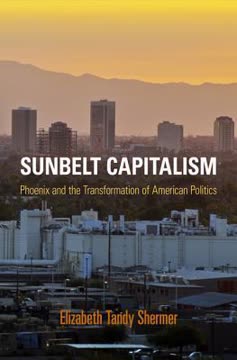
The reviews of Sunbelt Capitalism average 3.23 out of 5 stars. One reviewer appreciated the historical account of Barry Goldwater's business conservatives in Phoenix, noting their reliance on federal infrastructure while opposing labor rights, but criticized the book as repetitive and narrow, focusing too much on Chamber of Commerce minutiae. They also took issue with loose theoretical framing. A second reviewer, reading it for class, found the rise of Phoenix interesting and recommended a companion book on the broader Sunbelt transformation.








































