Key Takeaways
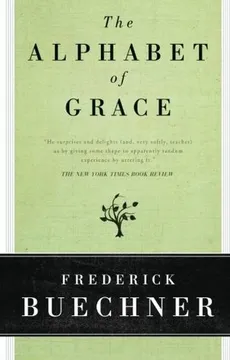
1. Everyday life is the alphabet of grace.
If there is a God who speaks anywhere, surely he speaks here: through waking up and working, through going away and coming back again, through people you read and books you meet, through falling asleep in the dark.
God's language. The author posits that God communicates not through grand, overt pronouncements, but through the ordinary, humdrum events of our daily existence. These seemingly insignificant moments form an "alphabet" through which divine meaning can be discerned. It's a call to find the sacred in the secular, the extraordinary in the everyday.
Incarnation in the mundane. This perspective suggests that grace is not an abstract concept but is "incarnated" in the tangible realities of our lives. From the simple act of breathing to the complex interactions with others, every experience holds the potential for revelation. It encourages a heightened awareness, a readiness to perceive deeper significance in what might otherwise be overlooked.
A continuous narrative. Our lives, with their routine tasks and unexpected turns, are continuously telling us something, guiding us somewhere. This ongoing narrative, composed of countless small incidents, hints at a larger purpose or "plot." The alphabet of grace invites us to read our own lives as a sacred text, seeking the melody within the random sounds.
2. Grace manifests in the "clack-clack" of the mundane.
And just this is the substance of what I want to talk about: the clack-clack of my life. The occasional, obscure glimmering through of grace. The muffled presence of the holy.
Subtle manifestations. Grace rarely appears as a blinding cosmic revelation or a dramatic miracle. Instead, it often arrives as a "dry clack-clack" – the sound of apple branches knocking together, a screen door slamming, or a single leaf fluttering. These are the "visible effects of the invisible," subtle stirrings that hint at a deeper reality without overwhelming us.
Broken images. The author emphasizes that these glimpses of the holy are always "broken, partial, ambiguous." Like the disciples at Emmaus who recognized Christ only in the breaking of bread before he vanished, we encounter grace in fragmented, fleeting moments. It's not about seeing the full picture, but recognizing the sacred in the incomplete.
Everyday miracles. This perspective redefines what constitutes a miracle. It's not necessarily the supernatural intervention that defies natural law, but the profound significance found within the natural.
- The sudden transformation of breathing into a spoken word in a dream.
- The unexpected connection forged in silence between strangers.
- The hint of melody emerging from random sounds.
These are the small, profound occurrences that make life compelling and real.
3. Our identity is a tapestry of past, present, and potential selves.
All the people I have ever been are buried there—the bouncing boy, his mother’s pride; the pimply boy and secret sensualist; the reluctant infantryman; the beholder at dawn through hospital plate-glass of his first-born child.
A necropolis of selves. The author describes himself as a "necropolis," a burial ground for all the past versions of himself. These former selves, though no longer actively lived, continue to reside within, influencing the present. They are ghosts that can be stirred by certain songs, tastes, or smells, shaping who we are now.
Inherited identities. We are also a composite of those who came before us—fathers, mothers, grandparents, teachers, friends. Their voices, mannerisms, and wisdom manifest in our own being.
- Hearing a dead grandfather's voice when taking a curve too fast.
- Rubbing a finger and thumb together, becoming a grandmother.
This intergenerational influence means we are never truly alone, but a living archive of human connection.
Unlived possibilities. Beyond the past, we also carry within us "all the people I have not been yet but might be someday." These are the unkept promises and undreamed dreams, the vast spectrum of human potential from saint to sinner. Our identity is not fixed but a dynamic, evolving entity, constantly being called into being.
4. Each day is both a first and a last, demanding full presence.
It is the first day because it has never been before and the last day because it will never be again. Be alive if you can all through this day today of your life.
A new creation. Every morning, waking up is akin to Adam on the morning of creation, given back life and the world anew. This perspective encourages approaching each day with fresh eyes, as if it has "never been before." It's an opportunity to name the world, to reassemble oneself from fragments, and to embrace new possibilities.
The finality of moments. Simultaneously, each day is also the "last day" because it will never be repeated. This awareness imbues every experience with a poignant preciousness, a "gilded with goodbyes" quality. It's a call to live fully, to keep unspoken words from remaining unspoken, and to live the life we have with those we love, today.
The choice to be alive. The author suggests a conscious choice in waking up, in embracing life over a metaphorical death. This choice involves engaging with the "slapstick needs" of the body, attending to the mundane, and finding meaning in the routine. It's about living the day out, not dreaming it out, and opening the "presents" the world offers.
5. Belief is a journey of uncertain, half-miracles and longing.
I believe without the miracles I have prayed for then; that is what I am explaining. I believe because certain uncertain things have happened, dim half-miracles, sermons and silences and what not.
Faith amidst doubt. The author grapples with the nature of belief, acknowledging his "congenital believer" tendencies and his hunger for the marvelous, yet also his skepticism. He questions whether his faith is a fabrication born of need, a "melancholy blunder." This honest wrestling with doubt is central to his understanding of faith.
Uncertain occurrences. His belief is not founded on undeniable, self-authenticating religious experiences, but on "dim half-miracles."
- The "great laughter" sermon that brought unexpected tears.
- The profound silence of a monastery visit.
- The "clack-clack" of apple branches.
These events, though not grand, held a "queer power" that resonated deeply, leaving room for both wonder and questioning.
The miracle of believing. Ultimately, the author suggests that perhaps the miracle itself is the act of believing, the persistence of faith despite the absence of clear signs. It's the longing that cannot be questioned, the hand reaching out in the dark even if no hand is felt. This ongoing act of faith, of not giving up, becomes its own testament to grace.
6. The divine speaks through metaphor and the ordinary.
The language of God seems mostly metaphor. His love is like a red, red rose. His love is like the old waiter with shingles, the guitar-playing Buddhist tramp, the raped child and the one who raped her.
Metaphorical language. God's communication is not literal but metaphorical, embracing the full spectrum of human experience, from beauty to suffering. No image is too "far-fetched," no sound too "harsh," no allusion too "obscure or outrageous." This expansive view suggests that the divine can be found in the most unexpected and even disturbing aspects of life.
Gutturals of grace. The "alphabet of grace" is full of "gutturals"—harsh, primal sounds that reflect the raw, unvarnished reality of existence. This implies that grace is not always gentle or comforting, but can be challenging, even painful. It encompasses the full range of human experience, including suffering and moral ambiguity.
Incarnation in all things. The author sees incarnation not just in the historical figure of Christ, but as a continuous process where "spirit becoming word," and "silence becoming prayer." This means that the divine is constantly manifesting in the tangible world, transforming the "drab and hubbub of our lives" into something sacred.
7. True connection requires vulnerability and mutual recognition.
Whatever “we love you” means, he meant—that at least for a moment they had seen who I was, really saw more or less who it was who had been sitting there in that face all those weeks awaiting and dreading his time, and they wished me well, they willed my good, my peace.
Beyond surface interactions. The author reflects on the "games" people play to avoid true connection, where "How are you?" means "Don't tell me who you are." These interactions create an illusion of togetherness while maintaining individual isolation, like "bathyspheres at the bottom of the sea."
The miracle of being known. A profound experience in a group-dynamics session, where a colleague said, "We love you too," revealed the deep human need "to be known, to be forgiven, to be healed, which I suppose is to say... to be loved." This moment of genuine recognition, seeing beyond the "face" or persona, is described as an "ancient and most holy miracle."
Left-handed clasp. The analogy of shaking hands with the left hand, rather than the customary right, symbolizes a departure from habitual, superficial interactions. The left hand, "the country-cousin gawking down Broadway," offers the advantage of inexperience, allowing for a more authentic, life-touching connection.
- Right hands have "forgotten how to clasp in any but a chit-chat way."
- Left hands can "touch life into each other."
This vulnerability allows for a deeper, more meaningful encounter where "one plus one is more than two."
8. The cost of being human is everything, including letting go.
To be rich, he must be willing to spend himself down to the last nickel. To be happy, he must be willing to let his heart break. To be blessed, he must be willing to live like a damned fool—giving not getting, losing not winning, reaching out into the night for a hand that’s not there, dancing a dance that clack-clack is the only music to.
The price of a heart. The author explores the question of "what it costs to be a man," drawing parallels to the Tin Woodman, Cowardly Lion, and Scarecrow from Oz. It's a question about the price of a heart, courage, or a brain—essentially, the cost of true humanity. The answer is "everything he's got."
Embracing vulnerability. This cost involves a radical willingness to let go of control, to embrace pain, loss, and even foolishness. It means:
- Spending oneself down to the last nickel.
- Letting one's heart break.
- Giving, not getting.
- Losing, not winning.
This paradox suggests that true fulfillment comes through self-emptying and vulnerability, rather than accumulation or self-protection.
The struggle to let go. The old man in the author's novel, contemplating a puddle reflecting the sky, feels an impulse to jump into it but resists. He realizes that the "poison you have to get rid of to be well is part of who you are, you will not let it go without a rumpus." This illustrates the profound difficulty of letting go of one's "death" (ego, fear, self-preservation) even in order to truly live.
9. Religion's essence is mystical encounter, a summons to mystery.
Religion as a word points essentially, I think, to that area of human experience where in one way or another man happens upon mystery as a summons to pilgrimage, a come-all-ye; where he is led to suspect the reality of splendors that he cannot name.
Beyond dogma and institution. The author argues that at its heart, religion is fundamentally mystical, preceding institutions, ethics, or dogma. It begins with a profound, ineffable experience—a "lump in the throat," a "bush going up in flames," a "rain of flowers." These are moments where a "doorway opened in the air," a word was spoken, and a response was elicited.
A summons to pilgrimage. This encounter with mystery is a "summons to pilgrimage," an invitation to a journey towards splendors that cannot be fully named or understood. It's a sensing of overwhelming meanings that can only be hinted at through myths, rituals, and "foolish, left-handed games."
Universal mysticism. Buechner suggests that "we are all of us more mystics than we believe or choose to believe." Through moments of beauty or pain, sudden life changes, or even the horrors of the news, we catch "glimmers at least of what the saints are blinded by." The religious dimension of life begins when we choose to acknowledge these glimmers and proceed as if something significant has indeed happened, even if its full meaning remains elusive.
10. Faith is filling in the vowels of life's consonants.
The alphabet is finally the Hebrew alphabet. There are nothing but consonants, and it is left to the faithful to fill in the vowels with faith.
The unsaid and the implied. The author concludes that the "most crucial thing is always the thing that is not said." Life, like the Hebrew alphabet, presents us with consonants—the raw, uninterpreted events and facts. It is the individual's task, through faith, to supply the "vowels," to infuse these events with meaning, purpose, and grace.
A personal interpretation. This act of "filling in the vowels" is deeply personal and subjective. It acknowledges that while the external events (the consonants) are shared, the internal interpretation and meaning (the vowels) are unique to each person's faith journey. It's a continuous, active process of making sense of the world.
The wildness of truth. Since the true nature of reality "beggars all alphabets," the author suggests that "the wilder the metaphor the nearer the wildness of truth." This encourages a creative, imaginative approach to faith, recognizing that conventional language often falls short. It's about embracing the "may be" of truth, the possibility that the grandest, wildest, and most joyous things are indeed true, even if clumsily expressed through the "alphabet of old men and dead crows."
Review Summary
People Also Read

Download PDF
Download EPUB
.epub digital book format is ideal for reading ebooks on phones, tablets, and e-readers.








































