

Key Takeaways
Barakah is more with less: divine abundance that defies arithmetic
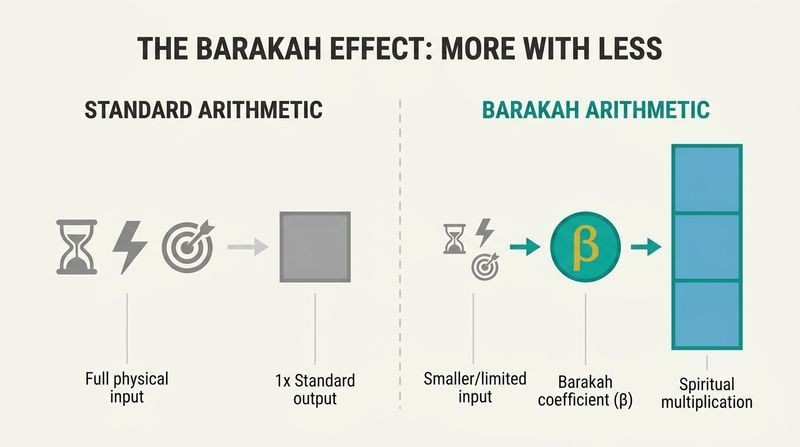
The book's central thesis. Barakah is often translated as "blessing," but Faris defines it as divine goodness that Allah attaches to time, wealth, relationships, or objects, creating a spiritual multiplier that transcends cause and effect. Little with Barakah beats abundance without it.
Consider Al-Baik, Saudi Arabia's beloved fried chicken chain. Its founder Shakour vowed to donate one riyal to charity for every chicken sold, even when the business was failing. Decades later it thrived against 400 copycats and multimillion-dollar competitors like KFC. Faris credits the charitable seed. His equation captures it: normally Energy times Focus times Time equals Outcome, but adding the beta (Barakah) coefficient multiplies each variable. Wake at dawn and 30 minutes of writing yields what three hours would elsewhere.
The concept resonates beyond Islam. Positive psychology's "flow" states and the compounding returns of habit both describe disproportionate output from modest input. What's distinctive here is attribution: Faris locates the multiplier in the divine rather than in neurochemistry or systems. Skeptics will note this makes Barakah unfalsifiable, since any outcome can be reframed as blessing or its absence. Yet that critique misses the pragmatic function. Believing that sincere small acts compound invisibly changes behavior in measurable ways, much as the placebo effect produces real physiological change. The Al-Baik story also echoes Adam Grant's research showing that generous "givers" often outperform selfish "takers" over long horizons.
Reject Hustle Culture; it runs on materialism and fear of death
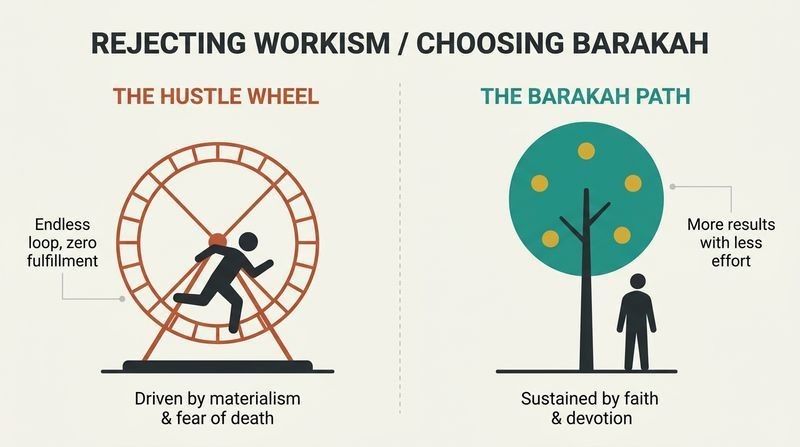
Work has become a false religion. Faris borrows Derek Thompson's term "workism" to describe how careers now promise identity, community, and meaning that faith once supplied. A 2019 Pew study found 95% of teens ranked an enjoyable career as extremely important, above helping others or marriage.
He diagnoses five pillars propping up this addiction:
1. Materialism (worth measured by wealth)
2. Individualism (the self-made hero myth)
3. Consumerism (the endless upgrade treadmill)
4. Capitalism (the doctrine that more is always better)
5. Fear of death (packing life with accomplishment to avoid emptiness)
He cites Keynes, who predicted in 1930 that growth would shrink the workweek to 15 hours. Instead, the affluent work more, chasing a mirage. The antidote, Faris argues, is the five pillars of Islam, each one countering a pillar of hustle.
The five-pillars-versus-five-pillars symmetry is rhetorically elegant, perhaps too tidy. Still, the underlying critique is empirically grounded. Sociologist Max Weber traced modern work devotion to the Protestant ethic, and Faris essentially argues the Muslim world imported this framework wholesale during colonial catch-up. The fear-of-death claim connects to Ernest Becker's "Denial of Death" and Terror Management Theory, which the book cites: research shows mortality reminders intensify materialism and status-seeking. Where the argument strains is treating capitalism and ambition as near-synonymous with spiritual decay. The book itself later concedes ambition can be virtuous, suggesting the real target is not work but work worship.
Purify your intention; sincerity for God alone unlocks maximum Barakah
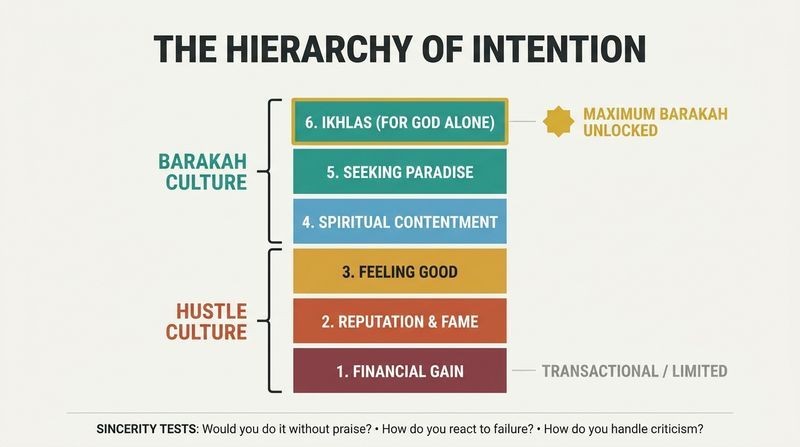
Actions are judged by intentions. Faris ranks intentions on a six-level hierarchy adapted from scholar Sulaiman Nadwi. The bottom three belong to Hustle Culture: financial gain, reputation and fame, and feeling good. The top three belong to Barakah Culture: spiritual contentment, seeking paradise, and ikhlas (acting purely for God with no desire for reward here or hereafter).
The Arabic word for intention, niyyah, shares a root with "seed." Bury it deep, water it with effort, and trust God to sprout it beyond expectation. Faris tested his own sincerity before a major keynote by praying he would NOT witness the standing ovation, only that God accept it. He walked offstage before the applause. Three sincerity tests: Would you do it without praise? How do you react to failure? How do you handle criticism?
The intention hierarchy maps neatly onto Self-Determination Theory, which distinguishes extrinsic motivation (money, status) from intrinsic and integrated motivation. Decades of research by Deci and Ryan show intrinsically motivated people show greater persistence and wellbeing, echoing Faris's claim that lower intentions produce emptiness. His keynote anecdote illustrates a subtle trap psychologists call "moral licensing": even spiritual acts can feed ego. The genuine difficulty, which the book honestly acknowledges, is that intention cannot be forced. This is where secular self-help often overpromises. Faris's humbler prescription, to prepare the heart and repeat corrective supplications, resembles cognitive reframing more than willpower.
Be a gardener, not a carpenter: control effort, surrender outcomes
The book's most practical mental model. A carpenter has a fixed blueprint and grows frustrated when reality deviates. A gardener plants, waters, and works hard but accepts that fruit depends on forces beyond control. Faris borrows the metaphor and roots it in his gardener equation: Free Will plus Natural Laws plus Allah's Will equals Outcome.
Your job is threefold: set sincere intentions (free will), align with cause and effect like planting the right seeds in the right soil (natural laws), and make dua while trusting the result (Allah's will). The Quran drives it home by asking whether you make the crop grow or God does. Applied to goal-setting, Faris urges process goals over achievement goals: "write 500 words daily" rather than "become a bestselling author," because process becomes habit while outcomes can feel like unreachable mirages.
This is Stoicism in Islamic dress, and the resemblance is remarkable. Epictetus taught the dichotomy of control: focus on what is yours (judgments, effort) and accept what is not (outcomes, reputation). Faris adds a theological third variable, divine will, which the Stoics folded into "Nature" or "Logos." The process-goals insight aligns with James Clear's systems-over-goals argument and with research on the planning fallacy, our chronic overconfidence about outcomes we do not control. The gardener frame is genuinely useful for anxiety: it decouples self-worth from results. One caution: surrender can shade into passivity if the "tie your camel" half (rigorous effort) gets neglected.
Say Bismillah before every act to consecrate the mundane
The smallest ritual, outsized effect. "Bismillah" (in the name of God) transforms routine acts into worship and, scholars warn, anything begun without it lacks Barakah. Faris shares the folk tale of a woman whose habit of saying Bismillah led to a ring, thrown in a river by her doubting husband, reappearing inside a fish she bought at market.
He cites 19th-century theologian Said Nursi's parable: crossing a bandit-filled desert, the traveler who invokes a powerful chief's name passes safely, while the proud loner perishes. Saying Bismillah is enrolling under divine protection. Faris connects this to Newberg and Waldman's book "Words Can Change Your Brain," arguing a conscious, sincere invocation orients mind and heart toward the divine. Practical nudge: it also deters wrongdoing, since you cannot comfortably say Bismillah before a sin.
The neuroscience citation is a stretch worth examining. Newberg's research concerns sustained meditation and repeated affirmation, not single utterances, so the bridge to Bismillah is more analogy than evidence. Still, the behavioral logic is sound. Rituals of consecration function as "implementation intentions," a concept from psychologist Peter Gollwitzer showing that linking an action to a specific cue dramatically increases follow-through and mindfulness. The self-deterrence point is especially shrewd: it turns a two-second phrase into an ethical checkpoint, resembling the Stoic practice of imagining a wise observer watching your conduct. Small friction, applied at the threshold of action, reliably shapes behavior.
Gratitude multiplies blessings; the "99 problem" reveals why we can't feel it
Thankfulness is a Barakah machine. The Quran promises that gratitude brings increase. Faris recounts feeling overwhelming shukr (gratitude) in a Jeddah mosque, then landing two unexpected contracts days later. He measures "enough" by a Prophetic standard: if you wake safe at home, healthy, with food for the day, you possess the whole world.
The barrier is illustrated by the "99 problem" parable. A content, singing servant is given a bag labeled 100 gold coins containing only 99. He becomes miserable hunting the missing coin, losing the peace he had while poor. Sudden abundance can destroy contentment. Faris distinguishes gratitude from complacency: you can hold high ambition for the Hereafter while being fully content with your worldly portion, seeking sustenance "beautifully" (moderately, ethically) as the Prophet taught, rather than desperately.
The 99 problem is a folk expression of the hedonic treadmill, the well-documented tendency to adapt to gains and reset to baseline dissatisfaction. Behavioral economics adds loss aversion: losing one coin stings more than gaining ninety-nine pleases. Faris's remedy, disciplined gratitude practice, is validated by Emmons and McCullough's landmark studies showing gratitude journaling improves wellbeing and even sleep. His sharper contribution is theological reframing: gratitude directed at a Giver, not just cataloged as positive events. This may explain why some studies find religious gratitude more durable. The contentment-plus-ambition distinction usefully preempts the common objection that gratitude breeds passivity.
Serve your parents with excellence; their pleasure channels divine favor
Paradise lies beneath the mother's feet. Faris argues that honoring parents (husna, the best possible treatment) is a potent and neglected source of Barakah, eroded by Hustle Culture's individualism and rising parent-child estrangement in the West. He tells of wealthy men who visit their mothers daily despite crushing schedules, understanding their success flows from that service.
But he refuses to endorse spiritual blackmail. His three-principle framework: lay a foundation of mercy (see a controlling parent as someone frightened of losing relevance), recognize husna means something different to each generation, and disagree respectfully. His model is Prophet Ibrahim confronting his idol-worshipping father: he repeatedly said "O my father," asked questions rather than accusing, offered evidence gently, and stayed calm even when threatened. Serving parents, Faris insists, never requires forfeiting your own legitimate life choices.
The balance struck here is more sophisticated than typical religious exhortations to obedience. Faris explicitly validates boundaries, addressing the real trauma of coercive families, which distinguishes his approach from guilt-driven cultural pressure. The "see the fear behind the control" reframe echoes attachment theory and Nonviolent Communication, both of which locate difficult behavior in unmet needs. There is also gerontological wisdom: research on aging shows loss of autonomy and social role drives much late-life irritability. One tension the chapter leaves open: what happens when a parent's demand and a child's wellbeing are genuinely irreconcilable? Faris gestures at mercy and respectful disagreement, but the hardest cases resist tidy frameworks.
Plant seeds for a thousand-year harvest, not a personal legacy
Adopt an Akhira (Hereafter) paradigm. Faris challenges readers to act as travelers passing through this world, investing in what outlasts them. The Prophet named three deeds that keep rewarding you after death: ongoing charity, beneficial knowledge, and a righteous child who prays for you.
But he says most people fulfill these lazily. A well runs dry in five years; a mosque crumbles unmaintained. Real Hereafter investing means building durable institutions, ideally a waqf (an endowment where an asset is permanently dedicated to God, its proceeds funding charity forever). He cites research that by the early 1800s, over half the Ottoman Empire's real estate was endowed as waqf, functioning as a cradle-to-grave social safety net. Crucially, this differs from Hustle Culture's legacy-building, which centers the ego rather than God.
The waqf history is the chapter's most valuable contribution, and it is genuinely underappreciated in Western discourse on civil society. Long before modern philanthropy, Islamic endowments provided hospitals, universities, and welfare, an early model of decentralized, non-state public goods. Economic historian Timur Kuran has argued, more critically, that the waqf's rigidity (assets frozen in perpetuity) eventually hampered Muslim economic development, a tension Faris does not engage. The ego-versus-God distinction is psychologically astute: research on "generativity" (Erikson's term for caring about future generations) links it to late-life meaning, though secular generativity is often explicitly about being remembered, exactly what Faris warns against.
Persist through sabr and salah; quit only when God shuts the door
Perseverance plus prayer is the engine of achievement. Faris reframes sabr not as passive patience but active perseverance, and pairs it with salah (the five daily prayers) as its fuel. He notes caliphs and scholars prayed extra hundreds of units daily to build spiritual capacity for their burdens. Hustle Culture relies on finite grit; Barakah Culture draws on an unlimited divine source.
When deciding whether to persist or quit, he offers istikhara, a four-step Prophetic decision process: clarify the decision and your intention, seek counsel from wise people, pray the istikhara prayer asking God for goodness, then act on where your heart inclines with full trust. His rule of thumb: persist for God-centered, Hereafter-focused goals even amid struggle; be willing to release purely ego-driven, worldly ones. Only total impossibility (bankruptcy with no path back) signals genuine quitting.
The grit-has-limits claim is quietly profound and challenges Angela Duckworth's popular framing of grit as a renewable trait. Faris suggests willpower is depletable (aligning with ego-depletion research, though that literature is now contested) and that ritual replenishes it, which resonates with studies showing meditation and prayer reduce stress reactivity and restore self-regulation. The istikhara framework is essentially structured decision-making under uncertainty, combining stakeholder consultation, deliberate deadline-setting, and intuition, remarkably similar to what decision scientists recommend. Its unique feature is outsourcing the residual anxiety to God, which offers a psychological benefit secular frameworks lack: the ability to act decisively without regret when outcomes are unknowable.
Remember death often to snap out of the rat race
Death is the antidote to distraction. Faris argues modern life sanitizes death into hospitals and nursing homes, treating it as a technological failure rather than a certain appointment. Yet remembering it frees you from four pillars of Hustle Culture: you cannot take materialism with you, death equalizes all individualism, it curbs consumerist shopping, and it motivates generous giving over hoarding.
He cites psychologists Zimbardo and Boyd: denying death makes us treat time like endless grains of sand rather than something more precious than gold, so we live less fully. His practical prescriptions are visceral: attend funeral prayers regularly, witness burials monthly, wash and carry bodies, contemplate your own death weekly, discuss it openly with family, and prepare an "in case I die" file with your will and passwords.
This inverts Terror Management Theory in a fascinating way. TMT research shows death reminders usually trigger defensive materialism and worldview clinging, exactly what Faris opposes. Yet other studies (and the Stoic memento mori tradition, plus Buddhist maranasati meditation) suggest that deliberate, sustained death contemplation, rather than sudden threat, can reduce materialism and increase intrinsic values. The difference may be dosage and framing: fleeting fear defends the ego, while structured reflection dissolves it. Faris's embodied practices (washing corpses, monthly burials) are more radical than a gratitude journal and likely more effective, since abstract mortality rarely moves us. The "in case I die" file is refreshingly concrete.
Structure your entire day around prayer, as the Prophet did
The Prophetic routine is a Barakah blueprint. Faris reconstructs a typical day of Prophet Muhammad in Medina and extracts habits that modern productivity culture ignores. He wakes before dawn (the hours the Prophet called blessed), stays mindful in his first waking moments rather than grabbing a phone, and anchors the whole day around five prayers that function like battery recharges.
Key observations: he napped (the most influential man in history made time to rest), he visited his community rather than expecting visits, he never had a marked special seat, he served his own family with chores, and he spent nights in long voluntary prayer as "self-care." Faris contrasts our obsession with billionaire morning routines, which are curated, one-dimensional, and belong to the privileged 1%, against a fully documented life that succeeded against every disadvantage.
The critique of billionaire-routine culture is sharp and fair: survivorship bias means we study winners' habits while ignoring identical habits in those who failed. Faris's alternative, a life recorded in granular public and private detail, sidesteps the pseudo-truth problem. The prayer-as-recharge insight aligns with research on "microbreaks" and ultradian rhythms, showing performance improves with regular structured pauses rather than sustained grinding. The nap endorsement is well supported by sleep science. What the reader must weigh independently is whether the five-prayer cadence works as a universal productivity structure or as a specifically devotional one; Faris treats them as inseparable, which is coherent within his worldview but not portable to everyone.
Send abundant salawat on the Prophet as a shortcut to blessing
The closing ritual of Barakah Culture. Salawat means invoking God's blessings upon Prophet Muhammad. The Prophet said whoever sends it once receives tenfold from God. Faris presents it as the fastest way to attract Barakah and to cultivate the love and reverence that motivates emulation.
He frames the Prophet's own life as saturated with Barakah on three levels: in his being (people noticed increase in food and wealth around him), in his life (an orphan who lost parents, sons, daughters, and wife yet became history's most influential person, per Michael Hart's ranking), and in his daily routine. When Ubayy bin Ka'b asked how much of his prayer time to devote to salawat, the Prophet said devoting all of it would solve his worries and forgive his sins. Practical minimum: 100 salawat morning and evening, increased abundantly on Fridays.
For non-Muslim readers this chapter is the least transferable, but its underlying mechanism is universal: devotional repetition of a loved figure's name builds emotional attachment and, through that attachment, behavioral emulation. This is how veneration works across traditions, from Christian contemplation of Christ to Buddhist recollection of the Buddha. The love-drives-imitation logic is psychologically sound; social learning theory shows we model those we admire most. Michael Hart's ranking, cited as external validation, is a single scholar's provocative opinion rather than consensus, so it carries rhetorical rather than evidentiary weight. The "solve your worries" promise functions much like a mantra, offering the documented stress-reduction benefits of rhythmic, meaningful repetition.
Analysis
"The Barakah Effect" is a thesis-driven work of Muslim self-help that attempts something ambitious: to offer an entire alternative operating system for productivity rooted in Islamic theology. Its structure is bifurcated, first diagnosing why modern Muslims feel spiritually depleted (the loss of Barakah to materialism), then prescribing a cure via a 100-word "Barakah Culture Manifesto" that anchors the second half's chapters. The difficulty in summarizing it lies in its density of layered sources: Quranic verses, hadith, medieval scholars like Ibn Ata'illah and Al-Ghazali, and modern secular research from The Atlantic to Terror Management Theory, all woven around folk parables.
What elevates the book above devotional platitude is Faris's willingness to translate mysticism into frameworks a management consultant would recognize: the Barakah coefficient equation, the gardener-versus-carpenter dichotomy, the six-level intention hierarchy, the istikhara decision process. This is Barakah as productivity science, and it is the book's genuine innovation. Faris essentially rediscovers Stoic and positive-psychology principles (dichotomy of control, intrinsic motivation, gratitude practice, memento mori) and grounds them in a theistic framework that supplies what secular versions lack: a locus for surrender and a reason to trust that unseen effort compounds.
The book's chief vulnerability is unfalsifiability. Because Barakah operates "beyond cause and effect," any outcome confirms the theory, which will frustrate empirically minded readers. Its critique of capitalism and ambition occasionally overreaches, though Faris hedges by distinguishing God-centered ambition from ego-driven hustle. The most historically valuable material, the waqf endowment system, deserved deeper economic treatment. Overall, the work succeeds as a coherent counter-narrative to workism for a Muslim professional audience, and its frameworks travel surprisingly well across traditions. Its deepest claim, that little with blessing beats much without it, is less a testable proposition than a reorientation of what one measures as success in the first place.
Review Summary
The Barakah Effect is highly praised by readers for offering an Islamic perspective on productivity and life balance. Reviewers appreciate its focus on spiritual well-being, practical advice, and emphasis on living a God-centric lifestyle. Many readers find the book inspiring and transformative, noting its ability to shift perspectives away from hustle culture. The book is commended for its comprehensive approach, blending Islamic teachings with practical frameworks. Readers particularly value the author's use of Quranic references and hadith, as well as the book's applicability to daily life.
People Also Read





FAQ
1. What is "The Barakah Effect: More With Less" by Mohammed Faris about?
- Core concept of Barakah: The book explores the Islamic concept of Barakah, a divine blessing that brings abundance, prosperity, and happiness beyond logical explanation.
- Contrast with Hustle Culture: It contrasts Barakah Culture with modern Hustle Culture, advocating for a God-centered, balanced lifestyle that achieves more with less through spiritual means.
- Practical frameworks: Mohammed Faris provides actionable frameworks rooted in Islamic teachings to help readers attract Barakah in time, wealth, relationships, and work.
2. Why should I read "The Barakah Effect: More With Less" by Mohammed Faris?
- Spiritual and practical blend: The book uniquely combines traditional Islamic wisdom with modern productivity science, making Barakah actionable in daily life.
- Counter to modern stress: It offers an alternative to the anxiety and burnout of Hustle Culture, promoting peace, purpose, and sustainable success.
- Empowerment for all: Insights are relevant for both Muslims and non-Muslims seeking deeper meaning and productivity beyond material gain.
3. What are the key takeaways from "The Barakah Effect: More With Less" by Mohammed Faris?
- Barakah as a multiplier: Barakah is a spiritual force that amplifies results, allowing one to achieve more with less effort.
- Mindsets and rituals matter: Adopting specific mindsets, values, and rituals rooted in faith is essential for attracting Barakah.
- God-centered living: Shifting from ego-centric to God-centric living brings contentment, abundance, and long-term impact.
- Practical application: The book provides checklists, frameworks, and daily practices to help readers implement Barakah Culture in all areas of life.
4. What is Barakah according to "The Barakah Effect: More With Less" by Mohammed Faris?
- Divine gift: Barakah is a gift from Allah that can be placed in anything—time, wealth, people, or places—bringing growth and goodness beyond expectations.
- Spiritual multiplier effect: It creates superabundance and positive outcomes that transcend normal cause-and-effect logic.
- Connection to Allah: True Barakah draws one closer to Allah; blessings that distract from Him lack Barakah and may lead to spiritual loss.
5. How does Mohammed Faris define the "Barakah Effect" mathematically in "The Barakah Effect: More With Less"?
- B Coefficient formula: Barakah is represented as a coefficient (β) that multiplies energy, focus, and time to produce an enhanced outcome: β(Energy) x β(Focus) x β(Time) = β(Outcome).
- Spiritual multiplier: This coefficient symbolizes the divine blessing that amplifies human effort, allowing for greater results with less input.
- Practical example: Early morning work (a time blessed with Barakah) can make a short session as productive as several hours at other times.
6. What is the difference between Barakah Culture and Hustle Culture in "The Barakah Effect: More With Less" by Mohammed Faris?
- God-centric vs ego-centric: Barakah Culture centers life around serving Allah, while Hustle Culture focuses on self and material success.
- Purpose-driven vs success-driven: Barakah Culture seeks long-term impact and Hereafter focus; Hustle Culture chases short-term gains and accolades.
- Abundance vs scarcity mindset: Barakah Culture embraces generosity and trust in Allah’s provision, while Hustle Culture fosters competition and fear.
7. What is the "Gardener Mindset" in "The Barakah Effect: More With Less" by Mohammed Faris, and how does it differ from Hustle Culture?
- Nurturing over control: The gardener mindset focuses on nurturing intentions and processes, not obsessing over outcomes.
- Trust in Allah: It emphasizes working hard while trusting Allah for results, embodying the principle of “Tie your camel, and trust in Allah.”
- Embracing setbacks: This mindset encourages patience, learning from challenges, and gratitude, in contrast to Hustle Culture’s fixation on immediate results.
8. What is the Barakah Tree metaphor in "The Barakah Effect: More With Less" by Mohammed Faris, and how can it be applied?
- Components of growth: The Barakah Tree represents intentions as seeds, environment as soil, spiritual mindsets and rituals as nutrients, and consistent effort as the process.
- Checklist for projects: Before starting any endeavor, ensure intentions are God-centered, the environment is supportive, values are present, and processes are well-managed.
- Practical application: For example, in career growth, align intentions, improve the environment, infuse spiritual values, and dedicate focused effort to attract Barakah.
9. How does "The Barakah Effect: More With Less" by Mohammed Faris suggest setting goals differently?
- Intentions over visions: Focus on pure, powerful intentions (the why) rather than rigid visions, allowing for flexibility as circumstances change.
- Seasonal awareness: Recognize your current life season—personal, professional, or spiritual—to set realistic and timely goals.
- Process goals and detachment: Prioritize habits and routines over achievement goals, and detach from results by trusting Allah and maintaining patience.
10. What practical framework does Mohammed Faris propose for living with Barakah in "The Barakah Effect: More With Less"?
- Three pillars: The framework is built on cultivating mindsets, values, and rituals rooted in Islamic faith, such as God-consciousness, gratitude, and reliance on Allah.
- Barakah Culture Manifesto: A concise manifesto encapsulates principles like sincere intention, serving with excellence, cherishing parents, and persistent prayer.
- Daily practice: Readers are encouraged to implement one mindset, value, and ritual each week for gradual transformation toward a Barakah-centered life.
11. How does "The Barakah Effect: More With Less" by Mohammed Faris explain the importance of intentions and how to cultivate them?
- Intentions as foundation: Actions are judged by intentions; sincere intentions to worship Allah in every act unlock the Barakah Effect.
- Hierarchy of intentions: The book outlines six levels, from worldly gain to pure sincerity (ikhlas), with higher levels attracting more Barakah.
- Cultivating sincerity: Practical steps include self-awareness, resisting ego-driven motives, focusing on pleasing Allah, and regularly renewing intentions.
12. What role do sabr (perseverance) and salah (prayer) play in achieving goals according to "The Barakah Effect: More With Less" by Mohammed Faris?
- Sabr as active perseverance: Sabr is defined as active persistence and trust in Allah, essential for enduring trials and pursuing ambitious intentions.
- Salah as spiritual fuel: Prayer replenishes spiritual strength, enabling one to maintain sabr and focus on higher goals.
- Combined power: Together, sabr and salah help navigate setbacks, maintain focus, and seek Allah’s guidance, with practical tools like the four-step istikhara process for decision making.
About the Author
Other books by Mohammed Faris
Download PDF
Download EPUB
.epub digital book format is ideal for reading ebooks on phones, tablets, and e-readers.








































