Key Takeaways
1. Redefining Black Speculative Fiction
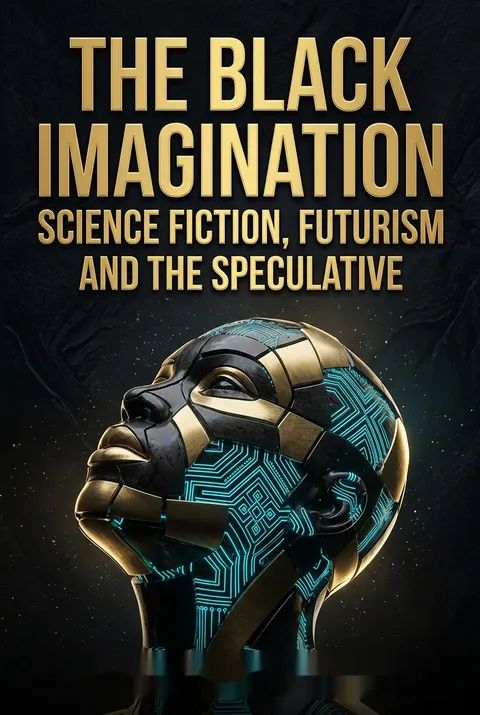
This book expands the discourse as well as the nature of critical commentary on science fiction, speculative fiction and futurism – literary and cinematic by Black writers.
Broadening critical scope. The book serves as a pivotal work, aiming to significantly broaden the academic and critical conversation surrounding science fiction, speculative fiction, and futurism. It specifically focuses on contributions from Black writers and filmmakers, moving beyond the often narrow, Western-centric perspectives that have historically dominated the genre's analysis. This expansion is crucial for recognizing the diverse voices and unique thematic concerns within Black speculative narratives.
Centering Black agency. A core objective is to highlight narratives where African descendant people are not merely absent, marginalized, or expendable background characters. Instead, the book champions stories where Black individuals are active agents, protagonists, and heroes, shaping events on Earth or across the universe, whether set in alternative pasts, distant futures, or near-future scenarios. This shift in focus underscores the importance of representation and self-determination within imagined worlds.
Interdisciplinary approach. The collection brings together scholars from various disciplines to offer fresh, innovative critical strategies. These approaches delve into complex issues such as race, gender, sexuality, power, agency, and resistance to domination and imperialism within both literary and cinematic SF narratives. By doing so, the book aims to fill significant gaps in the field and foster greater interest in the black imagination's power to envision alternative futures.
2. Broadening the Genre's Scope
In Speculative Fiction the action of the story can take place in a culture that never existed, a world we know nothing of, or an earth that might have been or might be.
Inclusive genre definition. The book champions a broad and inclusive understanding of "speculative fiction," positioning it as an umbrella term that encompasses all forms of fantastic fiction. This includes science fiction, fantasy, horror, supernatural fiction, apocalyptic and post-apocalyptic narratives, utopian and dystopian tales, alternative history, and magic realism. This expansive definition allows for a more comprehensive appreciation of diverse Black narratives that might not fit traditional, narrower SF categories.
The "What if?" question. At the heart of speculative fiction, as articulated by writers like Orson Scott Card, is the fundamental question: "What if?" This inquiry drives stories set in unknown futures, alternate historical pasts, other worlds, or those that defy known laws of nature. This imaginative freedom is particularly vital for Black writers, enabling them to explore different futures, pasts, and presents of societies and cultures in multifaceted ways, unconstrained by conventional thought.
Literature of freedom. Speculative fiction is presented as a literature of freedom, liberating authors from conventional thought and allowing readers to immerse themselves in discovery. This genre provides a unique platform for authors to ask relevant, provocative questions about society that might be challenging to address in more mainstream forms. For Black writers, this freedom has been instrumental in envisioning worlds where people of color are central to the narrative, actively shaping their destinies and challenging existing power structures.
3. Challenging Historical Erasures
While the genre of science fiction (SF) has a long history of social commentary (since the 1800s), until recently, it has not given much attention to issues of race and ethnicity in the context of imagined futures.
Historical neglect of race. Historically, the science fiction genre, despite its long tradition of social and political commentary, largely overlooked issues of race and ethnicity within its imagined futures. Early foundational works by authors like Mary Shelley, Jules Verne, and H.G. Wells, while exploring themes of empire and societal change, often either omitted Black characters or relegated them to stereotypical, alien signifiers of difference, reflecting Western-centric experiences and geopolitics.
Early Black speculative pioneers. The book challenges the misconception that Black sci-fi writers only emerged in the mid-20th century. It highlights earlier Black authors who utilized speculative idioms to imagine futures where Black and other non-white peoples were central agents of their own lives and global political change. Key examples include:
- W.E.B. Du Bois's "The Comet" (1920) and Dark Princess (1928)
- Charles W. Chesnutt's "The Goophered Grapevine" (1887)
- George S. Schuyler's Black No More (1931) and Black Empire (1936-38)
Expanding the canon. These works, though not always explicitly self-identified as science fiction by their authors, clearly employed genre conventions to offer salient social commentary, particularly regarding the state of the race. By including these foundational texts, the book significantly expands the framework of the genre, demonstrating a rich and continuous tradition of Black speculative thought that has long been overlooked in mainstream SF scholarship.
4. Black Superheroes as Afrofuturist Metaphors
In particular, the black superheroes that are ensconced in a SF motif function not only as counter-hegemonic symbols of black racial pride and racial progress but possibly even as Afrofuturistic metaphors for imagining race and black racial identity in new and provocative ways.
Counter-hegemonic symbols. Black superheroes, embedded within a science fiction motif, serve as powerful counter-hegemonic expressions of black racial pride and progress. They challenge the historical racial biases prevalent in superhero comics, which often reinforced real-world racial hierarchies and presented white heroes as symbols of American imperialism and racial superiority. These characters offer alternative, idealized projections of black physical power and fantastic abilities.
Afrofuturistic reimagining. These figures act as transformative Afrofuturistic metaphors, enabling new and provocative imaginings of race and black racial identity. They move beyond simplistic racial critiques, offering complex portrayals that integrate science, speculative fiction, black culture, African tradition, and technology. Examples discussed include:
- Black Panther (T'Challa): A regal, super-intelligent African prince from the technologically advanced nation of Wakanda, challenging primitive stereotypes of Africa.
- Steel (John Henry Irons): A black weapons engineer who becomes a superhero, revitalizing the black American folk hero John Henry with a sci-fi flair.
- Nick Fury (Samuel L. Jackson version): A black super-agent and leader of a hi-tech agency, signaling a post-race cultural politics and associating black identity with advanced technology.
- Storm (Ororo Munroe): A black female superhero and leader of the X-Men, embodying a black womanist perspective and challenging patriarchal structures.
Beyond conventional representation. Black superheroes provide an escape from conventional, often ghetto-centric, representations of black racial identity. They offer a galactic vision of blackness, fusing extraterrestrial themes, experimental technoculture, and cybertronic elements with the "black is beautiful" ethos. Their presence in mainstream comics marks a significant (re)imagining of black folk as innovative configurations of alternative worlds, standing outside America's traditional racial hierarchy.
5. Ecocritical Perspectives in Black SF
In her texts, environmental analyses navigate social, cultural and geographical terrain by challenging boundaries and expanding constrictive spaces.
Ecocritical lens on Butler. Octavia Butler's Xenogenesis trilogy, particularly Dawn, is a rich ground for ecocritical assessment, a burgeoning discipline that examines eco-consciousness and environmental issues in relation to individuals and societies. Butler's work challenges traditional boundaries, expanding constrictive spaces in both natural and social environments, and offers a unique perspective as a woman of color critiquing environmental conceptions.
Challenging hegemonic paradigms. Butler's narrative in Dawn presents a post-apocalyptic world where humanity has devastated Earth, necessitating a "return to nature" and a redefinition of human-environment relationships. The alien Oankali, who revive Earth, propose a symbiotic lifestyle that refutes Western cultural narratives of human dominance over nature. This challenges the myth that environmental systems are predicated on alterity, advocating for mutualistic relationships over competitive ones.
Self-identity and colonial subjectivities. The novel explores self-identity and ownership of self, particularly through the protagonist Lilith, a black woman. Her experience of corporeal invasion by the Oankali, though benevolent in intent (removing cancer), evokes historical anxieties of sexual abuse, eugenic experiments, and psychological colonization within the African American experience. This highlights the tension between autochthonous (self-determined) and heterochthonous (alien-imposed) transformations, reflecting how environmental and social contexts mold identity.
6. Utopian and Dystopian Impulses in Early Black Speculative Fiction
Both novels illustrate a type of racial utopian vision for the future in which a transformed global social order emerges.
Utopian visions for a transformed world. W.E.B. Du Bois's Dark Princess and George Schuyler's Black Empire are examined as pioneering works of speculative internationalist fiction, each presenting a distinct racial utopian vision for a future global social order. These novels engage with the "poetics of speculative prophecy," driven by utopian logics that imagine alternatives to white supremacy and allow talent and merit to flourish irrespective of race.
Du Bois's romantic millenarianism. Dark Princess envisions a utopian dream of solidarity among the world's darker peoples, reconfiguring the "color line" as a global problem. The novel culminates in the birth of Matthew Towns's and Princess Kautilya's son, heralded as the "Messiah to all the Darker Peoples!" This "gestational" utopia, a "mighty synthesis" of the black US South and romanticized India, offers a promissory note for a better future, grounded in affective connections rather than purely rational ones.
Schuyler's melodramatic technocratic messianism. Black Empire presents a more pragmatic, even ruthless, utopian scheme led by Dr. Belsidus, aiming to destroy white world supremacy and establish a powerful Negro nation in Africa. While envisioning a thoroughly modern, efficient society, Schuyler's narrative also plunges into dystopian complications, with elements of totalitarianism and the "elimination of the unfit." This highlights the uneasy relationship between utopian possibility and anti-utopian probability, questioning the means used to achieve a desired future.
7. Technology and Fluid Identity in Afro-Caribbean SF
In doing so, Midnight robber engages with tropes of decorporealisation in ways that complicate the magic realist approach by suggesting that technology, rather than magic, offers a more sustainable model for the uncanny disappearing body.
Decorporealization and fluid identity. Nalo Hopkinson's Midnight Robber innovatively uses Afro-Caribbean folklore and a futuristic setting to explore the concept of decorporealization, where the "black" body disappears. This act critiques and resists dominant representations of race and gender in traditional science fiction. Unlike magic realist vanishings, Hopkinson suggests that advanced technology, particularly cyberspace, offers a sustainable model for bodilessness, allowing for fluid and multiple identities.
Deterritorializing Black Atlantic metaphors. The novel projects the Afro-Caribbean female body into cyberspace, complicating Paul Gilroy's male-centric "black Atlantic" model. The "Nansi Web," an Afro-Caribbean-inspired sentient interface, acts as a vast network moderating planetary behavior, evoking the West African trickster god Anansi. This network, originating in language and capable of "singing" calypso, challenges essentialist constructions of "race" by dissolving distinctions between linguistic styles and fostering a community governed by bonds of orality.
Eshu and ancestral figures. Hopkinson re-imagines the Esu-Elegbara trickster deity as "eshu" robot holograms, a composite of advanced technology and Afro-Caribbean tradition. These figures, like the Nansi Web, are endlessly dissolving, claiming agency by "writing onto Antonio's optic nerve." The protagonist, Tan-Tan, also performs acts of decorporealization, transforming into a community of historical female revolutionaries like Anacaona, Yaa Asantewa, and Granny Nanny, asserting her heritage as both warrior and "caretaker to a nation."
8. Race, Representation, and US Racial Politics in 'The Space Traders'
That both the literary and visual works conclude with white Americans voting to trade the black population to the aliens, the teleplay revises specific aspects of the sci-fi’s narrative’s plot, characters and dialogue.
Indictment of white supremacy. Derrick Bell's 'The Space Traders' (1992) and its teleplay adaptation (1994) both present a chilling sci-fi scenario where white Americans vote to trade the Black population to aliens for wealth and solutions to national problems. This premise serves as a powerful indictment of white supremacy in the United States, reflecting the authors' belief that America historically prioritizes white self-interest, even at the ultimate cost to Black lives and rights.
Bell's "permanence of racism." Bell's original short story is rooted in his philosophy of the "permanence of racism," arguing that racism is an "integral, permanent, and indestructible component" of American society. He links the proposed trade to historical constitutional precedents, such as the Three-Fifths Compromise, where Black people were sacrificed for white political and economic benefit. Bell's narrative emphasizes white racial solidarity against Black people, regardless of their social class or privilege.
Ellis's "New Black Aesthetic" critique. Trey Ellis's teleplay, however, introduces a "generational shift" by revising Bell's narrative to highlight intra-racial divisions within the Black community, particularly based on skin complexion. The aliens specifically request darker-complexioned Black individuals, leading to internal conflicts and futile attempts by lighter-skinned characters to alter their appearance. Ellis's adaptation critiques the "old world" views and prescriptive ideas about Black identity, suggesting that internal disunity hinders proactive resistance against white supremacy.
9. African Films on Near-Future Risk
The use of cyberspace and cyborgs not only attests to the circulation of science fiction film icons, but also to the search for new semiotic codes for representing social reality.
Post-millennium anticipation narratives. African films like Jean-Pierre Bekolo's Les Saignantes (2005) and Sylvestre Amoussou's Africa Paradis (2007) utilize near-future scenarios to re-fashion anticipation narratives, moving beyond traditional realist modes of dramatizing social conflict. These films deploy science fiction iconography, such as cyberspace and cyborg figurations, to estrange and scrutinize circulating stories about African economic and political cultures, offering alternative visions for the continent.
Cognitive estrangement and social reality. Set in a decrepit Yaoundé (2025) or an affluent "United States of Africa," these films do not offer spectacular special effects but rather use SF elements to explore the "occulted," invisible, or pervasive forces structuring African realities. They create "hypnogogic" sites where anxieties and desires converge, prompting viewers to engage in "cognitive mapping"—a process of understanding the disparity between subjective lived experience and the complex social and economic structures.
Contrasting futures and risk distribution. Africa Paradis imagines a reverse immigration scenario where Europeans flee a bankrupt Europe for a prosperous Africa, exploring issues of exclusion and citizenship. Les Saignantes, a film noir, features cyborg-like female sex workers navigating a politically stagnant Cameroon, critiquing commodity fetishism and pervasive information systems. Both films, by referencing Sembène Ousmane's La Noire de..., delineate the emergence of individual awareness of pitfalls in democratic cultures and the uneven distribution of risk in a globalized world.
10. "Organic Fantasy" from an African Perspective
What I’ve realized I’m writing is something organic. This type of fantasy grows out of its own soil.
Fantasy rooted in reality. Nnedi Okorafor coins her unique brand of speculative fiction "organic fantasy," where the fantastical elements emerge directly from the "soil of the real." This approach is deeply connected to her complex cultural experiences as an American of Nigerian descent and her personal worldview, which perceives the world as inherently magical. Unlike fantasy written for fantasy's sake, organic fantasy is grounded in a method, purpose, and realness derived from lived experience.
Cultural friction as literary fairy dust. Okorafor illustrates this concept with personal anecdotes, such as her childhood encounter at "The House of Deformities" in Nigeria, where a black hole in an outhouse became the most accurate way to describe a sinister atmosphere. The "friction" of her American and Nigerian cultures, combined with her personal idiosyncrasies, produces literary elements that are fantastical yet truthful. This perspective allows her to portray jarring cultural shifts and surreal experiences with authenticity.
Truthful storytelling through the fantastic. For Okorafor, fantasy is the most accurate way to describe reality. She uses elements like Zahrah's ability to fly (inspired by the mythical Flying Africans) or Dikéogu's experiences on a cocoa farm in the Sahara (reflecting real-world child slavery) to explore profound truths. She also cites African authors like Ben Okri and Ngugi wa Thiong'o as practitioners of organic fantasy, where the "great essays on story-telling are done in stories themselves," blending the "real" with the magical to illuminate deeper cultural and social complexities.
11. The Power of Alternative Envisioning
We hope that this collection of works, written by scholars in different disciplines and fields, will spark greater interest in science fiction, the black imagination and the power of alternative envisioning of the future, in which African-descendant people are subjects and agents in the narratives of humanity.
Stimulating the Black Imagination. The collection collectively underscores the immense power of the Black imagination within science fiction. By critically exploring SF across comic books, novels, film, and television from the Black Diaspora, Africa, the Caribbean, Canada, and the United States, the book aims to continuously stimulate new ways of thinking. It highlights how the genre can present non-stereotypical representations of Black people, offering imagined futures and alternative realities that challenge existing norms.
Challenging oppression and pushing boundaries. These works demonstrate how Black speculative fiction actively challenges oppression and pushes the boundaries of thought regarding race, racial identity, sex, and gender. They provide platforms for Black characters to be subjects and agents in narratives of humanity, rather than being relegated to the periphery. This active engagement with speculative themes allows for a profound re-evaluation of societal structures and individual roles.
Diversity of Black subjectivities. Ultimately, the book illuminates the "diversity of black subjectivities currently at work in the African diaspora," as termed by Michelle Wright. By showcasing a broad spectrum of the genre and offering innovative critical strategies, the collection aims to foster greater interest in the transformative potential of Black speculative fiction. It champions the power of alternative envisioning, where African-descendant people are central to shaping the narratives of humanity's past, present, and future.
Download PDF
Download EPUB
.epub digital book format is ideal for reading ebooks on phones, tablets, and e-readers.








































