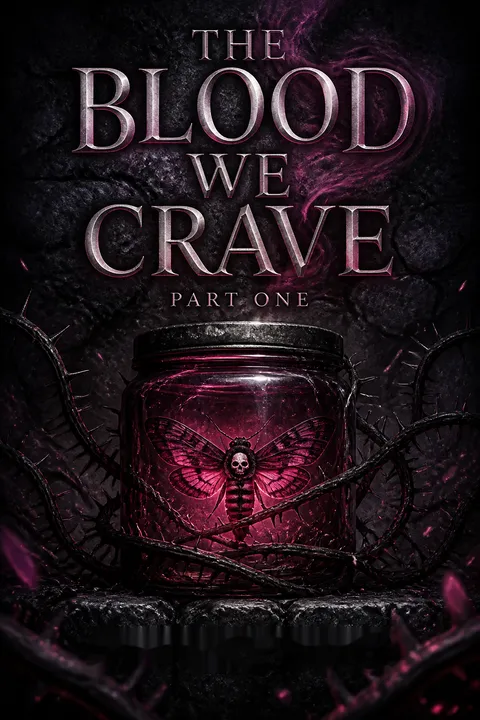

Plot Summary
Blood and Lullabies
Young Scarlett (Lyra) dreams of sweetness and warmth, awakens to terror as her mother hides her in a closet from an intruding figure—Henry Pierson. This is the night innocence is shattered: Scarlett listens through the crack of the door as her mother battles for her life but inevitably succumbs to Henry's monstrous violence. Traumatised, Lyra is reborn in horror, her only comfort the memory of her mother's "I love you." Hidden, she encounters Henry's ice-cold son, Thatcher, charged with ensuring her death—yet he spares her, enacting a ritual of mercy with coins on the dead woman's eyes. This single night forges unbreakable trauma and an obsession that warps innocence into the seed of something much darker. The legacy of blood and lullabies marks the beginning of Lyra's and Thatcher's intertwining destinies.
A Monster's Gift
Years later, Lyra—haunted, brilliant, and now a university student—lives as a ghost among friends, collecting insects and bones, nurturing a fascination for taxidermy as a way to wrestle control from death. Thatcher, heir to a dynasty of fear and violence, composes his own symphonies of death. His father's legacy looms over him, but Thatcher is determined to outdo, not emulate, his predecessor. Lyra obsesses over the boy who spared her—a beautiful monster who excels at turning pain into art, fixated on exacting justice from other killers by killing serial murderers. Both struggle to exist in a world that can neither contain nor understand them—each confronting the scars and compulsions gifted by their monstrous origins.
Obsession in the Shadows
Lyra's daily life is colored by the urge to blend into shadows, rendered nearly invisible except to those who matter. Her devotion to Thatcher is not merely affection—it is addiction. She tracks his routines, hoards his discarded clothes, and daydreams of his cruelty as a form of intimacy. The only relief comes in small satisfactions—collecting moths, finishing death displays, and brief, almost accidental touches with Thatcher's world. Lyra's fixation is mutual, if unspoken: Thatcher is aware of her presence, indulges it, yet never acknowledges her. Their dance is one of stalker and subject, but also co-survivors, both shaped by a single night's devastation.
Games for the Damned
During a nighttime gathering with friends—called the Loner Society, made up of other wounded, resilient souls—Lyra corners Thatcher with a proposition: teach her how to live with the killer inside her, or kill her outright. Thatcher, arrogant and cold, refuses, disdainful of her requests. Frustrated and desperate, Lyra turns their next game—an illicit game of tag in the stormy woods—into a lethal wager: if she wins, he must teach her; if she loses, she'll finally leave him alone. The rules are life or death, and in their hands, even innocent games become rehearsals for real violence and emotional survival.
Lessons in the Dark
The game careens out of control as Lyra flees through haunted woods with Thatcher in predatory pursuit. Knowing he will inevitably catch her—and what that would mean—she chooses instead to leap from a cliff's edge, plummeting into cold waters below to claim victory by her own hand. Thatcher is both furious and transfixed by her reckless courage. Through this act, she asserts agency, albeit briefly, over her own fate—proving herself worthy of his attention, and earning the terrible mentorship she so desperately craves. Their bargain is sealed in shock and adrenaline, two predators circling one another in the shadow of old scars.
Ghosts and Graveyards
In the aftermath, Lyra reunites with her friends, reinforcing bonds through rituals of loyalty, secrets, and shared trauma. Together, they navigate the corrupt and violent underbelly of Ponderosa Springs—a town riddled with missing girls and the sinister Halo trafficking ring. Thatcher, meanwhile, fights his own isolation among his fiercely bonded, equally broken companions. Both Lyra and Thatcher spill their truths only in safe, hidden places—abandoned towers, forgotten graveyards, and haunted memories of home—revealing, piece by piece, the haunted origin of each character and the dangers of loyalty in a world ruled by predation and power.
Bonded by Violence
Thatcher brings Lyra to a private cemetery, demanding she dig a grave as an initiation, to prove her commitment and confidentiality. For Lyra, the act is both punishment and absolution—a forced confrontation with mortality, physical suffering as an echo of childhood pain. Through this brutal lesson, Thatcher confronts his own history, drawing lines between the violence he inherited from his father and the violence he chooses. The grave becomes a mirror for them both: for Lyra, to accept the killer within; for Thatcher, to test whether he can forge connection through cruelty, rather than just annihilation.
Murderer's Education
Lyra's "lessons" with Thatcher are both chillingly clinical and deeply erotic. She studies bodies, blood, and the meticulous rituals of murder under his pitiless scrutiny, their dynamic oscillating between teacher and student, predator and prey, would-be lovers and doomed conspirators. Their connection grows darker, crossing lines as Lyra's obsession becomes reciprocal. They enact violence as both metaphor and act: blood becomes the currency of desire, control, and trauma. Yet beneath it all, Lyra craves something even more dangerous—acceptance, and to be seen not as a victim or an outcast, but as the monster she has become.
Torn by Thorns and Roses
Both Lyra and Thatcher are shaped by impossible legacies: she, the orphan of a murdered woman; he, the son of Ponderosa Springs' most infamous serial killer. Their families are both shields and shackles, warping self-concept and expectation. Through conversations with Thatcher's grandmother, May, Lyra glimpses the humanity buried beneath his ice, even as she is warned—loving him means embracing brutality. But Lyra, marked by her own bloodlust, is undeterred. The line between love and violence continues to blur, each new lesson binding them tighter in the thorns and roses of their shared monstrosity.
Cathedrals of Pain
The characters find solace only in places other people fear—abandoned mausoleums, libraries, and trauma-soaked bedrooms. Inside these sanctuaries, secrets unravel: Lyra's friends discover her fixation on Thatcher, even as Lyra is drawn deeper into the conspiracy gripping their town. Meanwhile, Thatcher's attempts to maintain emotional distance fail; he is drawn repeatedly to Lyra against his better judgment. The same structures that shield them are also cages, and the rituals of blood and confession inside these cathedrals of pain force every character to confront what they are willing to destroy, or die for.
Testing Loyalty
The outer plot—an investigation into the town's sex trafficking ring—is both literal and symbolic. Lyra's "invisibility" makes her the perfect spy, even as she risks her life stalking dangerous men like Easton, the Sinclair heir. The Hollow Boys' code of loyalty is put to the test when Lyra disappears, abducted by the ring's enforcers as punishment for meddling. Every character—whether motivated by love, guilt, or pride—must decide exactly how much they are prepared to sacrifice for one another. Survival now depends on choosing allies and betraying their own fears.
The Devil's Carnival
After Lyra is kidnapped and tortured, Thatcher and the Hollow Boys descend on the Nightmare Circus to exact vengeance. Blood answers blood: Thatcher stages a bloody showpiece, torturing and executing one of Lyra's abductors with poetic precision, letting Lyra deliver the fatal blow. Here, Lyra's metamorphosis from victim to predator is complete—her first true kill, a crowning act in the same arena where she was nearly destroyed. Their bond, cemented in violence and survival, is now unbreakable—yet fraught with greater danger than ever before.
Survival by Fire and Blood
In the aftermath, Lyra and Thatcher's dynamic turns fully carnal—a convergence of morbidity, tenderness, and desperation. Blood is no longer just memory or trauma, but an offering; pain and pleasure mingle in their acts of intimacy. Both are terrified, but neither can resist the gravity between them. Yet their victory is fragile, and the Halo responds with renewed threats and body parts left as warnings. As the tension mounts, Thatcher pulls away under the weight of his own self-hatred and fear of destroying her, only to realise—too late—that there truly is no life for either without the other.
Becoming the Hunter
As Thatcher disappears to protect her, Lyra is left unmoored—her obsession unsated without his presence. Friendships strain, the town's conspiracy deepens, and Lyra is forced to use all the darkness she's learned to track him down. Through revelations and confrontations—with friends, with herself, and finally with Thatcher—she refuses to be exiled from the only person who makes her feel real. Together, and apart, they must decide whether love can exist in a world that will always seek to devour or erase them.
Broken Things Reborn
Thatcher and Lyra reunite in the haunted house where their shared story began. Their confrontation is brutal and honest: he tries to reject her, cutting her with the sharpness of his words and the edge of his knife, but cannot kill the girl he could never touch as a child. When Lyra makes herself truly vulnerable—offering her life to end the cycle—they both surrender to one another, physically and emotionally. What follows is an act of reclamation: two broken monsters letting love and violence intermingle, no longer denying the beast inside themselves, or the other.
Chess among Monsters
The arrival of outside investigators—FBI agents hungry for a scapegoat—raises the stakes, as friends and lovers alike are implicated in murder and conspiracy. Throughout, the motif of chess recurs: every move has consequences, every alliance demands a sacrifice, and every adversary (whether family, friend, or fanatic) is prepared to betray or be betrayed. As secrets unravel, trust becomes a weapon or a liability—survival depends on who can anticipate and outmaneuver their enemies, both known and unseen.
Rules, Betrayal, and Blood
As threats circle, friends are tested, old scars are torn open, and violence becomes the last language possible. Betrayals are revealed: teachers are implicated in the trafficking ring, friends are forced to become bait, and warnings arrive in the form of severed hands. Thatcher and Lyra's love—twisted by violence and obsession—is the only certainty left, a blood pact set against a world intent on their destruction. Every rule they've been taught—about trust, violence, love—must be broken or rewritten if they are to survive.
The Addicted Heart
Lyra, abandoned and desperate, refuses to be erased. She hunts for Thatcher and, with the help of another damaged friend (Silas), tracks him back to the tomb of her childhood, confronting the true nature of their connection. Together, they wage a war against the wounds of the past and the dangers of the present. Lyra finally claims her place—not merely as Thatcher's obsession, but as his equal and his addiction, his ghost and his reward. To love is to survive; to survive is to love, even if that love is monstrous.
Death at December's Door
As winter deepens, a fresh horror strikes: blood is spilled on the threshold of Thatcher's family home, a body discovered beneath a sheet, and families (chosen and inherited) gather in terror. In the snow and sirens, Lyra's world collapses—the threat that's haunted them has finally claimed an unthinkable price. Trauma, for both Lyra and Thatcher, comes full circle; survival now means either surrendering to despair or finding the will to redefine what it means to live, love, and destroy in the name of blood—whether it is what they crave, what they spill, or what they share.
Analysis
Monty Jay's The Blood We Crave is less a traditional dark romance than a gothic, transgressive meditation on the nature of violence, trauma, and obsession. The novel fashions love not as redemption, but as a fatal, addictive bond—one that cannot heal what is broken, only give it meaning. Lyra and Thatcher are both the products and perpetuators of generational violence, their connection forged through blood and the mutual recognition of monstrosity. By entwining pleasure, pain, and obsession, the narrative asks uncomfortable questions: Can you survive what is done to you without becoming it? Is monstrous love any less real—or less necessary—than wholesome love? Through acts of submission, resistance, and ultimately shared agency, the book reclaims monstrosity as intimacy—a bond deeper than words, more binding than fate. Power, for Jay, is not granted by legacy or violence alone, but by the willingness to confront, claim, and transform one's own darkness. In this world, survival and love require both teeth and surrender, and only those willing to bleed can truly live.
Review Summary
The Blood We Crave receives mostly positive reviews, with readers praising its dark romance, complex characters, and intense plot. Many enjoy the dynamic between Thatcher, a psychopathic serial killer, and Lyra, his obsessive stalker. Readers appreciate the author's writing style, character development, and integration of Greek mythology. Some find the blood kink and violent themes disturbing, while others revel in the darkness. The cliffhanger ending leaves many eager for part two. Overall, it's a polarizing but captivating addition to the Hollow Boys series.
People Also Read
Characters
Lyra (Scarlett) Abbott
Lyra is the book's emotional and psychological hinge—a woman forged by the brutal childhood murder of her mother in front of her eyes, hidden and powerless. Her post-traumatic survival instills in her a ghost-like presence; she becomes a collector of insects and other dead things, comforted by transformation and taxidermy. Obsessively in love with Thatcher, the boy who spared her life, Lyra's "addicted heart" finds meaning in compulsion, risk, and pain; she is willing to die or kill for him, because violence and love have become the same language for her. Her arc is about confronting, then embracing, the killer bloodline inside her—not merely as trauma's residue but as a choice and source of power—until, by the novel's end, she becomes both hunter and lover, as dangerous as she is vulnerable.
Thatcher Alexander Pierson
Thatcher is the embodiment of the "beautiful monster," the heir to Ponderosa Springs' most feared serial killer. Raised by a father who forced violence on him, Thatcher channels his compulsions into meticulously artistic murders—targeting other killers, aspiring to be better, not simply crueler, than his progenitor. He is a study in control, routine, and isolation, using music, murder, and strict adherence to rules to keep his humanity at bay. Lyra's presence evokes both the memory of his first moment of mercy and his only weakness: she is the only person he cannot kill, and that both infuriates and enthralls him. Psychologically, Thatcher is both puppet and puppeteer, navigating the perpetual tension between self-loathing, pride, and a desperate but inarticulable longing to be seen and loved without restraint.
Henry Pierson
Thatcher's father, Henry, is the source of all original violence—chillingly emotionless, manipulative, addicted to control. His murder of Lyra's mother instigates the entire narrative, but his reach is psychological as much as physical: he is the haunting voice in Thatcher's head, the standard to be outdone or rejected, the blueprint for what "monster" means. Even from prison, Henry shapes the destinies and fears of everyone touched by his legacy. As a symbol, he embodies the generational curses that drive the plot—a violence that seeks self-replication at any cost.
May Pierson
As Thatcher's grandmother, May is a rare force of warmth in a lineage of coldness. Her attempts at nurturing, coupled with the deep regret over her son, offer glimmers of hope that nurture and love might blunt even the worst inheritance. She is the bearer of family memory and warning, guiding Lyra with both caution and kindness, aware that loving Thatcher comes with self-annihilating risks. May is, in many ways, the novel's conscience—honestly reckoning with the limits of love and the price of survival.
Rook Van Doren
Rook is a member of the Hollow Boys, notorious for his willingness to accept pain as penance, using violence as self-mortification and guardian instinct. His tragic boyhood and complicated relationship with his own father make him prone to both destruction and devotion. Rook's affinity for fire and his explosive temperament contrast with his quietly fierce loyalty to his friends, especially Silas and Sage. He is an example of how pain, if not transformed, can only be transferred.
Alistair Caldwell
Alistair is the backbone of the Hollow Boys—a figure who moves between lithe violence and rigid discipline. He struggles between following Thatcher's lead and asserting his own authority, particularly as he navigates the needs of friends and the desires triggered by his relationship with Briar. Psychologically, Alistair represents the cost of maintaining order in a world defined by chaos, often bearing guilt and responsibility for choices not solely his own.
Sage Donahue
Sage's arc is dominated by trauma—her family destroyed by the town's hidden trafficking ring, her sister lost to violence. She is all sharp edges and fire, channeling her grief into a quest for answers and a willingness to break every rule to find closure. Her dynamic with Rook gives her both grounding and temptation; she is proof that loyalty to others can offer hope, but also risk everything.
Briar Lowell
Briar's emotional intelligence and strategic thinking make her indispensable to the friend group. She is often the emotional center, mediating between the group's warring energies and pushing for action when paralysis sets in. Her loyalty—especially to Lyra and Sage—anchors the book's themes of chosen family and the courage required to confront horror with love.
Silas Hawthorne
Silas is defined by loss—his love, Rosemary, murdered, his mental health precarious, his position as hacker, protector, and sometimes confessor. He is a cipher, emotionally detached yet attuned to the suffering of others. Silas's advice and actions often steer Lyra on her quest, serving as both cautionary tale and support system. He is proof that enduring love and loss can contort a person into something both powerful and vulnerable.
Conner Godfrey
Conner appears as a supportive mentor to Lyra, encouraging her passions and fostering her prospects; yet his ties to the corrupt power structure of Ponderosa Springs make his intentions suspect. He is the face of well-meaning authority, both a comfort and a threat—offering opportunities while representing the system that perpetuates violence. His ambiguity is a symbol of the difficulties in discerning friend from foe in a world where all trust is potentially deadly.
Plot Devices
Mirrored Trauma and Doubling
The novel continually uses mirrored relationships—mother/daughter, father/son, victim/killer, teacher/student—to highlight the inevitability and horror of legacy. Each character is haunted by both direct and indirect inheritance of violence, particularly Thatcher and Lyra, whose fates are bound by the echo chamber of their parents' fatal bond. This doubling is reflected structurally: as Lyra is tested, so is Thatcher; as Lyra seeks education, Thatcher is forced to confront his own boundaries.
Obsession as Narrative Engine
Lyra's obsession with Thatcher (and his with her) is not merely thematic, but structural: the book moves forward because she refuses to let go, tracking his every move, interpreting every signal as fate. The tension arises from the self-destructive but irresistible gravity of their fixation—each feeding and mirroring the other's addiction, violence, and need.
Ritual and Rule-Breaking
Nearly every interaction between Lyra and Thatcher is ritualized—games of tag, grave-digging, quizzes, brutal lessons—in an attempt to impose order on what cannot be controlled: death, violence, attraction. The plot is a continual struggle between following inherited rules (from Thatcher's monstrous father) and the necessity of breaking them to forge a new path.
Blood as Symbol and Transmission
Blood recurs constantly, as trauma (the mother's murder), as act (killing, self-harm), as intimacy (sexual and emotional acts mingling pain and pleasure). Blood is the line that connects, corrupts, and redeems; it is both what the characters crave and what they fear will destroy them.
Setting as Character
The novel's key settings—closets, mausoleums, graveyards, abandoned towers, and the infamous Pierson estate—are not mere backdrops, but active agents shaping character and conflict. These spaces are refuges, traps, and stages for all main confrontations; they externalize the characters' internal landscape.
Power and Powerlessness
All relationships in the book are defined by shifting power: who is predator, who is prey; who is teacher and who is ruled by obsession. The perpetually fragile control Thatcher exerts is systematically challenged by Lyra's refusal to remain subject.
Interleaved Mysteries and Red Herrings
The group's investigation into the Halo provides momentum and danger, but also highlights the theme of trust and betrayal. The arrival of outside investigators magnifies the paranoia and uncertainty—no ally can be trusted, every supposed helper just another potential monster.
Hollow Boys Series Series
About the Author
Other books by Monty Jay
Download PDF
Download EPUB
.epub digital book format is ideal for reading ebooks on phones, tablets, and e-readers.








































