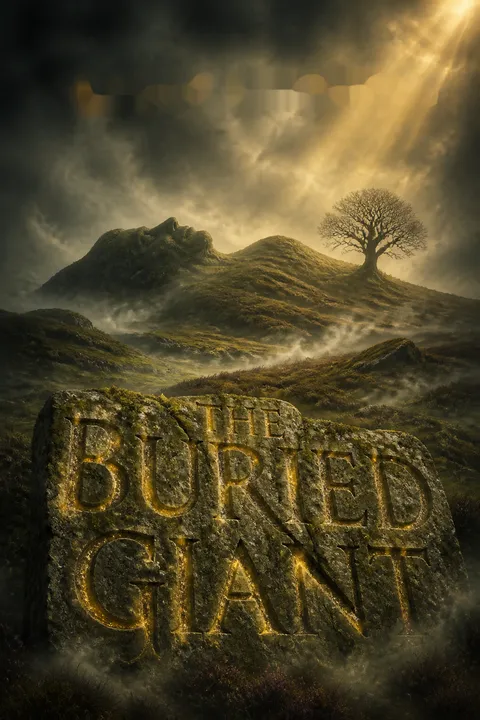

Plot Summary
Mist Over Forgotten Lands
In post-Arthurian Britain, a strange mist of forgetfulness hangs over the land, clouding memories and histories alike. Axl and Beatrice, an elderly Briton couple, live on the edge of a village, haunted by a sense of loss and the persistent feeling that something precious has been forgotten. Their community, like many others, is insular and wary, with the past rarely discussed and memories slipping away like dreams. The land itself is wild and dangerous, populated by ogres, fiends, and the remnants of Roman civilization. The couple's relationship is tender but marked by a shared amnesia, and the absence of their son—whose existence they only half-remember—gnaws at them. The mist is both literal and metaphorical, a veil over personal and collective trauma, and the couple's longing for clarity and reunion sets them on a journey eastward, in search of their son and the truth of their shared past.
A Journey Remembered
Prompted by fleeting memories and a yearning to see their son, Axl and Beatrice decide to leave their village. Their preparations are slow, hindered by communal obligations and the uncertainty of their own recollections. As they travel, the landscape is both beautiful and treacherous, filled with reminders of a world where supernatural dangers are as real as human ones. The couple's love is evident in their gentle banter and mutual care, but their conversations are haunted by gaps and uncertainties. They cross the Great Plain, avoiding the burial mound of a giant, and take shelter in a ruined Roman villa, where they encounter a boatman and an old woman locked in a cycle of accusation and regret. The boatman's tale of ferrying souls to an island where lovers may or may not be reunited foreshadows the couple's own fears about memory, love, and the afterlife.
The Boatman's Question
The encounter with the boatman and the old woman unsettles Axl and Beatrice, introducing the idea that only couples with an unbreakable bond can cross to the island together. The boatman's role as judge—asking travelers to recall their most cherished memories—raises the stakes for the couple, who fear that the mist has eroded the very foundation of their love. Beatrice confides her terror that, without shared memories, their love might fade and die. Axl reassures her, insisting that their feelings endure even in the absence of recollection. Yet the question lingers: can love survive when the past is lost? The journey becomes not just a physical quest, but a test of the endurance of love and the possibility of forgiveness in the face of forgotten wounds.
Monsters in the Mist
Their journey brings Axl and Beatrice to a Saxon village, where they witness the aftermath of a monstrous attack. The villagers are gripped by fear and superstition, and a rescued boy, Edwin, is shunned for bearing a mysterious wound. The couple meets Wistan, a Saxon warrior, who volunteers to help the villagers and later becomes their companion. The village's collective amnesia mirrors the couple's own, as the mist continues to erase both personal and communal histories. The villagers' treatment of Edwin—first as a victim, then as a potential threat—reflects the precariousness of memory and belonging in a world where the past is always slipping away. The couple's compassion for the boy and their alliance with Wistan deepen the emotional stakes of their journey.
The Warrior and the Boy
Wistan, on a secret mission from his Saxon king, joins Axl and Beatrice, along with Edwin, who is entrusted to their care. The group's dynamics are shaped by suspicion, cultural difference, and the ever-present mist. Wistan's warrior skills and Edwin's resilience are contrasted with the vulnerability of the elderly couple. As they travel together, Wistan's true purpose—to slay the she-dragon Querig, whose breath is said to cause the mist—gradually emerges. Edwin's wound, revealed to be from a dragon, marks him as both cursed and chosen. The journey becomes a convergence of personal quests: Axl and Beatrice's search for their son and lost memories, Wistan's mission of vengeance and justice, and Edwin's coming-of-age amid trauma and hope.
The Saxon Village's Fear
The group's passage through the Saxon village exposes the deep divisions and fears that persist in the land. Edwin, suspected of being tainted by his wound, is nearly sacrificed by his own people. Wistan's intervention saves the boy, but the episode underscores the fragility of community and the ease with which fear turns to violence. The villagers' inability to remember or confront the truth of their actions is both a symptom and a cause of the mist. The episode also reveals the limits of compassion and the dangers of scapegoating, as the group is forced to flee, carrying with them the burden of unresolved histories and the hope for redemption.
The Ruined Monastery
The travelers arrive at a monastery perched in the mountains, seeking the counsel of Father Jonus, a monk rumored to possess great wisdom. The monastery, once a fortress, is now a place of penance and division, its monks tormented by guilt and self-inflicted suffering. Father Jonus reveals that Querig's breath is indeed the source of the mist, a magical solution devised to suppress the memories of war and atrocity. The monks' attempts at atonement—exposing themselves to the ravages of birds—are both futile and tragic. The revelation that the mist is a deliberate, if desperate, attempt to secure peace forces the travelers to confront the moral cost of forgetting. Beatrice's illness is diagnosed as age and wear, but the deeper wounds—of memory, betrayal, and loss—remain unhealed.
The Dragon's Breath
The group learns that the mist is not a natural phenomenon, but the result of a spell cast by Merlin and Arthur's knights to end the cycle of vengeance between Britons and Saxons. Querig, the she-dragon, is both the instrument and the prisoner of this peace. The spell's cost is the erasure of memory—of atrocities committed, of loved ones lost, of the very reasons for hatred and forgiveness. The travelers are forced to reckon with the implications: to slay Querig is to restore memory, but also to risk reigniting ancient enmities. The moral dilemma is acute: is peace worth the price of forgetting? Is justice possible without remembrance? The group's resolve is tested as they prepare for the final confrontation.
The Knight's Confession
Sir Gawain, the last of Arthur's knights, joins the group as Querig's reluctant guardian. In a series of reveries, he reflects on the horrors of war, the betrayal of ideals, and the burden of memory. Gawain's loyalty to Arthur is complicated by his awareness of the cost of peace—the slaughter of innocents, the suppression of truth, the loneliness of survival. His confession reveals the deep wounds left by the past, and the impossibility of simple heroism. Gawain's role as both protector and potential adversary to Wistan sets the stage for the final reckoning, as the old knight and the young warrior embody the conflicting demands of justice, mercy, and remembrance.
The Poisoned Goat
Axl and Beatrice, separated from the others, encounter a group of orphaned children who beg them to deliver a poisoned goat to Querig's lair. The children's faith that slaying the dragon will bring back their lost parents is both heartbreaking and symbolic. The couple's decision to help, despite their exhaustion, is an act of compassion and hope. The episode highlights the innocence of those most harmed by the cycles of violence and forgetting, and the possibility that even small acts of kindness can have profound consequences. The poisoned goat becomes a symbol of both the hope for renewal and the tragic cost of vengeance.
The Giant's Cairn
The travelers converge at the giant's cairn, a desolate and windswept place where Querig sleeps. Tensions between Wistan and Gawain come to a head, as the old knight tries to dissuade the warrior from slaying the dragon. The moral and emotional stakes are at their highest: to kill Querig is to restore memory and justice, but also to risk unleashing new violence. The confrontation is both physical and philosophical, as the characters debate the meaning of peace, the necessity of vengeance, and the possibility of forgiveness. The cairn itself, a monument to forgotten slaughter, is a silent witness to the tragedy and hope of the moment.
The Slaying of Querig
Wistan and Gawain duel, and the old knight falls. Wistan descends into the pit and slays Querig, ending the spell and releasing the memories suppressed by her breath. The act is both triumphant and tragic: the mist lifts, but with it comes the return of pain, hatred, and the threat of renewed war. Wistan, burdened by his own ambivalence, entrusts Edwin with the duty of vengeance, warning that the peace built on forgetting cannot last. Axl and Beatrice, witnesses to the dragon's death, are left to face the consequences of restored memory—the joys and sorrows of their shared life, and the uncertain future of their people.
The Island Beyond Memory
With Querig dead and the mist lifting, Axl and Beatrice make their way down from the mountains, seeking shelter and a way to cross to the island where they believe their son is buried. Their journey is marked by exhaustion, loss, and the bittersweet return of memory. They encounter a boatman who offers to ferry them across, but only after subjecting them to a test: can their love survive the full return of memory, with all its wounds and betrayals? The island becomes a symbol of both reunion and separation, a place where the past is both recovered and transcended.
The Boatman's Test
The boatman, echoing the earlier encounter, questions Axl and Beatrice separately, probing the strength of their bond and the truth of their memories. The couple's love is revealed to be deep but not without pain: infidelity, pride, and the loss of their son have left scars that the mist could not fully erase. Yet their willingness to forgive, to hold onto love despite suffering, is their greatest strength. The boatman's judgment is ambiguous—he promises to ferry them together, but the possibility of separation lingers. The test is not just of love, but of the capacity to accept the fullness of memory, with all its joys and sorrows.
Love and Remembrance
As they wait on the shore, Axl and Beatrice reflect on their life together, the wounds they have inflicted and endured, and the meaning of love in the face of loss. The lifting of the mist brings both clarity and pain, but also the possibility of true reconciliation. Their conversation is tender, honest, and suffused with the knowledge that love is not the absence of suffering, but the willingness to endure and forgive. The island, now visible in the evening light, beckons as both a promise and a mystery—a place where love may be renewed, or where separation may be final.
The End of Forgetting
The boatman returns, and Beatrice is ferried first, leaving Axl to wait on the shore. The moment is filled with longing, fear, and hope. The couple's farewell is both an ending and a beginning, as they trust in the strength of their bond to carry them across the waters of memory and loss. The boatman's role as judge and guide is both compassionate and implacable, a reminder that the journey of love and remembrance is never without risk. The story ends with Axl watching the boat recede, his heart full of love and sorrow, as the mist finally lifts and the past is reclaimed.
Farewell on the Shore
Left alone on the shore, Axl waits for the boatman's return, his thoughts filled with memories of Beatrice, their son, and the life they shared. The future is uncertain—will they be reunited on the island, or will the wounds of the past keep them apart? The story closes on a note of ambiguity and grace, as Axl's love endures even in the face of separation. The journey through mist and memory has brought pain, but also the possibility of healing. The buried giant—the trauma of war, loss, and forgetting—has been unearthed, and the work of remembrance and forgiveness begins anew.
Analysis
Kazuo Ishiguro's The Buried Giant is a profound meditation on memory, trauma, and the cost of peace. Set in a mythic, post-Arthurian Britain, the novel explores the consequences of collective forgetting as both a blessing and a curse. The mist that erases memory is a magical solution to the cycles of vengeance that have devastated the land, but it also robs individuals and communities of the possibility of true healing and reconciliation. Through the journey of Axl and Beatrice, Ishiguro examines the endurance of love in the face of loss, betrayal, and the erosion of shared history. The story's ambiguous ending—will the couple be reunited on the island, or separated by the wounds of the past?—reflects the novel's central question: can forgiveness and peace be achieved without remembrance, or must the buried giant of trauma be unearthed and confronted? In a modern context, the book resonates as an allegory for societies grappling with historical injustice, the temptation to forget, and the necessity of facing painful truths. Ishiguro's spare, lyrical prose and his refusal to offer easy answers make The Buried Giant a haunting and essential exploration of the human need for both memory and mercy.
Review Summary
Reviews of The Buried Giant are deeply divided. Admirers praise Ishiguro's lyrical prose, rich allegorical exploration of memory, love, and collective trauma, and the emotionally resonant ending. Critics find the characters flat and emotionally distant, the dialogue unnaturally formal, and the pacing tedious. Many note the fantasy setting feels unfamiliar for Ishiguro, though some appreciate it as a vehicle for deeper themes. Axl's repetitive use of "princess" irritated numerous readers. Overall, the novel rewards patient readers willing to embrace its deliberate, fable-like rhythm, while frustrating those seeking conventional narrative momentum.
People Also Read



Characters
Axl
Axl is an elderly Briton, defined by his quiet strength, compassion, and deep love for his wife, Beatrice. Haunted by the sense of something missing, he is both a victim and a challenger of the mist that clouds his memory. His journey is as much internal as external, a quest to recover not only his son but the truth of his own life and marriage. Axl's relationship with Beatrice is marked by tenderness, but also by the pain of forgotten wounds—infidelity, pride, and the loss of their son. He is a man shaped by the traumas of war and the longing for peace, both personal and communal. As the story unfolds, Axl's capacity for forgiveness and his willingness to face the full truth of his past become his defining virtues, even as he confronts the possibility of final separation from Beatrice.
Beatrice
Beatrice is Axl's devoted partner, her character defined by resilience, vulnerability, and a fierce longing for connection. The mist's erasure of memory is both a curse and a mercy for her, as it shields her from pain but also threatens the foundation of her love. Beatrice's fears—that love cannot survive without shared memories, that she and Axl may be separated in life and death—drive much of the emotional arc of the story. Her illness and frailty are counterbalanced by her courage and honesty, especially in confronting the wounds of the past. Beatrice's journey is one of acceptance and forgiveness, both of herself and of Axl, and her willingness to face the truth, however painful, is a testament to the enduring power of love.
Wistan
Wistan is a Saxon knight on a secret mission to slay the she-dragon Querig and end the mist of forgetfulness. He is both a formidable fighter and a man burdened by the legacy of violence and betrayal. Wistan's relationship with Axl and Beatrice is complex—he admires their kindness but is driven by a sense of duty and vengeance for the wrongs done to his people. His mentorship of Edwin is both compassionate and ruthless, as he seeks to pass on the hatred necessary for the coming war. Wistan's internal conflict—between the desire for justice and the longing for peace—mirrors the larger moral dilemmas of the story. His ultimate act, slaying Querig, is both a liberation and a harbinger of renewed conflict.
Edwin
Edwin is a young Saxon boy, orphaned and wounded, whose fate becomes entwined with that of the travelers. His wound, inflicted by a dragon, marks him as both cursed and chosen, and his journey is one of survival, growth, and the search for belonging. Edwin's relationship with Wistan is that of apprentice and mentor, but also of surrogate son and father. The boy's innocence is repeatedly threatened by the violence and fear of the world around him, yet he retains a capacity for hope and loyalty. Edwin's promise to carry on Wistan's hatred for the Britons is both tragic and inevitable, a symbol of the cycles of vengeance that the mist was meant to suppress.
Sir Gawain
Sir Gawain, the last of Arthur's knights, is a figure of melancholy and dignity, burdened by the weight of memory and the compromises of peace. As Querig's guardian, he is both protector and prisoner, tasked with maintaining the spell that keeps the land in forgetfulness. Gawain's reveries reveal the horrors of war, the betrayal of ideals, and the loneliness of survival. His relationship with Axl is one of mutual respect and shared sorrow, and his final duel with Wistan is both a passing of the torch and a reckoning with the past. Gawain embodies the tragic cost of peace built on forgetting, and his death marks the end of an era.
The Boatman
The boatman is a mysterious, almost mythic figure who ferries souls to an island beyond the mortal world. His role is both compassionate and implacable, as he tests the strength of love by probing the memories of those who seek passage. The boatman's questions force Axl and Beatrice to confront the truth of their relationship—the wounds, betrayals, and forgiveness that define their bond. He is both a guide and a gatekeeper, embodying the story's central themes of memory, love, and the possibility of reunion or separation in the afterlife.
Father Jonus
Father Jonus is a monk at the mountain monastery, physically scarred and spiritually burdened by the legacy of violence and the failure of atonement. He reveals the truth about Querig and the mist, and his wisdom is tempered by humility and sorrow. Jonus's role is that of confessor and healer, offering both diagnosis and insight to the travelers. His recognition that true forgiveness requires remembrance, not forgetting, is a key turning point in the story.
The Old Woman
The old woman encountered by the boatman and the travelers is a figure of loss and accusation, forever separated from her husband by the boatman's judgment. Her story is a warning and a mirror to Axl and Beatrice, illustrating the consequences of a bond not strong enough to withstand the test of memory. She is both pitiable and unsettling, a reminder of the fragility of love and the finality of separation.
The Children
The orphaned children who beg Axl and Beatrice to deliver the poisoned goat are symbols of innocence and hope amid devastation. Their faith that slaying Querig will bring back their parents is both heartbreaking and emblematic of the story's central tension between forgetting and remembrance. The children's plight underscores the generational cost of violence and the longing for restoration.
The Mist
Though not a character in the traditional sense, the mist is a pervasive presence in the story, shaping the lives and destinies of all who dwell in its shadow. It is both a curse and a mercy, a magical solution to the cycle of vengeance and a barrier to healing. The mist's lifting is both a liberation and a threat, forcing the characters—and the land itself—to confront the buried giant of memory.
Plot Devices
The Mist of Forgetfulness
The central plot device is the mist of forgetfulness, a spell cast by Merlin and Arthur's knights to suppress the memories of war and atrocity between Britons and Saxons. The mist functions both literally and metaphorically, erasing personal and collective histories, and creating a fragile peace built on amnesia. Its presence shapes every aspect of the narrative: the characters' relationships, their sense of self, and the possibility of reconciliation or renewed conflict. The gradual lifting of the mist, triggered by the slaying of Querig, is both a narrative climax and a thematic reckoning, forcing the characters to confront the full truth of their pasts.
The Journey Structure
The story is structured as a journey, both physical and psychological. Axl and Beatrice's quest to find their son becomes a pilgrimage through the landscapes of memory, trauma, and love. Along the way, they encounter figures—Wistan, Edwin, Gawain, the boatman—who embody different responses to the wounds of the past. The journey is punctuated by encounters with danger, moments of revelation, and tests of character, culminating in the confrontation at Querig's lair and the final passage to the island.
The Boatman's Test
The motif of the boatman's questioning recurs throughout the narrative, serving as both foreshadowing and climax. The test—whether a couple's love can survive the return of memory—raises the stakes for Axl and Beatrice, and for the reader. The boatman's role as judge and guide is both compassionate and implacable, forcing the characters to confront the truth of their bond and the possibility of separation or reunion in the afterlife.
Foreshadowing and Symbolism
The narrative is rich in foreshadowing and symbolism: the buried giant as a metaphor for suppressed trauma; the dragon's breath as both curse and protection; the orphaned children as the cost of violence; the journey to the island as a passage between life and death, forgetting and remembrance. The story's structure—alternating between present action, reverie, and confession—mirrors the fragmented and elusive nature of memory itself.
About the Author
Other books by Kazuo Ishiguro


Download PDF
Download EPUB
.epub digital book format is ideal for reading ebooks on phones, tablets, and e-readers.








































