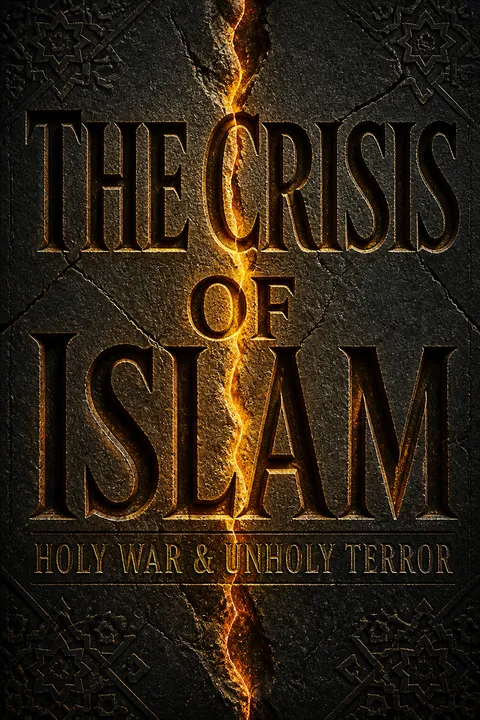

Key Takeaways
1. Islam represents both a religion and an all-encompassing civilization where church and state are historically unified.
The dichotomy of regnum and sacerdotium, so crucial in the history of Western Christendom, had no equivalent in Islam.
A unified identity. Unlike Western Christianity, which developed for centuries under secular Roman rule before gaining state power, Islam was politically empowered from its inception. The Prophet Muhammad was not only a religious teacher but also a head of state, commander of armies, and supreme judge. Consequently, the separation of church and state is an alien concept in classical Islamic thought, where religion, law, and governance are inextricably linked.
The role of law. The Shari'a, or Holy Law, serves as the ultimate constitutional framework regulating all aspects of public and private life. It defines the legitimacy of rulers, the duties of subjects, and the conduct of statecraft.
- The Qur'an is viewed as the uncreated, eternal, and literal word of God, unlike the compiled books of the Bible.
- The mosque is a place of worship, but "the Mosque" does not exist as an independent hierarchical institution separate from the state.
- The ulema are religious scholars and legal interpreters, not an ordained priesthood with sacramental powers.
A dual character. From its earliest days, Islamic society functioned simultaneously as a political polity and a religious community. This historical reality created two distinct political traditions: an authoritarian quietism that demands obedience to the ruler, and a radical activism that justifies rebellion against an unjust sovereign.
2. The historical division of the world into the House of Islam and the House of War shapes classical Islamic foreign policy.
In Muslim tradition, the world is divided into two houses: the House of Islam (Dr al-Islm), in which Muslim governments rule and Muslim law prevails, and the House of War (Dr al-Harb), the rest of the world, still inhabited and, more important, ruled by infidels.
A binary worldview. Classical Islamic jurisprudence conceptualizes international relations through a binary division of global territory. The primary objective of the state was to expand the borders of the House of Islam, bringing peace and divine justice to lands previously ruled by unbelievers. This expansion was to be achieved through jihad, which was historically understood by jurists in predominantly military terms rather than purely spiritual striving.
The rules of engagement. While a state of war theoretically existed between these two realms, it was frequently managed through pragmatism and legal flexibility. Treaties, commercial agreements, and temporary truces allowed for peaceful coexistence and diplomatic exchange.
- Dhimma: A protective treaty granting religious autonomy and security to Jews and Christians in exchange for a poll tax (jizya).
- Dār al-Sulh: The House of Truce, representing non-Muslim lands that paid tribute to maintain internal autonomy.
- Jihad: An obligatory communal duty in offensive warfare, but an individual duty for all able-bodied citizens in defense.
The rivalry with Christendom. Because Christianity and Islam shared similar monotheistic roots, universalist ambitions, and triumphalist beliefs, they became natural rivals for global leadership. For over a millennium, their relationship was defined by a series of military encounters, from the early Arab conquests to the Crusades and the Ottoman expansion into Europe.
3. The rise of Western dominance and the retreat of Islamic empires triggered a deep, ongoing crisis of humiliation and frustration.
But during the past three centuries, the Islamic world has lost its dominance and its leadership, and has fallen behind both the modern West and the rapidly modernizing Orient.
A sudden reversal. For centuries, Islamic civilization was the most advanced, wealthy, and powerful force on earth, making its subsequent decline deeply shocking to its people. The turning point became undeniable with the failed Ottoman siege of Vienna in 1683, which initiated a long, painful retreat before advancing Christian armies. This military reversal forced Islamic elites to ask painful questions about why their once-victorious societies were suddenly falling behind.
The shock of modernity. The invasion of Egypt by Napoleon Bonaparte in 1798 shattered the illusion of Middle Eastern security, demonstrating that a Western power could invade the heartlands of Islam at will. It also revealed a bitter truth: only another Western power, in this case the British navy, could expel the invaders.
- Commercial expansion and economic dominance through superior Western technology and joint-stock companies.
- The military conquest and colonization of vast Muslim territories in Asia, Africa, and the Middle East.
- The division of the defeated Ottoman Empire into European mandates after the First World War.
Humiliation and search for answers. The loss of global primacy created a profound psychological crisis, as a community accustomed to viewing itself as the custodian of God's final truth found itself dominated by infidels. Decades of attempting to adopt Western political, military, and economic models yielded poor results, leading to widespread frustration and a growing rejection of modernity itself.
4. Modern Middle Eastern borders and states are largely artificial creations of European imperial powers.
Most of the nation-states that make up the modern Middle East are relatively new creations, left over from the era of Anglo-French imperial domination that followed the defeat of the Ottoman Empire, and they preserve the state-building and frontier demarcations of their former imperial masters.
Artificial political boundaries. The collapse of the Ottoman Empire after World War I allowed Britain and France to carve up the Fertile Crescent into arbitrary administrative units. These newly created states, such as Iraq, Syria, Jordan, and Lebanon, did not correspond to historical regional identities or organic ethnic boundaries. Instead, they reflected the strategic and economic interests of the European imperial powers who drew their frontiers.
The lack of national cohesion. Because these states were constructed artificially, they struggled to develop a unified sense of national identity among their diverse populations. Traditional loyalties to family, tribe, and religion remained far stronger than allegiance to the newly imposed state structures.
- Iraq was a medieval province with vastly different borders, excluding northern Mesopotamia and including parts of western Iran.
- Syria, Palestine, and Libya were classical antiquity names revived and imposed by European imperialists.
- There was historically no word in the Arabic language for "Arabia" as a unified political or territorial entity.
The legacy of imperialism. The imposition of Western-style nation-states left a legacy of political instability, border disputes, and ethnic conflict that persists to this day. When the imperial powers eventually departed, they left behind fragile political systems that quickly degenerated into military dictatorships and autocracies.
5. The United States replaced European empires as the primary target of Middle Eastern resentment and the symbol of the "Great Satan."
Today as in the past, this world of Christian unbelievers is seen as the only serious force rivaling and obstructing the divinely ordained spread of Islam, resisting and delaying but not preventing its final, inevitable, universal triumph.
The new superpower. Following the decline of the British and French empires and the eventual collapse of the Soviet Union, the United States emerged as the undisputed leader of the Western world. To many in the Middle East, America inherited the mantle of Western imperialism, becoming the primary obstacle to Islamic revival and independence. This perception was intensified by America's extensive economic, political, and military involvement in the affairs of the region.
The concept of the Great Satan. During the Iranian Revolution of 1979, Ayatollah Khomeini famously labeled the United States the "Great Satan," a term that carries a specific theological meaning. In Islamic theology, Satan is not an imperial conqueror but a tempter who whispers into the hearts of men, seducing them away from the path of God.
- The perceived cultural threat of American materialism, consumerism, and moral degeneracy.
- The stationing of American military forces on the sacred soil of Saudi Arabia during and after the Gulf War.
- U.S. political and financial support for corrupt, autocratic regimes throughout the Arab world.
A clash of perceptions. While most Americans viewed their country's presence in the region as a benign effort to protect allies and secure energy resources, many Muslims saw it as an aggressive infidel occupation. This fundamental misunderstanding transformed America into the central target of both secular nationalist and radical Islamist rage.
6. Western foreign policy has frequently applied double standards by supporting corrupt regional dictators at the expense of democratic values.
Middle Easterners increasingly complain that the West judges them by different and lower standards than it does Europeans and Americans, both in what is expected of them and in what they may expect, in terms of their economic well-being and their political freedom.
The "devil-you-know" policy. For decades, Western governments prioritized stability and access to oil over the promotion of human rights and democracy in the Middle East. This approach led to active complicity with brutal dictators who ruthlessly suppressed their own citizens while remaining cooperative with Western strategic interests. To the people of the region, this policy revealed a deep-seated hypocrisy, proving that the West did not believe Muslims were worthy of or capable of enjoying democratic freedoms.
The cost of stability. By shielding friendly autocrats from criticism and providing them with military and financial aid, Western powers inadvertently fueled the rise of radical opposition movements. With all secular and moderate political opposition banned, the mosque became the only safe space for dissent, giving Islamists a monopoly on anti-government mobilization.
- The silent acquiescence of the West during the Syrian government's brutal slaughter of up to 25,000 citizens in Hama in 1982.
- The tacit approval of the military takeover in Algeria in 1992 to prevent a democratic victory by the Islamic Salvation Front.
- The abandonment of Iraqi rebels in 1991 after encouraging them to revolt against Saddam Hussein.
A legacy of betrayal. This consistent pattern of supporting tyrants and abandoning democratic reformers created deep-seated resentment and distrust toward the West. It convinced many Middle Easterners that Western talk of democracy was merely a rhetorical tool used to mask self-serving imperialist ambitions.
7. The marriage of Saudi oil wealth and Wahhabi fundamentalism exported an extremist, puritanical version of Islam globally.
The custodianship of the holy places and the revenues of oil have given worldwide impact to what would otherwise have been an extremist fringe in a marginal country.
An unholy alliance. In the mid-eighteenth century, a puritanical religious reformer named Muhammad ibn 'Abd al-Wahhab allied with the House of Saud, establishing a partnership that would shape the future of the Arabian peninsula. Wahhabism demanded a return to the literal, uncorrupted practices of early Islam, fiercely rejecting all later theological developments, mysticism, and non-Sunni sects. When the Saudi state conquered the holy cities of Mecca and Medina in the early twentieth century, this extremist fringe doctrine became the official state religion.
The power of oil. The discovery of vast oil reserves in Saudi Arabia transformed the kingdom from an impoverished desert realm into an economic superpower. Armed with billions of dollars in oil revenues, the Saudi religious establishment began a massive, systematic campaign to export Wahhabi doctrine to the rest of the world.
- Funding the construction of thousands of mosques, schools, and Islamic centers worldwide.
- Providing free religious literature and training to preachers, teachers, and converts in both Muslim and Western nations.
- Establishing madrasas in impoverished regions, offering the only available education to millions of young Muslims.
The radicalization of Islam. This global export of Wahhabism effectively marginalized traditional, tolerant, and diverse local Islamic practices, replacing them with a rigid, intolerant, and militant interpretation of the faith. It laid the ideological groundwork for modern extremist movements, including the Taliban and Al-Qa'ida, by teaching generations of students to view the non-Wahhabi world with hostility.
8. Modern Islamic terrorism is a distortion of classical Islamic law, which strictly regulates warfare and prohibits suicide.
At no point do the basic texts of Islam enjoin terrorism and murder.
A violation of sacred law. Classical Islamic jurisprudence contains highly developed, strict rules of engagement for warfare, which modern terrorists systematically violate. The Shari'a explicitly prohibits the killing of noncombatants, including women, children, and the elderly, and forbids the indiscriminate destruction of property. By targeting innocent civilians and uninvolved bystanders, extremist groups commit acts that are classified as major sins and blasphemy under traditional Islamic law.
The prohibition of suicide. The phenomenon of the suicide bomber represents a radical departure from classical Islamic teachings, which condemn suicide as a mortal sin deserving of eternal damnation. Traditional theology draws a sharp distinction between a warrior facing certain death at the hands of the enemy and an individual taking their own life.
- Classical law requires formal declaration of war by a legitimate political authority, not self-appointed vigilantes.
- Suicide is punished in the afterlife by the endless, painful repetition of the act of self-destruction.
- The random slaughter of civilians has no precedent in classical Islamic history or mainstream theology.
The manipulation of scripture. To justify their actions, modern terrorist leaders employ highly selective, distorted interpretations of sacred texts, ignoring centuries of established legal consensus. They have transformed the traditional legal opinion, or fatwa, into a tool for political assassination and vigilante violence, deeply damaging the reputation of Islam worldwide.
9. The ultimate struggle for the future of the region lies between radical fundamentalism and the internal quest for democratic freedom.
If the leaders of Al-Qa‘ida can persuade the world of Islam to accept their views and their leadership, then a long and bitter struggle lies ahead, and not only for America.
An internal civil war. The crisis of Islam is primarily an internal struggle within Muslim civilization to define its identity, values, and future direction. On one side are the radical fundamentalists who seek to impose a totalitarian, puritanical order by force, blaming all societal failures on Western influence. On the other side are millions of ordinary Muslims who desire freedom, human rights, and representative government, but are trapped between oppressive dictators and violent extremists.
The failure of secular alternatives. The appeal of fundamentalism grew directly from the failure of imported Western ideologies, such as nationalism, socialism, and secular autocracy, to deliver prosperity or freedom. For many, a return to religious authenticity seems to be the only untried alternative to the corrupt status quo.
- The lack of independent civil society institutions capable of limiting autocratic state power.
- The risk that free elections in volatile societies could bring anti-democratic Islamists to power.
- The historical tendency of Western powers to support stable tyrannies over unpredictable democracies.
The path forward. The resolution of this crisis cannot be imposed from the outside by Western military force, but must come from within Islamic society itself. True stability will only be achieved when the peoples of the Middle East are empowered to build free, accountable, and democratic institutions that reflect their own values and aspirations.
Review Summary
People Also Read