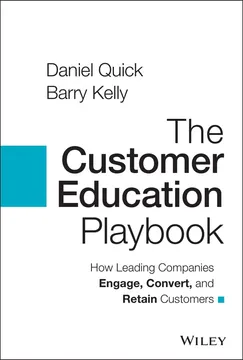
Key Takeaways
1. Customer Education is a Strategic Growth Catalyst, Not Just a Cost Center.
Without a customer education strategy, learning will happen anyway – just not the kind that positively impacts your business.
Strategic imperative. In today's subscription economy, customer education is no longer a reactive support function but a proactive business imperative. It transforms prospects into champions by teaching them how to effectively use products, ensuring they gain value and become brand advocates. This strategic shift is driven by increasing product complexity, intense market competition, and rising customer expectations for continuous learning and professional growth.
Business benefits. A centralized customer education strategy yields significant benefits across the entire customer lifecycle.
- Pre-sale: Creates Educated Qualified Leads (EQLs), optimizes trials, and scales partner training, reducing customer acquisition costs (CAC).
- Post-sale: Deflects support tickets, accelerates time to value (TTV), and scales onboarding beyond what individual customer success managers (CSMs) can achieve.
- Advocacy: Fosters mastery, increases Net Promoter Scores (NPS), and opens new revenue streams through paid certifications and skills-based learning.
Centralized function. Effective customer education requires a dedicated, strategic function, not just scattered activities across departments. This centralized approach ensures a cohesive learning journey, preventing fragmented experiences and enabling a team of professionals to focus on facilitating behavioral change through learning. It acts as a force multiplier, amplifying the company's ability to do more with less and accelerating growth throughout the customer journey.
2. Align Customer Education with Core Business Goals for Measurable Impact.
To achieve success, the goals of customer education need to align with the overarching objectives of the company.
Goal alignment. The success of any customer education program hinges on its alignment with broader business objectives and securing executive buy-in. Without clear, shared goals, efforts risk being aimless, making it difficult to demonstrate impact or secure necessary resources. Customer education teams must actively seek guidance from leadership to ensure their initiatives directly support the company's strategic priorities.
Five common goals. Customer education can address a range of critical business objectives, each with specific metrics for proving ROI:
- Improve Product Adoption: Create prescriptive learning paths or feature spotlights to drive usage.
- Metrics: Trained/Not Trained Cohort Analysis, Pre/Post Content Cohort Analysis.
- Scale Customer Support: Develop self-service resources like knowledge bases and online communities to deflect tickets.
- Metrics: Ticket deflection rate, support cost reduction.
- Maximize Customer Success: Automate basic training to free up CSMs for strategic conversations, reducing Time to Value (TTV).
- Metrics: Customer account completion rates, CSM strategic conversation scores, LTV, churn rates.
- Create Brand Ambassadors: Foster mastery, delight, and connection through certifications and community engagement.
- Metrics: Certification rates, NPS, LTV, community engagement.
- Lead Your Market Category: Publish thought leadership content that positions the company as an industry expert, beyond just product usage.
- Metrics: Webinar registrations, e-book downloads, organic search hits, social media mentions.
Strategic thinking. Effective customer education leaders think strategically, identifying the "bigger business problem" their programs can solve. This involves moving beyond simply churning out content to understanding how education drives growth, reduces costs, and enhances customer lifetime value. By consistently demonstrating this value, customer education earns trust and a seat at the executive table.
3. Motivate Customers by Curating Their Path to "Aha!" Moments and Success.
For your customers to achieve their desired outcomes, you must teach them what they need to know.
Customer-centricity. While business goals are crucial, customer education must primarily focus on the customer's definition of success. Customers "hire" a product to solve a problem or perform a job more easily and accurately, not simply to use its features. Therefore, education should put the value proposition front and center, designing learning that positions the product as a tool to achieve the customer's desired outcomes.
Defining success. Understanding what "success" looks like for diverse customer segments is paramount. This involves:
- Persona analysis: Identifying different roles (purchasing, core users, IT, HR) and industries that interact with the product.
- Job-to-be-Done (JTBD): Analyzing the specific jobs each customer is trying to accomplish and how the product can facilitate them.
- Evolving goals: Recognizing that customer needs and mastery evolve over time, requiring dynamic education paths. For example, early users need basic productivity help, while advanced users seek broader adoption strategies.
Creating "Aha!" moments. An "aha!" moment is a transformative experience where a user realizes the tangible value of a product. Identifying these moments through quantitative (analytics, churn data) and qualitative (customer interviews, surveys) research is critical.
- Analytics: Correlate sustained adoption/renewal with specific user behaviors.
- Qualitative research: Ask engaged customers what they love and disengaged customers why they left.
- Reduce TTV: Map learning journeys to guide users from one "aha!" moment to the next, accelerating their realization of value.
- Address pain points: Proactively design education to mitigate moments of frustration, turning potential churn into opportunities for support.
4. Personalize Learning Through Personas and Focus on Real-World Use Cases.
A learning persona is essentially a fictional profile that you develop that captures any segment of your customer base for whom you're designing a learning program.
Learning personas. Beyond general customer profiles, creating specific learning personas helps tailor education to individual learning needs. These fictional profiles capture common characteristics like job roles, goals, existing skill levels, preferred learning styles, and technical proficiency. They enable educators to step into the customer's shoes, anticipating hesitations and designing resonant learning journeys.
Gathering insights. Information for learning personas can be gathered through:
- Direct feedback: Surveys asking "What do you wish you knew at the start?" or "What was your 'aha!' moment?"
- Onboarding questions: Asking users to self-select their experience level or role to channel them into appropriate paths.
- Demographic data: Leveraging job titles or sales conversations to infer needs.
- Adaptive learning platforms: Using LMS features to dynamically adjust learning paths based on user input.
Focus on use cases. A common mistake is making education solely about product features. Instead, define specific, common use cases that customers leverage the product for. This approach directly aligns education with the problems customers are trying to solve, making the learning immediately relevant and valuable.
- Example: Instead of "How to use Zoom features," teach "How to conduct effective remote meetings using Zoom."
- 80/20 Rule: Focus on the 20% of content that addresses 80% of customer needs and use cases, avoiding cognitive overload from teaching everything. The remaining 80% can be addressed through scalable formats like community forums.
Data-driven personalization. Leverage both explicit (surveys, support tickets) and implicit (product analytics, search queries) data to understand user proficiency and friction points. This data helps identify what customers need to know to achieve success, allowing for targeted education that boosts engagement and mitigates pain. By connecting "aha!" moments to specific steps, educators can uncover the ideal curriculum sequence.
5. Execute Flawlessly with a Balanced Development Plan and Modular Content.
The quality of your customer education plan will be heavily impacted by the balance between the scope of your project, the timeline you have for it, and the resources that you have in place.
Strategic planning. A robust customer education development plan is essential for flawless execution and cross-functional alignment. It begins with a comprehensive project brief answering: who, what, when, where, why, and how success will be measured. This brief ensures all stakeholders understand the program's goals and approach.
Stakeholder management (RASCI). The RASCI model (Responsible, Accountable, Supportive, Consulted, Informed) clarifies roles and responsibilities for each task, from planning to iteration.
- Responsible: Person(s) doing the work.
- Accountable: Single person with final say.
- Supportive: Provides assistance.
- Consulted: Subject matter expert (SME) providing input.
- Informed: Kept in the loop.
This prevents confusion, ensures accountability, and streamlines project management.
Project management triangle. The quality of education is a delicate balance of scope, timeline, and resources.
- Scope: Define production value (professional vs. webcam), interactivity (simple text vs. complex branching scenarios), and focus (single objective vs. multiple problems). Prioritize getting content out over perfection.
- Timeline: Break projects into smaller milestones, working backward from completion. Iterate and gather feedback at each stage to avoid major rework. Align with company's go-to-market (GTM) strategy.
- Resources: Understand available budget and headcount. Consider contractors to expand capacity. Estimate content creation time (e.g., 60:1 ratio for simple content, up to 600:1 for highly interactive).
Modular content strategy. Create focused, bite-sized learning modules with single objectives. This approach offers:
- Flexibility: Modules can be assembled into larger courses or distributed individually (in-product, social media).
- Digestibility: Easier for busy customers to consume.
- Maintainability: Easier to update small parts as products evolve, rather than entire long-form courses.
- Reinforcement: Facilitates spaced repetition to combat the forgetting curve.
6. Design Engaging Learning Experiences Rooted in Science and User Experience.
While good UX delights learners and generates a positive psychological state, bad UX will cause frustration and bring up negative emotions for the learner.
UX for learning. User experience (UX) is paramount in customer education; poor design can negate even the best content. A good UX delights learners, fostering a positive psychological state conducive to learning, while bad UX creates frustration and inhibits retention. Design must be clear, simple, and engaging to capture attention within milliseconds.
Mayer's Principles. Richard E. Mayer's 12 principles of multimedia learning offer a bridge between UX and instructional design:
- Avoid extraneous information: Keep visuals simple, relevant, and limit on-screen text during narration.
- Minimize cognitive load: Place corresponding words and pictures near each other (spatial contiguity) and present them simultaneously (temporal contiguity). Segment content into manageable chunks, giving learners control over pacing. Offer pre-training for foundational concepts.
- Turn up engagement: Use visuals to back up text, adopt an informal conversational tone, and use professionally recorded human narration. Use "talking heads" strategically for introductions or breaks, not during core content presentation.
Effective learning strategies. Move beyond the myth of "learning styles" to implement scientifically proven learning strategies:
- Chunking, assessment, and feedback: Break information into smaller, themed sections. Use formative assessments to check understanding and provide immediate feedback.
- Observational learning: Demonstrate product usage and task completion, especially for software or physical products.
- Gamification: Apply game-like elements (points, badges, leaderboards) to boost motivation through operant conditioning.
- Storytelling: Structure content with narratives (beginning, problem, resolution, ending) to create mental maps and engage emotional regulation.
- Discussion boards and chatrooms: Foster social learning and communities of practice, allowing peer collaboration and critique.
Practical considerations. Choose content authoring tools (native LMS tools vs. SCORM) based on goals, interactivity needs, and maintenance. While SCORM offers rich design, native tools often provide better analytics and faster time-to-market. Allow for nonlinear navigation, offering recommended paths but enabling learners to skip redundant content, to accommodate diverse preferences and prior knowledge.
7. Transform Your Team and Partners into Expert Educators.
Your trainers must have absolute subject matter mastery in the area of value proposition.
Choosing trainers. For instructor-led training (ILT), the ideal trainer blends strong facilitation skills with subject matter expertise. While technical proficiency is valuable, the ability to translate complex knowledge into digestible learning experiences and engage learners is paramount. Trainers must be experts in the 20% of foundational content that covers 80% of customer use cases and fluent in communicating the product's value proposition.
Working with SMEs. Subject Matter Experts (SMEs) are crucial for developing accurate and impactful content.
- Nurture relationships: Build rapport early, explaining how their expertise contributes to customer and business success.
- Structured interviews: Prepare questions focusing on customer problems, value proposition, friction points, and essential knowledge (20% vs. 80%).
- Clear expectations: Define SME involvement using the RASCI model, outlining scope, timeline, and deliverables.
- Recognition: Acknowledge and reward SME contributions to foster continued collaboration.
Educate on product roadmap. Customer education teams must be integrated into the company's go-to-market (GTM) strategy to stay ahead of product changes.
- Proactive inclusion: Advocate for a seat on GTM teams or automated alerts for product updates.
- Continuous learning: Ensure the education team is updated on new features and modifications to maintain content accuracy.
- Impact: Prevent scrambling to create documentation post-launch and ensure educational materials are ready on day one.
Learning enablement. Customer education plays a vital role in enabling other customer-facing teams (sales, support, marketing, HR) to become better educators.
- Sales: Provide content on product functionality, common customer problems, and demo design.
- Customer Support: Train reps on technical aspects, FAQs, and effective use of documentation.
- Marketing: Collaborate on thought leadership, product messaging, and value proposition.
- HR: Onboard new hires with foundational product understanding and customer empathy.
This "whole-org" approach ensures consistent messaging and a seamless customer learning experience across all touchpoints.
8. Implement a Robust Distribution Strategy to Maximize Content Consumption.
A clear distribution plan is a must-have when creating educational content, and yet a lot of people skip this step and go straight to measuring the impact of the education.
Strategic distribution. Creating excellent content is only half the battle; a robust distribution strategy is essential to ensure customers consume it. This involves understanding who the content is for, when they need it, and where they are most likely to engage. Tailoring content delivery to learning personas is key.
Active promotion. Proactively promote content by forging alliances across the organization:
- Marketing teams: Leverage email nurture campaigns, website, and social media channels.
- Product teams: Implement in-app education (guiders, messages triggered by events) or promote via product release notes.
- Customer Support/Success: Empower these teams to recommend relevant content to customers at their moment of need.
- Professional Services: Package education into premium offerings.
Optimization for consumption. Organize content for easy discoverability and navigation:
- Information Architecture (IA): Use hierarchical, sequential, or matrix structures to make catalogs scannable.
- Clear CTAs: Guide learners from one piece of content to the next, eliminating guesswork.
- Notifications: Utilize in-LMS notifications or trigger-based emails to nudge learners.
- Searchability: Optimize content for web search (SEO) and consider unified search systems across platforms (knowledge base, LMS, community) to reduce friction.
Pricing and packaging. If monetizing content, align pricing with production cost, market demand, and perceived value.
- Pricing models: A la carte, bundles, training credits, or subscriptions.
- Value perception: Charging for content can increase perceived value and learner motivation.
- Accessibility: Ensure content is accessible to all users (e.g., screen reader optimization, descriptive hyperlinks, video captions, color-blind friendly design).
- Localization: Translate and culturally adapt content for international audiences, considering regional technology access and learning preferences. Start with text-based content for easier localization.
9. Measure Success with a Multi-Level Framework to Prove Customer and Business Impact.
Being able to measure the impact of your education falls into two categories. First, assess the success for the customer. ... And second, has your program paid off for the business – has it shown return on investment (ROI)?
Demystifying data. Measuring the impact of customer education doesn't have to be hard; the key is to start simple and gradually add sophistication. A data dictionary, a centralized repository of defined metrics, helps clarify meaning and align data with program goals.
Kirkpatrick Model (adapted). This framework provides a structured approach to evaluating education:
- Level Zero: Engagement: Measures content consumption and reach.
- Breadth: Percentage of customer accounts with at least one educated person.
- Depth: Percentage of users within an account who consume content.
- Volume: Average content objects consumed or time spent per individual.
- Level One: Reaction: Assesses learner satisfaction.
- Metrics: Upvotes/downvotes, smile sheets, CSAT/NPS scores, completion rates (used cautiously).
- Level Two: Learning: Determines if knowledge transfer occurred.
- Metrics: Summative assessments, quizzes, certifications.
- Level Three: Behavior: Analyzes changes in customer actions.
- Metrics: Time to Value (TTV), product adoption rates, feature usage.
- Level Four: Results: Evaluates business impact of behavioral changes.
- Metrics: Retention rates, churn reduction, upsell opportunities, A/B testing results.
Prioritizing data. Focus on 1-3 key metrics that directly align with customer and business goals. For example, if the goal is to improve customer experience, CSAT scores are relevant; if it's to speed up onboarding, TTV is key. This focused approach prevents overwhelm and ensures data collection is purposeful.
Communicating success to customers. Share findings back with learners to reinforce value and encourage continued engagement.
- Delightful moments: Certificates, badges, confetti.
- Personalized updates: Monthly emails celebrating learning achievements.
- Social proof: Show how their learning compares to peers or correlates with positive outcomes (e.g., "Customers who complete this training are 50% more likely to find value in the first 90 days").
10. Continuously Iterate and Improve Content Based on Data and Feedback.
Improving content requires a real commitment to the idea of iteration.
Iterative design mindset. Content improvement is an ongoing process, not a one-time fix. Adopt an iterative mindset from ideation, continuously validating assumptions and making small, incremental changes. Treat projects as "living things" that require regular nurturing, updates, and maintenance to stay relevant as products evolve.
Leveraging feedback. Establish explicit feedback loops to gather both quantitative and qualitative data:
- Quantitative: Ratings (1-5), upvotes/downvotes, pop-up surveys ("How are we doing so far?").
- Qualitative: Open-ended survey questions ("How would you suggest we improve?"), customer interviews, support team insights.
- Analysis: Look for themes and patterns in feedback, even single comments, especially when triangulated with quantitative data (e.g., low completion rates correlating with "video too long" feedback).
- Prioritization: Address objective feedback (typos, inaccuracies) first. Consider the effort vs. impact for subjective feedback (color schemes, animated characters).
Improving support content. Use data to identify gaps and enhance help documentation:
- Search queries: Analyze common search terms to uncover missing or hard-to-find content.
- Support tickets: Identify recurring questions that indicate a need for new articles or training.
- Help Content Optimization Matrix: Plot articles by traffic and helpfulness to prioritize improvements.
- High traffic, high helpfulness: Core, valuable content to protect and repurpose.
- High traffic, low helpfulness: High priority for immediate improvement.
- Low traffic, high helpfulness: Promote these valuable but undiscovered resources.
- Low traffic, low helpfulness: Consider archiving or deleting.
Improving training content. Focus on boosting enrollment, completion, and satisfaction:
- Consumption: Optimize titles (make them active and value-driven), enhance registration pages (marketing-focused, compelling visuals, short videos), and use funnel analysis to identify drop-off points.
- Satisfaction: Collect feedback via post-course surveys (short, focused questions), organize themes, prioritize objective fixes, and use learning science insights to address underlying issues (e.g., content density, lack of interactivity).
- Certifications: Use psychometrics and item analysis to ensure questions effectively discriminate between true experts and novices, maintaining the credential's integrity.
Archiving content. Don't fall victim to the sunk-cost fallacy. If data consistently shows content is not useful or providing value, archive or delete it to streamline offerings and reallocate resources.
11. Demonstrate ROI to Secure Your Seat at the Strategic Table.
The bottom line is, if you can't draw a connection from the customer education function to the rest of the business, how can you make a case for greater investment to grow your team or expand your portfolio?
Proving worth. Demonstrating the monetary and strategic ROI of customer education is crucial for securing investment, driving strategy, and gaining a seat at the executive table. Relying solely on intuition or executive sponsorship is insufficient; data-driven proof is essential.
Collecting business impact data. Connect education data to other organizational systems:
- Data integration: Prioritize hooking up your LMS data to a data warehouse with business intelligence tools (CRM, support databases, accounting systems).
- ROI formula: (Monetary Benefits - Training Costs) / Training Costs * 100 = ROI %.
- Training Costs: Headcount, technology, contractors.
- Monetary Benefits: Direct sales (for fee-based programs), or monetized impact of:
- Support ticket deflection (e.g., cost per ticket saved).
- Reduced churn (e.g., value of retained customers).
- Increased product adoption (e.g., value of feature usage).
- Faster Time to Value (e.g., resources saved on onboarding).
Training score and cohort analysis. Assign a "training score" (e.g., highly trained, trained, untrained) to accounts based on their engagement with education. Use cohort analysis to compare these groups against key business metrics:
- Example: Compare support tickets filed by "highly trained" vs. "untrained" accounts. If highly trained accounts file fewer tickets, quantify the cost savings.
- Correlation vs. Causation: While proving direct causation can be challenging, strong correlations between training and positive business outcomes (e.g., higher retention, faster TTV) are powerful indicators of value and justify investment.
Storytelling for impact. Effective communication is as vital as data collection. Design presentations to teach executives the impact of your program:
- Know your audience:
- Managers: Interested in details, team impact, challenges, and risks.
- Executives: Focus on overall significance, conclusions, and connection to current business objectives (e.g., 1-2-3 rule: one overall point, two metrics/slides, three minutes).
- Company: Evangelize education's value, share customer quotes, and highlight cross-departmental contributions.
- Narrative structure: Start with the problem, explain your solution, then present the data as the climax.
- Emotional appeal: Use customer quotes to humanize challenges and impact.
- Visuals: Employ clear charts and graphs to make data easily digestible and impactful (e.g., a line graph showing engagement spike after a new Academy launch).
12. Embrace an Agile, Data-Driven Future for Customer Education.
True innovation is not just something “cool,” it's sustainable and long-lasting, and it comes from a place of “What needs fixing?”
Rapid growth and evolution. Customer education is experiencing rapid growth, fueled by the shift to virtual learning and increasing recognition of its strategic value beyond product adoption and support. This growth will lead to a convergence of related functions (marketing, sales enablement, customer success) into centralized learning strategies.
Future innovations. Innovation will focus on solving current struggles:
- Beating the measurement challenge:
- Customer Learning Management (CLM) systems: Dedicated platforms integrating learning data with other business systems (CRM, product analytics, support data) to provide a single, comprehensive view of education's impact.
- AI-powered insights: AI analyzing product usage and support data to recommend specific learning experiences, eliminating guesswork for instructional designers.
- Learning anywhere:
- In-product deep learning: Moving beyond simple guiders to deliver comprehensive, sustainable learning directly within the product environment.
- Omnichannel presence: Expanding beyond traditional academies to leverage social media (YouTube, TikTok, Instagram) for learning, ensuring brand control over product information.
- Augmented Reality (AR): Delivering contextual, just-in-time education for physical products and machinery (e.g., manufacturing, medical devices).
- Agile growth mindset:
- Rapid content creation: Shifting from long, evergreen courses to quick, modular content (e.g., short videos) that can be produced and updated rapidly to match fast-paced product release cycles.
- AI-powered authoring: Tools that automatically scan products and generate basic content, freeing up human educators for higher-value tasks.
- Changing customer expectations:
- Consumer-grade experiences: Demand for delightful, engaging, personalized, and convenient learning experiences.
- Skills training and credentials: Customers will increasingly look to vendors for industry-specific skills training and certifications that offer career advancement, displacing traditional academic routes.
- Crowdsourced advocacy: Certified experts will contribute to content creation, fostering a growth loop of scale and community.
Strategic imperative. The future of customer education lies in a strategic, proactive approach that orchestrates learning across the entire customer lifecycle. By demonstrating value, embracing agile methodologies, and leveraging innovative technologies, customer education will solidify its position as an indispensable function driving exponential business growth.
People Also Read


Download PDF
Download EPUB
.epub digital book format is ideal for reading ebooks on phones, tablets, and e-readers.








































