

Key Takeaways
Become a radical realist who sees people as they are, not as you wish
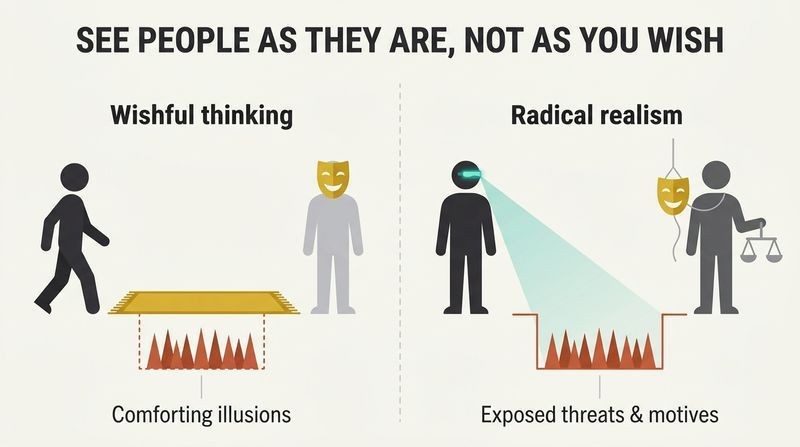
Robert Greene's central mission across all his books, distilled here into daily meditations, is to strip away the comforting delusions culture feeds us. We are taught that colleagues want the best for us, that bosses are secure, that nice people harbor no dark motives. Reality punishes these fantasies with betrayals, dead-end careers, and confusion.
The evolutionary framing. Greene argues our brains evolved over millions of years to detect danger and read the environment. Ancient humans who drifted into fantasy got eaten. Today the predators are people and their tricky psychology, not leopards, so our danger sense atrophies. The Daily Laws aims to reattune your mind to human nature as it actually operates, turning you into someone who reads dangers and opportunities clearly rather than someone blindsided by them.
What's striking is Greene's diagnosis that naivete is not innocence but a liability manufactured by culture. This echoes evolutionary psychology's mismatch theory: instincts calibrated for the Pleistocene misfire in modern environments. Critics fairly note the framing can curdle into cynicism, seeing manipulation everywhere. Greene's defense is subtle: radical realism is not paranoia but accuracy. The Stoics made a similar move, distinguishing between what we control and what we cannot. The strongest version of this insight is diagnostic humility: assume you are misreading people, then investigate, rather than trusting the snap judgments your ego finds convenient.
Dig up your childhood obsessions to find your life's true work
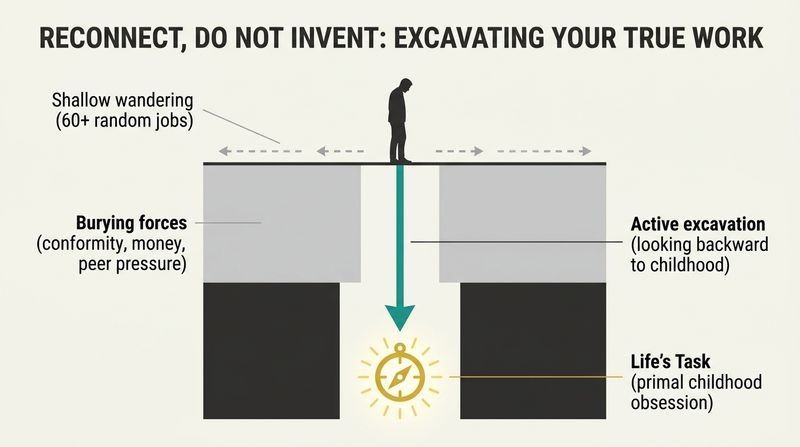
Greene calls it your Life's Task: a unique inclination planted at birth, expressed first in childhood as primal fascination. Marie Curie stood transfixed before her father's laboratory instruments at age four. John Coltrane heard Charlie Parker and found a voice for spiritual longings he could not verbalize. These pulls come from deeper than conscious words.
Reconnect, do not invent. Greene insists you do not create your calling, you excavate it. Over years, parents, peers, and the lure of money bury these signals. His own path wandered through roughly sixty jobs before, at thirty-six, an idea for The 48 Laws of Power gushed out and clicked like destiny. The lesson: it can arrive late. Look for activities that made you feel most alive, most yourself, and follow that thread relentlessly.
This reframes vocation as archaeology rather than ambition, which is psychologically shrewd. Research on intrinsic motivation (Deci and Ryan's self-determination theory) supports the claim that internally driven pursuits sustain effort far longer than externally rewarded ones. Yet the childhood-obsession thesis risks survivorship bias: we celebrate Curie and Coltrane but ignore the many whose early passions led nowhere. Greene's more durable point is about the false path, chasing money or approval, which produces the emptiness so many mid-career professionals report. The actionable core is quieter than destiny talk: notice what absorbs you when no one is watching.
Treat your first job as transformation, not a paycheck
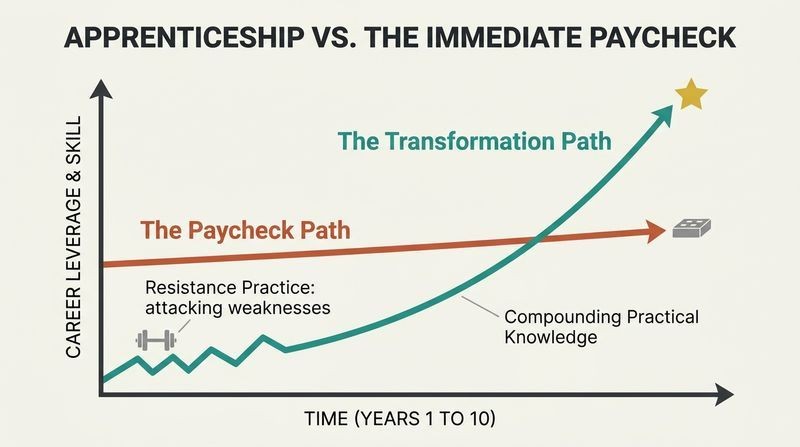
Greene revives the medieval idea of apprenticeship: a self-directed period of five to ten years whose sole purpose is transforming your mind and character, not earning money or titles. Choose positions offering the steepest learning curve, even at mediocre pay, because practical knowledge compounds for decades while salary bumps do not.
Learn by doing, move toward resistance. Greene's own year in Paris taught him that necessity (sink or swim) makes the brain absorb faster than any classroom. He advocates Resistance Practice: deliberately attacking your weaknesses rather than polishing what already comes easily, the path amateurs avoid. He cites the roughly 10,000 hours of quality practice research suggests separates novices from masters, calling shortcuts impossible. The very impatience that craves them, he argues, disqualifies you from mastery.
The apprenticeship model directly challenges the modern optimization culture of rapid job-hopping for salary gains. Greene's emphasis on hands-on repetition aligns with cognitive science on procedural memory and Anders Ericsson's deliberate practice, though Ericsson himself disputed the rigid 10,000-hour figure Malcolm Gladwell popularized. Practice quality, not raw hours, is what matters, and Greene mostly honors this with his stress on intensity and feedback. The subtle wisdom here is delayed gratification applied to careers: prioritizing learning velocity over immediate compensation is a bet that pays asymmetric dividends, but only for those who can tolerate the discomfort of prolonged beginnerhood.
Never outshine the master; make superiors feel brilliant
Greene's first and most famous law of power emerged from personal humiliation. In his twenties, working a research job he excelled at, he was mysteriously tortured by a superior until he quit. Years of analysis revealed he had violated Law 1: his talent made her feel insecure and threatened, touching her ego and her fear he was after her job.
The courtier's paradox. Everyone must appear civilized and fair, yet those who play strictly by those rules get crushed. Greene draws on the scheming aristocratic court as a model for the modern workplace. Galileo dedicated the moons of Jupiter to the Medicis, making his patrons shine among Italy's courts rather than merely funding him. The move: ascribe your best ideas to those above, let them radiate, and rise in their favor.
This is Greene's most morally contested territory, and it rewards a steelman. The insight is not sycophancy but social intelligence: recognizing that competence threatens fragile egos and that unacknowledged status hierarchies govern organizations. Organizational psychology confirms that perceived threat to a superior's status triggers sabotage. Yet the advice has limits Greene underplays: in genuinely meritocratic or flat cultures, excessive deference reads as weakness, and chronic self-effacement can erode your own reputation. The durable takeaway is emotional detachment, treating office politics as a game to observe coolly rather than a personal drama to react to, which Greene frames as liberation from taking things personally.
Judge people by actions over time, never by their words
Greene argues character reveals itself through behavioral patterns, not declared intentions. People dress up motives with words; their repeated actions, especially under stress when the mask slips, tell the truth. Chronic lateness, unreturned favors, disappearing when pressure mounts: nothing is too small to notice as a sign of something deeper.
Watch for the emphatic front. Greene warns that emphatic traits often conceal their opposite: blustery people are insecure, the overly friendly are often ambitious and aggressive, the constant joker hides mean-spiritedness. He illustrates with Howard Hughes, whose carefully cultivated image of the rugged, successful businessman masked a terrible manager whose ventures mostly lost money. Our blind spot, Greene says, is being mesmerized by reputation and charm rather than plumbing people's actual track record before we trust them.
Greene's behavioral emphasis anticipates a robust finding in psychology: past behavior is the best predictor of future behavior, far better than stated intentions or personality self-reports. His warning about emphatic traits echoes reaction formation from psychoanalysis, where people display the opposite of a repressed impulse. The nuance worth adding is the fundamental attribution error, our tendency to over-attribute others' behavior to fixed character while excusing our own as situational. Greene's method corrects for charm bias but could overcorrect into rigid labeling. The wisest application treats patterns as strong evidence while remaining open to genuine change, which is rare but not impossible.
Beware supposed nonplayers who flaunt virtue to disguise power moves
Greene identifies a dangerous type: people who claim to be above the game of power, parading their morality, piety, and sense of justice. These supposed nonplayers, he argues, are often the most skilled manipulators, using their virtuous front as a smoke screen. The noble gesture is a favorite tool: art dealer Joseph Duveen helped create a national art museum, letting wealthy clients dodge taxes and inflate their remaining paintings' value while appearing as public benefactors.
Three types of people. Greene sorts everyone into deniers (who pretend power games do not exist and get marginalized or play them unconsciously), lovers of manipulation (master schemers who eventually overreach and fall), and radical realists (who accept power as human nature and play skillfully in offense or defense). Everyone is playing, he insists. There is no opting out.
The nonplayer concept is Greene's sharpest psychological observation, and it cuts uncomfortably close. Moral grandstanding as a status strategy is now documented in research on virtue signaling, where public displays of moral outrage can serve reputational rather than ethical ends. Greene's framework risks a corrosive conclusion, that all virtue is performance, which is empirically false and philosophically self-defeating. The steelman is narrower and sound: be alert when someone's moral display seems calibrated for an audience or conveniently advances their interests. The real tell, consistent with the prior takeaway, is whether private actions match public sermons.
Persuade through others' self-interest, never through your own needs
Greene's core persuasion principle inverts our instinct. When asking for help, most people talk about their own needs, gratitude, or grand causes, putting the spotlight on themselves. But even the powerful are locked inside their own wants and see your need as a waste of time. The royal road is to uncover what benefits the other person and emphasize it out of all proportion.
Confirm their self-opinion. Greene argues everyone carries a self-image (independent, intelligent, decent) that only others can validate, and this validation is rare. Give it and defenses drop. Billy Wilder wanted Marlene Dietrich for a role she found distasteful; instead of pleading, he asked her to judge screen tests of two deliberately terrible actresses. Her competitive nature did the rest, and she volunteered for the part. The art: make people feel they are choosing what you want them to do.
This synthesizes Dale Carnegie with something more strategic. The self-interest principle is bedrock behavioral economics, but Greene's twist toward ego validation is subtler and supported by research on self-affirmation, which shows people become less defensive and more open to persuasion after their self-worth is affirmed. The Wilder anecdote illustrates reactance theory: people resist when they feel their freedom is threatened, so engineering the illusion of free choice bypasses resistance. The ethical edge is real, this is manipulation, but Greene's defense is that influence is unavoidable in social life, so skill beats clumsiness or denial. Deep listening, he notes, is the rarest and most seductive tool.
Seduce by directing attention outward and delaying satisfaction
Greene reframes seduction broadly as the power to penetrate people's psychological defenses, present in advertising, politics, and film, not just romance. The seducer's first move is getting inside the other person's skin, seeing the world through their eyes. Self-absorption is anti-seductive; outward attention gathers the intelligence that lets you provide the rare, individualized focus people crave.
The coquette's rhythm. The master technique is alternating warmth and withdrawal. Total pursuit smothers and signals neediness; strategic absence makes the mind idealize you and chase. Greene cites the coquette, who baits with promise then steps back, keeping desire in thrall. Familiarity kills seduction, so keep dark corners in your character and flout expectations. The deepest lure appeals to people's unrealized greatness, their sense of being inwardly more than the world recognizes.
The withdrawal mechanic maps onto intermittent reinforcement, the most powerful and addictive reward schedule in behavioral psychology, which explains why unpredictable responses breed stronger attachment than consistent ones. This is scientifically robust but ethically fraught, since the same principle drives gambling addiction and toxic relationships. Greene's emphasis on empathy as a seductive tool is more benign and aligns with research showing that feeling deeply understood is a core human need rarely met. The appeal to unrealized greatness resonates with humanistic psychology's self-actualization. The caution: techniques that manufacture longing can erode the authenticity that sustains real intimacy over time.
Rise above tactical hell by thinking strategically, not reactively
Greene describes tactical hell as the state most people live in: endlessly reacting to others' moves, getting emotional, fighting battles that never resolve. Strategy is the escape. A strategist elevates the mind above the battlefield, keeps long-term goals in view, and decides which fights to avoid entirely.
Assume formlessness. The final and highest law is to be like water, adapting to each new circumstance rather than following fixed formulas. Greene contradicts his own rulebook here: true strategy is not a brilliant step-by-step plan but positioning yourself with more options than your opponent, what Sun Tzu called shih, a position of latent force. He warns against attacking head-on (go for the flank, the vulnerable side) and against the danger of victory, where success intoxicates and makes you overreach past the mark you aimed for.
The tactical-versus-strategic distinction maps onto the psychological literature on hot and cold cognitive systems: reactive emotion versus deliberate reasoning. Greene's shih concept, prioritizing optionality over rigid plans, anticipates ideas from Nassim Taleb on antifragility and from real options theory in finance, where preserving flexibility under uncertainty has measurable value. The warning against overreach in victory is historically well-grounded, from Napoleon's march to Moscow to corporate hubris after breakthrough success. What Greene adds is the emotional discipline required: strategy fails not from lack of intelligence but from the inability to detach from immediate provocations. The formlessness principle usefully undercuts guru worship, including his own.
Master your emotions by widening the gap between feeling and action
Greene's law of human nature holds that rationality is not suppressing emotion but being aware of how emotion infects thinking. Irrational people rush to act under emotional influence and cannot introspect; rational people notice the pull and compensate for it. He invokes Pericles, who trained himself never to decide while gripped by a strong feeling, sometimes retreating home for days until calm returned.
Increase your reaction time. The practical method is resistance training for the mind: write the angry email but do not send it, sleep on decisions, never commit to people or make phone calls while emotion runs high. Greene offers the ancient Greek image of rider and horse: emotion is the powerful horse supplying energy, reason is the rider giving direction. Neither works alone. Channel emotion rather than obey or repress it.
Greene's definition of rationality as awareness rather than suppression is neuroscientifically sound. Antonio Damasio's work on patients with damaged emotional centers showed they became unable to make sound decisions, proving emotion is essential to reason, not opposed to it. The reaction-time technique is essentially the pause between stimulus and response that Viktor Frankl called the space where freedom lives, and it underlies modern cognitive behavioral therapy. The rider-and-horse metaphor predates Greene (Plato, and Jonathan Haidt's elephant and rider), but his framing as harmony rather than domination is the mature view. The honest caveat: awareness alone rarely tames strong emotion; it requires the repeated practice Greene prescribes.
Turn envy into a spur and practice joy at others' success
Greene calls envy the ugliest and most disguised human emotion, the only one, per Plutarch, that no one confesses. We reflexively recast it as resentment at unfairness because admitting inferiority is too painful. He offers Schopenhauer's test: tell a suspected envier good news and watch the microexpression of disappointment, or share misfortune and catch the flash of schadenfreude, glee at another's pain.
Two antidotes. First, convert envy into a competitive spur, using people slightly above your skill level to pull yourself upward, which requires confidence in your ability to improve and a solid work ethic. Second, practice what Nietzsche called Mitfreude, joying-with: actively imagine and feel others' happiness as a form of empathy. Because genuine delight in someone's good fortune is so rare, it forges powerful bonds. Moving closer to what you envy usually reveals hidden misery behind the glittering facade.
Greene's treatment of envy as socially camouflaged is well-supported: research on schadenfreude and its neural correlates confirms that others' misfortune activates reward regions, especially toward those we envy. Social comparison theory (Festinger) explains why upward comparisons breed both motivation and misery, depending on whether we feel capable of closing the gap. Greene's Mitfreude prescription is his most constructive move and dovetails with the Buddhist concept of mudita, sympathetic joy, cultivated in loving-kindness meditation shown to increase well-being. The facade insight (that the enviable are rarely as happy as they appear) is a genuine cognitive correction, since we compare our full interior to others' curated exterior.
Meditate on death daily to intensify life and free yourself
Greene's culminating law confronts mortality, which modern culture sanitizes into hospitals and hides behind closed doors, unlike ancestors who witnessed death constantly. This denial, he argues, breeds a chronic, unnamed anxiety that infects daily decisions. The remedy is turning to face death rather than fleeing it. After finishing a book on this very theme, Greene suffered a severe stroke, waking paralyzed, and reports that surviving made colors, sounds, and human connection more intense.
Death ground and amor fati. He draws on Sun Tzu's death ground, positioning soldiers with no retreat so they fight with triple spirit, and urges applying it to life: put yourself where you cannot afford to lose. Dostoyevsky, spared at the last second from a firing squad, felt reborn with deepened empathy. Greene closes with Nietzsche's amor fati, loving your fate, embracing even suffering as an opportunity to learn.
This is the book's philosophical heart and its most personally earned section, given Greene's stroke. The claim that death awareness enhances vitality has empirical backing: terror management theory shows mortality salience reshapes values and behavior, while research on people after near-death experiences and terminal diagnoses documents intensified presence and gratitude. The Stoic practice of memento mori and Heidegger's being-toward-death converge on the same insight. Greene's death ground application is bracing but double-edged, since manufactured desperation can also produce panic and burnout rather than focus. The most livable version is amor fati as reframing: treating setbacks as fated lessons, which builds the resilience positive psychology links to post-traumatic growth.
Analysis
The Daily Laws is an anthology, a 366-entry distillation drawn from Robert Greene's five major works plus interviews and unpublished material on the Sublime. This structure is both its strength and its challenge to summarize: it is not thesis-driven but mosaic, circling a handful of obsessions from countless angles. The unifying thread is what Greene calls radical realism, seeing human nature and power as they actually operate rather than as culture pretends. The book moves through a deliberate yearlong arc: self-discovery (Life's Task, apprenticeship, mastery), then the darker social terrain (power, toxic types, manipulation, seduction, persuasion, strategy), and finally an inward turn toward emotional mastery, the higher self, and mortality.
What makes Greene distinctive in the crowded self-help field is his refusal to moralize combined with his encyclopedic use of history. He teaches through Galileo, Napoleon, Chanel, Dietrich, and Lincoln rather than through studies and life hacks. This gives the work a literary density rare in the genre, though it also invites the charge that cherry-picked historical anecdotes prove whatever the author wishes.
The intellectual tension running through Greene is between amorality and wisdom. His power and seduction material can read as a manual for manipulation, and critics have called it cynical or worse. Yet the arc of the book resolves this: the later months on rationality, empathy, and death reveal that Greene's ultimate aim is self-mastery and connection, not domination. His defense is consistent, that these dynamics exist whether we acknowledge them or not, and denial leaves us defenseless.
The strongest, most transferable ideas are psychological rather than tactical: judge by patterns not words, widen the gap between emotion and action, convert envy into aspiration, and let mortality sharpen presence. These align well with Stoicism, behavioral science, and contemporary psychology. The weakest are the more Machiavellian prescriptions, which carry real ethical hazard and work poorly in genuinely collaborative settings. Read as a whole, the book is less a rulebook than an education in disillusionment, in the classical sense of shedding illusions to see clearly.
Review Summary
The Daily Laws receives mostly positive reviews, praised for distilling Greene's wisdom into daily meditations. Fans appreciate its concise format and practical advice, while critics find it manipulative or shallow. Many readers value the book as a refresher or introduction to Greene's ideas on power, strategy, and human nature. Some note it works best as a companion to his other books rather than a standalone work. The book's daily format is seen as both a strength and limitation.
People Also Read







Glossary
Life's Task
Your unique innate callingGreene's term for the singular purpose each person is born to fulfill, marked genetically and expressed first as childhood fascination. Unlike a career chosen for money or status, the Life's Task aligns with your deepest inclinations. Greene argues you do not invent it but excavate it by reconnecting with early obsessions and the activities that make you feel most alive and authentic.
Apprenticeship Phase
Transformative early learning periodA largely self-directed period of roughly five to ten years after formal education whose true goal is transforming your mind and character, not earning money or titles. Greene advises choosing positions with the steepest learning curves, valuing practical knowledge above salary, and moving toward challenges and resistance rather than comfort.
Resistance Practice
Practicing your weaknesses deliberatelyGreene's method of going against natural tendencies during practice by attacking the weaknesses you would rather avoid, becoming your own harshest critic, and doubling your focus. It is the opposite of the amateur habit of endlessly repeating what already comes easily, which produces lopsided skill.
Supposed nonplayers
Hidden manipulators feigning virtueGreene's label for people who publicly claim to be above power games, parading morality, piety, and fairness, while often being the most skilled manipulators. Their virtuous front serves as a smoke screen. Greene warns they are among the most dangerous types because their manipulation is disguised and often unconscious.
Tactical hell
Endless reactive emotional battlesThe state in which most people live, constantly reacting to others' moves, getting emotional, and fighting unresolvable battles on multiple fronts without perspective. Greene contrasts it with strategy, the ability to elevate the mind above the battlefield, keep long-term goals in view, and choose which fights to avoid.
Shih
Position of latent forceA concept from Sun Tzu that Greene adopts: strategic positioning that gives you maximum options and potential energy, like a boulder perched on a hilltop or a drawn bowstring. True strategy, in this view, is not following preordained steps toward a goal but placing yourself where you have more options than your opponent.
Mitfreude
Actively joying with othersNietzsche's term, meaning joying-with, that Greene prescribes as the antidote to envy and schadenfreude. Rather than merely congratulating people, you actively imagine and feel their joy as a form of empathy. Because genuine delight in another's good fortune is rare, practicing it forges strong bonds and increases your own capacity for joy.
The Cosmic Sublime
Mind-expanding encounter with infinityGreene's concept for an encounter with any physical phenomenon that implies the infinite in space or time, such as the night sky, vast wilderness, or contemplation of the brain's complexity. It pulls the mind out of its ruts and daily trivia, producing awe and internal transformation, as opposed to the False Sublime sought through drugs or distraction.
Amor fati
Love of your fateA Nietzschean phrase meaning love of fate, which Greene adopts as a life philosophy. Since much of life is beyond control, including death, the task is to accept and even embrace difficult events, not for the pain but for the opportunities to learn and strengthen. It involves seeing everything as fateful and gleaning the lesson.
Death ground
No-retreat position forcing focusSun Tzu's concept, adopted by Greene, describing a position where an army has no escape route and therefore fights with double or triple spirit because death is viscerally present. Greene applies it to life: deliberately place yourself in situations where you cannot afford to lose, creating urgency that concentrates energy and creativity.
FAQ
What's The Daily Laws about?
- Daily Meditations: The Daily Laws by Robert Greene offers 366 meditations focusing on power, seduction, mastery, strategy, and human nature. Each entry is crafted to provide insights and practical advice for life's complexities.
- Human Nature Focus: The book emphasizes understanding human nature, including our darker impulses, to better manage interactions and decisions. Greene encourages confronting emotions and biases for personal growth.
- Practical Guidance: It serves as a guide to navigating social interactions and personal development, aiming to transform readers into "radical realists" who connect with their true selves.
Why should I read The Daily Laws?
- Comprehensive Insights: The book distills lessons from Greene's previous works, offering a rich tapestry of knowledge on human behavior and strategy.
- Self-Improvement Focus: It encourages personal growth and self-awareness, suitable for anyone looking to enhance their understanding of themselves and their interactions.
- Engaging Style: Greene's writing is engaging and thought-provoking, often using storytelling to illustrate key points, making it both informative and enjoyable.
What are the key takeaways of The Daily Laws?
- Mastery is a Process: Mastery requires dedication, practice, and learning from failures, rather than being an innate talent.
- Understanding Human Nature: Recognizing the darker aspects of human nature helps navigate social dynamics more effectively.
- Power Dynamics: The book provides insights into subtle power plays in everyday interactions, encouraging awareness to protect oneself and advance interests.
What are the best quotes from The Daily Laws and what do they mean?
- "Mastery is a process...": This quote underscores that mastery requires a journey of self-discovery and continuous effort.
- "The world wants to be deceived.": It highlights that people often prefer illusions over harsh realities, a powerful tool in persuasion.
- "You are the obstacle.": A reminder that our perceptions and emotional responses can hinder progress, encouraging self-reflection and accountability.
How does The Daily Laws help with personal development?
- Self-Reflection Prompts: Each entry encourages reflection on experiences and behaviors, fostering a deeper understanding of motivations and actions.
- Practical Exercises: Greene includes actionable advice and exercises to cultivate mastery and improve social skills.
- Long-Term Growth: The book promotes lifelong learning and adaptability, essential for personal and professional success.
What is the significance of the "Life's Task" concept in The Daily Laws?
- Unique Purpose: Each individual has a unique "Life's Task," their calling or purpose in life, crucial for fulfillment and mastery.
- Childhood Connections: Reconnecting with childhood passions can uncover this task, emphasizing authenticity in pursuits.
- Guiding Force: The "Life's Task" helps individuals make decisions aligning with their true selves and aspirations.
How does Greene define mastery in The Daily Laws?
- Continuous Learning: Mastery is a lifelong process of learning and improvement, requiring dedication and embracing challenges.
- Integration of Knowledge: True mastery involves integrating knowledge from various fields for a holistic understanding of one's craft.
- Intuitive Understanding: Progressing toward mastery develops an intuitive feel for one's field, enabling navigation of complexities with ease.
What are the "supposed nonplayers" mentioned in The Daily Laws?
- Disguised Manipulators: "Supposed nonplayers" are individuals who claim to be uninvolved in power dynamics but are skilled manipulators.
- Psychological Insight: Recognizing these individuals requires understanding human behavior, as they use charm to mask true intentions.
- Cautionary Awareness: The book advises caution with such individuals, as they can be toxic and detrimental to personal and professional life.
How can I apply the concepts from The Daily Laws in my daily life?
- Daily Reflections: Incorporate meditations into your routine, reflecting on how concepts apply to your experiences and interactions.
- Practice Self-Awareness: Use insights to enhance self-awareness, recognizing strengths, weaknesses, and dynamics in relationships.
- Engage with Others: Apply principles of power dynamics and human nature in interactions for more effective and strategic navigation.
What role does storytelling play in The Daily Laws?
- Engaging Narratives: Greene uses storytelling to illustrate key concepts, making material relatable and engaging.
- Historical Examples: The book includes historical anecdotes providing context and depth to lessons, reinforcing principles.
- Emotional Connection: Narratives foster an emotional connection with readers, enhancing the impact of lessons and encouraging reflection.
How does The Daily Laws suggest dealing with toxic relationships?
- Recognizing Toxicity: Emphasizes recognizing toxic individuals and their impact on well-being as the first step in addressing them.
- Setting Boundaries: Advocates setting clear boundaries to protect emotional health, possibly limiting interactions.
- Empowerment Through Choice: Encourages taking control of relationships by prioritizing healthy connections for a positive social environment.
What is the importance of patience as discussed in The Daily Laws?
- Long-Term Perspective: Patience is valuable for achieving long-term goals, allowing thoughtful consideration and better outcomes.
- Emotional Regulation: Practicing patience helps regulate emotions, preventing impulsive reactions and maintaining clarity.
- Building Resilience: Patience fosters resilience, enabling navigation of setbacks with grace, understanding progress takes time.
About the Author








Download PDF
Download EPUB
.epub digital book format is ideal for reading ebooks on phones, tablets, and e-readers.








































