Key Takeaways
1. The Spectacle of 19th-Century Partisanship
"In the mid-nineteenth century an intense partisanship, embodied in the party press, and spectacular election campaigns helped to sustain a popular politics embracing all social classes."
A vibrant political culture. From the 1840s to the 1890s, American politics in the North was a lively, inclusive affair, characterized by widespread participation and fervent party loyalty. Elections were not just about casting ballots; they were grand public spectacles, featuring torchlight parades, mass rallies, and uniformed marching companies. This demonstrative style of politics, deeply woven into the fabric of Northern society, made political engagement a natural and exciting part of life for white men of all classes.
Partisanship as identity. Loyalty to a political party was a fundamental aspect of a man's identity, shaping his worldview and public behavior. Newspapers, acting as overt party organs, reinforced this intense partisanship by presenting a black-and-white world of political friends and enemies, blurring the lines between fact and opinion. This subjective approach meant that one's beliefs rightly conditioned one's perception, making political choices straightforward and emotionally resonant.
Communal rituals. Campaign events were powerful communal rituals, blending entertainment, martial excitement, and class interaction. While candidates often remained "mute tribunes," voters actively expressed their political preferences through public displays, from signing club constitutions to making ostentatious election bets. This collective participation socialized young men into politics and imbued the act of voting with significance far beyond a simple ballot, contributing to record voter turnouts that peaked at 77% between 1876 and 1900.
2. Liberal Reformers: A Challenge to Popular Rule
"For many Northerners of wealth and education, the years following the Civil War seemed to unfold a myriad of evils."
Disillusionment with democracy. After the Civil War, a segment of the Northern upper class, known as liberal reformers or "best men," grew increasingly alarmed by the state of popular politics. They viewed the expansion of universal suffrage, particularly to immigrants, as a threat, fearing it led to "the government of ignorance and vice" and the "severance of political power from intelligence and property." This elite group, largely Protestant, well-educated, and concentrated in the Northeast, believed that the existing system fostered corruption, party machines, and an undesirable emotionalism in public life.
Failed suffrage restriction. Initially, reformers sought to limit the right to vote, proposing educational and property qualifications, especially for municipal elections. The Tilden Commission in New York (1877) exemplified this effort, suggesting property requirements for voting in larger cities. However, these attempts largely failed due to strong opposition from political machines like Tammany Hall and a broader public reluctance to restrict suffrage, which was increasingly seen as an inviolable right.
A new political agenda. Recognizing the impracticality of direct disfranchisement, liberals shifted their focus to other reforms. Their agenda centered on:
- Voter education: Elevating the "ignorant voter" through reasoned discourse.
- Upper-class rejuvenation: Calling for educated men to reclaim their "rightful place" in public life.
- Party limitation: Reducing the power of party machines through civil service reform, secret ballots, and non-partisan municipal government.
This marked a fundamental redefinition of partisanship, moving away from absolute loyalty towards a more independent, intellectual, and restrained political style.
3. The Rise of "Educational Politics"
"By the presidential election of 1892, the two parties had almost entirely abandoned spectacular display for the less partisan and emotional 'campaign of education.'"
Tilden's pioneering approach. Governor Samuel J. Tilden of New York, a figure bridging traditional party politics and liberal reform, pioneered the "campaign of education" in the 1870s. Distrusting emotional spectacle, Tilden favored a quiet, systematic approach focused on informing uncommitted voters through:
- Circular letters and detailed polls to identify undecided voters.
- Personal appeals and distribution of pamphlets, speeches, and newspapers.
- A centralized "Literary Bureau" to produce vast quantities of "reasoned, objective argument."
This method, emphasizing "cold business methods," aimed to replace "hurrahs" with thoughtful engagement, particularly on complex issues like the tariff.
Republican adoption and refinement. Initially resistant, the Republican party, under figures like James S. Clarkson, gradually adopted and refined the educational style, especially after Cleveland's victory in 1884. Clarkson, despite his disdain for Mugwumps, recognized the declining power of spectacle and the need for a more accessible, yet still educational, approach. He advocated for:
- Permanent "Republican League of Clubs" to educate voters year-round.
- Increased newspaper circulation and "plate matter" (pre-written articles) to subtly spread party messages.
- Tailored literature for specific constituencies, avoiding overt "partisan imprint."
This marked a shift from overt propaganda to a more sophisticated, seemingly objective dissemination of information, reflecting a growing reliance on the press over traditional rallies.
A new orthodoxy, but with flaws. By 1892, both major parties embraced the "campaign of education," with national committees investing heavily in literary bureaus and press operations. This new style was celebrated by journalists as a "science" that replaced "noise, clash, and enthusiasm" with "reading, thinking, and work." However, this shift inadvertently led to "apathy" among voters accustomed to spectacle, as the less emotional, more complex approach failed to stir widespread interest. The focus on "intelligent" voters and national headquarters also alienated local party workers and overlooked the emotional drivers of mass participation.
4. Independent Journalism: Fact Over Fealty
"Independent Journalism!—that is the watchword of the future in the profession."
Breaking partisan shackles. As the newspaper business grew in scale and profitability after the Civil War, a new generation of journalists, often influenced by liberal reform, began to challenge the traditional party press. Figures like Whitelaw Reid and Horace White championed "independent journalism," advocating for a press that was "the master, not the tool, of party." This movement sought to free newspapers from direct financial dependence on political parties and from the obligation to distort news for partisan gain.
A new journalistic creed. Independent journalists argued for a clear distinction between fact and opinion, prioritizing accurate and impartial reporting. They believed that newspapers should provide readers with the "raw material" of news, allowing them to form their own "independent opinions" rather than blindly following party lines. This meant largely dispensing with overt partisan displays like masthead tickets, cheering headlines, and victory celebrations, which were seen as antithetical to journalistic integrity.
Growing influence and impact. The Liberal Republican bolt of 1872, led by prominent editors, dramatically publicized the rise of independent journalism. By the 1880s, new papers like the Chicago Daily News and the Kansas City Evening Star explicitly rejected permanent party affiliation, gaining significant circulation, especially in urban centers. This shift meant that a substantial portion of the Northern press now offered a less exciting, more complex, and muted partisan political world, contributing to the erosion of the old black-and-white simplicity that had sustained high voter turnouts.
5. Sensationalism: Depoliticizing the Masses
"Pulitzer, the onetime liberal reformer, created the anti-type of liberal, independent journalism."
Pulitzer's populist appeal. Joseph Pulitzer, initially a liberal reformer, revolutionized journalism by transforming the New York World into a sensationalist paper aimed at a broad, working-class, and immigrant audience. Unlike independent journalists who catered to the educated elite, Pulitzer sought to make his paper accessible and exciting, using simple language, abundant illustrations, and a focus on "human interest" stories, crime, and sex, alongside political news. While still partisan (Democratic), Pulitzer's approach subtly shifted public attention away from traditional political discourse.
Hearst's yellow journalism. William Randolph Hearst intensified this trend with his "yellow journalism" in the 1890s, further depoliticizing the news. Hearst's papers used banner headlines, often exaggerated, and copious illustrations to create sensation, reducing complex political issues to personalities and trivial gossip. Despite claims of fighting for the poor and spurring political participation, yellow journalism often served as a "safety valve for public indignation," offering an outlet for frustration rather than a conduit for sustained political action or radical change.
A fragmented public sphere. Sensationalism, along with independent journalism, fractured the unified political communication of the 19th century. While independent papers offered a complex, intellectual world, sensationalism presented an emotional, simplified one, but one where politics was often overshadowed by other diversions. This meant that for many, especially the less educated, political engagement became intermittent and personality-driven, rather than rooted in deep partisan loyalty or reasoned debate. The rise of tabloids in the 1920s further cemented this trend, pushing politics to the margins in favor of entertainment and scandal.
6. Advertised Politics: Selling the Candidate
"He has advertised McKinley as if he were a patent medicine!"
Hanna's innovative salesmanship. The 1896 presidential election, while seemingly a triumph for educational politics, also marked the emergence of "advertised politics." Mark Hanna, McKinley's campaign manager, pioneered this new style by applying commercial advertising techniques to politics. Leveraging a massive campaign fund, Hanna used posters, lithographs, cartoons, and pithy slogans like "The Advance Agent of Prosperity" and "Full Dinner Pail" to package and "sell" McKinley to the voters, simplifying complex issues into easily digestible symbols.
Candidate-centric campaigns. This new approach shifted the focus from party platforms and local community events to the personality and image of the candidate. William Jennings Bryan's extensive speaking tours in 1896, though driven by necessity, further cemented the idea of the presidential nominee as a central, active figure. Subsequent campaigns, from Roosevelt to Harding, refined this, with candidates undertaking rigorous tours, engaging in "stunts," and allowing unprecedented invasions of their privacy to project a pleasing, "human-interest" personality to the public.
The triumph of publicity. By the 1910s and 1920s, advertising and "publicity" became the dominant mode of campaigning. National committees, now run like "greater corporations" and staffed by former newspapermen turned public relations experts, prioritized securing media space for their candidates over distributing didactic literature. The use of movies and radio further amplified the candidate's personal appeal, allowing for direct communication with voters at home. This era saw the candidate become the "human-interest trade-mark" of politics, with personality increasingly overshadowing partisanship and reasoned argument.
7. The "Vanishing Voter" and Elitist Concerns
"By the ’twenties, a massive political withdrawal had occurred across the country."
Apathy and declining turnout. Following the 1896 election, voter turnout in the North steadily declined, dropping from 83% to 49% by 1920. This "apathy" was initially dismissed by politicians and journalists as a sign of thoughtful, private deliberation, a vindication of educational politics. However, the dramatic plunge in 1920 forced a public reckoning, revealing a widespread political withdrawal among newly enfranchised women, young people, immigrants, and the poor.
Elitist anxieties. The discovery of "non-voting" in the 1920s sparked alarm among the middle and upper classes, who wrongly believed that they were the primary non-voters, while "ignorant" workers continued to cast ballots. This misperception fueled fears of "rule by minorities" or "radicals" and a threat to democracy itself. Non-voters were often branded "slackers," betraying their civic duty.
The "Get-Out-the-Vote" movement. In response, a non-partisan "Get-Out-the-Vote" movement emerged, spearheaded by organizations like the National Association of Manufacturers and various civic groups. This conservative, patriotic crusade used advertising and publicity stunts to exhort "respectable" citizens to vote, often framing voting as a business responsibility ("stockholders meeting"). Despite its efforts, the movement largely failed to reverse the trend, highlighting its misperception of the electorate and the limitations of its advertising-driven approach.
8. Erosion of Communal Political Life
"The decline of traditional campaigning was part, too, of a transcendence of community, a shifting of the delicate balance between local autonomy and national participation that had allowed spectacular campaigns to flourish in the mid-nineteenth century."
Spectacle's swift demise. After 1896, the vibrant, communal rituals of 19th-century popular politics rapidly disappeared. Torchlight parades, uniformed marching companies, pole-raisings, and all-day rallies became rare, seen as "old-fashioned" curiosities. This decline was not merely a shift in taste but reflected profound social changes that undermined the very foundations of local, demonstrative politics.
New leisure and consumption. The rise of new forms of entertainment and the glorification of consumption in the early 20th century offered compelling alternatives to political engagement. Vaudeville, amusement parks, sports, movies, phonographs, automobiles, and radio captivated public attention, making political campaigns seem less thrilling and less essential for leisure. The political "drama" could no longer compete with the myriad diversions available, especially in an increasingly "urban" and "speed-driven" world.
Weakened local ties. The waning of local community identity also contributed to the decline. As national corporations and centralized communications (railroads, newspapers, radio) increasingly bound towns and cities into broader networks, the sense of local autonomy diminished. Voters became less interested in local orators and parades, preferring national figures and media-driven campaigns. The intimate, face-to-face class relations that once characterized local political rituals gave way to a more distant, impersonal interaction between politicians and the electorate.
9. The Fractured Landscape of Political Communication
"The unified language and consciousness of nineteenth-century partisan politics had split into two modes of expression, both of which presented obstacles to political understanding and involvement."
The end of a unified discourse. The transformation of the press, from overwhelmingly partisan to a mix of independent, sensational, and diluted partisan styles, shattered the coherent political world of the 19th century. This fragmentation meant that no single journalistic style could command the cultural authority once held by the party press, leading to a less accessible and more confusing political landscape for many citizens.
Independent vs. sensational. Independent journalism, with its emphasis on objective facts and reasoned argument, separated reportage from editorial, thought from emotion. While appealing to the educated, it presented a complex, often unexciting political world. Sensationalism, conversely, offered an emotional, simplified world, but one where politics was often trivialized and overshadowed by "human interest" stories, crime, and scandal. This split meant that the emotional and intellectual aspects of politics were no longer integrated into a single, universally accessible style.
Diluted partisanship. Even the remaining party papers, influenced by their independent and sensationalist competitors, watered down their traditional partisanship. They downplayed overt party loyalty, promised fair reporting, and increasingly filled their pages with sports, women's features, cartoons, and advertisements for consumer goods. Politics lost its old prominence, becoming just one of many attractions in longer, multi-sectioned newspapers. New mediums like magazines, movies, and radio further diffused attention, ensuring that no single channel could dominate political communication or foster deep partisan engagement.
10. The Unintended Consequence: Stifled Radicalism
"The decline of popular politics did have at least one tangible consequence of enduring importance. As voter turnout fell in the twentieth century, significant challenges to conventional politics diminished."
A paradox of partisanship. While 19th-century partisanship could be confining, it also provided a powerful framework for political liberation and radical movements. Generations of men, habituated to political organization and action through the major parties, carried this "valuable inheritance" with them when they broke away. Movements like the Greenbackers, Knights of Labor, and Populists, though critical of the mainstream, freely leveraged the traditional partisan style—including spectacle, rallies, and communal rituals—to mobilize broad-based support and challenge the status quo.
The end of a mobilizing culture. The Populists, for instance, consciously adopted the "smoke and noise and speeches" of old partisan campaigns, using communal rituals to declare their collective strength and break from established parties. This ability to harness popular political culture for diverse purposes diminished with the decline of spectacular partisanship. The new "educational" and "advertised" styles, with their emphasis on individual candidates, reasoned appeals, or manipulative salesmanship, lacked the inherent capacity to foster mass political action and collective identity.
A less vibrant political landscape. The shift in political style, driven by the aspirations and actions of the Northern middle and upper classes, inadvertently removed a crucial means for the disadvantaged to envision and organize new alternatives. While the 20th century saw some political revivals (e.g., New Deal), they never fully restored the broad, inclusive, and emotionally resonant popular politics of the 19th century. The decline of popular politics, therefore, meant more than just falling turnout; it marked the loss of a rich heritage of mass political action and initiative, leading to a less dynamic and less challenging political system.
Review Summary
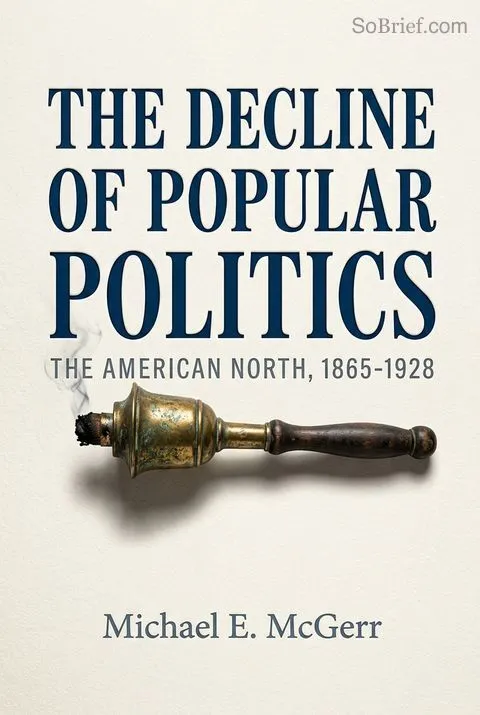
Reviewers praise The Decline of Popular Politics as an insightful exploration of how American political campaigns evolved from the Civil War to the Depression. McGerr traces three phases: spectacular, educational, and advertising politics, arguing that shifting campaign styles contributed to voter disillusionment and declining participation. One reviewer notes the book's limited discussion of race and gender, while both appreciate its accessible writing. Though not all readers fully agree with McGerr's causal arguments, they recommend it as an essential resource for understanding American political history.
Download PDF
Download EPUB
.epub digital book format is ideal for reading ebooks on phones, tablets, and e-readers.








































