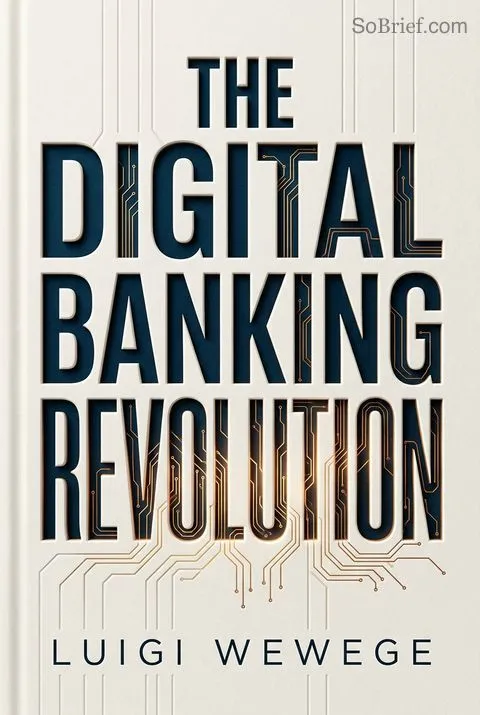
Key Takeaways
1. FinTech's Rise: A Revolution Driven by Disruption
Today, financial customers have become as restless, demanding more from their financial service providers than ever before.
Industry Transformation. The traditional retail banking industry is undergoing a rapid transformation, primarily driven by the emergence of Financial Technology (FinTech) companies. These agile start-ups are leveraging advanced technology to offer more efficient, convenient, and often cheaper financial services, fundamentally challenging the long-standing banking model. This shift is not merely incremental but a profound revolution, forcing established banks to adapt or risk obsolescence.
Catalysts for Change. Several factors have converged to accelerate this digital banking revolution. The global financial crisis of 2007-09 severely eroded public trust in traditional banks, creating an opening for new players. Simultaneously, the mass adoption of smartphones and advancements in data processing technology provided the infrastructure for FinTech companies to deliver innovative solutions directly to consumers.
New Market Dynamics. The market is no longer dominated by a few large banks; new players are rapidly gaining market share. Examples like Google erasing 85% of GPS companies' market cap or Alibaba becoming the world's fourth-largest money market fund in nine months illustrate how quickly technology-enabled disruptors can reshape industries. This dynamic environment demands that banks shift their strategic focus from product providers to solution providers, deeply integrating into customers' daily lives.
2. Eroding Trust & Changing Demands Fuel the Shift
The global financial crisis of 2007-09 created a seismic shift in the dynamics of trust in banking services, and thus created a slight opening for FinTech companies to gain a foothold.
Post-Crisis Distrust. The financial crisis of 2007-09 profoundly damaged public trust in traditional retail banks, a trust that has largely not been regained. This widespread disillusionment, compounded by over $235 billion in fines paid by major banks for regulatory breaches, created a fertile ground for alternative financial service providers to emerge and gain consumer confidence.
Millennial Influence. A new demographic, millennials, are now the largest generation and will soon command the greatest purchasing power, yet they exhibit significantly different banking expectations. Unlike older generations, millennials lack strong legacy relationships with traditional banks and are quick to switch providers if better digital capabilities or service experiences are available.
- 18% of US millennials switched primary banks in the past 12 months.
- They judge banks based on digital capabilities.
Demand for Digital. Modern financial consumers, across all age groups but especially millennials, demand simple, transparent, and 24/7 accessible banking experiences. FinTech companies are excelling at delivering these, while many traditional banks struggle to keep pace with the rapid evolution of mobile technology and digital applications, creating an "innovation gap" that disruptors are eager to fill.
3. Disruptors Redefine Financial Services with Innovation
Ask any payment industry professional, and they will tell you that PayPal is without a doubt the biggest financial digital disruptor of all time.
Pioneering FinTechs. Companies like PayPal paved the way for the current wave of financial disruption, demonstrating that non-bank entities could successfully challenge established financial services. PayPal, with 179 million active accounts and $9.2 billion in revenue by 2015, proved the viability of internet-based payment systems and inspired a new generation of innovators.
Diverse Disruptors. The landscape of financial disruptors is broad, encompassing major tech giants and agile start-ups, each targeting specific aspects of traditional banking.
- Payments: Square (mobile POS), Apple Pay, Google Wallet/Android Pay, Starbucks loyalty card.
- Lending: Amazon Lending, Alibaba (commercial lending), Funding Circle, Lending Club.
- Money Transfer: Skrill (low-cost international transfers), TransferWise (peer-to-peer currency exchange).
- Wealth Management: Alibaba (money market fund), FutureAdvisor, Wealthfront.
Strategic Focus. Many FinTech companies strategically focus on one or two specific areas of banking, such as payments or international transfers, to create superior, lower-cost, and more convenient products. This targeted approach allows them to quickly gain market share by addressing specific customer pain points, rather than attempting to compete across the entire spectrum of traditional banking services.
4. Digital Innovations Transform Everyday Banking
Mobile banking, check imaging, and smartwatches are just some of the latest financial innovations assisting customers with a variety of ways in which to spend, move, and manage their money.
Banking on the Go. Mobile banking apps have revolutionized how customers interact with their banks, offering 24/7 access to balances, payments, and other services. This convenience has led to unprecedented engagement, with some users logging into their mobile apps almost daily, a stark contrast to traditional branch visits.
- Halifax reported nearly 40 million mobile app logins in March 2016, almost double the previous year.
- HSBC allows new account opening with a selfie and facial recognition.
Contactless & Biometric Payments. Contactless cards and payment-enabled wearables (like Nationwide's N.Band or Barclaycard's bPay) offer faster and more secure transaction methods, reducing checkout times and enhancing convenience. Biometric security, including facial recognition and fingerprint scans, is also gaining traction, offering more secure and user-friendly authentication than traditional passwords.
- Contactless payments are ~6 seconds faster than chip and PIN.
- USAA's facial recognition login takes ~2 seconds.
Streamlined Processes. Innovations like check imaging technology allow customers to deposit checks by simply taking a picture with their mobile device, significantly speeding up the clearing process from six days to two. Banks are also streamlining loan applications online, enabling faster decisions and fund transfers, often within minutes, without requiring branch visits.
5. Global Examples Pave the Way for Future Banking
This small Nordic nation may not be the first country which comes to mind when one thinks of newly dynamic financial innovations, but this island’s finance industry is transforming at a rapid rate after recovering from the financial crisis it experienced several years ago.
Australian Innovation. The Commonwealth Bank of Australia (CBA) introduced "Albert," a tablet device transforming retail and dining payments. Albert accepts various payment methods, offers digital receipts, and allows businesses to download apps for sales analysis, demonstrating a comprehensive approach to point-of-sale innovation.
Turkish Digital Leadership. Turkey's iGaranti mobile banking app is a global leader, enabling payments to Facebook friends, mobile wallet functionality, and personalized budgeting with notifications. Its use of an avatar and voice activation showcases advanced customer interaction.
Icelandic PFM. Meniga, an Icelandic company, specializes in personal finance management (PFM) software, providing detailed spending breakdowns and comparative insights. Adopted by 24 banks in 16 countries, Meniga helps customers improve financial behavior and aims for banks to become "smart and trusted advisers."
Augmented Reality & Cashless Societies. New Zealand's Westpac uses augmented reality to display financial information by pointing a phone at a bank card and to navigate to ATMs. Norway and Sweden are rapidly moving towards cashless societies, with high card usage and popular mobile payment apps like Swish and Vipps, driven by government encouragement and bank policies.
African Mobile Money. In Kenya, M-PESA has created a serious mobile payments culture, with over two-thirds of Kenyans using their phones for financial transactions. This system brings financial services to millions previously unbanked, addressing challenges like rampant crime and unreliable infrastructure in developing economies.
6. Banks Must Overhaul Legacy Systems for Survival
Retail banks need to quickly realize that neither financial customers nor FinTech companies are going to wait around for them to catchup, and if banks decide to delay implementing the latest in digital technology, they will soon find themselves struggling to not only attract potential clients, but to retain their current ones.
Antiquated Infrastructure. Many traditional retail banks operate with decades-old back-office legacy technology systems that are difficult and expensive to integrate with new digital solutions. This technological inertia hinders their ability to innovate rapidly and meet evolving customer expectations.
Narrow Digital View. Senior bank executives often view digital transformation too narrowly, focusing only on front-end features like mobile apps without addressing underlying internal processes, data analytics, or staff capabilities. A truly effective digital transformation requires a coherent, front-to-back system overhaul.
Cost vs. Benefit. While the initial upfront cost of digital adoption can be significant, the long-term benefits, including substantial cost reductions and improved earnings, are compelling. Research suggests that full digital transformation can lead to over 40% improvement in earnings over five years.
- Digital transformation can put one-third of a typical retail bank's revenues "in play."
Competitive Pressure. Banks face fierce competition not only from other traditional banks but increasingly from agile online digital banking firms and FinTech companies. Delaying digital updates risks losing both prospective and existing clients who are accustomed to seamless digital experiences in other industries.
7. A Strategic Blueprint for Digital Banking Success
Leveraging opportunities enabled by digital technologies will be a critical part of the path forward for banks; however, their current most pressing need is for them to shift from defending the old way of banking, to now going on the offensive by producing innovative financial technologies of their own, ensuring they are back at the forefront of providing disruptive banking solutions of their very own.
Customer-Centricity. To remain relevant, banks must prioritize nurturing the customer experience by offering convenient, simple-to-use, and personalized banking products and services that seamlessly integrate into customers' lives. This means going beyond mere financial products to offer solutions that address all aspects of important life stages.
Data-Driven Personalization. Banks possess vast amounts of customer and transaction data, a significant competitive advantage. They must leverage this data through advanced analytics to:
- Improve customer targeting via digital marketing and micro-segmentation.
- Engage in dynamic, tailored pricing and product bundling.
- Provide personalized advice and offers, anticipating customer needs.
Transparency and Trust. Rebuilding and maintaining trust is paramount. Banks need to promote transparency in all dealings, proactively protect customers from data, privacy, and cybersecurity threats, and always keep customers' interests at heart. This builds reciprocal, long-lasting loyal relationships.
Operational Agility. Banks must streamline operational processes with technology, update multichannel customer experience platforms, and provide applications via platforms like Apple and Google stores. This requires a complete rethink of the organizational model, including skills, structure, incentives, and performance management, to foster a culture of continuous adaptation and innovation.
Review Summary
The Digital Banking Revolution receives a 3.86 out of 5 rating from 21 Goodreads reviewers. Readers appreciate the book's macro perspective on how technology advances impact global economics and financial transactions. The author effectively demonstrates how innovative products combine to create disruptive technologies like cryptocurrency, with relevant 2017 examples included. Reviewers describe it as short, clear, and straightforward, making it an accessible introduction for those interested in understanding modern banking and the future of financial services.
People Also Read

Download PDF
Download EPUB
.epub digital book format is ideal for reading ebooks on phones, tablets, and e-readers.








































